
How to Grow and Care for Scrub palmetto
Sabal etonia
Written by Emilio Marruso · last checked
At a glance
This compact palm grows just 4–6 feet tall and wide, so it fits small gardens and even containers or indoor spots. Give it full sun, though it also tolerates partial shade, and plant it in late spring or early summer after the last frosts. Its fruit feeds birds and other animals, bringing a little wildlife right into your garden.
- Sun
Full sun; it also tolerates partial shade
What the sources say (3)
Light: Full sun; tolerates partial shade
The Scrub Palmetto prefers full sun but will tolerate partial shade. It is moderately salt tolerant and does best in moist, well-drained soils.
— Foolproof Palm Care: Scrub Palmetto - UF/IFAS Extension Citrus County [2] Light: Full Sun Moisture Tolerance: Not wet but not extremely dry -to- Very long very dry periods
— Florida Native Plant Society | Conserve, Preserve & Restore Florida's Native Plants [3] Succeeds in most fertile moist but well-drained soils in a sheltered sunny position
— Sabal etonia - Useful Temperate Plants [8] - Water
Water plenty after planting until it settles in
What the sources say (1)
Watering notes: Give plenty of water after transplanting until re-established
It is important to stake the plant very firmly to prevent rock, and also to give it plenty of water until re-established - removing many of the leaves can also help
— Sabal etonia - Useful Temperate Plants [8] - Cold
Survives winters down to 10 °F (−12.2 °C)
Hardy in cold winters · USDA 8a · RHS H5 · Z8
What the sources say (2)
Hardiness, coldest zone: 8a [winter low −12.2 to −9.4 °C (10 to 15 °F)]
Soil pH: Acidic Suitable to Grow In: 8A,8B,9A,9B USDA zones are based on the average annual extreme minimum winter temperature.
— Florida Native Plant Society | Conserve, Preserve & Restore Florida's Native Plants [3] Hardiness, warmest zone: 9b [winter low −3.9 to −1.1 °C (25 to 30 °F)]
Soil pH: Acidic Suitable to Grow In: 8A,8B,9A,9B USDA zones are based on the average annual extreme minimum winter temperature.
— Florida Native Plant Society | Conserve, Preserve & Restore Florida's Native Plants [3] - Planting
Plant in late spring or early summer, after the last frosts
What the sources say (1)
Planting: Late spring or early summer, after the last expected frosts
Plant them out into their permanent positions in late spring or early summer, after the last expected frosts.
— Sabal etonia - Useful Temperate Plants [8] - Feeding
Yellow leaves or spots: check the soil pH, then use a palm fertilizer
- Harvest
Its fruit is food for birds and other animals
- Size
4–6 ft tall and 4–6 ft wide
What the sources say (2)
Mature height: 122-183 cm (4-6 ft)
Maintaining a clumping growth habit, at maturity, scrub palmettos can be 4 x 6 ft. tall and 4 x 6 ft. wide
— Foolproof Palm Care: Scrub Palmetto - UF/IFAS Extension Citrus County [2] Mature width: 122-183 cm (4-6 ft)
Maintaining a clumping growth habit, at maturity, scrub palmettos can be 4 x 6 ft. tall and 4 x 6 ft. wide
— Foolproof Palm Care: Scrub Palmetto - UF/IFAS Extension Citrus County [2] - Sowing
Sow seeds as soon as ripe, in a warm greenhouse at 75 °F (24 °C) or more
What the sources say (1)
Sowing: As soon as ripe, in a warm greenhouse at not less than 24 °C [75 °F]
Seed - best sown as soon as it is ripe in a warm greenhouse at not less than 24°c
— Sabal etonia - Useful Temperate Plants [8] - Containers
Grows in containers and indoors too
What the sources say (2)
In containers: Yes
In areas at the limit of their cold tolerance, therefore, it is prudent to grow the plants in containers for some years, giving them winter protection
— Sabal etonia - Useful Temperate Plants [8] Indoors: Yes
yellow/green fan shaped leaves, and easy care nature, it grows very well as a house plant in a bright spot,
— Sabal etonia [7]
Overview
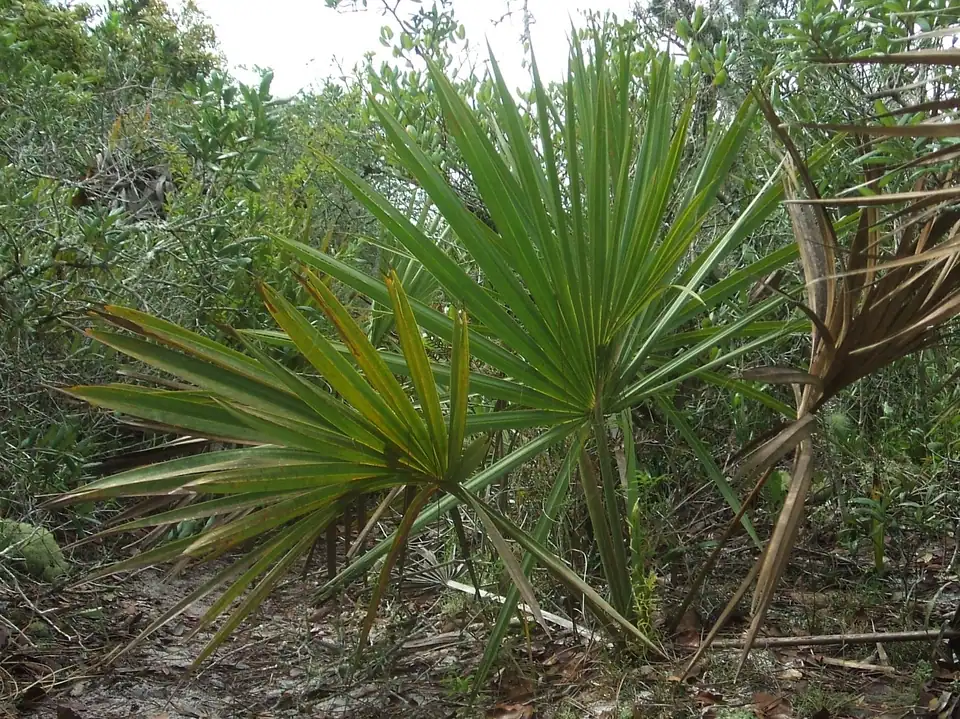
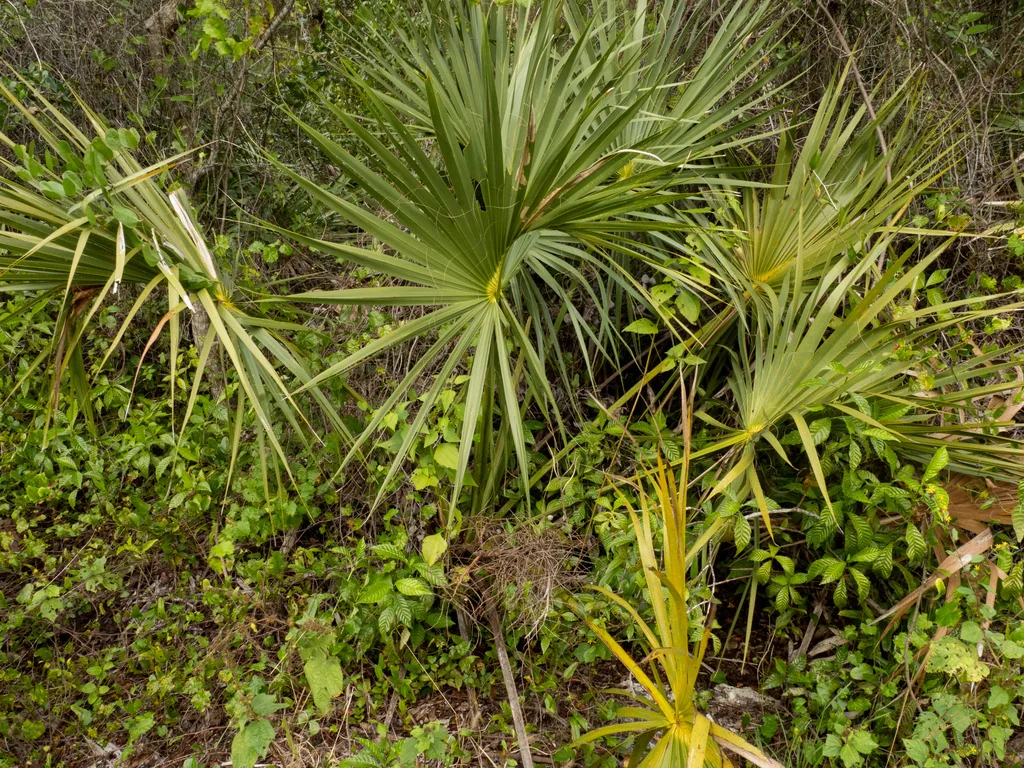
Scrub palmetto is a slow-growing Florida endemic palm with a mostly underground, spiral trunk and 4-7 yellow-green leaves. [1][2] In the wild it grows in deep sand of sand pine scrub on the central Florida ridge and coastal ridges. [5] It prefers full sun and well-drained soil, and is best direct-planted from seed because transplant survival is low. [2]
This record is incomplete: the sources we read do not cover every field yet.
Not yet covered by our sources: Pruning
Scrub palmetto care
Measurements in square brackets are our conversion into the other unit system; the quoted text is unchanged.
How to water Scrub palmetto
Watering
The sources give different values depending on region, zone or growing conditions.
What each source says
According to Florida Native Plant Society: Not wet but not extremely dry to very long very dry periods
According to UF/IFAS Extension Citrus County: Does best in moist, well-drained soils
According to Useful Temperate Plants: Plenty of moisture at the roots; tolerates arid atmospheres
What the sources say (5)
According to Florida Native Plant Society: Light:
Full Sun
Moisture Tolerance:
Not wet but not extremely dry
-to- Very long very dry periodsAccording to UF/IFAS Extension Citrus County: The Scrub Palmetto prefers full sun but will tolerate partial shade. It is moderately salt tolerant and does best in moist, well-drained soils.According to Useful Temperate Plants: Although it prefers a humid atmosphere, this species is tolerant of arid atmospheres so long as it has plenty of moisture available at the rootsThe Scrub Palmetto prefers full sun but will tolerate partial shade. It is moderately salt tolerant and does best in moist, well-drained soils.Light:
Full Sun
Moisture Tolerance:
Not wet but not extremely dry
-to- Very long very dry periodsWatering notes
Give plenty of water after transplanting until re-established
What the sources say (1)
It is important to stake the plant very firmly to prevent rock, and also to give it plenty of water until re-established - removing many of the leaves can also helpHow much light Scrub palmetto needs
Full sun; tolerates partial shade
What the sources say (3)
The Scrub Palmetto prefers full sun but will tolerate partial shade. It is moderately salt tolerant and does best in moist, well-drained soils.Light:
Full Sun
Moisture Tolerance:
Not wet but not extremely dry
-to- Very long very dry periodsSucceeds in most fertile moist but well-drained soils in a sheltered sunny positionHow much cold Scrub palmetto can take
Hardiness, coldest zone
8a [winter low −12.2 to −9.4 °C (10 to 15 °F)]
What the sources say (1)
Soil pH:
Acidic
Suitable to Grow In:
8A,8B,9A,9B
USDA zones are based on the average annual extreme minimum winter temperature.Hardiness, warmest zone
9b [winter low −3.9 to −1.1 °C (25 to 30 °F)]
What the sources say (1)
Soil pH:
Acidic
Suitable to Grow In:
8A,8B,9A,9B
USDA zones are based on the average annual extreme minimum winter temperature.Where to grow Scrub palmetto
Indoors
Yes
What the sources say (1)
yellow/green fan shaped leaves, and easy care nature, it grows very well as a house plant in a bright spot,In containers
Yes
What the sources say (1)
In areas at the limit of their cold tolerance, therefore, it is prudent to grow the plants in containers for some years, giving them winter protectionHow to propagate Scrub palmetto
The sources disagree:
What the sources say (3)
Propagation:
Seed.
Light:
Full Sun
Moisture Tolerance:
Not wet but not extremely drySeed - best sown as soon as it is ripe in a warm greenhouse at not less than 24°cHowever, it is strongly recommended to direct-plant scrub palmettos from seed as their transplant survival rate is low.How to grow Scrub palmetto
The plant
Mature height
122-183 cm (4-6 ft)
What the sources say (1)
Maintaining a clumping growth habit, at maturity, scrub palmettos can be 4 x 6 ft. tall and 4 x 6 ft. wideMature width
122-183 cm (4-6 ft)
What the sources say (1)
Maintaining a clumping growth habit, at maturity, scrub palmettos can be 4 x 6 ft. tall and 4 x 6 ft. wideScrub palmetto pests and problems
Nutrient deficiency
Symptom: Yellowing fronds or yellow/brown spots on fronds
What to do: Use a palm fertilizer after checking soil pH
What the sources say (2)
Generally, symptoms of nutrient deficiencies include yellowing fronds or yellow/brown spots on fronds.
— Foolproof Palm Care: Scrub Palmetto - UF/IFAS Extension Citrus County [2] Although a fertilizer specially formulated for palms can be used to address nutrient deficiencies, it is recommended that a soil pH reading is done prior to applying.
— Foolproof Palm Care: Scrub Palmetto - UF/IFAS Extension Citrus County [2]
Remedies
The sources we checked give no remedies for this plant.
Calendar
Sowing
As soon as ripe, in a warm greenhouse at not less than 24 °C [75 °F]
What the sources say (1)
Seed - best sown as soon as it is ripe in a warm greenhouse at not less than 24°cPlanting
Late spring or early summer, after the last expected frosts
What the sources say (1)
Plant them out into their permanent positions in late spring or early summer, after the last expected frosts.Pruning
Not stated in the sources we read.
Months as given by the sources, which are mostly from the United States (northern hemisphere). In the southern hemisphere they shift by about six months.
Edibility
Reported by the source, quoted verbatim. Do not eat a plant on the basis of this page alone: identification mistakes can be dangerous.
(Deyrup et al. 2002). Fruit is eaten by birds and other animals.
[3]
Indicative values
Values from a secondary source, not checked word for word like the rest of this page. Use them as a starting point.
- Life cycle
- PerennialIndicative value, adapt it to your climate · Secondary source
- Drought tolerant
- yesIndicative value, adapt it to your climate · Secondary source
- Soil pH
- 6-7.5Indicative value, adapt it to your climate · Secondary source
- Care level
- LowIndicative value, adapt it to your climate · Secondary source
- Growth rate
- LowIndicative value, adapt it to your climate · Secondary source
- Pruning
- March, April, MayIndicative value, adapt it to your climate · Secondary source
Similar plants
- Palmetto Sabal palmetto
- Dwarf Palmetto Sabal minor
- Abies grandis Abies grandis
- Abraham Trachystemon orientalis
- Abyssinian banana Ensete ventricosum
- Acacia longifolia Acacia longifolia
- Acanthus hungaricus Acanthus hungaricus
- Achlys triphylla Achlys triphylla
Sources
Every value above is quoted from these documents. Links lead to the original publisher.
- FOR289 · edis.ifas.ufl.edu, consulted
- Foolproof Palm Care: Scrub Palmetto - UF/IFAS Extension Citrus County · blogs.ifas.ufl.edu, consulted
- Florida Native Plant Society | Conserve, Preserve & Restore Florida's Native Plants · fnps.org, consulted
- Lady Bird Johnson Wildflower Center - The University of Texas at Austin · wildflower.org, consulted
- Sabal etonia - FNA · floranorthamerica.org, consulted
- Scrub palmetto – Port St. Lucie Botanical Gardens · pslbg.org, consulted
- Sabal etonia · www-archiv.fdm.uni-hamburg.de, consulted
- Sabal etonia - Useful Temperate Plants · temperate.theferns.info, consulted
Written by Emilio Marruso · last checked