
How to Grow and Care for St. Augustine grass
Stenotaphrum secundatum
Written by Emilio Marruso · last checked
At a glance
St. Augustine grass is a perennial lawn grass that loves heat and still copes with some shade, growing happily from full sun to partial shade. You start it from sod, plugs or sprigs, and it fills in while it is actively growing. Just water when the blades fold or turn blue-gray, and enjoy a lush green carpet.
- Sun
Full sun to partial shade; it handles shade well
What the sources say (3)
Light: Full sun to partial shade; shade tolerant
Typically grown in full sun, it will tolerate full shade and semi-shaded locations.
— Stenotaphrum secundatum (St. Augustinegrass, St. Augustine Grass) | North Carolina Extension Gardener Plant Toolbox [1] Light: St. Augustinegrass performs best in full sun but can tolerate moderate shade.
—  [4] Full sun (6 or more hours of direct sunlight a day) Partial Shade
— Stenotaphrum secundatum (St. Augustinegrass, St. Augustine Grass) | North Carolina Extension Gardener Plant Toolbox [1] - Water
When blades fold, wilt or turn blue-gray, give 1/2–3/4 inch of water
What the sources say (5)
Watering: Water as needed when leaf blades fold, wilt or turn blue-gray; apply 1.3-1.9 cm (1/2-3/4 in) per application
According to UF/IFAS Extension: Apply ½–¾ inch of water per application. This applies water to roughly the top 8 inches of soil where the majority of the roots are.
— ENH5 [2] According to Alabama Cooperative Extension System: Irrigate once the first signs of drought stress or wilt are observed. Apply roughly 1⁄2 inch of water and avoid watering faster than it can soak into the ground.
— St. Augustinegrass Lawns - Alabama Cooperative Extension System [6] Irrigation is needed when leaf blades begin to fold up, wilt, or turn a blue-gray color, or when footprints remain visible after walking on the grass
— ENH5 [2] Apply ½–¾ inch of water per application. This applies water to roughly the top 8 inches of soil where the majority of the roots are.
— ENH5 [2] Irrigate once the first signs of drought stress or wilt are observed. Apply roughly 1⁄2 inch of water and avoid watering faster than it can soak into the ground.
— St. Augustinegrass Lawns - Alabama Cooperative Extension System [6] - Cold
Survives winters down to 0 °F (−17.8 °C)
Hardy in very cold winters · USDA 7a · RHS H6 · Z7
What the sources say (2)
Hardiness, coldest zone: 7a [winter low −17.8 to −15 °C (0 to 5 °F)]
USDA Plant Hardiness Zone: 7a, 7b, 8a, 8b, 9a, 9b, 10a, 10b, 11a, 11b, 12a, 12b
— Stenotaphrum secundatum (St. Augustinegrass, St. Augustine Grass) | North Carolina Extension Gardener Plant Toolbox [1] Hardiness, warmest zone: 12b [winter low 12.8 to 15.6 °C (55 to 60 °F)]
USDA Plant Hardiness Zone: 7a, 7b, 8a, 8b, 9a, 9b, 10a, 10b, 11a, 11b, 12a, 12b
— Stenotaphrum secundatum (St. Augustinegrass, St. Augustine Grass) | North Carolina Extension Gardener Plant Toolbox [1] - Spacing
Plugs 6–24 in apart; sprigs in rows 6–12 in apart
What the sources say (7)
Spacing: Plugs 15.2-61.0 cm (6-24 in) apart
According to UF/IFAS Extension (plugs): Spacing of plugs varies from 6 to 24 inches. The closer spacing provides coverage more quickly and reduces weed intrusion.
— ENH5 [2] According to Alabama Cooperative Extension System (plugs): Space plugs 6 to 12 inches apart in 6-to-12-inch–wide rows. The closer together the plugs are placed, the faster the turfgrass will grow in.
— St. Augustinegrass Lawns - Alabama Cooperative Extension System [6] According to LSU AgCenter (plugs): Plugs: Purchase or create plugs from sod and plant each piece about 1 foot apart.
—  [4] According to UF/IFAS Extension (sprigs, furrows): Sprigs contain nodes on stolons, which are planted end-to-end in furrows 6–12 inches apart.
— ENH5 [2] Spacing of plugs varies from 6 to 24 inches. The closer spacing provides coverage more quickly and reduces weed intrusion.
— ENH5 [2] Between rows: Sprigs are planted in rows (furrows) 15-30 cm [6–12 in] apart.
Sprigs contain nodes on stolons, which are planted end-to-end in furrows 6–12 inches apart.
— ENH5 [2] Plant the sprigs in rows that are 6 to 12 inches apart.
— St. Augustinegrass Lawns - Alabama Cooperative Extension System [6] - Planting
Plant while the grass is actively growing
What the sources say (5)
Planting: During active growth: May-August (Alabama); late fall, winter or spring (south Florida)
Alabama: The best time to plant St. Augustinegrass is during its active growth period, normally between May and August.
— St. Augustinegrass Lawns - Alabama Cooperative Extension System [6] south Florida: In south Florida, the optimal time for establishment is late fall, winter, or spring.
— ENH5 [2] central and north Florida: In central and north Florida, try to avoid establishment during cold winter or hot, dry summer months.
— ENH5 [2] The best time to plant St. Augustinegrass is during its active growth period, normally between May and August.
— St. Augustinegrass Lawns - Alabama Cooperative Extension System [6] In south Florida, the optimal time for establishment is late fall, winter, or spring.
— ENH5 [2] - Feeding
Feed 2 to 6 times a year, from spring green-up to early fall; wait 30–60 days on a new lawn
What the sources say (14)
When: During active growth, from spring green-up through summer into early autumn; not too early in spring nor after growth has slowed
south Florida: Depending on geographical location, fertilizer should be applied to St. Augustinegrass in 2–6 applications from spring green-up through fall (or year-round in south Florida).
— ENH5 [2] Louisiana: Fertilize with up to 3 pounds of nitrogen per 1,000 square feet per year. Fertilizer should be applied from midspring to midsummer.
—  [4] Depending on geographical location, fertilizer should be applied to St. Augustinegrass in 2–6 applications from spring green-up through fall (or year-round in south Florida).
— ENH5 [2] Fertilize using 4 lbs. nitrogen/1000 sq. ft. per year during the period of active growth (March - October).
— [7] Do not apply too early in the growing season, particularly in north Florida, because late-season frosts may damage the grass and the root system will not be fully grown in at this time to assimilate the nutrients.
— ENH5 [2] Likewise, do not fertilize too late in the year after growth has subsided.
— ENH5 [2] How often: 2 to 6 applications a year, depending on climate
lower-maintenance lawn: (1) apply 1 pound of nitrogen per 1,000 square feet once in May and once in July or (2) apply 1⁄2 pound of nitrogen per 1,000 square feet once per month in May, June, July, and August.
— St. Augustinegrass Lawns - Alabama Cooperative Extension System [6] maximum fertility: To reach this annual rate, apply 1 pound of nitrogen per 1,000 square feet once per month in April, May, July, and August.
— St. Augustinegrass Lawns - Alabama Cooperative Extension System [6] Depending on geographical location, fertilizer should be applied to St. Augustinegrass in 2–6 applications from spring green-up through fall (or year-round in south Florida).
— ENH5 [2] Avoid: Heavy doses of fast-release nitrogen or applying it on wet turf (it burns the grass); fertilizing too early in spring or after growth has slowed; excess nitrogen, which favours large patch disease
new lawns: A newly planted lawn should not be fertilized until 30–60 days after planting.
— ENH5 [2] Augustinegrass lawns; however, these fast-release nitrogen fertilizers will burn turfgrass if applied too heavily or if applied to wet turf.
— St. Augustinegrass Lawns - Alabama Cooperative Extension System [6] Do not apply too early in the growing season, particularly in north Florida, because late-season frosts may damage the grass and the root system will not be fully grown in at this time to assimilate the nutrients.
— ENH5 [2] Likewise, do not fertilize too late in the year after growth has subsided.
— ENH5 [2] Large patch occurs in warm, humid weather and is encouraged by excessive nitrogen.
— ENH5 [2] - Pests
Chinch bugs, webworms, armyworms and mole crickets; gray leaf spot and large patch
What the sources say (5)
Pests: southern chinch bug, webworms, armyworms, grass loopers, mole crickets, white grubs, nematodes
The major insect pest of St. Augustinegrass is the southern chinch bug (Blissus insularis Barber), which can cause considerable damage if not treated.
— ENH5 [2] Other insect pests, including webworms, armyworms, grass loopers, and mole crickets can damage St. Augustinegrass.
— ENH5 [2] White grubs are another pest of St. Augustinegrass. These can be found by lifting the grass to a depth of about 2 inches.
— ENH5 [2] Nematodes Several types of nematodes infest St. Augustinegrass lawns.
— ENH5 [2] Diseases: gray leaf spot, large patch, take-all root rot
Some cultivars are also susceptible to diseases, such as gray leaf spot (Pyricularia grisea), large patch (Rhizoctonia solani), and take-all root rot (Gaeumannomyces graminis var. graminis).
— ENH5 [2] - Watch out
Thatch over 3/4 inch stresses the lawn: dethatch from late May through August
- Propagation
Grows from sod, plugs or sprigs; rarely from seed
What the sources say (3)
Propagation: Vegetative: sod, plugs or sprigs (stolons); rarely seed
St. Augustinegrass is established by vegetative propagation only, which includes sod, plugs, or sprigs.
— ENH5 [2] It is sold as sod or plugs and is rarely propagated by seed.
— Stenotaphrum secundatum (St. Augustinegrass, St. Augustine Grass) | North Carolina Extension Gardener Plant Toolbox [1] Se reproduce por semilla, pero una vez establecida su expansión se lleva a cabo por vía vegetativa a partir de sus largos y vigorosos estolones
— Atlas de las Plantas Alóctonas Invasoras en España [3]
Overview
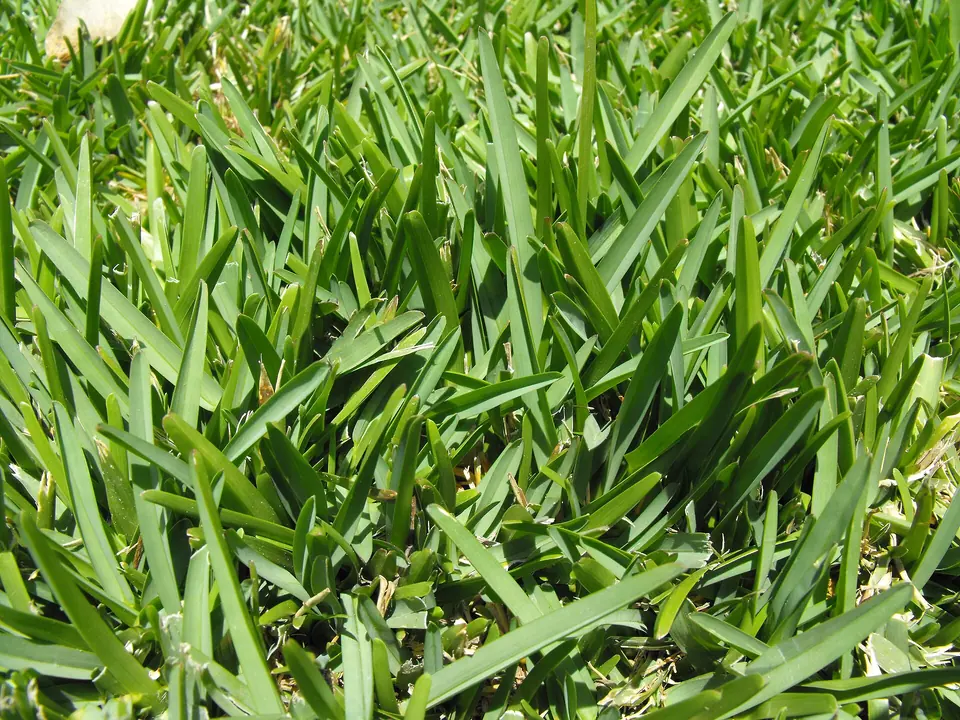
St. Augustinegrass is a coarse-textured, warm-season perennial turfgrass adapted to warm, humid regions and the most shade-tolerant of the warm-season lawn grasses. [6][1] It has poor cold tolerance and poor wear tolerance, and the southern chinch bug is its major insect pest. [5][6] In Spain it is listed as an invasive alien plant that is very hard to eradicate once established, because any stolon or rhizome fragment can regrow. [3]
This record is incomplete: the sources we read do not cover every field yet.
Not yet covered by our sources: Pruning
St. Augustine grass care
How to water St. Augustine grass
Watering
Water as needed when leaf blades fold, wilt or turn blue-gray; apply 1.3-1.9 cm (1/2-3/4 in) per application
What each source says
According to UF/IFAS Extension: 1.3-1.9 cm (1/2-3/4 in) per application, as needed
According to Alabama Cooperative Extension System: 1.3 cm (1/2 in) at first signs of drought stress or wilt
What the sources say (5)
According to UF/IFAS Extension: Apply ½–¾ inch of water per application. This applies water to roughly the top 8 inches of soil where the majority of the roots are.According to Alabama Cooperative Extension System: Irrigate once the first signs of drought stress or wilt are observed. Apply roughly 1⁄2 inch of water and avoid watering faster than it can soak into the ground.Irrigation is needed when leaf blades begin to fold up, wilt, or turn a blue-gray color, or when footprints remain visible after walking on the grassApply ½–¾ inch of water per application. This applies water to roughly the top 8 inches of soil where the majority of the roots are.Irrigate once the first signs of drought stress or wilt are observed. Apply roughly 1⁄2 inch of water and avoid watering faster than it can soak into the ground.Watering notes
The sources disagree:
What the sources say (4)
Multiple, short (5–10 minutes) irrigations throughout the course of the day for 7–10 days following planting helps the grass establish without drying out.For the next 7–10 days, irrigate once a day to apply ¼–½ inch of water. After this, frequency should be reduced to 2–3 times weeklyWater or irrigate early in the morning while dew is still on the lawn. Irrigating or watering during the night or evening hours can increase disease problems.Its drought tolerance is low, it will lose its color under dry conditions.How much light St. Augustine grass needs
Full sun to partial shade; shade tolerant
What the sources say (3)
Typically grown in full sun, it will tolerate full shade and semi-shaded locations.Light: St. Augustinegrass performs best in full sun but can tolerate moderate shade.Full sun (6 or more hours of direct sunlight a day)
Partial ShadeHow much cold St. Augustine grass can take
Hardiness, coldest zone
7a [winter low −17.8 to −15 °C (0 to 5 °F)]
What the sources say (1)
USDA Plant Hardiness Zone:
7a, 7b, 8a, 8b, 9a, 9b, 10a, 10b, 11a, 11b, 12a, 12bHardiness, warmest zone
12b [winter low 12.8 to 15.6 °C (55 to 60 °F)]
What the sources say (1)
USDA Plant Hardiness Zone:
7a, 7b, 8a, 8b, 9a, 9b, 10a, 10b, 11a, 11b, 12a, 12bWhere to grow St. Augustine grass
Plugs 15.2-61.0 cm (6-24 in) apart
What each source says
According to UF/IFAS Extension (plugs): 15.2-61.0 cm (6-24 in)
According to Alabama Cooperative Extension System (plugs): 15.2-30.5 cm (6-12 in)
According to LSU AgCenter (plugs): 30.5 cm (1 ft)
According to UF/IFAS Extension (sprigs, furrows): 15.2-30.5 cm (6-12 in) between furrows
What the sources say (5)
According to UF/IFAS Extension (plugs): Spacing of plugs varies from 6 to 24 inches. The closer spacing provides coverage more quickly and reduces weed intrusion.According to Alabama Cooperative Extension System (plugs): Space plugs 6 to 12 inches apart in 6-to-12-inch–wide rows. The closer together the plugs are placed, the faster the turfgrass will grow in.According to LSU AgCenter (plugs): Plugs: Purchase or create plugs from sod and plant each piece about 1 foot apart.According to UF/IFAS Extension (sprigs, furrows): Sprigs contain nodes on stolons, which are planted end-to-end in furrows 6–12 inches apart.Spacing of plugs varies from 6 to 24 inches. The closer spacing provides coverage more quickly and reduces weed intrusion.How to propagate St. Augustine grass
Vegetative: sod, plugs or sprigs (stolons); rarely seed
What the sources say (3)
St. Augustinegrass is established by vegetative propagation only, which includes sod, plugs, or sprigs.It is sold as sod or plugs and is rarely propagated by seed.Se reproduce por semilla, pero una vez establecida su expansión se lleva a cabo por vía vegetativa a partir de sus largos y vigorosos estolonesHow to grow St. Augustine grass
The plant
Life cycle
perennial
What the sources say (1)
Uses (Ethnobotany):
Lawns, forage
Life Cycle:
Perennial
Country Or Region Of Origin:Family
Poaceae
What the sources say (1)
Genus:
Stenotaphrum
Species:
secundatum
Family:
Poaceae
Uses (Ethnobotany):
Lawns, foragePests and diseases
Pests
southern chinch bug, webworms, armyworms, grass loopers, mole crickets, white grubs, nematodes
What the sources say (4)
The major insect pest of St. Augustinegrass is the southern chinch bug (Blissus insularis Barber), which can cause considerable damage if not treated.Other insect pests, including webworms, armyworms, grass loopers, and mole crickets can damage St. Augustinegrass.White grubs are another pest of St. Augustinegrass. These can be found by lifting the grass to a depth of about 2 inches.Nematodes Several types of nematodes infest St. Augustinegrass lawns.Diseases
gray leaf spot, large patch, take-all root rot
What the sources say (1)
Some cultivars are also susceptible to diseases, such as gray leaf spot (Pyricularia grisea), large patch (Rhizoctonia solani), and take-all root rot (Gaeumannomyces graminis var. graminis).Fertilizing
When
During active growth, from spring green-up through summer into early autumn; not too early in spring nor after growth has slowed
What each source says
south Florida: All year round, since growth is year-round
Louisiana: From mid-spring to midsummer
What the sources say (6)
south Florida: Depending on geographical location, fertilizer should be applied to St. Augustinegrass in 2–6 applications from spring green-up through fall (or year-round in south Florida).Louisiana: Fertilize with up to 3 pounds of nitrogen per 1,000 square feet per year. Fertilizer should be applied from midspring to midsummer.Depending on geographical location, fertilizer should be applied to St. Augustinegrass in 2–6 applications from spring green-up through fall (or year-round in south Florida).Fertilize using 4 lbs. nitrogen/1000 sq. ft. per year during the period
of active growth (March - October).Do not apply too early in the growing season, particularly in north Florida, because late-season frosts may damage the grass and the root system will not be fully grown in at this time to assimilate the nutrients.Likewise, do not fertilize too late in the year after growth has subsided.How often
2 to 6 applications a year, depending on climate
What each source says
lower-maintenance lawn: Twice a year (May and July), or monthly from May to August
maximum fertility: Monthly in April, May, July and August
What the sources say (3)
lower-maintenance lawn: (1) apply 1 pound of nitrogen per 1,000 square feet once in May and once in July or (2) apply 1⁄2 pound of nitrogen per 1,000 square feet once per month in May, June, July, and August.maximum fertility: To reach this annual rate, apply 1 pound of nitrogen per 1,000 square feet once per month in April, May, July, and August.Depending on geographical location, fertilizer should be applied to St. Augustinegrass in 2–6 applications from spring green-up through fall (or year-round in south Florida).Natural fertilizers
Manure, as a slow-release nitrogen source
What the sources say (1)
Slow-release nitrogen sources include sulfur-coated urea (SCU), polymer-coated urea (PCU), isobutylidine diurea (IBDU), urea formaldehyde (UF), methylene urea (MU), and natural organics such as manure.Mineral fertilizers
Nitrogen fertilizer, no more than 4.88 g of nitrogen per m² per application; a complete fertilizer such as 16-4-8 only if a soil test calls for phosphorus or potassium
What each source says
California: 19.5 g of nitrogen per m² per year, during active growth
Florida: North 9.76-19.5, central 9.76-24.4, south 19.5-29.3 g of nitrogen per m² per year
Louisiana: Up to 14.6 g of nitrogen per m² per year
Arkansas: Never more than 14.6 g of nitrogen per m² per year
for winter hardiness: Potassium at 4.88 g/m² in September
What the sources say (7)
California: Fertilize using 4 lbs. nitrogen/1000 sq. ft. per year during the period
of active growth (March - October).Florida: Location1 N fertility guideline(lbs N/1000 sq ft/year) North Florida 2–4 Central Florida 2–5 South Florida 4–6Louisiana: Fertilize with up to 3 pounds of nitrogen per 1,000 square feet per year. Fertilizer should be applied from midspring to midsummer.Arkansas: It should never receive more
than 3 pounds of nitrogen per thousand
square feet in one year.for winter hardiness: For improved winter hardiness, make one application of potassium in September at 1 pound of potassium per 1,000 square feet.If a soil test recommends applying P and/or K, a complete fertilizer may be used (e.g., 16-4-8); otherwise, P and K should be absent in the fertilizer used.To avoid burning the turf, do not apply more than 1 pound of actual nitrogen per 1,000 square feet per fertilizer application.Micronutrients
Iron, frequently needed as a supplement (iron sulfate or chelated iron, also as foliar spray); iron or manganese on high-pH soils
What the sources say (3)
Fertilize using 4 lbs. nitrogen/1000 sq. ft. per year during the period
of active growth (March - October).
- Iron is frequently needed as a fertilizer supplement.On high-pH (> 7.0) soils or where high-pH water is applied, yellow leaf blades may be an indication of iron or manganese deficiency. Application of soluble or chelated sources of these micronutrients can provide a green-up in these cases.Foliar iron fertilizers, such as iron sulfate or chelated iron solutions, and nitrogen fertilizers applied according to UF/IFAS guidelines help alleviate iron deficiencies.Avoid
Heavy doses of fast-release nitrogen or applying it on wet turf (it burns the grass); fertilizing too early in spring or after growth has slowed; excess nitrogen, which favours large patch disease
What each source says
new lawns: No fertilizer until 30-60 days after planting
What the sources say (5)
new lawns: A newly planted lawn should not be fertilized until 30–60 days after planting.Augustinegrass lawns; however, these fast-release nitrogen fertilizers will burn turfgrass if applied too heavily or if applied to wet turf.Do not apply too early in the growing season, particularly in north Florida, because late-season frosts may damage the grass and the root system will not be fully grown in at this time to assimilate the nutrients.Likewise, do not fertilize too late in the year after growth has subsided.Large patch occurs in warm, humid weather and is encouraged by excessive nitrogen.Signs of deficiency
Yellowing leaf blades: on high-pH soils from iron or manganese deficiency; nitrogen deficiency also yellows the turf
What the sources say (2)
On high-pH (> 7.0) soils or where high-pH water is applied, yellow leaf blades may be an indication of iron or manganese deficiency. Application of soluble or chelated sources of these micronutrients can provide a green-up in these cases.While both iron and nitrogen deficiencies result in turfgrass yellowing, they are distinctly different deficiencies in plants.Signs of excess
Heavy thatch build-up and more pest and disease problems (large patch, gray leaf spot); fast-release nitrogen in excess burns the turf
What the sources say (3)
Too much fertilization can cause excessive thatch accumulation and other pest problems.If large patch or gray leaf spot diseases are a continuous problem, excessive watering and nitrogen fertilization may be responsible.Augustinegrass lawns; however, these fast-release nitrogen fertilizers will burn turfgrass if applied too heavily or if applied to wet turf.Spacing
Between plants
The sources give different values depending on region, zone or growing conditions.
What each source says
plugs, Florida (USA): Plugs 15-61 cm [6–24 in] apart; closer spacing covers faster
plugs, Alabama (USA): Plugs 15-30 cm [6–12 in] apart in rows 15-30 cm [6–12 in] wide
plugs, Louisiana (USA): Plugs 30 cm [12 in] apart
What the sources say (3)
plugs, Florida (USA): Sod also can be made into plugs by cutting it into small squares. Spacing of plugs varies from 6 to 24 inches.plugs, Alabama (USA): Space plugs 6 to 12 inches apart in 6-to-12-inch–wide rows.plugs, Louisiana (USA): Plugs: Purchase or create plugs from sod and plant each piece about 1 foot apart.Between rows
Sprigs are planted in rows (furrows) 15-30 cm [6–12 in] apart.
Heat and drought
Heat
Heat tolerant.
What each source says
cultivar 'Raleigh': Yellows and grows less aggressively during peak summer heat
What the sources say (2)
cultivar 'Raleigh': During peak summertime heat, 'Raleigh' has been noted to yellow and grow less aggressively than it does at cooler temperatures.This plant is heat tolerant and mildly drought tolerant. There are several cultivars of this plant available.St. Augustine grass pests and problems
Southern chinch bug
Symptom: Considerable damage to the turf
What to do: Insecticides or resistant newer varieties
What the sources say (2)
The major insect pest of St. Augustinegrass is the southern chinch bug (Blissus insularis Barber), which can cause considerable damage if not treated.
— ENH5 [2] This insect can be controlled with chemicals (insecticides) or, the better option, by planting a newer variety of St. Augustinegrass that has genetic resistance to the pest.
— St. Augustinegrass Lawns - Alabama Cooperative Extension System [6] Large patch and gray leaf spot
Symptom: Fungal diseases of the lawn
What to do: Good maintenance; fungicides for major outbreaks; avoid excessive watering and nitrogen
What the sources say (2)
St. Augustinegrass lawns are susceptible to several plant diseases, the most common of which are large patch and gray leaf spot.
— St. Augustinegrass Lawns - Alabama Cooperative Extension System [6] If large patch or gray leaf spot diseases are a continuous problem, excessive watering and nitrogen fertilization may be responsible.
— ENH5 [2] Nematodes
Symptom: Lawn turns yellow and thin, especially in hot, dry periods
What to do: Keep the lawn healthy: weekly irrigation in drought, adequate fertility, correct mowing height
What the sources say (1)
Nematodes cause the lawn to turn yellow in color and become thin, especially during hot, dry periods.
— St. Augustinegrass Lawns - Alabama Cooperative Extension System [6] Thatch
Symptom: Layer over 3/4 inch increases drought stress or winter injury
What to do: Mechanically dethatch from late May through August
What the sources say (1)
If the thatch layer is thicker than 3⁄4 inch, mechanically dethatch the lawn in the spring, any time from late May through August.
— St. Augustinegrass Lawns - Alabama Cooperative Extension System [6]
Remedies
Each remedy shows what official sources say about it; traditional remedies without an official source are marked as such. Harmful ones are listed so you know to avoid them.
Treating the plant
southern chinch bug
reducing thatch and fertilizer Partly works
How: Reduce thatch and minimize fertilizer use; avoid poor irrigation distribution, mowing too short and too much nitrogen.
Always incorporate non-chemical options like reducing thatch and minimizing fertilizer use. Encouraging beneficial insects will also help you manage the pest problem.
— gardeningsolutions.ifas.ufl.edu [9] What the evidence says Always incorporate non-chemical options like reducing thatch and minimizing fertilizer use. Encouraging beneficial insects will also help you manage the pest problem.
— gardeningsolutions.ifas.ufl.edu [9] encouraging beneficial insects Partly works
How: Encourage beneficial insects such as big-eyed bugs, which eat chinch bugs; learn to tell them apart from the pest.
Big-eyed bugs could be easily confused with a chinch bug, except “big-eyes” eat chinch bugs for breakfast!
— gardeningsolutions.ifas.ufl.edu [9] What the evidence says Encouraging beneficial insects will also help you manage the pest problem.
— gardeningsolutions.ifas.ufl.edu [9]
large patch
reducing watering and nitrogen Official source, not independently tested
How: If large patch or gray leaf spot are a continuous problem, excessive watering and nitrogen fertilization may be responsible.
If large patch or gray leaf spot diseases are a continuous problem, excessive watering and nitrogen fertilization may be responsible.
— ENH5 [2]
Getting rid of it
unwanted lawn grass
manual removal with a garden spade Not verified
Traditional remedy, not verified by an official source.
How: Use a garden spade, a square-point shovel with a flat blade, to cut a straight edge through the turf and remove it; St. Augustine grass and roots can be scooped up fairly cleanly.
digging out and disposing of plants Not verified
Traditional remedy, not verified by an official source.
How: Dig out the plants; remove the seeds to greenwaste or landfill if practical.
sod cutter Not verified
Traditional remedy, not verified by an official source.
How: Rent a sod cutter to precisely cut and lift the sod, without any chemicals.
solarization with clear plastic Not verified
Traditional remedy, not verified by an official source.
How: Cover the growing grass with clear plastic for at least six weeks in summer sun, so that the grass overheats.
follow-up and replanting dense ground cover Not verified
Traditional remedy, not verified by an official source.
How: Follow up treated areas 3 times per year; after 2-3 treatments encourage native regeneration or replant to establish dense ground cover and minimise reinvasion.
Calendar
Planting
During active growth: May-August (Alabama); late fall, winter or spring (south Florida)
What each source says
Alabama: May-August
south Florida: Late fall, winter or spring
central and north Florida: Avoid cold winter and hot, dry summer months
What the sources say (5)
Alabama: The best time to plant St. Augustinegrass is during its active growth period, normally between May and August.south Florida: In south Florida, the optimal time for establishment is late fall, winter, or spring.central and north Florida: In central and north Florida, try to avoid establishment during cold winter or hot, dry summer months.The best time to plant St. Augustinegrass is during its active growth period, normally between May and August.In south Florida, the optimal time for establishment is late fall, winter, or spring.Pruning
Not stated in the sources we read.
Months as given by the sources, which are mostly from the United States (northern hemisphere). In the southern hemisphere they shift by about six months.
Similar plants
- African lovegrass Eragrostis curvula
- Aristida purpurea Aristida purpurea
- Autumn Moor Grass Sesleria autumnalis
- Bamboo Phyllostachys aurea
- Beaked Panicgrass Coleataenia anceps
- Bermuda grass Cynodon dactylon
- Big Bluestem Andropogon gerardi
- Bigtop Lovegrass Eragrostis hirsuta
Sources
Every value above is quoted from these documents. Links lead to the original publisher.
- Stenotaphrum secundatum (St. Augustinegrass, St. Augustine Grass) | North Carolina Extension Gardener Plant Toolbox · plants.ces.ncsu.edu, consulted
- ENH5 · edis.ifas.ufl.edu, consulted
- Atlas de las Plantas Alóctonas Invasoras en España · miteco.gob.es, consulted
-  · lsuagcenter.com, consulted
- St. Augustinegrass - TurfFiles | NC State Extension · turffiles.ncsu.edu, consulted
- St. Augustinegrass Lawns - Alabama Cooperative Extension System · aces.edu, consulted
- ipm.ucanr.edu · ipm.ucanr.edu
- uaex.uada.edu · uaex.uada.edu
- gardeningsolutions.ifas.ufl.edu · gardeningsolutions.ifas.ufl.edu
Written by Emilio Marruso · last checked