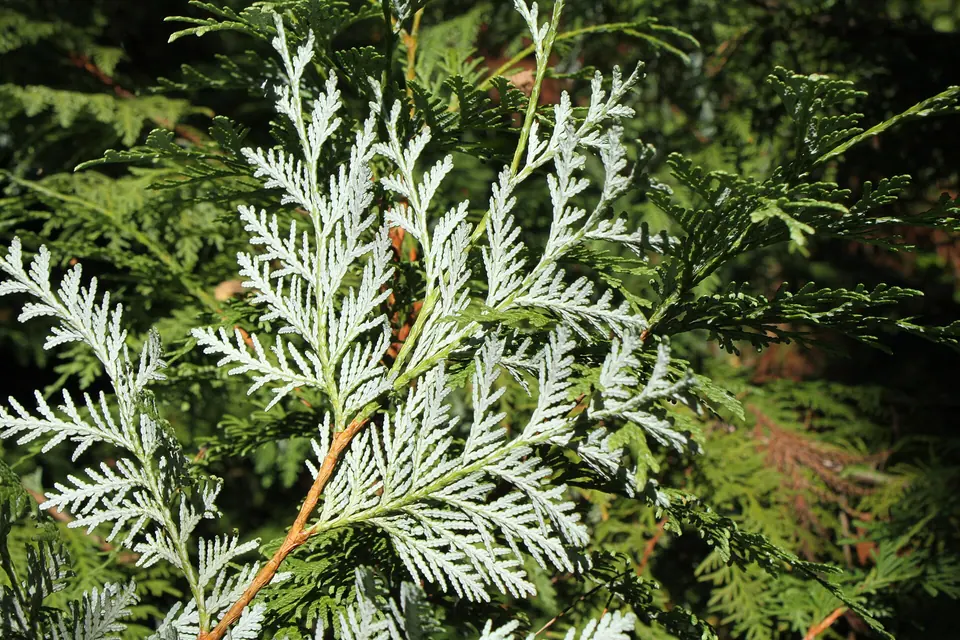

How to Grow and Care for Korean arbor-vitae
Thuja koraiensis
Written by Emilio Marruso · last checked
At a glance
Korean thuja is wonderfully adaptable: it grows in part shade or full sun, in soil from quite acidic to alkaline, pH 4.5 to 8. Give it normal to moist soil and it can reach up to 33 feet tall, though in most places it stays a low thicket of 2 feet. You can start new plants from seed or cuttings.
- Sun
Part shade to full sun
What the sources say (1)
Light: Part shade to full sun
Light Range: Part Shade to Full Sun pH Range: 4.5 to 8
— Thuja koraiensis ( Korean arborvitae ) - Professional Gardening Tips [5] - Water
Normal watering; it also likes moist soil
What the sources say (1)
Watering: Normal to moist
Soil Range: Sandy Loam to Clay Loam Water Range: Normal to Moist
— Thuja koraiensis ( Korean arborvitae ) - Professional Gardening Tips [5] - Soil
Grows in acidic to alkaline soil, pH 4.5–8
What the sources say (2)
Soil pH, minimum: 4.5
pH Range: 4.5 to 8 Soil Range: Sandy Loam to Clay Loam
— Thuja koraiensis ( Korean arborvitae ) - Professional Gardening Tips [5] Soil pH, maximum: 8
pH Range: 4.5 to 8 Soil Range: Sandy Loam to Clay Loam
— Thuja koraiensis ( Korean arborvitae ) - Professional Gardening Tips [5] - Size
Up to 33 ft tall, but in most places a low thicket of 2 ft
What the sources say (2)
Mature height: up to 1000 cm (10 m)
low thickets (most locations): 60 cm: It mostly forms dense low thickets to 60cm tall but in some locations it will form a tree to 10m tall
— Thuja koraiensis | Threatened Conifers of the World (en-GB) [1] It mostly forms dense low thickets to 60cm tall but in some locations it will form a tree to 10m tall
— Thuja koraiensis | Threatened Conifers of the World (en-GB) [1] - Propagation
Grow new plants from seed or cuttings
What the sources say (2)
Propagation: Seed; cuttings
Examples of recently introduced material with this habit can be seen at the Morris Arboretum, collected (as cuttings) by the 1989 US National Arboretum expedition to Korea
— Thuja koraiensis - Trees and Shrubs Online [4] This was grown from seed collected in 1989 at 750 m in the Mount Soraksan Nature Reserve
— Thuja koraiensis - Trees and Shrubs Online [4]
Overview
Korean arborvitae is an evergreen conifer that ranges from a low shrub to a small tree up to 10 m [32.8 ft] tall. [2][4] In the wild it grows on mountain slopes in Korea and north-east China, where it is considered threatened. [1] In cultivation it adapts to a variety of sites and soils, tolerates hedge pruning, but grows slowly. [4][5]
This record is incomplete: the sources we read do not cover every field yet.
Not yet covered by our sources: Pruning
Korean arbor-vitae care
Measurements in square brackets are our conversion into the other unit system; the quoted text is unchanged.
How to water Korean arbor-vitae
Normal to moist
What the sources say (1)
Soil Range:
Sandy Loam to Clay Loam
Water Range:
Normal to MoistHow much light Korean arbor-vitae needs
Part shade to full sun
What the sources say (1)
Light Range:
Part Shade to Full Sun
pH Range:
4.5 to 8How much cold Korean arbor-vitae can take
Hardiness, coldest zone
The sources give different values depending on region, zone or growing conditions.
What each source says
According to The Gymnosperm Database: 5 [winter low −28.9 to −23.3 °C (−20 to −10 °F)]
According to Trees and Shrubs Online: 5 [winter low −28.9 to −23.3 °C (−20 to −10 °F)]
According to American Conifer Society: 5 [winter low −28.9 to −23.3 °C (−20 to −10 °F)] or 6 [winter low −23.3 to −17.8 °C (−10 to 0 °F)]
According to Backyard Gardener: 5 [winter low −28.9 to −23.3 °C (−20 to −10 °F)]
What the sources say (7)
According to The Gymnosperm Database: Hardy to Zone 5 (cold hardiness limit between -28.8°C and -23.3°C) ( Bannister and Neuner 2001 ).According to Trees and Shrubs Online: Habitat Valleys and mountain ridges, between 700 and 1800 m asl. USDA Hardiness Zone 5.According to American Conifer Society: In literature, it is considered winter hardy to USDA Zones 5 or 6.According to Backyard Gardener: USDA Hardiness Zone:
5 to 7
AHS Heat Zone:
2 to 9Hardy to Zone 5 (cold hardiness limit between -28.8°C and -23.3°C) ( Bannister and Neuner 2001 ).Habitat Valleys and mountain ridges, between 700 and 1800 m asl. USDA Hardiness Zone 5.USDA Hardiness Zone:
5 to 7
AHS Heat Zone:
2 to 9Hardiness, warmest zone
7 [winter low −17.8 to −12.2 °C (0 to 10 °F)]
What the sources say (1)
USDA Hardiness Zone:
5 to 7
AHS Heat Zone:
2 to 9Best soil for Korean arbor-vitae
Soil pH, minimum
4.5
What the sources say (1)
pH Range:
4.5 to 8
Soil Range:
Sandy Loam to Clay LoamSoil pH, maximum
8
What the sources say (1)
pH Range:
4.5 to 8
Soil Range:
Sandy Loam to Clay LoamHow to propagate Korean arbor-vitae
Seed; cuttings
What the sources say (2)
Examples of recently introduced material with this habit can be seen at the Morris Arboretum, collected (as cuttings) by the 1989 US National Arboretum expedition to KoreaThis was grown from seed collected in 1989 at 750 m in the Mount Soraksan Nature ReserveHow to grow Korean arbor-vitae
The plant
Mature height
up to 1000 cm (10 m)
What each source says
low thickets (most locations): 60 cm:
What the sources say (2)
low thickets (most locations): 60 cm: It mostly forms dense low thickets to 60cm tall but in some locations it will form a tree to 10m tallIt mostly forms dense low thickets to 60cm tall but in some locations it will form a tree to 10m tallRemedies
Each remedy shows what official sources say about it; traditional remedies without an official source are marked as such. Harmful ones are listed so you know to avoid them.
Treating the plant
caterpillars
hand-picking Works
How: Keep weeds down, scout individual plants and remove caterpillars.
Prevention and Control : keep weeds down, scout individual plants and remove caterpillars, apply labeled insecticides such as soaps and oils
— Thuja koraiensis ( Korean arborvitae ) - Professional Gardening Tips [5] What the evidence says Many insect and disease issues can be solved in the home garden by hand-picking insects or clipping and disposing of diseased plant parts.
— extension.unh.edu [7] insecticidal soap or oil spray Works
How: Apply labeled insecticides such as soaps and oils.
scout individual plants and remove caterpillars, apply labeled insecticides such as soaps and oils, take advantage of natural enemies such as parasitic wasps in the garden
— Thuja koraiensis ( Korean arborvitae ) - Professional Gardening Tips [5] What the evidence says For example, insecticidal soap is a safe, effective organic insecticide with minimal environmental impact.
— extension.psu.edu [8] bacillus thuringiensis Not verified
Traditional remedy, not verified by an official source.
How: Take advantage of natural enemies such as parasitic wasps and use Bacillus thuringiensis for some caterpillar species.
scale insects
isolate infested plants Not verified
Traditional remedy, not verified by an official source.
How: Isolate infested plants away from those that are not infested; encourage natural enemies such as parasitic wasps.
deer
wire mesh fence Not verified
Traditional remedy, not verified by an official source.
How: A fence is a good deer barrier: a really tall one (7 to 8 feet) or 2 parallel fences 4 to 5 feet apart; use wire mesh rather than board, since deer can wiggle through a 12 inch space.
Calendar
Pruning
Not stated in the sources we read.
Months as given by the sources, which are mostly from the United States (northern hemisphere). In the southern hemisphere they shift by about six months.
Indicative values
Values from a secondary source, not checked word for word like the rest of this page. Use them as a starting point.
- Life cycle
- PerennialIndicative value, adapt it to your climate · Secondary source
- Drought tolerant
- yesIndicative value, adapt it to your climate · Secondary source
- Care level
- LowIndicative value, adapt it to your climate · Secondary source
- Growth rate
- LowIndicative value, adapt it to your climate · Secondary source
- Pruning
- February, March, AprilIndicative value, adapt it to your climate · Secondary source
Similar plants
- American Arborvitae Thuja occidentalis
- Japanese Arbor-vitae Thuja standishii
- Western Redcedar Thuja plicata
- Abies grandis Abies grandis
- Abraham Trachystemon orientalis
- Abyssinian banana Ensete ventricosum
- Acacia longifolia Acacia longifolia
- Acanthus hungaricus Acanthus hungaricus
Sources
Every value above is quoted from these documents. Links lead to the original publisher.
- Thuja koraiensis | Threatened Conifers of the World (en-GB) · threatenedconifers.rbge.org.uk, consulted
- Thuja koraiensis (Korean arborvitae) description · conifers.org, consulted
- Conifer Database - koraiensis · conifersociety.org, consulted
- Thuja koraiensis - Trees and Shrubs Online · treesandshrubsonline.org, consulted
- Thuja koraiensis ( Korean arborvitae ) - Professional Gardening Tips · backyardgardener.com, consulted
- Thuja koraiensis - Korean thuja | Arboretum Mustila · mustila.fi, consulted
- extension.unh.edu · extension.unh.edu
- extension.psu.edu · extension.psu.edu
Written by Emilio Marruso · last checked