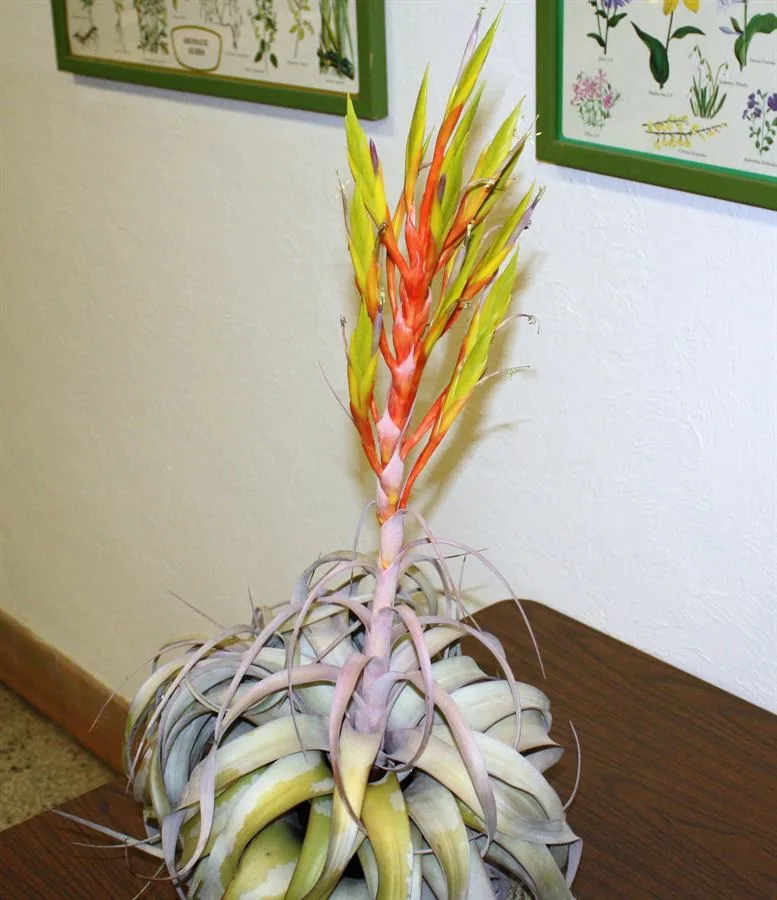


How to Grow and Care for Air Plant
Tillandsia xerographica
Written by Emilio Marruso · last checked
At a glance
This tillandsia is a perennial that is happy indoors and in containers, as long as it gets bright light but not full sun. Care is simple: soak it in water for 15 minutes every 1 or 2 weeks, and only monthly in winter. Afterward, shake it out and let it dry upside-down, and add diluted liquid fertilizer to the water once or twice a month.
- Sun
Bright light, but not full sun
What the sources say (1)
Light: Bright light but not full sunlight
It requires bright light but not full sunlight. A south-facing window should be sufficient.
— Tillandsia xerographica (Air Plant, Giant Air Plant, Xerographic Air Plant) | North Carolina Extension Gardener Plant Toolbox [1] - Water
Soak 15 minutes every 1–2 weeks, monthly in winter; dry homes may need more
What the sources say (3)
Watering: Soak in water for 15 minutes every 1 or 2 weeks; in winter soak monthly
Soak the plant in water for 15 minutes every 1 or 2 weeks. In the winter it can be soaked monthly.
— Tillandsia xerographica (Air Plant, Giant Air Plant, Xerographic Air Plant) | North Carolina Extension Gardener Plant Toolbox [1] Watering notes: In a home, the heating and air conditioning can affect humidity and the plant might need more watering; shake out the plant and let it dry upside-down after soaking to prevent crown rot
In a home, the heating and air conditioning can affect humidity, and the plant might need more watering.
— Tillandsia xerographica (Air Plant, Giant Air Plant, Xerographic Air Plant) | North Carolina Extension Gardener Plant Toolbox [1] Just be sure to shake out the plant and let it dry upside-down soaking to prevent crown rot.
— Tillandsia xerographica (Air Plant, Giant Air Plant, Xerographic Air Plant) | North Carolina Extension Gardener Plant Toolbox [1] - Cold
Survives winters down to 20 °F (−6.7 °C)
Hardy in average winters · USDA 9a · RHS H4 · Z9
What the sources say (2)
Hardiness, coldest zone: 9a [winter low −6.7 to −3.9 °C (20 to 25 °F)]
USDA Plant Hardiness Zone: 9a, 9b, 10a, 10b, 11a, 11b
— Tillandsia xerographica (Air Plant, Giant Air Plant, Xerographic Air Plant) | North Carolina Extension Gardener Plant Toolbox [1] Hardiness, warmest zone: 11b [winter low 7.2 to 10 °C (45 to 50 °F)]
USDA Plant Hardiness Zone: 9a, 9b, 10a, 10b, 11a, 11b
— Tillandsia xerographica (Air Plant, Giant Air Plant, Xerographic Air Plant) | North Carolina Extension Gardener Plant Toolbox [1] - Feeding
Once or twice a month, add liquid fertilizer at half strength or less to the soaking water
What the sources say (2)
How often: Once or twice a month, added to the soaking water
You can also add liquid fertilizer (diluted to half-strength or less) to the water once or twice a month to encourage growth, pup formation and flowering.
— Tillandsia xerographica (Air Plant, Giant Air Plant, Xerographic Air Plant) | North Carolina Extension Gardener Plant Toolbox [1] Mineral fertilizers: Liquid fertilizer diluted to half strength or less
You can also add liquid fertilizer (diluted to half-strength or less) to the water once or twice a month to encourage growth, pup formation and flowering.
— Tillandsia xerographica (Air Plant, Giant Air Plant, Xerographic Air Plant) | North Carolina Extension Gardener Plant Toolbox [1] - Pests
Crown rot: after soaking, shake it out and let it dry upside-down
What the sources say (1)
Diseases: crown rot
Just be sure to shake out the plant and let it dry upside-down soaking to prevent crown rot.
— Tillandsia xerographica (Air Plant, Giant Air Plant, Xerographic Air Plant) | North Carolina Extension Gardener Plant Toolbox [1] - Propagation
Make new plants by division
What the sources say (1)
Propagation: Division
Recommended Propagation Strategy: Division
— Tillandsia xerographica (Air Plant, Giant Air Plant, Xerographic Air Plant) | North Carolina Extension Gardener Plant Toolbox [1] - Containers
Grows well indoors and in containers
What the sources say (2)
In containers: Yes
Landscape Location: Container Hanging Baskets Houseplants
— Tillandsia xerographica (Air Plant, Giant Air Plant, Xerographic Air Plant) | North Carolina Extension Gardener Plant Toolbox [1] Indoors: Yes
This plant can be grown indoors or outside in mild climates.
— Tillandsia xerographica (Air Plant, Giant Air Plant, Xerographic Air Plant) | North Carolina Extension Gardener Plant Toolbox [1]
Overview
Giant air plant is a tropical epiphytic perennial that can be grown indoors as a houseplant or outdoors in mild climates. [1] It is watered by soaking and needs bright light but not full sunlight. [1]
Air Plant care
How to water Air Plant
Watering
Soak in water for 15 minutes every 1 or 2 weeks; in winter soak monthly
What the sources say (1)
Soak the plant in water for 15 minutes every 1 or 2 weeks. In the winter it can be soaked monthly.Watering notes
In a home, the heating and air conditioning can affect humidity and the plant might need more watering; shake out the plant and let it dry upside-down after soaking to prevent crown rot
What the sources say (2)
In a home, the heating and air conditioning can affect humidity, and the plant might need more watering.Just be sure to shake out the plant and let it dry upside-down soaking to prevent crown rot.How much light Air Plant needs
Bright light but not full sunlight
What the sources say (1)
It requires bright light but not full sunlight. A south-facing window should be sufficient.How much cold Air Plant can take
Hardiness, coldest zone
9a [winter low −6.7 to −3.9 °C (20 to 25 °F)]
What the sources say (1)
USDA Plant Hardiness Zone:
9a, 9b, 10a, 10b, 11a, 11bHardiness, warmest zone
11b [winter low 7.2 to 10 °C (45 to 50 °F)]
What the sources say (1)
USDA Plant Hardiness Zone:
9a, 9b, 10a, 10b, 11a, 11bWhere to grow Air Plant
Indoors
Yes
What the sources say (1)
This plant can be grown indoors or outside in mild climates.In containers
Yes
What the sources say (1)
Landscape Location:
Container
Hanging Baskets
HouseplantsHow to propagate Air Plant
Division
What the sources say (1)
Recommended Propagation Strategy:
DivisionHow to grow Air Plant
The plant
Life cycle
perennial
What the sources say (1)
The giant air plant is a tropical, epiphytic, evergreen herbaceous perennial in the pineapple family (Bromeliaceae).Family
Bromeliaceae
What the sources say (1)
The giant air plant is a tropical, epiphytic, evergreen herbaceous perennial in the pineapple family (Bromeliaceae).Pests and diseases
Diseases
crown rot
What the sources say (1)
Just be sure to shake out the plant and let it dry upside-down soaking to prevent crown rot.Fertilizing
How often
Once or twice a month, added to the soaking water
What the sources say (1)
You can also add liquid fertilizer (diluted to half-strength or less) to the water once or twice a month to encourage growth, pup formation and flowering.Mineral fertilizers
Liquid fertilizer diluted to half strength or less
What the sources say (1)
You can also add liquid fertilizer (diluted to half-strength or less) to the water once or twice a month to encourage growth, pup formation and flowering.Air Plant pests and problems
Crown rot
Symptom: Rot of the crown after soaking if water stays in the plant
What to do: Shake out the plant and let it dry upside-down after soaking
What the sources say (1)
Just be sure to shake out the plant and let it dry upside-down soaking to prevent crown rot.
— Tillandsia xerographica (Air Plant, Giant Air Plant, Xerographic Air Plant) | North Carolina Extension Gardener Plant Toolbox [1]
Remedies
Each remedy shows what official sources say about it; traditional remedies without an official source are marked as such. Harmful ones are listed so you know to avoid them.
Treating the plant
crown rot
shake out and dry upside-down after soaking Works
How: Shake out the plant and let it dry upside-down after soaking.
Just be sure to shake out the plant and let it dry upside-down soaking to prevent crown rot.
— Tillandsia xerographica (Air Plant, Giant Air Plant, Xerographic Air Plant) | North Carolina Extension Gardener Plant Toolbox [1] What the evidence says You should let the plant air dry after watering in a spot with good air circulation where it will dry out within four hours.
— ask.extension.org [3]
scale insects
picking off scales by hand Partly works
How: Pick off individual scales or gently scrub (or rub) the scales loose from the leaves and stems.
One possibility is to pick off individual scales or gently scrub (or rub) the scales loose from the leaves and stems. This is a laborious task that works only on small, large-leafed plants.
— yardandgarden.extension.iastate.edu [4] What the evidence says One possibility is to pick off individual scales or gently scrub (or rub) the scales loose from the leaves and stems. This is a laborious task that works only on small, large-leafed plants.
— yardandgarden.extension.iastate.edu [4] alcohol-soaked cotton swab Partly works
How: Dab each scale with an alcohol-soaked cotton swab, on lightly-infested plants.
Dabbing each scale with an alcohol-soaked cotton swab is another possibility on lightly-infested plants.
— yardandgarden.extension.iastate.edu [4] What the evidence says Dabbing each scale with an alcohol-soaked cotton swab is another possibility on lightly-infested plants.
— yardandgarden.extension.iastate.edu [4] mild dishwashing detergent solution Official source, not independently tested
How: Use a dilute solution of 1 Tbs of detergent per quart of water, applied with a sprayer or a soft cloth.
You can use a mild dishwashing detergent in place of commercial insecticide soaps. Use a dilute solution of 1 Tbs of detergent per quart of water.
— yardandgarden.extension.iastate.edu [4]
mealybugs
rubbing alcohol on cotton balls Not verified
Traditional remedy, not verified by an official source.
How: Dip a cotton ball in rubbing alcohol and gently wipe the affected areas, focusing on the mealybugs and their eggs; repeat every few days until they are gone.
neem oil spray Not verified
Traditional remedy, not verified by an official source.
How: Dilute neem oil with water according to the product label, spray tops and undersides of the leaves, and repeat every seven to ten days until the mealybugs are gone.
dish soap spray Not verified
Traditional remedy, not verified by an official source.
How: Add 1 tablespoon of dish soap per quart of water in a spray bottle and lightly mist the plants, repeating every few days for a couple of weeks.
Similar plants
- Air Plant Tillandsia ionantha
- Spanish moss Tillandsia usneoides
- Amazonian Zebra Plant Aechmea chantinii
- Earth Star Cryptanthus bivittatus
- Flaming Sword Vriesea splendens
- Pineapple Ananas comosus
- Scarlet Star Guzmania lingulata
- Urn Plant Aechmea fasciata
Sources
Every value above is quoted from these documents. Links lead to the original publisher.
- Tillandsia xerographica (Air Plant, Giant Air Plant, Xerographic Air Plant) | North Carolina Extension Gardener Plant Toolbox · plants.ces.ncsu.edu, consulted
- Tillandsia (Air Plant) | North Carolina Extension Gardener Plant Toolbox · plants.ces.ncsu.edu, consulted
- ask.extension.org · ask.extension.org
- yardandgarden.extension.iastate.edu · yardandgarden.extension.iastate.edu
Written by Emilio Marruso · last checked