How to Grow and Care for Baldwin's ironweed
Vernonia baldwinii
Written by Emilio Marruso · last checked
At a glance
Baldwin's ironweed asks for very little: once established it uses little water and shrugs off drought, as long as the soil drains well. Leave its stems standing until spring and tunnel-nesting bees will use them as a place to nest. It spreads freely by underground stems, so give it a natural area or a large meadow where a big colony can shine.
- Water
Little water; drought tolerant once established, in soil that drains well
What the sources say (2)
Watering: Low water use; drought tolerant once established
Best in natural areas and large meadows where large colonies can be appreciated. Tough, drought tolerant. Needs well-drained conditions.
— Vernonia baldwinii - Native Plant Society of Texas [6] Watering notes: Needs well-drained conditions
Best in natural areas and large meadows where large colonies can be appreciated. Tough, drought tolerant. Needs well-drained conditions.
— Vernonia baldwinii - Native Plant Society of Texas [6] - Cold
Survives winters down to −20 °F (−28.9 °C)
Very hardy · USDA 5 · RHS H7 · Z5
What the sources say (2)
Hardiness, coldest zone: 5 [winter low −28.9 to −23.3 °C (−20 to −10 °F)]
Hardiness Zone: 5 - 9
— Vernonia baldwinii | Chicago Botanic Garden [1] Hardiness, warmest zone: 9 [winter low −6.7 to −1.1 °C (20 to 30 °F)]
Hardiness Zone: 5 - 9
— Vernonia baldwinii | Chicago Botanic Garden [1] - Pruning
Leave the stems standing until spring: bees nest in them
What the sources say (1)
Pruning: Leave stems until spring (nesting habitat for tunnel-nesting bees)
Leave stems until spring to provide nesting habitat for tunnel-nesting bees.
— Vernonia baldwinii - Native Plant Society of Texas [6] - Watch out
Spreads fast by underground stems: best in natural areas and large meadows
- Propagation
From seed, root division or soft tip cuttings
What the sources say (1)
Propagation: Seed; root division; softwood tip cuttings
Few seeds are fertile, so sow thickly when soil temperature is warm. May also be propagated by root division and softwood tip cuttings.
— Lady Bird Johnson Wildflower Center - The University of Texas at Austin [3] - Sowing
Sow in spring once the ground has warmed up
What the sources say (1)
Sowing: In spring once the ground has warmed up
In the spring once the ground has warmed up, scatter seeds directly onto the soil surface in a well-prepared bed.
— Vernonia baldwinii - Native Plant Society of Texas [6]
Overview
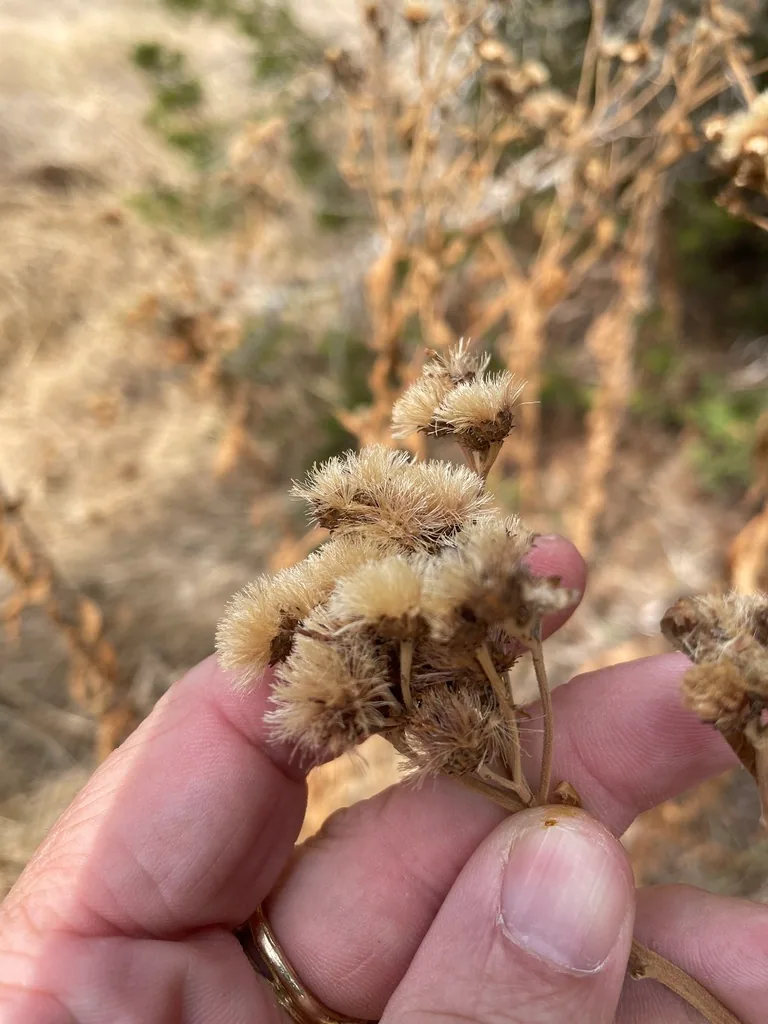
Western ironweed is a native North American perennial herb with red-violet to purple flower clusters in summer and fall. [3][1] It colonizes aggressively by rhizomes and is best placed in natural areas and large meadows. [3][6] It is drought tolerant, needs well-drained conditions, and is generally avoided by deer and livestock. [6][5]
Baldwin's ironweed care
How to water Baldwin's ironweed
Watering
Low water use; drought tolerant once established
What the sources say (1)
Best in natural areas and large meadows where large colonies can be appreciated. Tough, drought tolerant. Needs well-drained conditions.Watering notes
Needs well-drained conditions
What the sources say (1)
Best in natural areas and large meadows where large colonies can be appreciated. Tough, drought tolerant. Needs well-drained conditions.How much light Baldwin's ironweed needs
How much cold Baldwin's ironweed can take
Hardiness, coldest zone
5 [winter low −28.9 to −23.3 °C (−20 to −10 °F)]
What the sources say (1)
Hardiness Zone:
5 - 9Hardiness, warmest zone
9 [winter low −6.7 to −1.1 °C (20 to 30 °F)]
What the sources say (1)
Hardiness Zone:
5 - 9How to propagate Baldwin's ironweed
Seed; root division; softwood tip cuttings
What the sources say (1)
Few seeds are fertile, so sow thickly when soil temperature is warm. May also be propagated by root division and softwood tip cuttings.Baldwin's ironweed pests and problems
Rampant colonizing by rhizomes
What to do: Plant in natural areas and large meadows where large colonies can be appreciated.
What the sources say (1)
Best in natural areas and large meadows where large colonies can be appreciated. Can be rampant colonizer when planted in garden soils.
— Lady Bird Johnson Wildflower Center - The University of Texas at Austin [3]
Remedies
Each remedy shows what official sources say about it; traditional remedies without an official source are marked as such. Harmful ones are listed so you know to avoid them.
Getting rid of it
aggressive spread
repeated mowing Partly works
How: Mow early (May 20), then mow repeatedly whenever the regrowth reaches 6 to 8 inches; single mowing events often resulted in higher stands.
In contrast, western ironweed that was mowed early (May 20) then mowed repeatedly whenever the regrowth reached 6 to 8 inches resulted in 19 to 87% stand reduction compared to the nontreated plots
— ag.purdue.edu [7] What the evidence says In contrast, western ironweed that was mowed early (May 20) then mowed repeatedly whenever the regrowth reached 6 to 8 inches resulted in 19 to 87% stand reduction compared to the nontreated plots
— ag.purdue.edu [7]
Calendar
Sowing
In spring once the ground has warmed up
What the sources say (1)
In the spring once the ground has warmed up, scatter seeds directly onto the soil surface in a well-prepared bed.Pruning
Leave stems until spring (nesting habitat for tunnel-nesting bees)
What the sources say (1)
Leave stems until spring to provide nesting habitat for tunnel-nesting bees.Months as given by the sources, which are mostly from the United States (northern hemisphere). In the southern hemisphere they shift by about six months.
Indicative values
Values from a secondary source, not checked word for word like the rest of this page. Use them as a starting point.
- Life cycle
- Herbaceous PerennialIndicative value, adapt it to your climate · Secondary source
- Mature height
- 91.4-152.4 cm (3-5 ft)Indicative value, adapt it to your climate · Secondary source
- Hours of sun
- 6-8 hoursIndicative value, adapt it to your climate · Secondary source
- Drought tolerant
- yesIndicative value, adapt it to your climate · Secondary source
- Soil pH
- 6-7Indicative value, adapt it to your climate · Secondary source
- Care level
- MediumIndicative value, adapt it to your climate · Secondary source
- Growth rate
- LowIndicative value, adapt it to your climate · Secondary source
Similar plants
- Appalachian Ironweed Vernonia glauca
- Giant Ironweed Vernonia gigantea
- Ironweed Vernonia acaulis
- Ironweed Vernonia angustifolia
- Ironweed Vernonia lettermannii
- Ironweed Vernonia noveboracensis
- Aaron's Beard Hypericum calycinum
- Abies grandis Abies grandis
Sources
Every value above is quoted from these documents. Links lead to the original publisher.
- Vernonia baldwinii | Chicago Botanic Garden · chicagobotanic.org, consulted
- Western Ironweed (Baldwin's Ironweed) | Missouri Department of Conservation · mdc.mo.gov, consulted
- Lady Bird Johnson Wildflower Center - The University of Texas at Austin · wildflower.org, consulted
- Baldwin's Ironweed (Vernonia baldwinii) · m.illinoiswildflowers.info, consulted
- Plants of Louisiana · warcapps.usgs.gov, consulted
- Vernonia baldwinii - Native Plant Society of Texas · npsot.org, consulted
- ag.purdue.edu · ag.purdue.edu
Written by Emilio Marruso · last checked