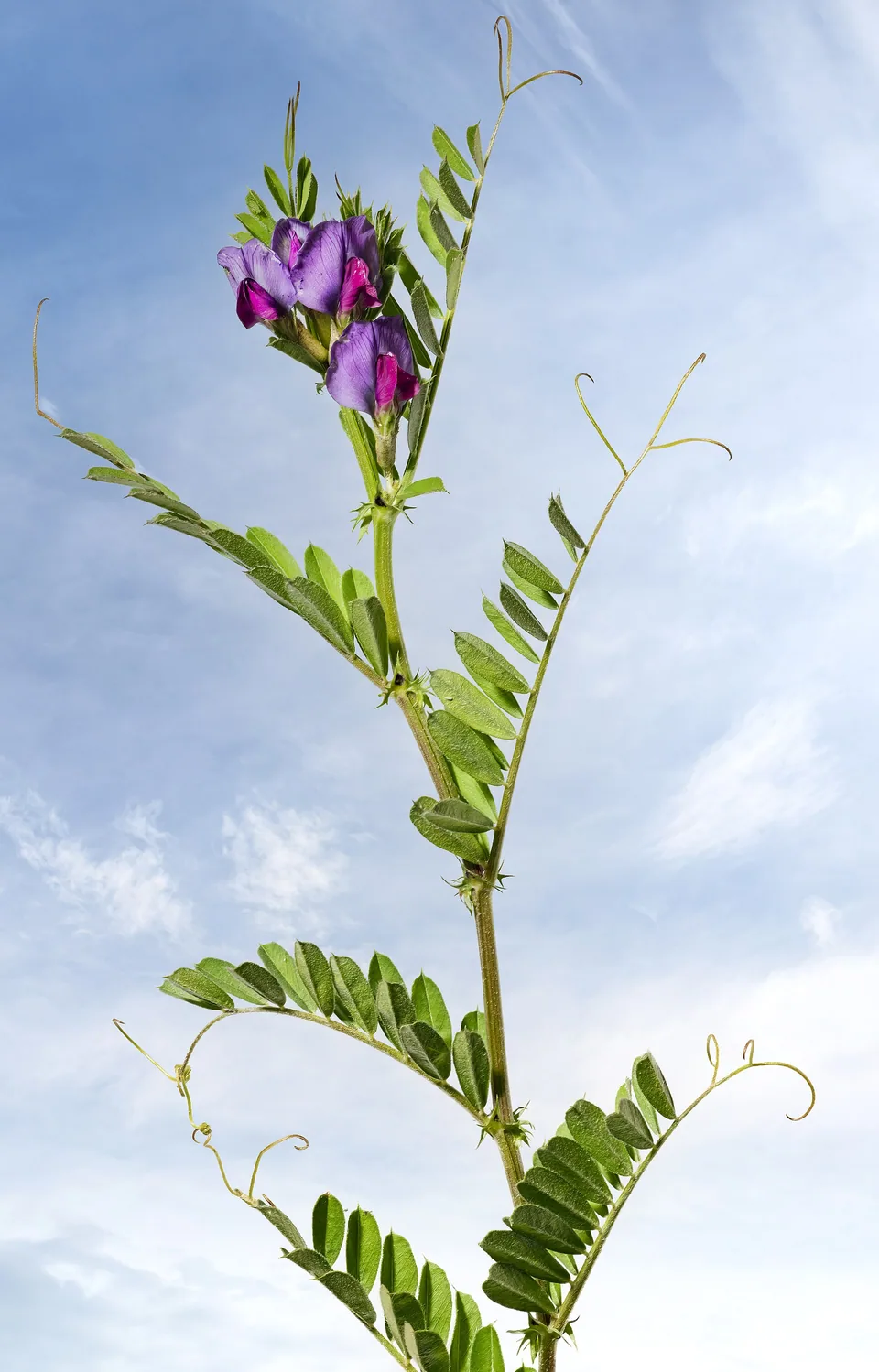


How to Grow and Care for Vetch
Vicia sativa
Written by Emilio Marruso · last checked
Toxic to: People · Why
At a glance
Common vetch is a generous winter annual that grows in full sun or partial shade and handles soils from slightly acidic to alkaline. Sow the seeds in fall in warm climates, and it needs no nitrogen fertilizer when grown alone. Its young leaves can be cooked or made into tea, and cattle, horses and sheep enjoy it as forage.
- Sun
Full sun to partial shade; it handles some shade
What the sources say (2)
Light: Full sun to partial shade; somewhat shade-tolerant
Light: Full sun (6 or more hours of direct sunlight a day) Partial Shade (Direct sunlight only part of the day, 2-6 hours)
— Vicia sativa (Common Vetch, Garden Vetch, Golden Tare, Vetch) | North Carolina Extension Gardener Plant Toolbox [1] If small grains are planted, they should be seeded at a rate of 60 lb/ac. Common vetch is somewhat shade-tolerant.
— Common Vetch (Vicia sativa) | Mississippi State University Extension Service [2] - Cold
Survives winters down to −50 °F (−45.6 °C)
Very hardy · USDA 2a · RHS H7 · Z2
What the sources say (2)
Hardiness, coldest zone: 2a [winter low −45.6 to −42.8 °C (−50 to −45 °F)]
USDA Plant Hardiness Zone: 2a, 2b, 3a, 3b, 4a, 4b, 5a, 5b, 6a, 6b, 7a, 7b, 8a, 8b, 9a, 9b, 10a, 10b
— Vicia sativa (Common Vetch, Garden Vetch, Golden Tare, Vetch) | North Carolina Extension Gardener Plant Toolbox [1] Hardiness, warmest zone: 10b [winter low 1.7 to 4.4 °C (35 to 40 °F)]
USDA Plant Hardiness Zone: 2a, 2b, 3a, 3b, 4a, 4b, 5a, 5b, 6a, 6b, 7a, 7b, 8a, 8b, 9a, 9b, 10a, 10b
— Vicia sativa (Common Vetch, Garden Vetch, Golden Tare, Vetch) | North Carolina Extension Gardener Plant Toolbox [1] - Soil
Fertile, well-drained soil, pH 6.0–8.0; clay is fine if it drains well
What the sources say (4)
Soil pH, minimum: 6.0
Soil pH: Neutral (6.0-8.0) Soil Drainage: Good Drainage
— Vicia sativa (Common Vetch, Garden Vetch, Golden Tare, Vetch) | North Carolina Extension Gardener Plant Toolbox [1] Soil pH, maximum: 8.0
Soil pH: Neutral (6.0-8.0) Soil Drainage: Good Drainage
— Vicia sativa (Common Vetch, Garden Vetch, Golden Tare, Vetch) | North Carolina Extension Gardener Plant Toolbox [1] Watering notes: Adapted to moderately to well-drained, fertile soils; tolerates fine-textured clay soils as long as there is good drainage
It is well-adapted to moderately to well-drained, fertile soils.
— Common Vetch (Vicia sativa) | Mississippi State University Extension Service [2] as well as on fine-textured clay soils as long as there is good drainage.
— Common Vetch (Vicia sativa) | Mississippi State University Extension Service [2] - Feeding
No nitrogen needed when grown alone; add phosphorus and potassium unless the soil is already rich
What the sources say (4)
Mineral fertilizers: Phosphorus and potassium: 67.3 kg [148.4 lb]/ha of P₂O₅ and 135 kg [297.6 lb]/ha of K₂O, which can be skipped where soil tests are very high
planted alone: When planted alone, nitrogen fertilizer is not needed, as vetch obtains its nitrogen through symbiotic nitrogen fixation with bacteria in plant root nodules.
— Common Vetch (Vicia sativa) | Mississippi State University Extension Service [2] planted with a cereal grain or other grass: If planted with a cereal grain or other grass, however, apply nitrogen at 75% of normal rates for grasses.
— Common Vetch (Vicia sativa) | Mississippi State University Extension Service [2] Phosphorus fertilization is often required. An application of 60 lb /ac of P 2 O 5 and 120 lb/acre of K 2 O should be adequate.
— Common Vetch (Vicia sativa) | Mississippi State University Extension Service [2] However, where soil tests are very high (greater than 25 to 30 ppm P and 110 to 130 ppm K) applications can be eliminated.
— Common Vetch (Vicia sativa) | Mississippi State University Extension Service [2] - Harvest
Cook young leaves or make tea; animals can graze it once it is 5–6 inches tall
What the sources say (1)
How to harvest: Forage use: begin grazing when plants are 12.7-15.2 cm (5 to 6 in) tall; close grazing below the lowest leaf axil removes axillary buds and slows regrowth
Grazing should be begin when plants have are 5 to 6 inches tall. Close grazing below the lowest leaf axil will remove axillary buds, resulting in slow re-growth.
— Common Vetch (Vicia sativa) | Mississippi State University Extension Service [2] - Pests
Aphids, cutworms and armyworms; anthracnose, rust and downy mildew
What the sources say (2)
Pests: pea aphid, cutworms, fall armyworm, vetch bruchid, American grasshopper, lygus bugs, clover leafhopper, potato leafhopper
Many of the insects of forage legumes attack vetches, including the pea aphid, cutworms, fall armyworm, vetch bruchid, American grasshopper, lygus bugs, clover leafhopper, and potato leafhopper.
— Common Vetch (Vicia sativa) | Mississippi State University Extension Service [2] Diseases: anthracnose, leaf spot, downy mildew, stem and root rots, rust
Diseases of vetches include anthracnose, leaf spot and downy mildew, several stem and root rots, and rust.
— Common Vetch (Vicia sativa) | Mississippi State University Extension Service [2] - Watch out
Reseeds itself and spreads fast like a weed; stems lying on the ground can rot without support
- Propagation
Grows from seed
What the sources say (1)
Propagation: Seed
Recommended Propagation Strategy: Seed Country Or Region Of Origin: Europe, Asia, North Africa
— Vicia sativa (Common Vetch, Garden Vetch, Golden Tare, Vetch) | North Carolina Extension Gardener Plant Toolbox [1] - Sowing
In warm climates sow from early September to mid-October, 1/2–3/4 inch deep
What the sources say (3)
Sowing: Early September to mid-October (Mississippi, forage seeding)
Mississippi (forage seeding): Recommended seeding rates vary from 20 to 40 lb/ac and should be planted from early September to mid-October.
— Common Vetch (Vicia sativa) | Mississippi State University Extension Service [2] Recommended seeding rates vary from 20 to 40 lb/ac and should be planted from early September to mid-October.
— Common Vetch (Vicia sativa) | Mississippi State University Extension Service [2] Sowing depth: 1.3-1.9 cm (1/2 in - 3/4 in)
Drill seed into a firm seedbed from 1/2 to 3/4 inch deep depending on soil moisture.
— Common Vetch (Vicia sativa) | Mississippi State University Extension Service [2] - Safety
The seeds are mildly poisonous to people
Overview
Common vetch is a weedy winter annual climbing legume used as a cover crop because it fixes nitrogen. [1] It is grown from seed and tolerates full sun to partial shade. [1] It self-seeds aggressively and can spread quickly. [1]
Vetch care
How to water Vetch
Adapted to moderately to well-drained, fertile soils; tolerates fine-textured clay soils as long as there is good drainage
What the sources say (2)
It is well-adapted to moderately to well-drained, fertile soils.as well as on fine-textured clay soils as long as there is good drainage.How much light Vetch needs
Full sun to partial shade; somewhat shade-tolerant
What the sources say (2)
Light:
Full sun (6 or more hours of direct sunlight a day)
Partial Shade (Direct sunlight only part of the day, 2-6 hours)If small grains are planted, they should be seeded at a rate of 60 lb/ac. Common vetch is somewhat shade-tolerant.How much cold Vetch can take
Hardiness, coldest zone
2a [winter low −45.6 to −42.8 °C (−50 to −45 °F)]
What the sources say (1)
USDA Plant Hardiness Zone:
2a, 2b, 3a, 3b, 4a, 4b, 5a, 5b, 6a, 6b, 7a, 7b, 8a, 8b, 9a, 9b, 10a, 10bHardiness, warmest zone
10b [winter low 1.7 to 4.4 °C (35 to 40 °F)]
What the sources say (1)
USDA Plant Hardiness Zone:
2a, 2b, 3a, 3b, 4a, 4b, 5a, 5b, 6a, 6b, 7a, 7b, 8a, 8b, 9a, 9b, 10a, 10bBest soil for Vetch
Soil pH, minimum
6.0
What the sources say (1)
Soil pH:
Neutral (6.0-8.0)
Soil Drainage:
Good DrainageSoil pH, maximum
8.0
What the sources say (1)
Soil pH:
Neutral (6.0-8.0)
Soil Drainage:
Good DrainageHow to propagate Vetch
Seed
What the sources say (1)
Recommended Propagation Strategy:
Seed
Country Or Region Of Origin:
Europe, Asia, North AfricaHow to grow Vetch
The plant
Life cycle
annual (winter annual)
What the sources say (2)
Life Cycle:
Annual
Recommended Propagation Strategy:
Seed
Country Or Region Of Origin:
Europe, Asia, North AfricaCommon vetch is a slender, viney winter annualFamily
Fabaceae
What the sources say (1)
Genus:
Vicia
Species:
sativa
Family:
Fabaceae
Life Cycle:
AnnualSowing and growth
Sowing depth
1.3-1.9 cm (1/2 in - 3/4 in)
What the sources say (1)
Drill seed into a firm seedbed from 1/2 to 3/4 inch deep depending on soil moisture.Harvest and storage
How to harvest
Forage use: begin grazing when plants are 12.7-15.2 cm (5 to 6 in) tall; close grazing below the lowest leaf axil removes axillary buds and slows regrowth
What the sources say (1)
Grazing should be begin when plants have are 5 to 6 inches tall. Close grazing below the lowest leaf axil will remove axillary buds, resulting in slow re-growth.Pests and diseases
Pests
pea aphid, cutworms, fall armyworm, vetch bruchid, American grasshopper, lygus bugs, clover leafhopper, potato leafhopper
What the sources say (1)
Many of the insects of forage legumes attack vetches, including the pea aphid, cutworms, fall armyworm, vetch bruchid, American grasshopper, lygus bugs, clover leafhopper, and potato leafhopper.Diseases
anthracnose, leaf spot, downy mildew, stem and root rots, rust
What the sources say (1)
Diseases of vetches include anthracnose, leaf spot and downy mildew, several stem and root rots, and rust.Fertilizing
Mineral fertilizers
Phosphorus and potassium: 67.3 kg [148.4 lb]/ha of P₂O₅ and 135 kg [297.6 lb]/ha of K₂O, which can be skipped where soil tests are very high
What each source says
planted alone: No nitrogen fertilizer needed
planted with a cereal grain or other grass: Nitrogen at 75% of the normal rate for grasses
What the sources say (4)
planted alone: When planted alone, nitrogen fertilizer is not needed, as vetch obtains its nitrogen through symbiotic nitrogen fixation with bacteria in plant root nodules.planted with a cereal grain or other grass: If planted with a cereal grain or other grass, however, apply nitrogen at 75% of normal rates for grasses.Phosphorus fertilization is often required. An application of 60 lb /ac of P 2 O 5 and 120 lb/acre of K 2 O should be adequate.However, where soil tests are very high (greater than 25 to 30 ppm P and 110 to 130 ppm K) applications can be eliminated.Micronutrients
Sulfur and calcium from gypsum (calcium sulfate) at 84.1–168 kg [185.4–370.4 lb]/ha; gypsum does not correct soil acidity
What the sources say (1)
Gypsum (calcium sulfate) is commonly applied at the rate of 75 to 150 lb/ac in areas with alkaline or low pH. This provides an adequate source of sulfur fertilizer but will not correct soil acidity problems.Vetch pests and problems
Aggressive self-seeding
Symptom: Spreads quickly as a weed
What to do: Not stated in sources
What the sources say (1)
Its aggressive self seeding can cause this weedy plant to spread quickly.
— Vicia sativa (Common Vetch, Garden Vetch, Golden Tare, Vetch) | North Carolina Extension Gardener Plant Toolbox [1] Rot without support
Symptom: Plants spreading along the ground can rot
What to do: Provide adjacent companion plants for support
What the sources say (1)
When planted as a forage plant for animals, it is beneficial to have adjacent companion plants for support of this climbing vine-like plant. Without support, it can be subject to rot as it spreads along the ground.
— Vicia sativa (Common Vetch, Garden Vetch, Golden Tare, Vetch) | North Carolina Extension Gardener Plant Toolbox [1] Diseases and insects
Symptom: Anthracnose, leaf spot, downy mildew, stem and root rots, rust; pea aphid, cutworms, fall armyworm and other insects
What to do: Not stated in sources
What the sources say (1)
Diseases of vetches include anthracnose, leaf spot and downy mildew, several stem and root rots, and rust.
— Common Vetch (Vicia sativa) | Mississippi State University Extension Service [2]
Remedies
Each remedy shows what official sources say about it; traditional remedies without an official source are marked as such. Harmful ones are listed so you know to avoid them.
Treating the plant
aphids
strong water spray Not verified
Traditional remedy, not verified by an official source.
How: Spray plants with a strong stream of water to dislodge colonies, repeating every 5-7 days until populations drop.
Getting rid of it
common vetch
digging out the root system Partly works
How: Use a digging tool to remove as much of the root system as possible, and remove as much of the weed as possible before seed production begins.
use a digging tool to remove as much of the root system as possible.
— hgic.clemson.edu [3] What the evidence says The weed has a tap root that breaks easily, making it difficult to remove when weeding by hand.
— hgic.clemson.edu [3] shredded paper mulch Partly works
Be mindful when using a weed blocker such as the shredded paper (I use plain old cardboard boxes broken down) because it can also block rain water and your desired plants can suffer. Water carefully.
— hometalk.com [4] How: Pull the vetch, mulch with shredded paper, moisten the paper after it is in place and it becomes like papier-mache as it dries; a decorative mulch can go on top.
Pull it, then mulch with shredded paper, moisten the paper after it is in place and it will become like paper mache as it dries.
— hometalk.com [4] What the evidence says A variety of household items, such as newspapers, can be used as weed barriers.
— extension.usu.edu [5] vinegar, salt and dish soap spray Harmful
Since most homemade recipes need repeated application to be effective, the salts will build up. However, increased salts concentration in the soil can harm desired plants nearby.
— extension.uconn.edu [7] Vinegar contains acetic acid that in concentrations over 11 percent can cause burns if it gets on your skin and permanent corneal injury if it comes in contact with your eyes.
— extension.illinois.edu [8] How: Spray on the weeds as they come up, nearly every day; recipe given by the source: 1 gal vinegar, 1/8 cup salt, 1/4 cup [nome commerciale] dish soap.
Vinegar, salt, and [nome commerciale] works well to spray it on the weeds as it comes up, this will kill the roots as well, but you have to spray just about every day.
— hometalk.com [4] What the evidence says Salt is soluble and thus highly mobile in your soil allowing it to spread to areas planted with desirable vegetables and ornamentals, damaging them along with your weeds.
— extension.illinois.edu [6] mowing before pods mature Not verified
Traditional remedy, not verified by an official source.
How: Mow or cut plants before pods mature, limit bare ground, and rotate planting areas to keep it contained.
Is Vetch poisonous?
Reported by the source, quoted verbatim. This is not medical or veterinary advice: if a person or an animal may have eaten this plant, contact a poison control centre or a veterinarian.
Calendar
Sowing
Early September to mid-October (Mississippi, forage seeding)
What each source says
Mississippi (forage seeding): Early September to mid-October
What the sources say (2)
Mississippi (forage seeding): Recommended seeding rates vary from 20 to 40 lb/ac and should be planted from early September to mid-October.Recommended seeding rates vary from 20 to 40 lb/ac and should be planted from early September to mid-October.Harvest
Seasonal forage production March to May in northern Mississippi; November to December and February to April in southern Mississippi
What each source says
northern Mississippi: March to May
southern Mississippi: November to December and February to April
What the sources say (3)
northern Mississippi: Seasonal production in the northern part of the state from March to Maysouthern Mississippi: and in the southern part from November to December and February to April.Seasonal production in the northern part of the state from March to May and in the southern part from November to December and February to April.Months as given by the sources, which are mostly from the United States (northern hemisphere). In the southern hemisphere they shift by about six months.
Edibility
Reported by the source, quoted verbatim. Do not eat a plant on the basis of this page alone: identification mistakes can be dangerous.
The leaves can be made into teas, cooked or eaten with the young leaves.
[1]It is occasionally planted as a food source for farm animals including cattle, horses, and sheep.
[1]It is occasionally planted as a food source for farm animals including cattle, horses, and sheep.
[1]It is occasionally planted as a food source for farm animals including cattle, horses, and sheep.
[1]
Indicative values
Values from a secondary source, not checked word for word like the rest of this page. Use them as a starting point.
- Watering
- FrequentIndicative value, adapt it to your climate · Secondary source
- Care level
- MediumIndicative value, adapt it to your climate · Secondary source
- Growth rate
- HighIndicative value, adapt it to your climate · Secondary source
- Pruning
- May, June, JulyIndicative value, adapt it to your climate · Secondary source
Similar plants
- Faba Bean Vicia faba
- Hairy Vetch Vicia villosa
- Wood Vetch Vicia caroliniana
- Lentil Vicia lens
- Blister vetch Vicia ervilia
- American Groundnut Apios americana
- American hogpeanut Amphicarpaea bracteata
- Bean Phaseolus vulgaris
Sources
Every value above is quoted from these documents. Links lead to the original publisher.
- Vicia sativa (Common Vetch, Garden Vetch, Golden Tare, Vetch) | North Carolina Extension Gardener Plant Toolbox · plants.ces.ncsu.edu, consulted
- Common Vetch (Vicia sativa) | Mississippi State University Extension Service · extension.msstate.edu, consulted
- hgic.clemson.edu · hgic.clemson.edu
- hometalk.com · hometalk.com
- extension.usu.edu · extension.usu.edu
- extension.illinois.edu · extension.illinois.edu
- extension.uconn.edu · extension.uconn.edu
- extension.illinois.edu · extension.illinois.edu
Written by Emilio Marruso · last checked