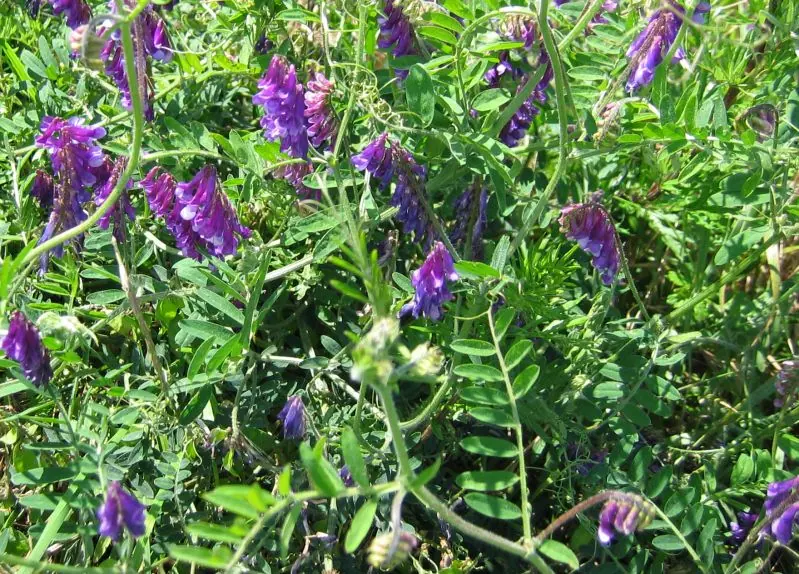
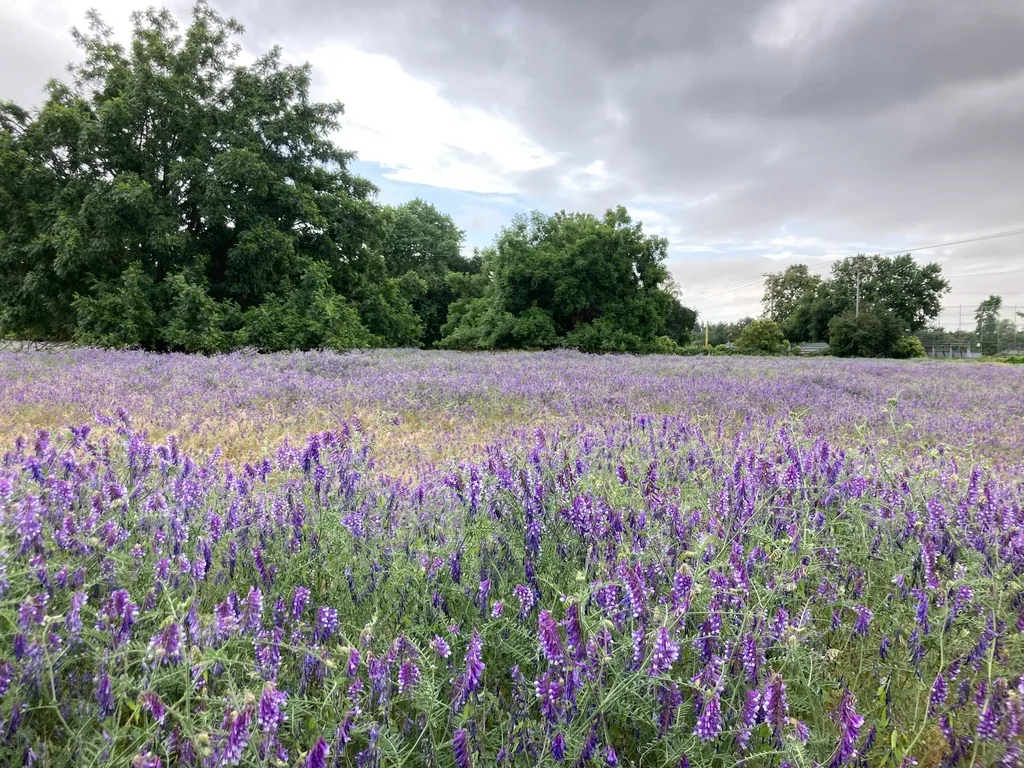

How to Grow and Care for Hairy Vetch
Vicia villosa
Written by Emilio Marruso · last checked
Toxic to: Animals · Why
At a glance
Hairy vetch is a winter annual in the bean family, often grown as a cover crop or as animal fodder. Sow it from early September to mid-October in full sun or partial shade; grown on its own, it needs no nitrogen fertilizer. Just keep an eye on it: it reseeds itself and can become an aggressive weed.
- Sun
Full sun to partial shade
What the sources say (2)
Light: Full sun to partial shade
Full sun (6 or more hours of direct sunlight a day)
— Vicia villosa (Cardyne Hairy Vetch, Fodder Vetch, Hairy Vetch, Lana Vetch, Sand Vetch, Smooth Vetch, Thick-fruited Vetch, Winter Vetch, Wooley-pod Vetch, Wooly Vetch) | North Carolina Extension Gardener Plant Toolbox [1] Partial Shade (Direct sunlight only part of the day, 2-6 hours)
— Vicia villosa (Cardyne Hairy Vetch, Fodder Vetch, Hairy Vetch, Lana Vetch, Sand Vetch, Smooth Vetch, Thick-fruited Vetch, Winter Vetch, Wooley-pod Vetch, Wooly Vetch) | North Carolina Extension Gardener Plant Toolbox [1] - Soil
Neutral to alkaline soil, pH 6.0–8.0
What the sources say (2)
Soil pH, minimum: 6.0
Soil pH: Neutral (6.0-8.0) Soil Drainage: Good Drainage
— Vicia villosa (Cardyne Hairy Vetch, Fodder Vetch, Hairy Vetch, Lana Vetch, Sand Vetch, Smooth Vetch, Thick-fruited Vetch, Winter Vetch, Wooley-pod Vetch, Wooly Vetch) | North Carolina Extension Gardener Plant Toolbox [1] Soil pH, maximum: 8.0
Soil pH: Neutral (6.0-8.0) Soil Drainage: Good Drainage
— Vicia villosa (Cardyne Hairy Vetch, Fodder Vetch, Hairy Vetch, Lana Vetch, Sand Vetch, Smooth Vetch, Thick-fruited Vetch, Winter Vetch, Wooley-pod Vetch, Wooly Vetch) | North Carolina Extension Gardener Plant Toolbox [1] - Feeding
Grown alone it needs no nitrogen; mixed with grasses, use less nitrogen than usual
What the sources say (4)
Mineral fertilizers: Phosphorus and potassium: 67.3 kg [148.4 lb]/ha of P₂O₅ and 135 kg [297.6 lb]/ha of K₂O, which can be skipped where soil tests are very high
planted alone: When planted alone, nitrogen fertilizer is not needed, as vetch obtains its nitrogen through symbiotic nitrogen fixation with bacteria in plant root nodules.
— Hairy Vetch (Vicia villosa) | Mississippi State University Extension Service [2] planted with a cereal grain or other grass: If planted with a cereal grain or other grass, however, apply nitrogen at 75% of normal rates for grasses.
— Hairy Vetch (Vicia villosa) | Mississippi State University Extension Service [2] Phosphorus fertilization is often required. An application of 60 lb /ac of P 2 O 5 and 120 lb/acre of K 2 O should be adequate.
— Hairy Vetch (Vicia villosa) | Mississippi State University Extension Service [2] However, where soil tests are very high (greater than 25 to 30 ppm P and 110 to 130 ppm K) applications can be eliminated.
— Hairy Vetch (Vicia villosa) | Mississippi State University Extension Service [2] - Harvest
Used as animal fodder: grazing can begin when plants are 5–6 inches tall
What the sources say (4)
Harvest: Grazing begins when plants are 5 to 6 inches [13–15 cm] tall; seasonal production from March to May in the northern part of the state and from November to December and February to April in the southern part
northern part of the state: Seasonal production in the northern part of the state from March to May and in the southern part from November to December and February to April.
— Hairy Vetch (Vicia villosa) | Mississippi State University Extension Service [2] southern part: Seasonal production in the northern part of the state from March to May and in the southern part from November to December and February to April.
— Hairy Vetch (Vicia villosa) | Mississippi State University Extension Service [2] Grazing should be begging when plants have are 5 to 6 inches tall.
— Hairy Vetch (Vicia villosa) | Mississippi State University Extension Service [2] Seasonal production in the northern part of the state from March to May and in the southern part from November to December and February to April.
— Hairy Vetch (Vicia villosa) | Mississippi State University Extension Service [2] - Pests
Pea aphids, cutworms, nematodes; diseases like anthracnose, rust and downy mildew
What the sources say (3)
Pests: pea aphid, cutworms, fall armyworm, vetch bruchid, American grasshopper, lygus bugs, clover leafhopper, potato leafhopper, root-knot nematodes, soybean cyst nematodes
Many of the insects of forage legumes attack vetches, including the pea aphid, cutworms, fall armyworm, vetch bruchid, American grasshopper, lygus bugs, clover leafhopper, and potato leafhopper.
— Hairy Vetch (Vicia villosa) | Mississippi State University Extension Service [2] Hairy vetch is susceptible to root-knot nematodes and soybean cyst nematodes.
— Hairy Vetch (Vicia villosa) | Mississippi State University Extension Service [2] Diseases: anthracnose, leaf spot, downy mildew, stem and root rots, rust
Diseases of vetches include anthracnose, leaf spot and downy mildew, several stem and root rots, and rust.
— Hairy Vetch (Vicia villosa) | Mississippi State University Extension Service [2] - Watch out
Aggressive and weedy: it reseeds itself, climbs on other plants and crowds out natives
What the sources say (2)
Propagation: Seed, broadcast and disked in or drilled; self-reseeding
Seed is usually broadcast and disked in. On heavy clay soils, plowing and disking may be necessary before seeding.
— Hairy Vetch (Vicia villosa) | Mississippi State University Extension Service [2] Vetch is a self-reseeding species and rapidly colonizes low fertility, open spaces.
— Hairy Vetch (Vicia villosa) | Mississippi State University Extension Service [2] - Size
1 to 3 ft tall and wide
What the sources say (2)
Mature height: 30-91 cm (1 to 3 ft)
Height: 1 ft. 0 in. - 3 ft. 0 in. Width: 1 ft. 0 in. - 3 ft. 0 in.
— Vicia villosa (Cardyne Hairy Vetch, Fodder Vetch, Hairy Vetch, Lana Vetch, Sand Vetch, Smooth Vetch, Thick-fruited Vetch, Winter Vetch, Wooley-pod Vetch, Wooly Vetch) | North Carolina Extension Gardener Plant Toolbox [1] Mature width: 30-91 cm (1 to 3 ft)
Height: 1 ft. 0 in. - 3 ft. 0 in. Width: 1 ft. 0 in. - 3 ft. 0 in.
— Vicia villosa (Cardyne Hairy Vetch, Fodder Vetch, Hairy Vetch, Lana Vetch, Sand Vetch, Smooth Vetch, Thick-fruited Vetch, Winter Vetch, Wooley-pod Vetch, Wooly Vetch) | North Carolina Extension Gardener Plant Toolbox [1] - Propagation
By seed, scattered and worked into the soil or sown in rows; it also reseeds itself
What the sources say (2)
Propagation: Seed, broadcast and disked in or drilled; self-reseeding
Seed is usually broadcast and disked in. On heavy clay soils, plowing and disking may be necessary before seeding.
— Hairy Vetch (Vicia villosa) | Mississippi State University Extension Service [2] Vetch is a self-reseeding species and rapidly colonizes low fertility, open spaces.
— Hairy Vetch (Vicia villosa) | Mississippi State University Extension Service [2] - Sowing
Sow early September to mid-October, ½–¾ inch deep
What the sources say (3)
Sowing: Early September to mid-October
According to Mississippi State University Extension: Recommended seeding rates vary from 20 to 25 lb/ac and should be planted from early September to mid-October
— Hairy Vetch (Vicia villosa) | Mississippi State University Extension Service [2] Recommended seeding rates vary from 20 to 25 lb/ac and should be planted from early September to mid-October
— Hairy Vetch (Vicia villosa) | Mississippi State University Extension Service [2] Sowing depth: 1.3-1.9 cm (1/2 to 3/4 in)
Drill seed into a firm seedbed from 1/2 to 3/4 inch deep depending on soil moisture.
— Hairy Vetch (Vicia villosa) | Mississippi State University Extension Service [2] - Safety
Can be poisonous to poultry and mammals
Overview
Vicia villosa is a viney winter annual in the bean family that is grown as a cover crop or used as animal fodder. [1][2] It grows in full sun to partial shade and is a self-reseeding species that rapidly colonizes low fertility, open spaces. [1][2] It is described as an aggressive, weedy plant that is listed as invasive in Oregon. [1]
This record is incomplete: the sources we read do not cover every field yet.
Not yet covered by our sources: Hardiness, coldest zone, Hardiness, warmest zone
Hairy Vetch care
Measurements in square brackets are our conversion into the other unit system; the quoted text is unchanged.
How much light Hairy Vetch needs
Full sun to partial shade
What the sources say (2)
Full sun (6 or more hours of direct sunlight a day)Partial Shade (Direct sunlight only part of the day, 2-6 hours)How much cold Hairy Vetch can take
Hardiness, coldest zone
Not stated in the sources we read.
Hardiness, warmest zone
Not stated in the sources we read.
Best soil for Hairy Vetch
Soil pH, minimum
6.0
What the sources say (1)
Soil pH:
Neutral (6.0-8.0)
Soil Drainage:
Good Drainage Soil pH, maximum
8.0
What the sources say (1)
Soil pH:
Neutral (6.0-8.0)
Soil Drainage:
Good Drainage How to propagate Hairy Vetch
Seed, broadcast and disked in or drilled; self-reseeding
What the sources say (2)
Seed is usually broadcast and disked in. On heavy clay soils, plowing and disking may be necessary before seeding.Vetch is a self-reseeding species and rapidly colonizes low fertility, open spaces.How to grow Hairy Vetch
The plant
Life cycle
winter annual
What the sources say (1)
Hairy vetch is a winter annual weed in the Fabaceae (bean) family often grown as a cover crop or used as animal fodder.Family
Fabaceae
What the sources say (1)
Hairy vetch is a winter annual weed in the Fabaceae (bean) family often grown as a cover crop or used as animal fodder.Mature height
30-91 cm (1 to 3 ft)
What the sources say (1)
Height: 1 ft. 0 in. - 3 ft. 0 in.
Width: 1 ft. 0 in. - 3 ft. 0 in.Mature width
30-91 cm (1 to 3 ft)
What the sources say (1)
Height: 1 ft. 0 in. - 3 ft. 0 in.
Width: 1 ft. 0 in. - 3 ft. 0 in.Sowing and growth
Sowing depth
1.3-1.9 cm (1/2 to 3/4 in)
What the sources say (1)
Drill seed into a firm seedbed from 1/2 to 3/4 inch deep depending on soil moisture.Pests and diseases
Pests
pea aphid, cutworms, fall armyworm, vetch bruchid, American grasshopper, lygus bugs, clover leafhopper, potato leafhopper, root-knot nematodes, soybean cyst nematodes
What the sources say (2)
Many of the insects of forage legumes attack vetches, including the pea aphid, cutworms, fall armyworm, vetch bruchid, American grasshopper, lygus bugs, clover leafhopper, and potato leafhopper.Hairy vetch is susceptible to root-knot nematodes and soybean cyst nematodes.Diseases
anthracnose, leaf spot, downy mildew, stem and root rots, rust
What the sources say (1)
Diseases of vetches include anthracnose, leaf spot and downy mildew, several stem and root rots, and rust.Fertilizing
Mineral fertilizers
Phosphorus and potassium: 67.3 kg [148.4 lb]/ha of P₂O₅ and 135 kg [297.6 lb]/ha of K₂O, which can be skipped where soil tests are very high
What each source says
planted alone: No nitrogen fertilizer needed
planted with a cereal grain or other grass: Nitrogen at 75% of the normal rate for grasses
What the sources say (4)
planted alone: When planted alone, nitrogen fertilizer is not needed, as vetch obtains its nitrogen through symbiotic nitrogen fixation with bacteria in plant root nodules.planted with a cereal grain or other grass: If planted with a cereal grain or other grass, however, apply nitrogen at 75% of normal rates for grasses.Phosphorus fertilization is often required. An application of 60 lb /ac of P 2 O 5 and 120 lb/acre of K 2 O should be adequate.However, where soil tests are very high (greater than 25 to 30 ppm P and 110 to 130 ppm K) applications can be eliminated.Micronutrients
Sulfur and calcium from gypsum (calcium sulfate) at 84.1–168 kg [185.4–370.4 lb]/ha; gypsum does not correct soil acidity
What the sources say (1)
Gypsum (calcium sulfate) is commonly applied at the rate of 75 to 150 lb/ac in areas with alkaline or high pH. This provides an adequate source of sulfur fertilizer but will not correct soil acidity problems.Hairy Vetch pests and problems
Weediness and invasiveness
Symptom: Aggressive, weedy plant that competes with native plants and planted cropland and uses other plants for support, affecting their health.
What to do: Not specified in the source.
What the sources say (1)
Its invasive tendencies lead it to compete with native plants and with planted cropland. It uses other plants for support, affecting those plants' health.
— Vicia villosa (Cardyne Hairy Vetch, Fodder Vetch, Hairy Vetch, Lana Vetch, Sand Vetch, Smooth Vetch, Thick-fruited Vetch, Winter Vetch, Wooley-pod Vetch, Wooly Vetch) | North Carolina Extension Gardener Plant Toolbox [1] Diseases
Symptom: Anthracnose, leaf spot, downy mildew, stem and root rots, and rust.
What to do: Not specified in the source.
What the sources say (1)
Diseases of vetches include anthracnose, leaf spot and downy mildew, several stem and root rots, and rust.
— Hairy Vetch (Vicia villosa) | Mississippi State University Extension Service [2] Root-knot and soybean cyst nematodes
Symptom: Hairy vetch is susceptible to root-knot nematodes and soybean cyst nematodes.
What to do: Not specified in the source.
What the sources say (1)
Hairy vetch is susceptible to root-knot nematodes and soybean cyst nematodes.
— Hairy Vetch (Vicia villosa) | Mississippi State University Extension Service [2]
Remedies
Each remedy shows what official sources say about it; traditional remedies without an official source are marked as such. Harmful ones are listed so you know to avoid them.
Treating the plant
aphids
beneficial insects Official source, not independently tested
How: Lady beetles, lacewing flies, and other beneficial insects feed on pea aphids.
Lady beetles, lacewing flies, and other beneficial insects feed on pea aphids.
— extensionentomology.tamu.edu [8]
Getting rid of it
weediness
close mowing at peak flowering Not verified
Traditional remedy, not verified by an official source.
How: Close mowing can be done at peak flowering to kill plants.
Is Hairy Vetch toxic to pets?
Reported by the source, quoted verbatim. This is not medical or veterinary advice: if a person or an animal may have eaten this plant, contact a poison control centre or a veterinarian.
This aggressive, weedy, plant can cause issues for croplands. Competition for space can endanger more desirable native plants. Can be poisonous to poultry and mammals.
[1]The source flags the risk for this animal but does not explain why.
Calendar
Early September to mid-October
What each source says
According to Mississippi State University Extension: Early September to mid-October
What the sources say (2)
According to Mississippi State University Extension: Recommended seeding rates vary from 20 to 25 lb/ac and should be planted from early September to mid-OctoberRecommended seeding rates vary from 20 to 25 lb/ac and should be planted from early September to mid-OctoberGrazing begins when plants are 5 to 6 inches [13–15 cm] tall; seasonal production from March to May in the northern part of the state and from November to December and February to April in the southern part
What each source says
northern part of the state: March to May
southern part: November to December and February to April
What the sources say (4)
northern part of the state: Seasonal production in the northern part of the state from March to May and in the southern part from November to December and February to April.southern part: Seasonal production in the northern part of the state from March to May and in the southern part from November to December and February to April.Grazing should be begging when plants have are 5 to 6 inches tall.Seasonal production in the northern part of the state from March to May and in the southern part from November to December and February to April.Months as given by the sources, which are mostly from the United States (northern hemisphere). In the southern hemisphere they shift by about six months.
Edibility
Reported by the source, quoted verbatim. Do not eat a plant on the basis of this page alone: identification mistakes can be dangerous.
Hairy vetch is a winter annual weed in the Fabaceae (bean) family often grown as a cover crop or used as animal fodder.
[1]
Similar plants
- Faba Bean Vicia faba
- Vetch Vicia sativa
- Wood Vetch Vicia caroliniana
- Lentil Vicia lens
- Blister vetch Vicia ervilia
- American Groundnut Apios americana
- American hogpeanut Amphicarpaea bracteata
- Bean Phaseolus vulgaris
Sources
Every value above is quoted from these documents. Links lead to the original publisher.
- Vicia villosa (Cardyne Hairy Vetch, Fodder Vetch, Hairy Vetch, Lana Vetch, Sand Vetch, Smooth Vetch, Thick-fruited Vetch, Winter Vetch, Wooley-pod Vetch, Wooly Vetch) | North Carolina Extension Gardener Plant Toolbox · plants.ces.ncsu.edu, consulted
- Hairy Vetch (Vicia villosa) | Mississippi State University Extension Service · extension.msstate.edu, consulted
- Smooth Vetch - Vicia villosa | North Carolina Extension Gardener Plant Toolbox · plants.ces.ncsu.edu, consulted
- Thick-fruited Vetch - Vicia villosa | North Carolina Extension Gardener Plant Toolbox · plants.ces.ncsu.edu, consulted
- Winter Vetch - Vicia villosa | North Carolina Extension Gardener Plant Toolbox · plants.ces.ncsu.edu, consulted
- Sand Vetch - Vicia villosa | North Carolina Extension Gardener Plant Toolbox · plants.ces.ncsu.edu, consulted
- Hairy Vetch - Vicia villosa | North Carolina Extension Gardener Plant Toolbox · plants.ces.ncsu.edu, consulted
- extensionentomology.tamu.edu · extensionentomology.tamu.edu
Written by Emilio Marruso · last checked