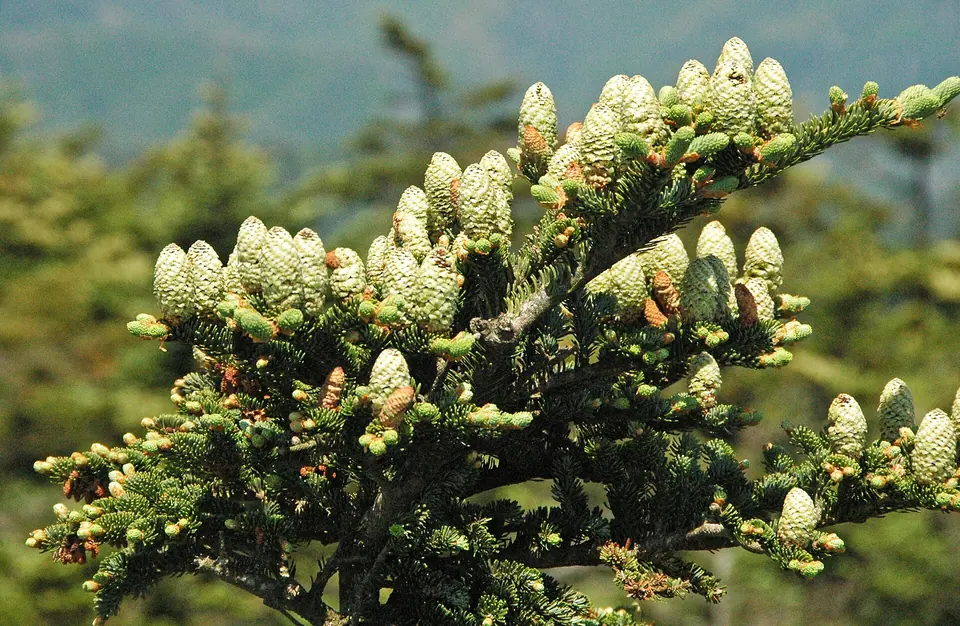


How to Grow and Care for Fraser fir
Abies fraseri
Written by Emilio Marruso · last checked
At a glance
Fraser fir is a stately tree that reaches 30 to 55 feet tall and grows happily in full sun to partial shade. Give it moist, well-drained, acidic soil and go easy on fertilizer, especially while the tree is young. Keep an eye out for the balsam woolly adelgid, a pest that spreads quickly between trees and can be deadly.
- Sun
Full sun to partial shade
What the sources say (1)
Light: Full sun to partial shade
Fraser fir grows best in full sun to light shade and moist, well-drained, acidic, loamy soil.
— Abies fraseri (Fraser Fir, Mountain Balsam, She-Balsam, Southern Balsam) | North Carolina Extension Gardener Plant Toolbox [1] - Water
Keep the soil moist, but never soggy
What the sources say (1)
Watering notes: Grows best in moist, well-drained soil
Fraser fir grows best in full sun to light shade and moist, well-drained, acidic, loamy soil.
— Abies fraseri (Fraser Fir, Mountain Balsam, She-Balsam, Southern Balsam) | North Carolina Extension Gardener Plant Toolbox [1] - Cold
Survives winters down to −30 °F (−34.4 °C)
Very hardy · USDA 4a · RHS H7 · Z4
What the sources say (2)
Hardiness, coldest zone: 4a [winter low −34.4 to −31.7 °C (−30 to −25 °F)]
USDA Plant Hardiness Zone: 4a, 4b, 5a, 5b, 6a, 6b, 7a
— Abies fraseri (Fraser Fir, Mountain Balsam, She-Balsam, Southern Balsam) | North Carolina Extension Gardener Plant Toolbox [1] Hardiness, warmest zone: 7a [winter low −17.8 to −15 °C (0 to 5 °F)]
USDA Plant Hardiness Zone: 4a, 4b, 5a, 5b, 6a, 6b, 7a
— Abies fraseri (Fraser Fir, Mountain Balsam, She-Balsam, Southern Balsam) | North Carolina Extension Gardener Plant Toolbox [1] - Soil
Moist, well-drained, acidic soil with pH 6.0 or lower
What the sources say (2)
Watering notes: Grows best in moist, well-drained soil
Fraser fir grows best in full sun to light shade and moist, well-drained, acidic, loamy soil.
— Abies fraseri (Fraser Fir, Mountain Balsam, She-Balsam, Southern Balsam) | North Carolina Extension Gardener Plant Toolbox [1] Soil pH, maximum: 6.0
Soil pH: Acid (<6.0) Soil Drainage: Good Drainage
— Abies fraseri (Fraser Fir, Mountain Balsam, She-Balsam, Southern Balsam) | North Carolina Extension Gardener Plant Toolbox [1] - Feeding
Feed lightly; too much nitrogen or fertilizer piled over the roots burns the tree
What the sources say (5)
Avoid: Excess potassium or nitrogen and handfuls of fertilizer placed over the roots, which cause salt injury; high nitrogen rates on young trees
More frequently, growers have induced salt injury to trees by applying too much potassium or allowing workers to improperly place handfuls of fertilizer over tree roots.
— [4] Young Christmas trees that have been in the field one or two years need less nitrogen annually. Research has demonstrated that no additional growth occurs with higher nitrogen rates and there is greater risk of salt injury
— [4] Micronutrients: Manganese; calcium from gypsum when calcium is low but pH is adequate
More frequently, Christmas trees exhibit manganese deficiency symptoms in high pH soils. Manganese is still present in higher pH soils, but not readily available for plant uptake.
— [4] Manganese deficiencies in Fraser fir Christmas trees are visible as stunted, yellow growth in the midsection of trees.
— [4] Sometimes, however, the situation may arise where Ca is low but the pH is adequate, indicating that lime should not be added. This sometimes occurs with Fraser fir, hemlock, and Norway spruce.
— [3] - Pests
Balsam woolly adelgid spreads fast between trees and can kill them
What the sources say (1)
Pests: balsam woolly adelgid
The balsam wooly adelgid, an introduced insect, is a major threat to wild fraser fir populations.
— Abies fraseri (Fraser Fir, Mountain Balsam, She-Balsam, Southern Balsam) | North Carolina Extension Gardener Plant Toolbox [1] - Size
30 to 55 ft tall and 10 to 25 ft wide
What the sources say (2)
Mature height: 914-1676 cm (30 ft - 55 ft)
Height: 30 ft. 0 in. - 55 ft. 0 in.
— Abies fraseri (Fraser Fir, Mountain Balsam, She-Balsam, Southern Balsam) | North Carolina Extension Gardener Plant Toolbox [1] Mature width: 305-762 cm (10 ft - 25 ft)
Width: 10 ft. 0 in. - 25 ft. 0 in.
— Abies fraseri (Fraser Fir, Mountain Balsam, She-Balsam, Southern Balsam) | North Carolina Extension Gardener Plant Toolbox [1]
Overview
Fraser fir is a needled evergreen tree native to the Appalachian Mountains in the southeastern United States. [1] It grows to 30 to 55 feet [9.1–16.8 m] tall and is commercially farmed in North Carolina as a Christmas tree. [1] It does not tolerate heat. [1]
This record is incomplete: the sources we read do not cover every field yet.
Not yet covered by our sources: Watering, Pruning, Propagation
Fraser fir care
Measurements in square brackets are our conversion into the other unit system; the quoted text is unchanged.
How to water Fraser fir
Watering
Not stated in the sources we read.
Watering notes
Grows best in moist, well-drained soil
What the sources say (1)
Fraser fir grows best in full sun to light shade and moist, well-drained, acidic, loamy soil.How much light Fraser fir needs
Full sun to partial shade
What the sources say (1)
Fraser fir grows best in full sun to light shade and moist, well-drained, acidic, loamy soil.How much cold Fraser fir can take
Hardiness, coldest zone
4a [winter low −34.4 to −31.7 °C (−30 to −25 °F)]
What the sources say (1)
USDA Plant Hardiness Zone:
4a, 4b, 5a, 5b, 6a, 6b, 7aHardiness, warmest zone
7a [winter low −17.8 to −15 °C (0 to 5 °F)]
What the sources say (1)
USDA Plant Hardiness Zone:
4a, 4b, 5a, 5b, 6a, 6b, 7aBest soil for Fraser fir
6.0
What the sources say (1)
Soil pH:
Acid (<6.0)
Soil Drainage:
Good DrainageHow to propagate Fraser fir
Not stated in the sources we read.
How to grow Fraser fir
The plant
Family
Pinaceae
What the sources say (1)
Fraser fir is a needled, evergreen tree in the Pinaceae (pine) family native to the Appalachian Mountains in the southeastern United States.Mature height
914-1676 cm (30 ft - 55 ft)
What the sources say (1)
Height: 30 ft. 0 in. - 55 ft. 0 in.Mature width
305-762 cm (10 ft - 25 ft)
What the sources say (1)
Width: 10 ft. 0 in. - 25 ft. 0 in.Pests and diseases
Pests
balsam woolly adelgid
What the sources say (1)
The balsam wooly adelgid, an introduced insect, is a major threat to wild fraser fir populations.Fertilizing
When
The sources give different values depending on region, zone or growing conditions.
What each source says
Christmas tree plantations: Nitrogen split between spring, 2 weeks before budbreak, and fall
Christmas tree plantations: Fall application after mid-August, once growth has fully matured
What the sources say (2)
Christmas tree plantations: Fall/Spring split applications of nitrogen (N) are often applied to older trees. Spring applications about 2 weeks prior to budbreak allow for adequate movement of the fertilizer into the rooting zone.Christmas tree plantations: Fall fertilization should occur after August 15 or when growth has fully matured and cooler temperatures are likely.How often
The sources give different values depending on region, zone or growing conditions.
What each source says
Christmas tree plantations: Annual nitrogen split into two applications, spring and fall
What the sources say (1)
Christmas tree plantations: It is best if the annual nitrogen requirement is provided in two applications. In Christmas tree research studies, the best growth occurred when nitrogen was split between spring and fall applications.Mineral fertilizers
The sources give different values depending on region, zone or growing conditions.
What each source says
Christmas tree plantations: 28.3 g of nitrogen per tree per year at 1.52 m [5 ft] x 1.52 m [5 ft] spacing
Christmas tree plantations: Diammonium phosphate when only nitrogen and phosphorus are needed
What the sources say (2)
Christmas tree plantations: The soil test report recommends 100 to 120 lbs/acre of N, which is the standard recommendation for soils statewide. This rate equates to one ounce of N per tree, assuming a 5 ft. x 5 ft. spacing.Christmas tree plantations: If only nitrogen and phosphorus are needed, diammonium phosphate is the optimal choice. If nitrogen alone is needed, there are several choices. Urea is one of the most concentrated materialsMicronutrients
Manganese; calcium from gypsum when calcium is low but pH is adequate
What the sources say (3)
More frequently, Christmas trees exhibit manganese deficiency symptoms in high pH soils. Manganese is still present in higher pH soils, but not readily available for plant uptake.Manganese deficiencies in Fraser fir Christmas trees are visible as stunted, yellow growth in the midsection of trees.Sometimes, however, the situation may arise where Ca is low but the pH is adequate, indicating that lime should not be added. This sometimes occurs with Fraser fir, hemlock, and Norway spruce.Avoid
Excess potassium or nitrogen and handfuls of fertilizer placed over the roots, which cause salt injury; high nitrogen rates on young trees
What the sources say (2)
More frequently, growers have induced salt injury to trees by applying too much potassium or allowing workers to improperly place handfuls of fertilizer over tree roots.Young Christmas trees that have been in the field one or two years need less nitrogen annually. Research has demonstrated that no additional growth occurs with higher nitrogen rates and there is greater risk of salt injurySigns of deficiency
Manganese: stunted, yellow growth in the midsection of the tree; potassium: slow growth, weak color and spindle-shaped shoots
What the sources say (2)
Manganese deficiencies in Fraser fir Christmas trees are visible as stunted, yellow growth in the midsection of trees.The target index for potassium (K-I) has also been elevated to 80-100 for optimal Christmas tree production in the mountain region. Potassium (K) deficiencies are associated with slow growth, weak color, and spindle-shaped foliageFraser fir pests and problems
Balsam woolly adelgid
Symptom: Infestations spread easily and quickly among trees and are deadly; a major threat to wild Fraser fir populations
What the sources say (1)
The balsam wooly adelgid, an introduced insect, is a major threat to wild fraser fir populations.
— Abies fraseri (Fraser Fir, Mountain Balsam, She-Balsam, Southern Balsam) | North Carolina Extension Gardener Plant Toolbox [1]
Remedies
The sources we checked give no remedies for this plant.
Calendar
Pruning
Not stated in the sources we read.
Months as given by the sources, which are mostly from the United States (northern hemisphere). In the southern hemisphere they shift by about six months.
Indicative values
Values from a secondary source, not checked word for word like the rest of this page. Use them as a starting point.
- Life cycle
- PerennialIndicative value, adapt it to your climate · Secondary source
- Watering
- FrequentIndicative value, adapt it to your climate · Secondary source
- Soil
- Well-drainedIndicative value, adapt it to your climate · Secondary source
- Care level
- MediumIndicative value, adapt it to your climate · Secondary source
- Growth rate
- ModerateIndicative value, adapt it to your climate · Secondary source
- Pruning
- February, March, April, June, July, AugustIndicative value, adapt it to your climate · Secondary source
- Propagation
- Seed Propagation, Seed Propagation, Seed Propagation, Cutting, Grafting Propagation, Layering Propagation, Tissue CultureIndicative value, adapt it to your climate · Secondary source
Similar plants
- Abies grandis Abies grandis
- Alpine Fir Abies lasiocarpa
- Balsam Fir Abies balsamea
- Greek Fir Abies cephalonica
- Korean Fir Abies koreana
- Momi Fir Abies firma
- Noble Fir Abies procera
- Nordmann Fir Abies nordmanniana
Sources
Every value above is quoted from these documents. Links lead to the original publisher.
- Abies fraseri (Fraser Fir, Mountain Balsam, She-Balsam, Southern Balsam) | North Carolina Extension Gardener Plant Toolbox · plants.ces.ncsu.edu, consulted
- Fraser Fir - Abies fraseri | North Carolina Extension Gardener Plant Toolbox · plants.ces.ncsu.edu, consulted
- pubs.ext.vt.edu · pubs.ext.vt.edu
- content.ces.ncsu.edu · content.ces.ncsu.edu
Written by Emilio Marruso · last checked