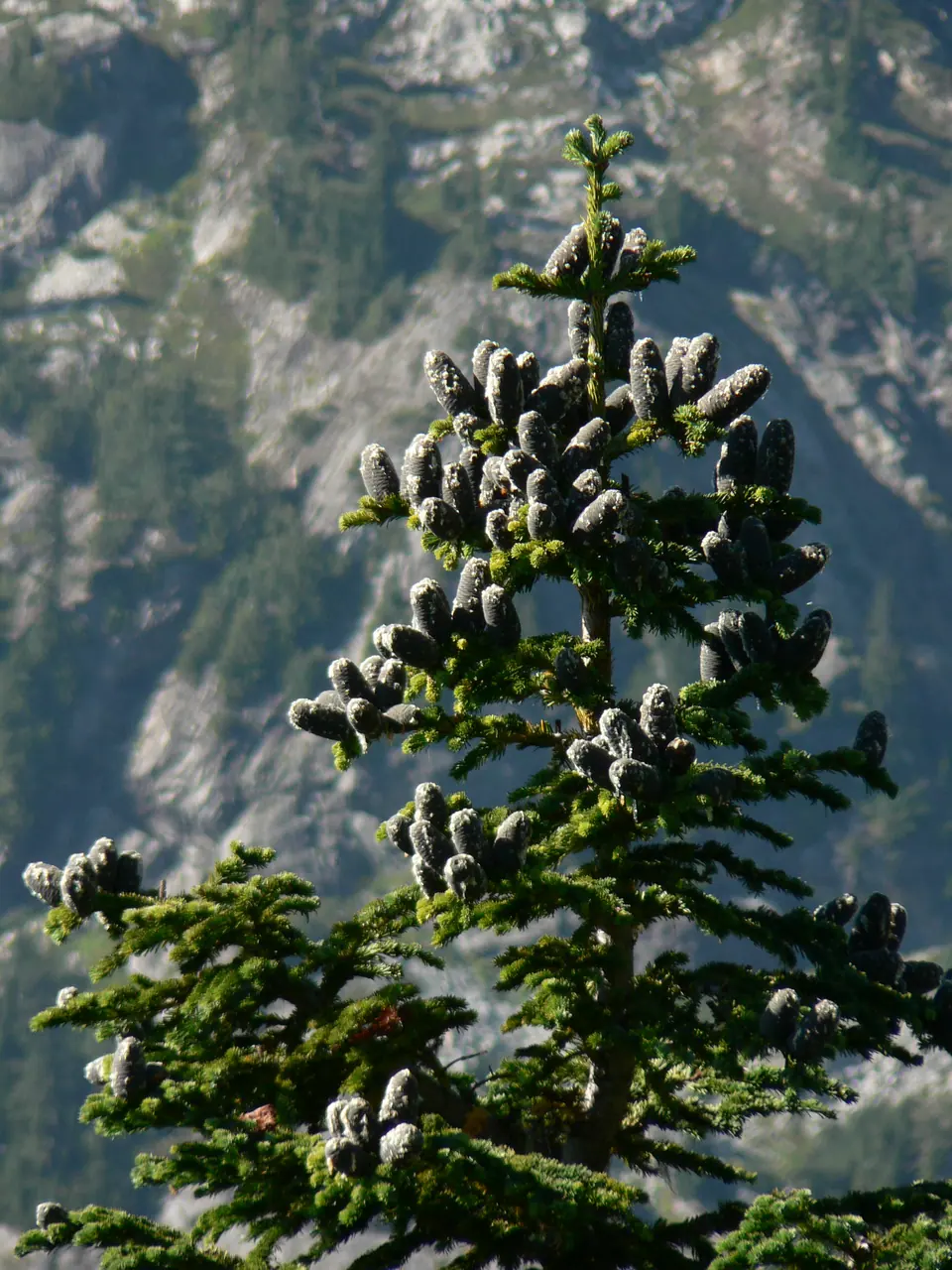


How to Grow and Care for Alpine Fir
Abies lasiocarpa
Written by Emilio Marruso · last checked
At a glance
Subalpine fir is a stately conifer that can reach 100 feet tall, and it is happiest in a moist, cool climate. It thrives in full sun yet also tolerates shade, and it likes acidic soil with a pH of 6.0 or lower. Give it the cool conditions it loves, because at low altitude it tends to lose its natural shape.
- Sun
Full sun, but it also tolerates shade
What the sources say (1)
Light: Full sun, also shade-tolerant
Subalpine fir will grow in full sun but is also shade-tolerant.
— Abies lasiocarpa (Alpine Fir, Mountain Balsam Fir, Pino Real Blanco de las Sierras, Rocky Mountain Fir, Subalpine Fir, Western Balsam Fir, White Balsam Fir) | North Carolina Extension Gardener Plant Toolbox [1] - Water
Grows best in a moist, cool climate
What the sources say (1)
Watering notes: Best grown in a moist, cool climate
It is best grown in a moist, cool climate as in the high altitude of the Pacific mountains.
— Abies lasiocarpa (Alpine Fir, Mountain Balsam Fir, Pino Real Blanco de las Sierras, Rocky Mountain Fir, Subalpine Fir, Western Balsam Fir, White Balsam Fir) | North Carolina Extension Gardener Plant Toolbox [1] - Cold
Survives winters down to −30 °F (−34.4 °C)
Very hardy · USDA 4a · RHS H7 · Z4
What the sources say (2)
Hardiness, coldest zone: 4a [winter low −34.4 to −31.7 °C (−30 to −25 °F)]
USDA Plant Hardiness Zone: 4a, 4b, 5a, 5b, 6a, 6b, 7a
— Abies lasiocarpa (Alpine Fir, Mountain Balsam Fir, Pino Real Blanco de las Sierras, Rocky Mountain Fir, Subalpine Fir, Western Balsam Fir, White Balsam Fir) | North Carolina Extension Gardener Plant Toolbox [1] Hardiness, warmest zone: 7a [winter low −17.8 to −15 °C (0 to 5 °F)]
USDA Plant Hardiness Zone: 4a, 4b, 5a, 5b, 6a, 6b, 7a
— Abies lasiocarpa (Alpine Fir, Mountain Balsam Fir, Pino Real Blanco de las Sierras, Rocky Mountain Fir, Subalpine Fir, Western Balsam Fir, White Balsam Fir) | North Carolina Extension Gardener Plant Toolbox [1] - Soil
Acidic soil, pH 6.0 or lower
What the sources say (1)
Soil pH, maximum: 6.0
Soil pH: Acid (<6.0)
— Abies lasiocarpa (Alpine Fir, Mountain Balsam Fir, Pino Real Blanco de las Sierras, Rocky Mountain Fir, Subalpine Fir, Western Balsam Fir, White Balsam Fir) | North Carolina Extension Gardener Plant Toolbox [1] - Watch out
At low altitude it tends to lose its natural shape
- Size
Up to 100 ft tall
What the sources say (1)
Mature height: 3048 cm (100 ft)
It will grow up to 100 feet tall and is fairly short-lived.
— Abies lasiocarpa (Alpine Fir, Mountain Balsam Fir, Pino Real Blanco de las Sierras, Rocky Mountain Fir, Subalpine Fir, Western Balsam Fir, White Balsam Fir) | North Carolina Extension Gardener Plant Toolbox [1]
Overview
Subalpine fir is an evergreen conifer that grows up to 100 feet [30.5 m] tall and is fairly short-lived. [1] It grows in full sun but is also shade-tolerant, and is best grown in a moist, cool climate. [1]
This record is incomplete: the sources we read do not cover every field yet.
Not yet covered by our sources: Watering, Pruning, Propagation
Alpine Fir care
Measurements in square brackets are our conversion into the other unit system; the quoted text is unchanged.
How to water Alpine Fir
Watering
Not stated in the sources we read.
Watering notes
Best grown in a moist, cool climate
What the sources say (1)
It is best grown in a moist, cool climate as in the high altitude of the Pacific mountains.How much light Alpine Fir needs
Full sun, also shade-tolerant
What the sources say (1)
Subalpine fir will grow in full sun but is also shade-tolerant.How much cold Alpine Fir can take
Hardiness, coldest zone
4a [winter low −34.4 to −31.7 °C (−30 to −25 °F)]
What the sources say (1)
USDA Plant Hardiness Zone:
4a, 4b, 5a, 5b, 6a, 6b, 7aHardiness, warmest zone
7a [winter low −17.8 to −15 °C (0 to 5 °F)]
What the sources say (1)
USDA Plant Hardiness Zone:
4a, 4b, 5a, 5b, 6a, 6b, 7aBest soil for Alpine Fir
6.0
What the sources say (1)
Soil pH:
Acid (<6.0)How to propagate Alpine Fir
Not stated in the sources we read.
How to grow Alpine Fir
The plant
Family
Pinaceae
What the sources say (1)
Subalpine fir is an evergreen conifer in the pine family (Pinaceae) that is native to the Pacific Northwest.Mature height
3048 cm (100 ft)
What the sources say (1)
It will grow up to 100 feet tall and is fairly short-lived.Alpine Fir pests and problems
Loss of natural shape at low altitude
Symptom: The tree tends to lose its natural shape if grown in lower altitudes.
What the sources say (1)
It tends to lose its natural shape if grown in lower altitudes.
— Abies lasiocarpa (Alpine Fir, Mountain Balsam Fir, Pino Real Blanco de las Sierras, Rocky Mountain Fir, Subalpine Fir, Western Balsam Fir, White Balsam Fir) | North Carolina Extension Gardener Plant Toolbox [1]
Remedies
Each remedy shows what official sources say about it; traditional remedies without an official source are marked as such. Harmful ones are listed so you know to avoid them.
Treating the plant
spider mites
strong water spray Works
How: Hose trees with a strong stream of water to wash off spider mites, where practical.
Hose trees with strong stream of water to wash off spider mites (where practical).
— hortsense.cahnrs.wsu.edu [4] What the evidence says Hose trees with strong stream of water to wash off spider mites (where practical).
— hortsense.cahnrs.wsu.edu [4] soap spray Works
How: Apply soaps in May or early June if mites are present.
Soaps should be applied in May or early June if mites are present.
— hortsense.cahnrs.wsu.edu [4] What the evidence says insecticidal soap is a safe, effective organic insecticide with minimal environmental impact.
— extension.psu.edu [5]
needle cast
remove fallen needles Not verified
Traditional remedy, not verified by an official source.
How: Collect fallen needles from the ground and discard them to prevent re-infection.
root rot
improve drainage and avoid overwatering Not verified
Traditional remedy, not verified by an official source.
How: Prevent waterlogging by improving drainage and avoiding watering until the substrate is dry on the surface.
Calendar
Pruning
Not stated in the sources we read.
Months as given by the sources, which are mostly from the United States (northern hemisphere). In the southern hemisphere they shift by about six months.
Indicative values
Values from a secondary source, not checked word for word like the rest of this page. Use them as a starting point.
- Life cycle
- PerennialIndicative value, adapt it to your climate · Secondary source
- Hours of sun
- 6-8 hoursIndicative value, adapt it to your climate · Secondary source
- Watering
- AverageIndicative value, adapt it to your climate · Secondary source
- Soil
- Loamy RockyIndicative value, adapt it to your climate · Secondary source
- Care level
- MediumIndicative value, adapt it to your climate · Secondary source
- Growth rate
- LowIndicative value, adapt it to your climate · Secondary source
- Pruning
- February, March, AprilIndicative value, adapt it to your climate · Secondary source
- Propagation
- Seed Propagation, Cutting, Grafting Propagation, Layering Propagation, DivisionIndicative value, adapt it to your climate · Secondary source
Similar plants
- Abies grandis Abies grandis
- Balsam Fir Abies balsamea
- Fraser fir Abies fraseri
- Greek Fir Abies cephalonica
- Korean Fir Abies koreana
- Momi Fir Abies firma
- Noble Fir Abies procera
- Nordmann Fir Abies nordmanniana
Sources
Every value above is quoted from these documents. Links lead to the original publisher.
- Abies lasiocarpa (Alpine Fir, Mountain Balsam Fir, Pino Real Blanco de las Sierras, Rocky Mountain Fir, Subalpine Fir, Western Balsam Fir, White Balsam Fir) | North Carolina Extension Gardener Plant Toolbox · plants.ces.ncsu.edu, consulted
- Subalpine Fir - Abies lasiocarpa | North Carolina Extension Gardener Plant Toolbox · plants.ces.ncsu.edu, consulted
- Western Balsam Fir - Abies lasiocarpa | North Carolina Extension Gardener Plant Toolbox · plants.ces.ncsu.edu, consulted
- hortsense.cahnrs.wsu.edu · hortsense.cahnrs.wsu.edu
- extension.psu.edu · extension.psu.edu
Written by Emilio Marruso · last checked