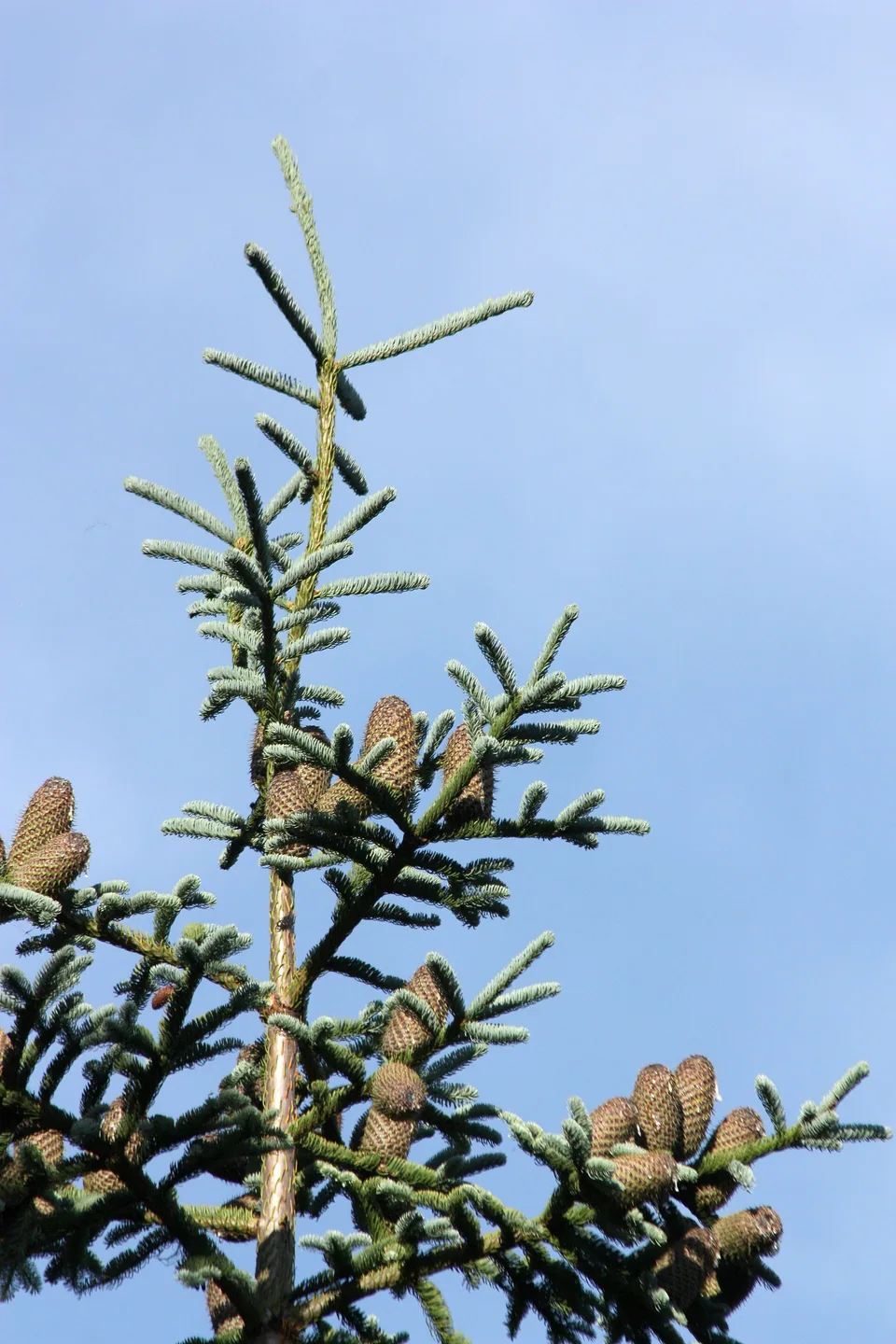


How to Grow and Care for Noble Fir
Abies procera
Written by Emilio Marruso · last checked
At a glance
Noble fir grows into a true giant, 50 to 100 feet tall yet only 8 to 12 feet wide, like a slender tower. It is happy in full sun or partial shade, in moist, well-drained loamy soil. It is a gift to wildlife too: it gives animals cover and shelter from the cold, and mammals eat its twigs and cones.
- Sun
Full sun to partial shade
What the sources say (1)
Light: Full sun to partial shade
Light: Full sun (6 or more hours of direct sunlight a day) Partial Shade (Direct sunlight only part of the day, 2-6 hours)
— Abies procera (Christmas Tree, Noble Fir, Red Fir) | North Carolina Extension Gardener Plant Toolbox [1] - Water
Keep the soil moist, but make sure it drains well
What the sources say (1)
Watering notes: Does well in well-drained moist loamy soils
This tree does well in windy and sunny conditions in well-drained moist loamy soils.
— Abies procera (Christmas Tree, Noble Fir, Red Fir) | North Carolina Extension Gardener Plant Toolbox [1] - Cold
Survives winters down to −20 °F (−28.9 °C)
Very hardy · USDA 5a · RHS H7 · Z5
What the sources say (2)
Hardiness, coldest zone: 5a [winter low −28.9 to −26.1 °C (−20 to −15 °F)]
Available Space To Plant: 6-feet-12 feet USDA Plant Hardiness Zone: 5a, 5b, 6a, 6b
— Abies procera (Christmas Tree, Noble Fir, Red Fir) | North Carolina Extension Gardener Plant Toolbox [1] Hardiness, warmest zone: 6b [winter low −20.6 to −17.8 °C (−5 to 0 °F)]
Available Space To Plant: 6-feet-12 feet USDA Plant Hardiness Zone: 5a, 5b, 6a, 6b
— Abies procera (Christmas Tree, Noble Fir, Red Fir) | North Carolina Extension Gardener Plant Toolbox [1] - Soil
Moist, well-drained loamy soil with a pH of 6.0 or lower
What the sources say (2)
Soil pH, maximum: 6.0
Soil pH: Acid (<6.0) Soil Drainage: Good Drainage
— Abies procera (Christmas Tree, Noble Fir, Red Fir) | North Carolina Extension Gardener Plant Toolbox [1] Watering notes: Does well in well-drained moist loamy soils
This tree does well in windy and sunny conditions in well-drained moist loamy soils.
— Abies procera (Christmas Tree, Noble Fir, Red Fir) | North Carolina Extension Gardener Plant Toolbox [1] - Pests
Bark beetles can kill the tree, often when roots are sick; dwarf mistletoe in some areas
What the sources say (1)
Pests: noble fir bark beetle, dwarf mistletoe
Noble fir bark beetle ( Pseudohylesinus nobilis ) is often associated with root-diseased trees and can kill the tree. Dwarf mistletoe may be a problem requiring management action in some areas
— Abies procera (Christmas Tree, Noble Fir, Red Fir) | North Carolina Extension Gardener Plant Toolbox [1] - Size
50 to 100 ft tall and 8 to 12 ft wide
What the sources say (2)
Mature height: 1524-3048 cm (50-100 ft)
The tree will grow 50 to 100 feet tall or taller with a pyramidal to narrow form.
— Abies procera (Christmas Tree, Noble Fir, Red Fir) | North Carolina Extension Gardener Plant Toolbox [1] Mature width: 244-366 cm (8-12 ft)
Dimensions: Height: 50 ft. 0 in. - 100 ft. 0 in. Width: 8 ft. 0 in. - 12 ft. 0 in.
— Abies procera (Christmas Tree, Noble Fir, Red Fir) | North Carolina Extension Gardener Plant Toolbox [1]
Overview
Abies procera (noble fir) is an evergreen conifer native to the Cascade and Coastal Range mountains of northwest California, western Oregon and Washington. [1] It grows 50 to 100 feet [15.2–30.5 m] tall or taller in a pyramidal to narrow form and is used as a Christmas tree. [1] It does well in sunny and windy conditions in well-drained moist loamy soils and is best grown within its native range of the Pacific Northwest. [1]
This record is incomplete: the sources we read do not cover every field yet.
Not yet covered by our sources: Watering, Pruning, Propagation
Noble Fir care
Measurements in square brackets are our conversion into the other unit system; the quoted text is unchanged.
How to water Noble Fir
Watering
Not stated in the sources we read.
Watering notes
Does well in well-drained moist loamy soils
What the sources say (1)
This tree does well in windy and sunny conditions in well-drained moist loamy soils.How much light Noble Fir needs
Full sun to partial shade
What the sources say (1)
Light:
Full sun (6 or more hours of direct sunlight a day)
Partial Shade (Direct sunlight only part of the day, 2-6 hours)How much cold Noble Fir can take
Hardiness, coldest zone
5a [winter low −28.9 to −26.1 °C (−20 to −15 °F)]
What the sources say (1)
Available Space To Plant:
6-feet-12 feet
USDA Plant Hardiness Zone:
5a, 5b, 6a, 6bHardiness, warmest zone
6b [winter low −20.6 to −17.8 °C (−5 to 0 °F)]
What the sources say (1)
Available Space To Plant:
6-feet-12 feet
USDA Plant Hardiness Zone:
5a, 5b, 6a, 6bBest soil for Noble Fir
6.0
What the sources say (1)
Soil pH:
Acid (<6.0)
Soil Drainage:
Good DrainageHow to propagate Noble Fir
Not stated in the sources we read.
How to grow Noble Fir
The plant
Life cycle
perennial
What the sources say (1)
Whole Plant Traits: Plant Type: Perennial Tree Woody Plant Leaf Characteristics: Needled EvergreenFamily
Pinaceae
What the sources say (1)
Noble fir is an evergreen conifer in the Pinaceae (pine) family. It is native to the Cascade Range and Coastal Range mountainsMature height
1524-3048 cm (50-100 ft)
What the sources say (1)
The tree will grow 50 to 100 feet tall or taller with a pyramidal to narrow form.Mature width
244-366 cm (8-12 ft)
What the sources say (1)
Dimensions: Height: 50 ft. 0 in. - 100 ft. 0 in. Width: 8 ft. 0 in. - 12 ft. 0 in.Pests and diseases
Pests
noble fir bark beetle, dwarf mistletoe
What the sources say (1)
Noble fir bark beetle ( Pseudohylesinus nobilis ) is often associated with root-diseased trees and can kill the tree. Dwarf mistletoe may be a problem requiring management action in some areasNoble Fir pests and problems
Noble fir bark beetle
Symptom: Often associated with root-diseased trees and can kill the tree.
What to do: No management given in the sources.
What the sources say (1)
Noble fir bark beetle ( Pseudohylesinus nobilis ) is often associated with root-diseased trees and can kill the tree.
— Abies procera (Christmas Tree, Noble Fir, Red Fir) | North Carolina Extension Gardener Plant Toolbox [1] Dwarf mistletoe
Symptom: May be a problem in some areas.
What to do: May require management action in some areas.
What the sources say (1)
Dwarf mistletoe may be a problem requiring management action in some areas
— Abies procera (Christmas Tree, Noble Fir, Red Fir) | North Carolina Extension Gardener Plant Toolbox [1]
Remedies
Each remedy shows what official sources say about it; traditional remedies without an official source are marked as such. Harmful ones are listed so you know to avoid them.
Treating the plant
dwarf mistletoe
pruning out witches brooms or hand-picking Official source, not independently tested
No chemical controls are recommended for homeowner use.
— hortsense.cahnrs.wsu.edu [5] How: Remove mistletoe from the host tree by pruning out witches’ brooms or hand-picking the parasite.
Remove mistletoe from host tree by pruning out witches’ brooms or hand-picking the parasite.
— hortsense.cahnrs.wsu.edu [5]
twig aphid
encouraging natural predators Official source, not independently tested
How: Encourage natural predators such as lacewings, earwigs, lady beetles, ants, predatory thrips, predaceous midges and parasitoids.
Encourage natural predators like lacewings, earwigs, lady beetles and their larvae, ants, predatory thrips, predaceous midges and parasitoids such as Aphidius spp.
— extension.oregonstate.edu [6]
Calendar
Pruning
Not stated in the sources we read.
Months as given by the sources, which are mostly from the United States (northern hemisphere). In the southern hemisphere they shift by about six months.
Edibility
Reported by the source, quoted verbatim. Do not eat a plant on the basis of this page alone: identification mistakes can be dangerous.
Provides cover and thermal protection for wildlife. Mammals eat the twigs and cones.
[1]
Indicative values
Values from a secondary source, not checked word for word like the rest of this page. Use them as a starting point.
- Hours of sun
- 6-8 hoursIndicative value, adapt it to your climate · Secondary source
- Watering
- AverageIndicative value, adapt it to your climate · Secondary source
- Soil
- Loamy RockyIndicative value, adapt it to your climate · Secondary source
- Care level
- MediumIndicative value, adapt it to your climate · Secondary source
- Growth rate
- LowIndicative value, adapt it to your climate · Secondary source
- Pruning
- February, March, AprilIndicative value, adapt it to your climate · Secondary source
- Propagation
- Seed Propagation, Cutting, Grafting Propagation, Layering Propagation, Air Layering PropagationIndicative value, adapt it to your climate · Secondary source
Similar plants
- Abies grandis Abies grandis
- Alpine Fir Abies lasiocarpa
- Balsam Fir Abies balsamea
- Fraser fir Abies fraseri
- Greek Fir Abies cephalonica
- Korean Fir Abies koreana
- Momi Fir Abies firma
- Nordmann Fir Abies nordmanniana
Sources
Every value above is quoted from these documents. Links lead to the original publisher.
- Abies procera (Christmas Tree, Noble Fir, Red Fir) | North Carolina Extension Gardener Plant Toolbox · plants.ces.ncsu.edu, consulted
- Red Fir - Abies procera | North Carolina Extension Gardener Plant Toolbox · plants.ces.ncsu.edu, consulted
- Noble Fir - Abies procera | North Carolina Extension Gardener Plant Toolbox · plants.ces.ncsu.edu, consulted
- Christmas Tree - Abies procera | North Carolina Extension Gardener Plant Toolbox · plants.ces.ncsu.edu, consulted
- hortsense.cahnrs.wsu.edu · hortsense.cahnrs.wsu.edu
- extension.oregonstate.edu · extension.oregonstate.edu
Written by Emilio Marruso · last checked