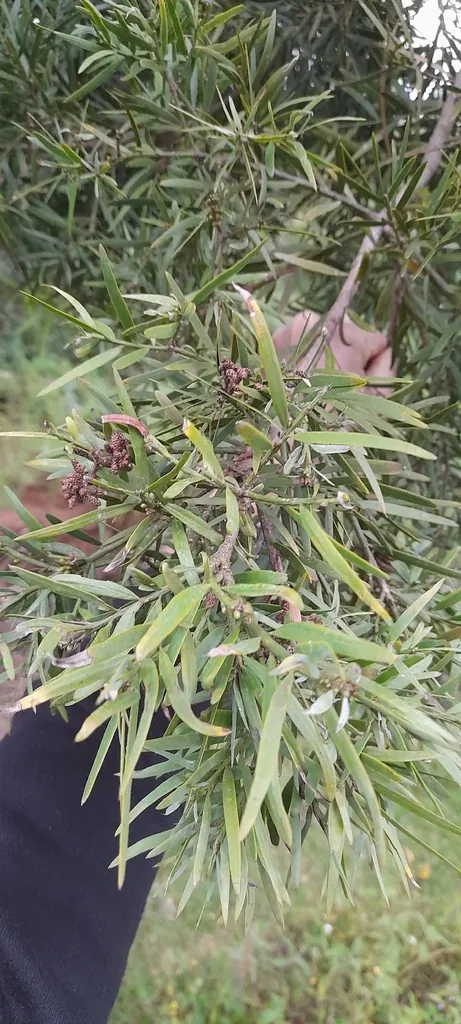
How to Grow and Care for East African Yellowwood
Afrocarpus gracilior
Written by Emilio Marruso · last checked
At a glance
This graceful tree is easygoing: it grows anywhere from nearly full shade to full sun, and once mature it resists drought, needing water only every other week. Shape it while it is young, and after that it needs no pruning. It can reach 40 feet tall, yet it also grows in containers and even indoors.
- Sun
Nearly full shade to full sun; avoid reflected sunlight and bright west-facing spots
What the sources say (1)
Light: Nearly full shade to full sun, avoiding reflected sunlight and bright western exposures
Light: Nearly full shade to full sun, but no reflected sunlight or bright western exposures.
— [5] - Water
Young trees: 15–20 gallons a week; mature trees: the same every other week
What the sources say (2)
Watering: Regular
Watering: Regular Pruning: Raising the crown base is
— [5] Watering notes: Young trees: 15-20 gallons [56.8–75.7 L] of water per week; mature trees: the same amount every other week, as the tree is drought resistant
While the Fern Pine is young it should be hydrated with 15-20 gallons of water per week, but as it matures it is acceptable to water with the same amount every other week
— Fern Pine | University of Redlands [4] - Pruning
Prune only when young to shape it; after that it needs no pruning
What the sources say (1)
Pruning: When young, to shape the tree; afterwards pruning is not necessary
The tree should be pruned at a young age the desired shape, after which pruning is not necessary.
— Fern Pine | University of Redlands [4] - Size
Up to 40 ft tall
What the sources say (1)
Mature height: 1219 cm (40 ft)
A small tree reaching 40 feet tall and when left unpruned gracefully drooping to the ground.
— Virginia Tech Dendrology Fact Sheet [3] - Propagation
Grow new plants from seed or cuttings
What the sources say (1)
Propagation: Seed or cutting
Propagation: Seed or cutting. Seed propagated trees are
— [5]
Overview
A large evergreen tree from East Africa, widely used in the United States as a decorative plant and for hedges. [4][2] It tolerates nearly full shade to full sun and is propagated by seed or cutting. [5]
East African Yellowwood care
Measurements in square brackets are our conversion into the other unit system; the quoted text is unchanged.
How to water East African Yellowwood
Watering notes
Young trees: 15-20 gallons [56.8–75.7 L] of water per week; mature trees: the same amount every other week, as the tree is drought resistant
What the sources say (1)
While the Fern Pine is young it should be hydrated with 15-20 gallons of water per week, but as it matures it is acceptable to water with the same amount every other weekHow much light East African Yellowwood needs
Nearly full shade to full sun, avoiding reflected sunlight and bright western exposures
What the sources say (1)
Light: Nearly full shade to full sun, but no reflected sunlight or bright western exposures.How much cold East African Yellowwood can take
Hardiness, coldest zone
The sources give different values depending on region, zone or growing conditions.
What each source says
According to Arizona State University: 9 [winter low −6.7 to −1.1 °C (20 to 30 °F)]
According to Gymnosperm Database: 10 [winter low −1.1 to 4.4 °C (30 to 40 °F)]
Hardiness, warmest zone
11 [winter low 4.4 to 10 °C (40 to 50 °F)]
What the sources say (1)
USDA 9-11
Landscape Use: Fern pine because ofWhere to grow East African Yellowwood
Indoors
Yes
What the sources say (1)
It is also found in large indoor atriums in the eastern United StatesIn containers
Yes
What the sources say (1)
can be cultivated for extended periods in large containersHow to propagate East African Yellowwood
Seed or cutting
What the sources say (1)
Propagation: Seed or cutting. Seed propagated trees areHow to grow East African Yellowwood
The plant
Family
Podocarpaceae
What the sources say (1)
Family Podocarpaceae ( 1POCF ) Genus Afrocarpus ( 1AFKG ) Species Afrocarpus gracilior ( PODGR )Mature height
1219 cm (40 ft)
What the sources say (1)
A small tree reaching 40 feet tall and when left unpruned gracefully drooping to the ground.Remedies
The sources we checked give no remedies for this plant.
Calendar
Pruning
When young, to shape the tree; afterwards pruning is not necessary
What the sources say (1)
The tree should be pruned at a young age the desired shape, after which pruning is not necessary.Months as given by the sources, which are mostly from the United States (northern hemisphere). In the southern hemisphere they shift by about six months.
Indicative values
Values from a secondary source, not checked word for word like the rest of this page. Use them as a starting point.
- Life cycle
- PerennialIndicative value, adapt it to your climate · Secondary source
- Drought tolerant
- yesIndicative value, adapt it to your climate · Secondary source
- Soil pH
- 6-7Indicative value, adapt it to your climate · Secondary source
- Care level
- MediumIndicative value, adapt it to your climate · Secondary source
- Growth rate
- LowIndicative value, adapt it to your climate · Secondary source
Similar plants
- Podocarpus Podocarpus macrophyllus
- Abies grandis Abies grandis
- Abraham Trachystemon orientalis
- Abyssinian banana Ensete ventricosum
- Acacia longifolia Acacia longifolia
- Acanthus hungaricus Acanthus hungaricus
- Aconite Aconitum napellus
- Adam's Needle Yucca flaccida
Sources
Every value above is quoted from these documents. Links lead to the original publisher.
- Conifer Database - gracilior · conifersociety.org, consulted
- Afrocarpus gracilior (East African yellowwood) description · conifers.org, consulted
- Virginia Tech Dendrology Fact Sheet · dendro.cnre.vt.edu, consulted
- Fern Pine | University of Redlands · sites.redlands.edu, consulted
- · asu.edu, consulted
- Afrocarpus gracilior (PODGR)[Overview]| EPPO Global Database · gd.eppo.int, consulted
Written by Emilio Marruso · last checked