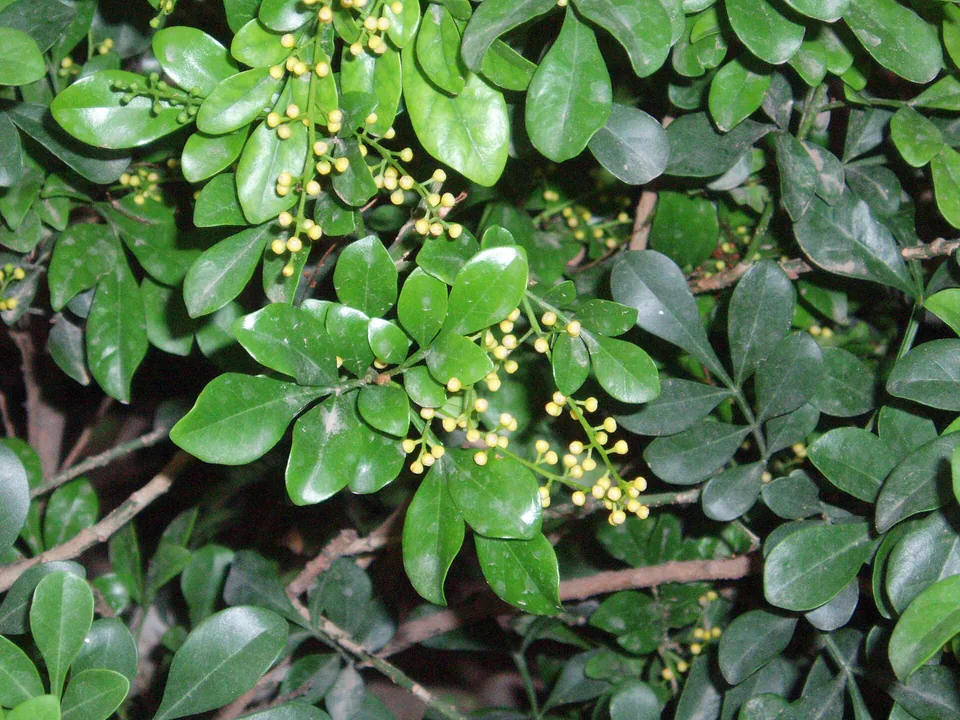

How to Grow and Care for Chinese perfume tree
Aglaia odorata
Written by Emilio Marruso · last checked
Toxic to: People · Why
At a glance
Aglaia brings a pleasant fragrance into your home: its dried flowers and buds are added to tea, and its tender young leaves can be cooked and eaten as a vegetable. It grows happily in full sun or partial shade, indoors or in a container. Water it moderately and regularly, letting the soil dry a little, but never completely.
- Sun
Full sun to partial shade
- Water
Water moderately; let the soil dry a little, never completely, and avoid soggy soil
What the sources say (3)
Watering: Moderate, regular watering, letting the soil dry somewhat between waterings
water moderately but consistently, allow the soils to dry somewhat but not completely between watering
— Chinese Perfume Tree – Port St. Lucie Botanical Gardens [6] They’ll need moderate but regular irrigation . The soil must dry out between watering times.
— Chinese Perfume Tree Facts - Learn About Growing Aglaia Odorata Plants | Gardening Know How [3] Watering notes: Never let the soil dry out completely; avoid wet soils
but never to dry out completely, and avoid wet soils.
— Chinese Perfume Tree – Port St. Lucie Botanical Gardens [6] - Cold
Survives winters down to 30 °F (−1.1 °C)
Half hardy: mild winters or an unheated greenhouse · USDA 10a · RHS H3 · Z10
What the sources say (3)
Hardiness, coldest zone: 10a [winter low −1.1 to 1.7 °C (30 to 35 °F)]
Zone: 10A – 11 - Light Needs: Full sun – Partial shade
— Chinese Perfume Tree – Port St. Lucie Botanical Gardens [6] Hardiness, warmest zone: 11 [winter low 4.4 to 10 °C (40 to 50 °F)]
Zone: 10A – 11 - Light Needs: Full sun – Partial shade
— Chinese Perfume Tree – Port St. Lucie Botanical Gardens [6] The trees are only hardy in U.S. Department of Agriculture plant hardiness zones 10 through 11 .
— Chinese Perfume Tree Facts - Learn About Growing Aglaia Odorata Plants | Gardening Know How [3] - Soil
Slightly acidic to slightly alkaline soil, pH 6.1–7.5
What the sources say (2)
Soil pH, minimum: 6.1
prefers moderately fertile, well-drained soils that are mildly acidic – neutral (pH 6.1 – 7.5)
— Chinese Perfume Tree – Port St. Lucie Botanical Gardens [6] Soil pH, maximum: 7.5
prefers moderately fertile, well-drained soils that are mildly acidic – neutral (pH 6.1 – 7.5)
— Chinese Perfume Tree – Port St. Lucie Botanical Gardens [6] - Harvest
Add the dried flowers and buds to tea; cook the tender young leaves as a vegetable
- Containers
Grows in containers and indoors too
What the sources say (3)
In containers: Yes
Landscape Uses | General, Parks & Gardens, Small Gardens, Hedge / Screening, Container Planting, Suitable for Bonsai
— NParks | Aglaia odorata [1] In cooler regions, you can grow Aglaia odorata plants in containers and move them indoors when temperatures drop.
— Chinese Perfume Tree Facts - Learn About Growing Aglaia Odorata Plants | Gardening Know How [3] Indoors: Yes
Designer Considerations: use as a hedge, specimen, or container plant, a small tree in the landscape, and also makes a beautiful houseplant.
— Chinese Perfume Tree – Port St. Lucie Botanical Gardens [6] - Safety
No known hazards to people
Overview
A shrub or small tree grown for its small, intensely fragrant yellow flowers. [1] Grown in full sun to partial shade in well-drained soil, hardy in USDA zones 10 to 11 and kept in containers in cooler regions. [6][3]
This record is incomplete: the sources we read do not cover every field yet.
Not yet covered by our sources: Pruning
Chinese perfume tree care
How to water Chinese perfume tree
Watering
Moderate, regular watering, letting the soil dry somewhat between waterings
What the sources say (2)
water moderately but consistently, allow the soils to dry somewhat but not completely between wateringThey’ll need moderate but regular irrigation . The soil must dry out between watering times.Watering notes
Never let the soil dry out completely; avoid wet soils
What the sources say (1)
but never to dry out completely, and avoid wet soils.How much light Chinese perfume tree needs
How much cold Chinese perfume tree can take
Hardiness, coldest zone
10a [winter low −1.1 to 1.7 °C (30 to 35 °F)]
What the sources say (1)
Zone: 10A – 11 - Light Needs: Full sun – Partial shadeHardiness, warmest zone
11 [winter low 4.4 to 10 °C (40 to 50 °F)]
What the sources say (2)
Zone: 10A – 11 - Light Needs: Full sun – Partial shadeThe trees are only hardy in U.S. Department of Agriculture plant hardiness zones 10 through 11 .Best soil for Chinese perfume tree
Soil pH, minimum
6.1
What the sources say (1)
prefers moderately fertile, well-drained soils that are mildly acidic – neutral (pH 6.1 – 7.5)Soil pH, maximum
7.5
What the sources say (1)
prefers moderately fertile, well-drained soils that are mildly acidic – neutral (pH 6.1 – 7.5)Where to grow Chinese perfume tree
Indoors
Yes
What the sources say (1)
Designer Considerations: use as a hedge, specimen, or container plant, a small tree in the landscape, and also makes a beautiful houseplant.In containers
Yes
What the sources say (2)
Landscape Uses | General, Parks & Gardens, Small Gardens, Hedge / Screening, Container Planting, Suitable for BonsaiIn cooler regions, you can grow Aglaia odorata plants in containers and move them indoors when temperatures drop.How to propagate Chinese perfume tree
The sources disagree:
Propagation Method | Seed, Stem Cutting (Semi-Hardwood)
[1]
What the sources say (2)
Propagation: by semi-hardwood cuttings and air layering, (does not set seed, flowers are sterile, and plants will not come true from any seed that may be produced).Propagation Method | Seed, Stem Cutting (Semi-Hardwood)How to grow Chinese perfume tree
Fertilizing
Mineral fertilizers
The sources give different values depending on region, zone or growing conditions.
What each source says
dwarf form: Well-balanced fertilizer, for a healthy, bushier plant
What the sources say (1)
dwarf form: Apply a well-balanced fertilizer to encourage healthy plant and bushier form.Remedies
Each remedy shows what official sources say about it; traditional remedies without an official source are marked as such. Harmful ones are listed so you know to avoid them.
Treating the plant
mealybugs
alcohol swab Partly works
How: Dab the visible insects with alcohol on a cotton swab; alcohol dissolves the wax around the insect and its egg masses.
A few mealybugs found on a plant can be killed by dabbing the visible insects with alcohol on a cotton swab (alcohol dissolves the wax around the insect and its egg masses and kills them).
— extension.missouri.edu [8] What the evidence says (alcohol dissolves the wax around the insect and its egg masses and kills them). This strategy is not adequate when mealybugs are present in large numbers.
— extension.missouri.edu [8] soapy water wash Official source, not independently tested
How: Wash plants with soapy water (2 teaspoons mild detergent per gallon of water) and a soft cloth.
Wash plants with soapy water (2 teaspoons mild detergent per gallon of water) and a soft cloth.
— extension.missouri.edu [8] rubbing off by hand Official source, not independently tested
How: When plants are lightly infested, kill mealybugs by rubbing them off with your fingers.
When plants are lightly infested, kill mealybugs by rubbing them off with your fingers.
— extension.missouri.edu [8] insecticidal soap Official source, not independently tested
How: Spot treat with insecticidal soap if needed, after quarantining new plants.
Quarantine new plants and treat before placing them among established plants. Spot treat with insecticidal soap if needed.
— extension.missouri.edu [8] horticultural oil Official source, not independently tested
How: Apply a 2 percent solution of horticultural oil.
Apply a 2 percent solution of horticultural oil.
— extension.missouri.edu [8]
Is Chinese perfume tree poisonous?
Reported by the source, quoted verbatim. This is not medical or veterinary advice: if a person or an animal may have eaten this plant, contact a poison control centre or a veterinarian.
Known Hazards None known ## Botanical References 266 Title Flora of China
[4]
Calendar
Pruning
Not stated in the sources we read.
Months as given by the sources, which are mostly from the United States (northern hemisphere). In the southern hemisphere they shift by about six months.
Edibility
Reported by the source, quoted verbatim. Do not eat a plant on the basis of this page alone: identification mistakes can be dangerous.
Indicative values
Values from a secondary source, not checked word for word like the rest of this page. Use them as a starting point.
- Life cycle
- PerennialIndicative value, adapt it to your climate · Secondary source
- Mature height
- 243.8-304.8 cm (8-10 ft)Indicative value, adapt it to your climate · Secondary source
- Drought tolerant
- yesIndicative value, adapt it to your climate · Secondary source
- Care level
- MediumIndicative value, adapt it to your climate · Secondary source
- Growth rate
- LowIndicative value, adapt it to your climate · Secondary source
- Pruning
- February, March, AprilIndicative value, adapt it to your climate · Secondary source
Similar plants
- Abies grandis Abies grandis
- Abraham Trachystemon orientalis
- Abyssinian banana Ensete ventricosum
- Acacia longifolia Acacia longifolia
- Acanthus hungaricus Acanthus hungaricus
- Achlys triphylla Achlys triphylla
- Aconite Aconitum napellus
- Adam's Needle Yucca flaccida
Sources
Every value above is quoted from these documents. Links lead to the original publisher.
- NParks | Aglaia odorata · nparks.gov.sg, consulted
- NParks | Aglaia odorata (Dwarf) · nparks.gov.sg, consulted
- Chinese Perfume Tree Facts - Learn About Growing Aglaia Odorata Plants | Gardening Know How · gardeningknowhow.com, consulted
- Aglaia odorata - Useful Tropical Plants · tropical.theferns.info, consulted
- Aglaia odorata (PROSEA) - Pl@ntUse · uses.plantnet-project.org, consulted
- Chinese Perfume Tree – Port St. Lucie Botanical Gardens · pslbg.org, consulted
- nparks.gov.sg · nparks.gov.sg
- extension.missouri.edu · extension.missouri.edu
Written by Emilio Marruso · last checked