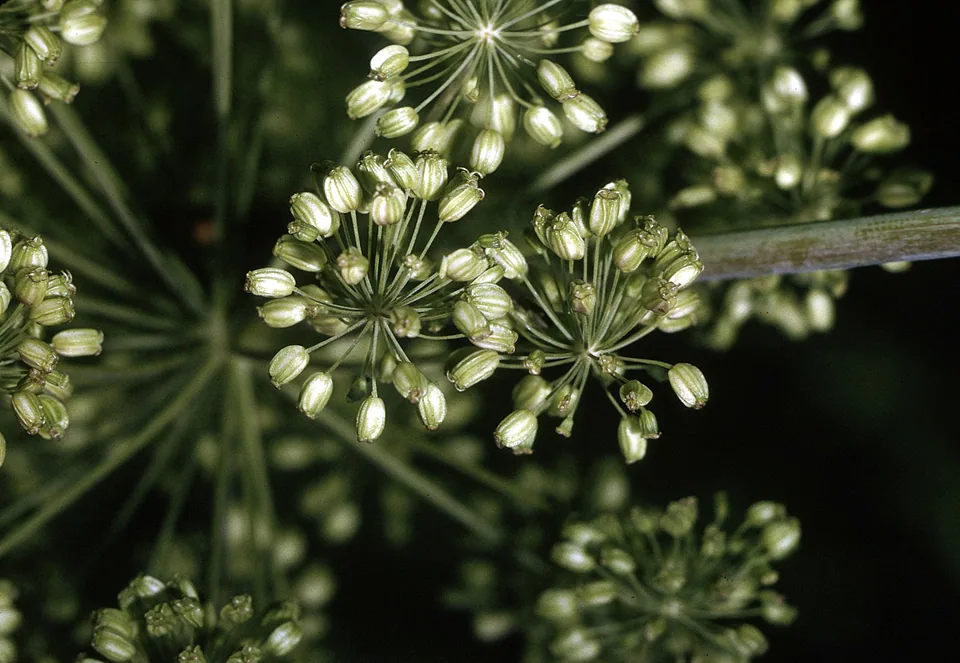

How to Grow and Care for Great angelica
Angelica atropurpurea
Written by Emilio Marruso · last checked
Toxic to: People · Why
At a glance
Angelica is a natural fit for the wettest corner of your garden: it loves consistently wet to moist soil and handles standing water well. Give it full sun to part shade, and it rewards you in the kitchen too, with flavorful stems like celery for salads, stir-fries or soups, and seeds for seasoning.
- Sun
Full sun to part shade
- Water
Keep the soil always wet to moist; standing water is fine
What the sources say (3)
Watering: Consistently wet to moist soil; wet to medium-wet soils
full or partial sun, consistently wet to moist conditions, and loamy or sandy soil with decaying organic matter
— Great Angelica (Angelica atropurpurea) [3] Angelica should be planted in wet to medium-wet soils in full sun to part shade.
— rn, [1] Watering notes: Standing water is well tolerated
Standing water is well-tolerated. Individual plants can vary considerably in size depending on environmental conditions.
— Great Angelica (Angelica atropurpurea) [3] - Cold
Survives winters down to −30 °F (−34.4 °C)
Very hardy · USDA 4 · RHS H7 · Z4
What the sources say (1)
Hardiness, coldest zone: 4 [winter low −34.4 to −28.9 °C (−30 to −20 °F)]
Hardiness Zone 4+ Soil textures sandy, loamy, clay
— Purplestem Angelica (Angelica atropurpurea) — Practical Plants [4] - Soil
Soil pH 5–7.5, from acidic to slightly alkaline
- Planting
Plant bare-root plants in fall or spring
What the sources say (1)
Planting: Fall or spring (bare-root plants)
Bare roots should be planted in fall or spring.
— rn, [1] - Harvest
Eat young shoots and leaf stalks raw or cooked; use the seeds as a seasoning
- Propagation
Divide the plant or grow it from seed
What the sources say (1)
Propagation: Division; seed
Propagation can be accomplished via division or seed.
— rn, [1] - Sowing
Sow seed as soon as it's ripe, in a cold frame; spring sowing sprouts less well
What the sources say (3)
Sowing: As soon as the seed is ripe (cold frame); spring sowing gives lower germination
According to Minnesota Board of Water and Soil Resources: the seed requires a complicated stratification process (cold moist followed by warm moist followed by cold moist). If planted outdoors without stratification, the seed will take two years or longer to germinate.
— rn, [1] Seed - best sown in a cold frame as soon as it is ripe since the seed only has a short viability
— Angelica atropurpurea - Useful Temperate Plants [5] Seed can also be sown in the spring, though germination rates will be lower.
— Angelica atropurpurea - Useful Temperate Plants [5] - Safety
It can make skin sensitive to sunlight and cause a rash; large amounts are toxic
Overview
Purple-stemmed angelica is a tall herbaceous perennial that grows along streambanks, shores, marshes, calcareous fens, springs and sedge meadows. [1] It is planted in wet to medium-wet soils in full sun to part shade, and is propagated by division or seed. [1] The plant contains furocoumarins that increase skin sensitivity to sunlight, while its young shoots and leaf stalks are eaten raw or cooked. [5]
This record is incomplete: the sources we read do not cover every field yet.
Not yet covered by our sources: Hardiness, warmest zone, Pruning
Great angelica care
How to water Great angelica
Watering
Consistently wet to moist soil; wet to medium-wet soils
Watering notes
Standing water is well tolerated
What the sources say (1)
Standing water is
well-tolerated. Individual plants can vary considerably in size
depending on environmental conditions.How much light Great angelica needs
How much cold Great angelica can take
Hardiness, coldest zone
4 [winter low −34.4 to −28.9 °C (−30 to −20 °F)]
What the sources say (1)
Hardiness
Zone 4+
Soil textures
sandy, loamy, clayHardiness, warmest zone
Not stated in the sources we read.
Best soil for Great angelica
Soil pH, minimum
5
What the sources say (1)
Prefers a pH in the range 5 - 7.5, tolerating 4.5 - 8Soil pH, maximum
7.5
What the sources say (1)
Prefers a pH in the range 5 - 7.5, tolerating 4.5 - 8How to propagate Great angelica
Division; seed
What the sources say (1)
Propagation can be accomplished via division or seed.Remedies
Each remedy shows what official sources say about it; traditional remedies without an official source are marked as such. Harmful ones are listed so you know to avoid them.
First aid
First aid: not a substitute for a doctor
phytophotodermatitis
wash skin with soap and water Official source, not independently tested
If skin changes such as blistering or rash occur after exposure to sunlight and citrus fruits, stay out of the sunlight as much as possible to reduce the risk of dark pigmentation changes.
— poison.org [6] How: Wash the affected skin as soon as possible with soap and water.
If a spill occurs, wash the affected skin as soon as possible with soap and water.
— poison.org [6]
Is Great angelica poisonous?
Reported by the source, quoted verbatim. This is not medical or veterinary advice: if a person or an animal may have eaten this plant, contact a poison control centre or a veterinarian.
All members of this genus contain furocoumarins, which increase skin sensitivity to sunlight and may cause dermatitis
[5]- Toxic principle
All members of this genus contain furocoumarins, which increase skin sensitivity to sunlight and may cause dermatitis
[5]
Cases of toxicity have been reported when large amounts of the plant have been taken to try to induce an abortion
[5]
Calendar
Sowing
As soon as the seed is ripe (cold frame); spring sowing gives lower germination
What each source says
According to Minnesota Board of Water and Soil Resources: Direct seeding needs cold moist, warm moist, then cold moist stratification; unstratified seed takes two years or longer to germinate
What the sources say (3)
According to Minnesota Board of Water and Soil Resources: the seed requires a complicated stratification process (cold moist followed by warm moist followed by cold moist). If planted outdoors without stratification, the seed will take two years or longer to germinate.Seed - best sown in a cold frame as soon as it is ripe since the seed only has a short viabilitySeed can also be sown in the spring, though germination rates will be lower.Planting
Fall or spring (bare-root plants)
What the sources say (1)
Bare roots should be planted in fall or spring.Pruning
Not stated in the sources we read.
Months as given by the sources, which are mostly from the United States (northern hemisphere). In the southern hemisphere they shift by about six months.
Edibility
Reported by the source, quoted verbatim. Do not eat a plant on the basis of this page alone: identification mistakes can be dangerous.
Indicative values
Values from a secondary source, not checked word for word like the rest of this page. Use them as a starting point.
- Life cycle
- Herbaceous PerennialIndicative value, adapt it to your climate · Secondary source
- Mature height
- 91.4-304.8 cm (3-10 ft)Indicative value, adapt it to your climate · Secondary source
- Soil
- Clay, Sand, LoamIndicative value, adapt it to your climate · Secondary source
- Growth rate
- LowIndicative value, adapt it to your climate · Secondary source
- Pruning
- AugustIndicative value, adapt it to your climate · Secondary source
Similar plants
- Angelica Angelica archangelica
- Angelica gigas Angelica gigas
- Appalachian Angelica Angelica triquinata
- Ranger's Buttons Angelica capitellata
- Wild angelica Angelica sylvestris
- Abies grandis Abies grandis
- Abraham Trachystemon orientalis
- Abyssinian banana Ensete ventricosum
Sources
Every value above is quoted from these documents. Links lead to the original publisher.
- rn, · bwsr.state.mn.us, consulted
- Angelica atropurpurea (Angelica): Minnesota Wildflowers · minnesotawildflowers.info, consulted
- Great Angelica (Angelica atropurpurea) · illinoiswildflowers.info, consulted
- Purplestem Angelica (Angelica atropurpurea) — Practical Plants · practicalplants.org, consulted
- Angelica atropurpurea - Useful Temperate Plants · temperate.theferns.info, consulted
- poison.org · poison.org
Written by Emilio Marruso · last checked