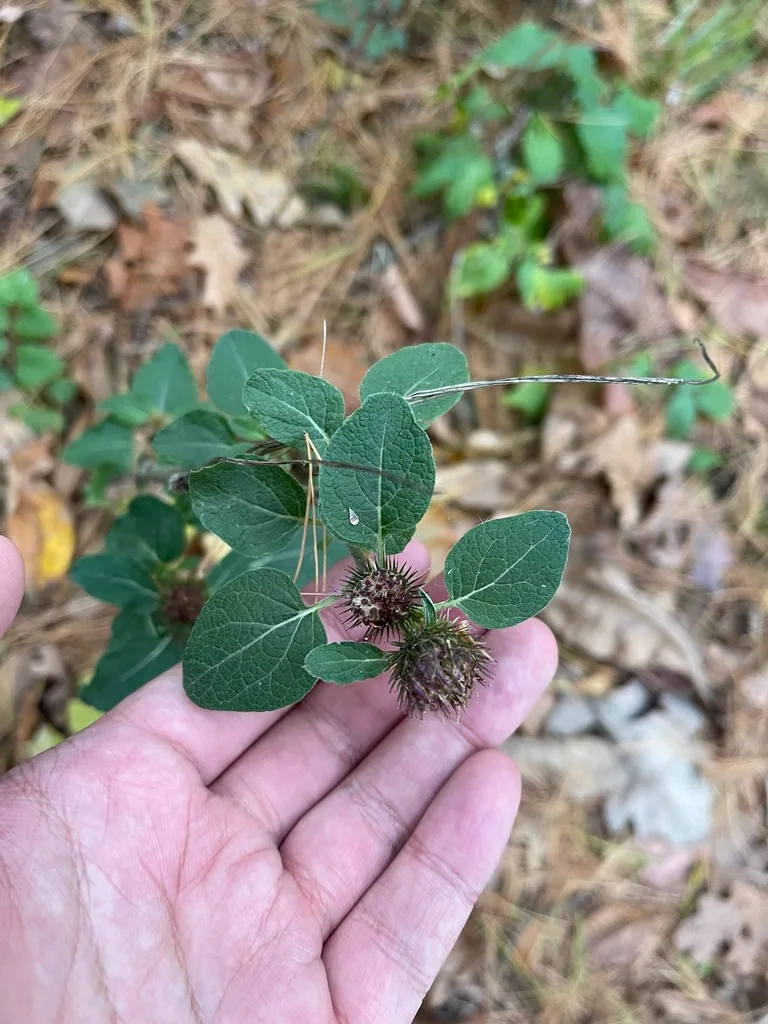
How to Grow and Care for Common Burdock
Arctium minus
Written by Emilio Marruso · last checked
Toxic to: Dogs, Horses, Livestock, People · Why
At a glance
Common burdock is a biennial that grows 3–6 feet tall in full sun or partial shade. Sow it in summer in moist, rich soil, and by late fall of its first year you can dig up its edible roots to enjoy raw or cooked. Young leaves, immature flower stalks and peeled young stems are tasty too.
- Sun
Full sun to partial shade
What the sources say (1)
Light: Full sun to partial shade
Light: Full sun (6 or more hours of direct sunlight a day) Partial Shade (Direct sunlight only part of the day, 2-6 hours)
— Arctium minus (Bardane, Common Burdock, Lesser Burdock) | North Carolina Extension Gardener Plant Toolbox [1] - Water
Keep the soil moist, but make sure water drains away
What the sources say (2)
Watering notes: Prefers moist, well drained soil rich in organic matter and nitrogen
It prefers full sun locations with moist, well drained soil rich in organic matter and nitrogen.
— Arctium minus (Bardane, Common Burdock, Lesser Burdock) | North Carolina Extension Gardener Plant Toolbox [1] Prefers moist, fertile soils, but will grow in a variety of soils.
— Burdock | USU [3] - Cold
Survives winters down to −40 °F (−40 °C)
Very hardy · USDA 3a · RHS H7 · Z3
What the sources say (2)
Hardiness, coldest zone: 3a [winter low −40 to −37.2 °C (−40 to −35 °F)]
USDA Plant Hardiness Zone: 3a, 3b, 4a, 4b, 5a, 5b, 6a, 6b, 7a, 7b, 8a, 8b, 9a, 9b, 10a, 10b
— Arctium minus (Bardane, Common Burdock, Lesser Burdock) | North Carolina Extension Gardener Plant Toolbox [1] Hardiness, warmest zone: 10b [winter low 1.7 to 4.4 °C (35 to 40 °F)]
USDA Plant Hardiness Zone: 3a, 3b, 4a, 4b, 5a, 5b, 6a, 6b, 7a, 7b, 8a, 8b, 9a, 9b, 10a, 10b
— Arctium minus (Bardane, Common Burdock, Lesser Burdock) | North Carolina Extension Gardener Plant Toolbox [1] - Soil
Well-drained soil rich in organic matter and nitrogen
What the sources say (2)
Watering notes: Prefers moist, well drained soil rich in organic matter and nitrogen
It prefers full sun locations with moist, well drained soil rich in organic matter and nitrogen.
— Arctium minus (Bardane, Common Burdock, Lesser Burdock) | North Carolina Extension Gardener Plant Toolbox [1] Prefers moist, fertile soils, but will grow in a variety of soils.
— Burdock | USU [3] - Harvest
Dig first-year roots by late fall; pick young leaves and flower stalks before flowers appear
What the sources say (3)
Harvest: First-year roots by late autumn, before they become too fibrous; young leaves and immature flower stalks before flowers appear
Cultivated plants are sown from seed in summer and first-year roots are harvested by late autumn before becoming too fibrous.
— Arctium minus (Bardane, Common Burdock, Lesser Burdock) | North Carolina Extension Gardener Plant Toolbox [1] Primarily the roots are edible. Young leaves and immature flower stalks are also edible before flowers appear.
— Arctium minus (Bardane, Common Burdock, Lesser Burdock) | North Carolina Extension Gardener Plant Toolbox [1] How to harvest: First-year roots are harvested by late autumn before they become too fibrous.
Cultivated plants are sown from seed in summer and first-year roots are harvested by late autumn before becoming too fibrous.
— Arctium minus (Bardane, Common Burdock, Lesser Burdock) | North Carolina Extension Gardener Plant Toolbox [1] - Pests
Can get powdery mildew and root rot
What the sources say (1)
Diseases: powdery mildew, root rot
It is susceptible to powdery mildew and root rot with potential to impact agricultural plants.
— Arctium minus (Bardane, Common Burdock, Lesser Burdock) | North Carolina Extension Gardener Plant Toolbox [1] - Watch out
Weedy and invasive: very hard to get rid of once it settles in
- Size
3 to 6 ft tall
What the sources say (1)
Mature height: 91-183 cm (3-6 feet)
In its second year, it bolts to heights 3-6 feet, develops very large heart-shaped leaves, pink to purple thistle-like flowers on branched stems
— Arctium minus (Bardane, Common Burdock, Lesser Burdock) | North Carolina Extension Gardener Plant Toolbox [1] - Propagation
Grows from seed
- Sowing
Sow in summer
What the sources say (1)
Sowing: Summer (cultivated plants)
Cultivated plants are sown from seed in summer and first-year roots are harvested by late autumn before becoming too fibrous.
— Arctium minus (Bardane, Common Burdock, Lesser Burdock) | North Carolina Extension Gardener Plant Toolbox [1] - Safety
Tiny bristles in the burs can badly irritate eyes, skin and breathing in people, dogs and horses
Overview
Common burdock is a weedy, biennial wildflower of the Aster family, native to Europe and widely distributed. [1] It prefers full sun and moist, well drained soil rich in organic matter and nitrogen. [1] The roots are edible, but the burs and bristles can cause severe irritation in humans, dogs, horses and other livestock. [1]
Common Burdock care
How to water Common Burdock
Prefers moist, well drained soil rich in organic matter and nitrogen
What the sources say (2)
It prefers full sun locations with moist, well drained soil rich in organic matter and nitrogen.Prefers moist, fertile soils, but will grow in a variety of soils.How much light Common Burdock needs
Full sun to partial shade
What the sources say (1)
Light:
Full sun (6 or more hours of direct sunlight a day)
Partial Shade (Direct sunlight only part of the day, 2-6 hours)How much cold Common Burdock can take
Hardiness, coldest zone
3a [winter low −40 to −37.2 °C (−40 to −35 °F)]
What the sources say (1)
USDA Plant Hardiness Zone:
3a, 3b, 4a, 4b, 5a, 5b, 6a, 6b, 7a, 7b, 8a, 8b, 9a, 9b, 10a, 10bHardiness, warmest zone
10b [winter low 1.7 to 4.4 °C (35 to 40 °F)]
What the sources say (1)
USDA Plant Hardiness Zone:
3a, 3b, 4a, 4b, 5a, 5b, 6a, 6b, 7a, 7b, 8a, 8b, 9a, 9b, 10a, 10bHow to propagate Common Burdock
How to grow Common Burdock
The plant
Life cycle
biennial
What the sources say (1)
Common burdock - Arctium minus (Hill) Bernh.
Family: Asteraceae (Composite family)
Life cycle: BiennialFamily
Asteraceae
What the sources say (1)
Common burdock - Arctium minus (Hill) Bernh.
Family: Asteraceae (Composite family)
Life cycle: BiennialMature height
91-183 cm (3-6 feet)
What the sources say (1)
In its second year, it bolts to heights 3-6 feet, develops very large heart-shaped leaves, pink to purple thistle-like flowers on branched stemsHarvest and storage
How to harvest
First-year roots are harvested by late autumn before they become too fibrous.
What the sources say (1)
Cultivated plants are sown from seed in summer and first-year roots are harvested by late autumn before becoming too fibrous.Pests and diseases
Diseases
powdery mildew, root rot
What the sources say (1)
It is susceptible to powdery mildew and root rot with potential to impact agricultural plants.Common Burdock pests and problems
Root rot and powdery mildew
Symptom: May host root rot and powdery mildew, potentially impacting agricultural crops
What the sources say (1)
It is susceptible to powdery mildew and root rot with potential to impact agricultural plants.
— Arctium minus (Bardane, Common Burdock, Lesser Burdock) | North Carolina Extension Gardener Plant Toolbox [1] Weediness
Symptom: Weedy, invasive and difficult to eradicate once established
What the sources say (1)
This plant is weedy, invasive and difficult to eradicate once established.
— Arctium minus (Bardane, Common Burdock, Lesser Burdock) | North Carolina Extension Gardener Plant Toolbox [1]
Remedies
Each remedy shows what official sources say about it; traditional remedies without an official source are marked as such. Harmful ones are listed so you know to avoid them.
Getting rid of it
weedy spread
hand digging or pulling Partly works
Established plants will resprout if the whole root is not removed. Any existing seed heads should be bagged and removed from the site.
— ask.extension.org [5] How: dig or pull small plants; water the area before pulling and remove the whole taproot; bag existing seed heads and remove them from the site
Digging, hand pulling, or plowing can be effective ways of controlling common burdock when the weeds are small.
— gardeningknowhow.com [4] What the evidence says small infestations can be pulled or hand dug
— ask.extension.org [5] mowing before flowering Partly works
How: mow taller plants before the plant has bloomed, or the seeds will be spread
You can mow taller plants, but mowing must be done before the plant has bloomed or you will simply spread the seeds.
— gardeningknowhow.com [4] What the evidence says Mowing or other cutting methods used prior to seed set will prevent seed formation.
— ask.extension.org [5] horticultural vinegar in the pulling hole Not verified
Traditional remedy, not verified by an official source.
If you do use horticultural vinegar be sure to remember that this can affect other plants nearby as well as the soil.
— gardeningknowhow.com [4] How: pour horticultural vinegar into the hole left when a burdock weed is pulled, to kill the rest of the taproot
Is Common Burdock toxic to pets?
Reported by the source, quoted verbatim. This is not medical or veterinary advice: if a person or an animal may have eaten this plant, contact a poison control centre or a veterinarian.
Fruits (achenes) within these burs contain sharp, minute bristles (pappas hairs) that easily become windborne and, if exposed to them, can cause severe eye, skin, and respiratory irritation and/or infection in humans, dogs, horses or other livestock.
[1]- Poisonous parts
Achenes are oblong and have fine, minute bristles (pappas hairs) on one end that soon fall off and easily become airborne.
[1]- Symptoms
These can be seriously irritating to humans or other mammals (particularly dogs, horses, or livestock) if exposed to eyes, skin, or the respiratory tract.
[1]
Burs and bristles may cause severe eye, skin or respiratory problems in humans, dogs, horses, and other livestock.
[1]- Poisonous parts
Achenes are oblong and have fine, minute bristles (pappas hairs) on one end that soon fall off and easily become airborne.
[1]- Symptoms
These can be seriously irritating to humans or other mammals (particularly dogs, horses, or livestock) if exposed to eyes, skin, or the respiratory tract.
[1]
Calendar
Sowing
Summer (cultivated plants)
What the sources say (1)
Cultivated plants are sown from seed in summer and first-year roots are harvested by late autumn before becoming too fibrous.Harvest
First-year roots by late autumn, before they become too fibrous; young leaves and immature flower stalks before flowers appear
What the sources say (2)
Cultivated plants are sown from seed in summer and first-year roots are harvested by late autumn before becoming too fibrous.Primarily the roots are edible. Young leaves and immature flower stalks are also edible before flowers appear.Months as given by the sources, which are mostly from the United States (northern hemisphere). In the southern hemisphere they shift by about six months.
Edibility
Reported by the source, quoted verbatim. Do not eat a plant on the basis of this page alone: identification mistakes can be dangerous.
Primarily the roots are edible. Young leaves and immature flower stalks are also edible before flowers appear.
[1]After peeling away the outer husk of young stems, the pith can be eaten as a vegetable.
[1]The root of common burdock is edible raw or cooked. The best roots are obtained from young plants.
[3]The roots of young plants are harvested for consumption.
[2]
Indicative values
Values from a secondary source, not checked word for word like the rest of this page. Use them as a starting point.
- Watering
- MinimalIndicative value, adapt it to your climate · Secondary source
- Soil pH
- 6-7.5Indicative value, adapt it to your climate · Secondary source
- Care level
- MediumIndicative value, adapt it to your climate · Secondary source
- Growth rate
- LowIndicative value, adapt it to your climate · Secondary source
- Pruning
- May, June, JulyIndicative value, adapt it to your climate · Secondary source
Similar plants
- Great Burdock Arctium lappa
- African Marigold Tagetes erecta
- American Burnweed Erechtites hieraciifolius
- Aspen Fleabane Erigeron speciosus
- Autumn Goldenrod Solidago sphacelata
- Blue Chalksticks Curio repens
- Blue Wood Aster Symphyotrichum cordifolium
- Boneset Eupatorium perfoliatum
Sources
Every value above is quoted from these documents. Links lead to the original publisher.
- Arctium minus (Bardane, Common Burdock, Lesser Burdock) | North Carolina Extension Gardener Plant Toolbox · plants.ces.ncsu.edu, consulted
- Common burdock | Integrated Crop Management · crops.extension.iastate.edu, consulted
- Burdock | USU · extension.usu.edu, consulted
- gardeningknowhow.com · gardeningknowhow.com
- ask.extension.org · ask.extension.org
Written by Emilio Marruso · last checked