
How to Grow and Care for Arthropodium cirratum
Arthropodium cirrhatum
Written by Emilio Marruso · last checked
At a glance
The rengarenga, or New Zealand rock lily, is an easygoing plant that tolerates dry conditions and grows happily in containers too. Plant it after the fall rains, give each plant 20 inches of room, and simply remove the old flowers once blooming ends. Even if frost turns its leaves to brown mush, it can recover in spring.
- Water
Tolerates dry conditions
What the sources say (1)
Watering: Tolerates dry conditions
Prefers free-draining soil in full sun or shade. Tolerates dry conditions.
— About Garden Design - Arthropodium cirratum [2] - Cold
Frost damages the leaves, but the plant can recover in spring
- Spacing
20 in between plants
What the sources say (1)
Spacing: 50 cm [20 in]
In a well-planned border , the plants in flower should just touch each other to create a full effect without overcrowding. Plant approximately 50cm apart.
— Arthropodium cirratum [5] - Planting
Plant after the fall rains
What the sources say (1)
Planting: After autumn rains
Always choose healthy, well-grown plants and plant after autumn rains.
— Arthropodium cirratum [5] - Pruning
After flowering, remove the old flowers
What the sources say (1)
Pruning: After flowering (remove old flowers)
Fertilise in spring with a balanced fertiliser, such as blood and bone, at a handful per square metre. Prune any old flowers after flowering.
— Arthropodium cirratum [5] - Pests
Slugs and snails love it; slug bait may be needed
- Propagation
Propagate by dividing the plant
What the sources say (1)
Propagation: Division
Fertilise or add compost if the plant seems to sulk and the foliage turns yellowish. Easy to propagate by division.
— About Garden Design - Arthropodium cirratum [2] - Containers
Grows in containers too
What the sources say (1)
In containers: Yes
Particularly effective when used as a foliage plant, adding a structural dimension to mixed plantings. Also suitable for containers.
— About Garden Design - Arthropodium cirratum [2]
Overview
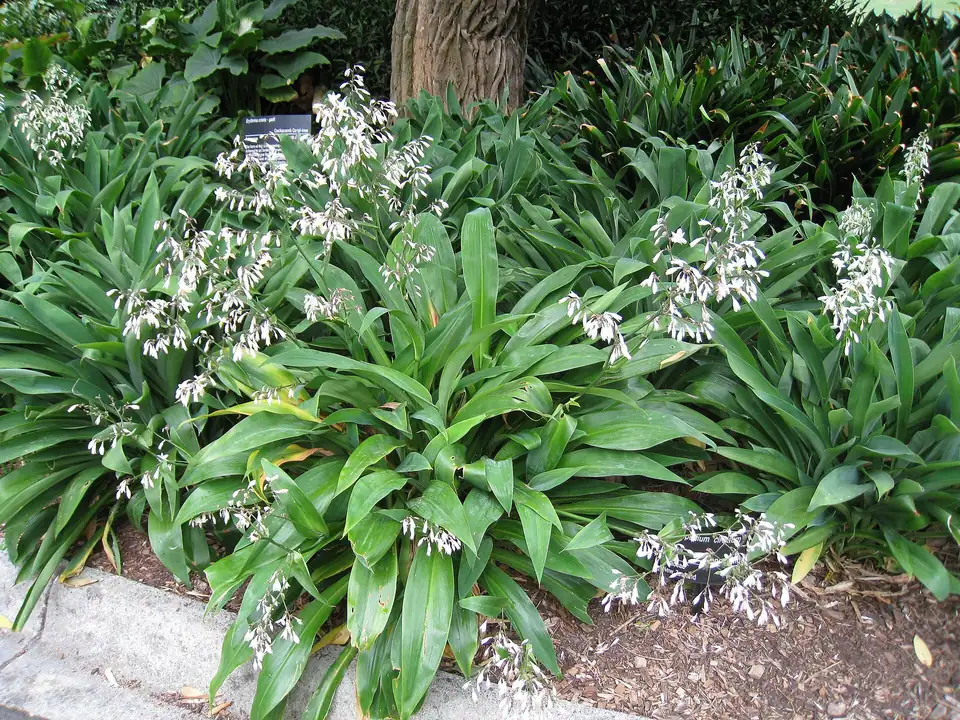
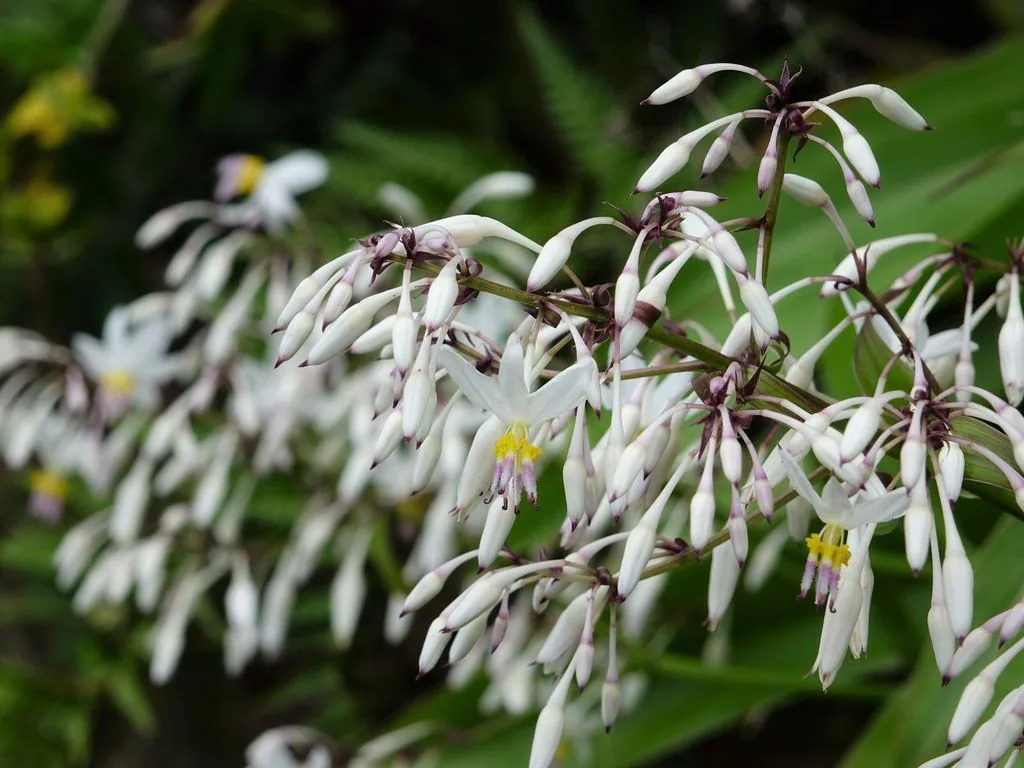
Rengarenga is a clump-forming evergreen perennial about 60 cm [24 in] tall and wide. [5] It occurs naturally throughout the North Island and northern parts of the South Island of New Zealand. [2] Leaves are damaged by light to moderate frosts but the plant can recover in spring. [2]
This record is incomplete: the sources we read do not cover every field yet.
Not yet covered by our sources: Light, Hardiness, coldest zone, Hardiness, warmest zone
Arthropodium cirratum care
Measurements in square brackets are our conversion into the other unit system; the quoted text is unchanged.
How to water Arthropodium cirratum
Tolerates dry conditions
What the sources say (1)
Prefers free-draining soil in full sun or shade. Tolerates dry conditions.How much light Arthropodium cirratum needs
Not stated in the sources we read.
How much cold Arthropodium cirratum can take
Hardiness, coldest zone
Not stated in the sources we read.
Hardiness, warmest zone
Not stated in the sources we read.
Where to grow Arthropodium cirratum
In containers
Yes
What the sources say (1)
Particularly effective when used as a foliage plant, adding a structural dimension to mixed plantings. Also suitable for containers.Spacing
50 cm [20 in]
What the sources say (1)
In a well-planned border , the plants in flower should just touch each other to create a full effect without overcrowding. Plant approximately 50cm apart.How to propagate Arthropodium cirratum
Division
What the sources say (1)
Fertilise or add compost if the plant seems to sulk and the foliage turns yellowish. Easy to propagate by division.Arthropodium cirratum pests and problems
Slug and snail damage
Symptom: Plants are very susceptible to damage by slugs and snails.
What to do: Slug bait may be needed.
What the sources say (1)
Slug bait may be needed as they are very susceptible to damage.
— Arthropodium cirratum [5] Frost damage
Symptom: Leaves are damaged by light to moderate frosts.
What to do: The plant can recover in spring even after leaves turn to brown mush.
What the sources say (1)
Leaves are damaged by light to moderate frosts, but even when all the leaves have turned into a brown mush due to frost burn, there is a good chance that the plant will recover in spring.
— About Garden Design - Arthropodium cirratum [2]
Remedies
Each remedy shows what official sources say about it; traditional remedies without an official source are marked as such. Harmful ones are listed so you know to avoid them.
Treating the plant
orange leaf blotching
digging out the worst affected plants and replanting clean ones Not verified
Traditional remedy, not verified by an official source.
How: Dig out and dump the worst affected plants, clean up and dig over the ground, then replant with clean plants.
cutting off the affected leaves Not verified
Traditional remedy, not verified by an official source.
How: Cut off the few affected leaves; compost them only in a heap hot enough to kill bugs and diseases.
Calendar
Planting
After autumn rains
What the sources say (1)
Always choose healthy, well-grown plants and plant after autumn rains.Pruning
After flowering (remove old flowers)
What the sources say (1)
Fertilise in spring with a balanced fertiliser, such as blood and bone, at a handful per square metre. Prune any old flowers after flowering.Months as given by the sources, which are mostly from the United States (northern hemisphere). In the southern hemisphere they shift by about six months.
Indicative values
Values from a secondary source, not checked word for word like the rest of this page. Use them as a starting point.
- Life cycle
- Herbaceous PerennialIndicative value, adapt it to your climate · Secondary source
- Mature height
- 61-91.4 cm (2-3 ft)Indicative value, adapt it to your climate · Secondary source
- Light
- Part shadeIndicative value, adapt it to your climate · Secondary source
- Drought tolerant
- yesIndicative value, adapt it to your climate · Secondary source
- Soil pH
- 6-7.5Indicative value, adapt it to your climate · Secondary source
- USDA hardiness zones
- 8-11 [winter low −12.2 to 10 °C (10 to 50 °F)]Indicative value, adapt it to your climate · Secondary source
- Care level
- MediumIndicative value, adapt it to your climate · Secondary source
- Growth rate
- LowIndicative value, adapt it to your climate · Secondary source
Similar plants
- Aaron's Beard Hypericum calycinum
- Abies grandis Abies grandis
- Abraham Trachystemon orientalis
- Abyssinian banana Ensete ventricosum
- Acacia longifolia Acacia longifolia
- Acacia retinodes Acacia retinodes
- Acanthus hungaricus Acanthus hungaricus
- Achlys triphylla Achlys triphylla
Sources
Every value above is quoted from these documents. Links lead to the original publisher.
- Flora of New Zealand | Taxon Profile | Arthropodium cirratum · nzflora.info, consulted
- About Garden Design - Arthropodium cirratum · aboutgardendesign.com, consulted
- Arthropodium cirratum - The University of Auckland · nzplants.auckland.ac.nz, consulted
- Arthropodium cirrhatum · plantselector.botanicgardens.sa.gov.au, consulted
- Arthropodium cirratum · aucklandbotanicgardens.co.nz, consulted
Written by Emilio Marruso · last checked