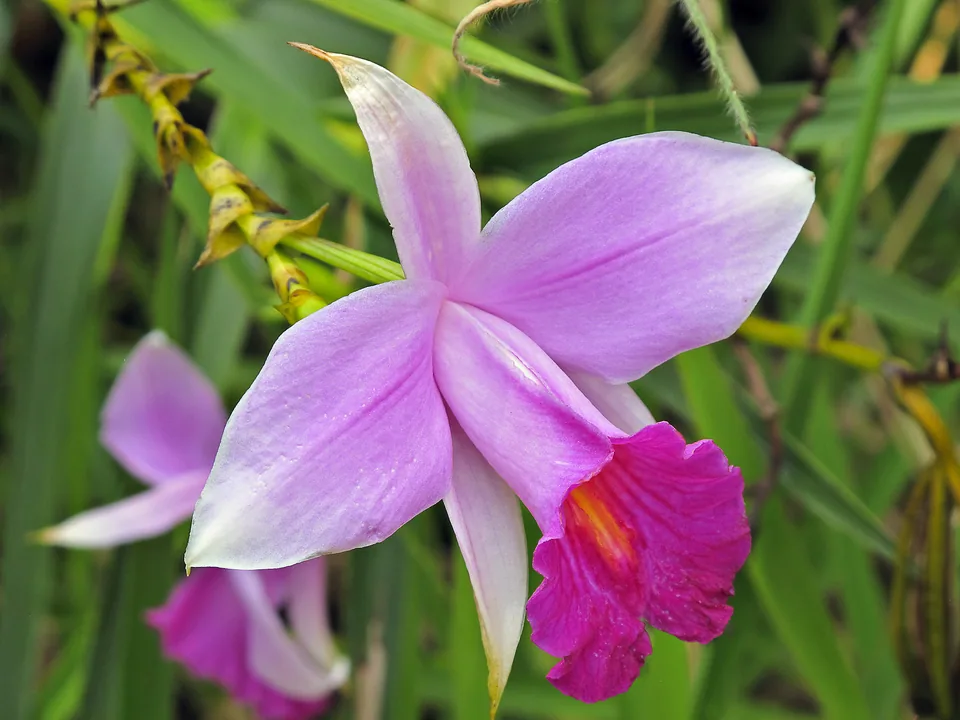
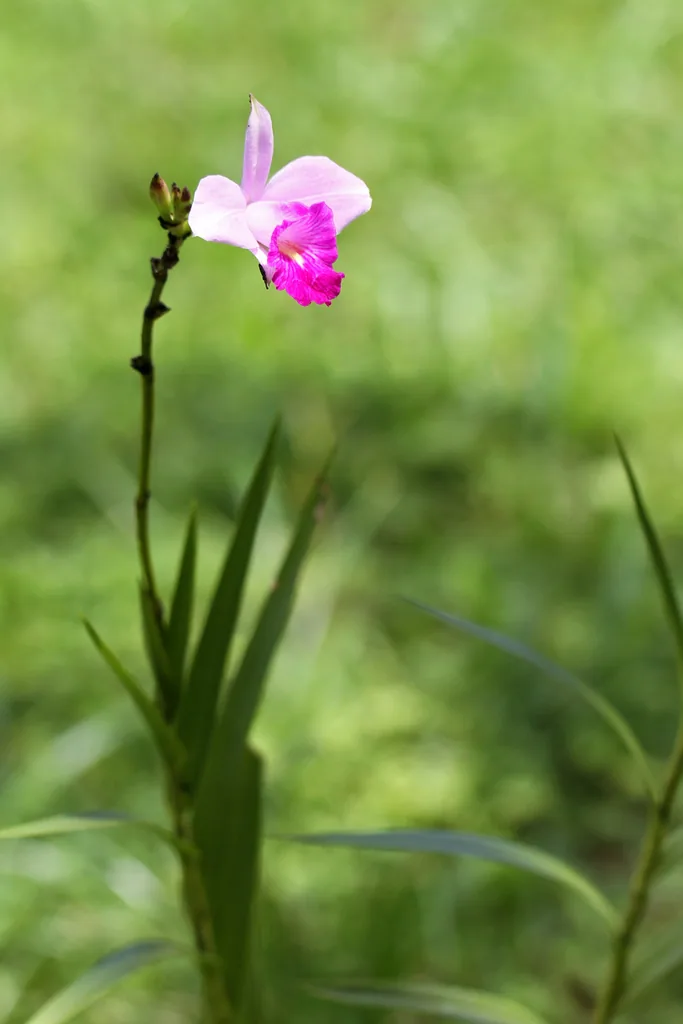

How to Grow and Care for Bamboo orchid
Arundina graminifolia
Written by Emilio Marruso · last checked
At a glance
Arundina is an orchid you can grow in a pot, even indoors, and its flowers are edible: stir-fried, they taste a little bitter, like bitter gourd flowers. Give it plenty of light so it keeps blooming, and a well-draining pot with soil rich in organic matter to keep its roots healthy and happy.
- Sun
Needs plenty of light: with too little, it stops flowering
- Water
Roots rot easily: use pots that drain well
What the sources say (2)
Watering notes: Vulnerable to root rot; pots must drain well
These plants are vulnerable to root rot , so ensure that your pots drain well
— Bamboo Orchid | GardeningSG [2] it loves the full sun and draining soils rich of organic substance with regular waterings, but avoiding stagnations
— Arundina graminifolia - Monaco Nature Encyclopedia [6] - Soil
Soil with plenty of organic matter
- Harvest
Pick flowers anytime to stir-fry; collect seeds when the pods dry and start to crack
What the sources say (2)
- Pests
Aphids, mealybugs, whiteflies and spider mites attack stressed plants; cut off infested parts
- Propagation
From seed, by dividing the clump, or from the baby plants that grow on the stems
What the sources say (3)
Propagation: Seed; division; aerial plantlets (keikis)
Maintenance Requirements | Moderate | Propagation Method | Seed, Division, Aerial Plantlet
— NParks | Arundina graminifolia [1] Arundina s readily propagate themselves by keikis , which frequently develop along the pseudobulbs
— Arundina graminifolia (Bamboo Orchid) [4] It reproduces by micro-propagation and, at amateur level, by division
— Arundina graminifolia - Monaco Nature Encyclopedia [6] - Containers
Grows in pots, even indoors
What the sources say (2)
In containers: Yes
it can be cultivated in a large enough pot, in an as much as possible luminous position
— Arundina graminifolia - Monaco Nature Encyclopedia [6] Indoors: Yes
If you grow orchids indoors , these plants are often too big to take to the sink
— Arundina graminifolia (Bamboo Orchid) [4]
Overview
Arundina graminifolia is a clumping terrestrial orchid with erect, leafy stems up to 2.5 m [8.2 ft] tall. [1] It is propagated by seed, division and aerial plantlets. [1]
This record is incomplete: the sources we read do not cover every field yet.
Not yet covered by our sources: Hardiness, coldest zone, Hardiness, warmest zone, Pruning
Bamboo orchid care
Measurements in square brackets are our conversion into the other unit system; the quoted text is unchanged.
How to water Bamboo orchid
Watering
The sources disagree:
Bamboo orchids should be watered as they approach dryness; don't let them dry out too thoroughly.
[4]
Watering notes
Vulnerable to root rot; pots must drain well
What the sources say (2)
These plants are vulnerable to root rot , so ensure that your pots drain wellit loves the full sun and draining soils rich of organic substance with regular waterings, but avoiding stagnationsHow much light Bamboo orchid needs
The sources give different values depending on region, zone or growing conditions.
What each source says
According to NParks Flora&Fauna Web: Full sun
According to UBD Botanical Research Centre: Partial shade
What the sources say (4)
According to NParks Flora&Fauna Web: The bamboo orchid prefers well-drained moderately moist to moist soil, full sun, high humidity and good air circulation.According to UBD Botanical Research Centre: It prefers fertile, moist but well-drained loamy soil under partial shade.The bamboo orchid prefers well-drained moderately moist to moist soil, full sun, high humidity and good air circulation.This plant thrives in 4-8 hours of direct sunlightHow much cold Bamboo orchid can take
Hardiness, coldest zone
Not stated in the sources we read.
Hardiness, warmest zone
Not stated in the sources we read.
Where to grow Bamboo orchid
Indoors
Yes
What the sources say (1)
If you grow orchids indoors , these plants are often too big to take to the sinkIn containers
Yes
What the sources say (1)
it can be cultivated in a large enough pot, in an as much as possible luminous positionHow to propagate Bamboo orchid
Seed; division; aerial plantlets (keikis)
What the sources say (3)
Maintenance Requirements
| Moderate
| Propagation Method
| Seed, Division, Aerial PlantletArundina s readily propagate themselves by keikis , which frequently develop along the pseudobulbsIt reproduces by micro-propagation and, at amateur level, by divisionBamboo orchid pests and problems
Insect and mite pests
Symptom: Aphids, mealy bugs, whiteflies and spider mites infest the plant when it has underlying problems such as repeated wilting from heat stress.
What to do: Mechanical control such as pruning the infested parts; resolve the underlying problem to prevent recurrence.
What the sources say (2)
Aphids , mealy bugs , whiteflies , and spider mites often infest the plant if it has underlying problems like repeated wilting from heat stress.
— Bamboo Orchid | GardeningSG [2] Mechanical pest control methods like pruning the infested parts are the best methods for managing these pests in the short term
— Bamboo Orchid | GardeningSG [2] Few or no flowers
Symptom: The plant stops producing flowers when it does not receive enough light.
What to do: Prune surrounding plants or move the orchid to a sunnier spot.
Root rot
Symptom: Plants are vulnerable to root rot.
What to do: Ensure pots drain well and the soil has plenty of organic matter.
What the sources say (1)
These plants are vulnerable to root rot , so ensure that your pots drain well, and that your soil has plenty of organic matter to let the roots breathe.
— Bamboo Orchid | GardeningSG [2]
Remedies
Each remedy shows what official sources say about it; traditional remedies without an official source are marked as such. Harmful ones are listed so you know to avoid them.
Treating the plant
aphids
prune the infested parts Official source, not independently tested
How: Prune the infested parts; resolve the underlying problem to prevent recurrence.
Mechanical pest control methods like pruning the infested parts are the best methods for managing these pests in the short term, but resolving the underlying problem will prevent them in the long term.
— Bamboo Orchid | GardeningSG [2]
mealybugs
prune the infested parts Official source, not independently tested
How: Prune the infested parts; resolve the underlying problem to prevent recurrence.
Mechanical pest control methods like pruning the infested parts are the best methods for managing these pests in the short term, but resolving the underlying problem will prevent them in the long term.
— Bamboo Orchid | GardeningSG [2]
whiteflies
prune the infested parts Official source, not independently tested
How: Prune the infested parts; resolve the underlying problem to prevent recurrence.
Mechanical pest control methods like pruning the infested parts are the best methods for managing these pests in the short term, but resolving the underlying problem will prevent them in the long term.
— Bamboo Orchid | GardeningSG [2]
spider mites
prune the infested parts Official source, not independently tested
How: Prune the infested parts; resolve the underlying problem to prevent recurrence.
Mechanical pest control methods like pruning the infested parts are the best methods for managing these pests in the short term, but resolving the underlying problem will prevent them in the long term.
— Bamboo Orchid | GardeningSG [2]
wilt
water more often or mulch Official source, not independently tested
How: Increase the number of times a plant is watered, or use mulch to retain moisture in the soil.
Increase the number of times a plant is watered, or use mulch to retain moisture in the soil.
— Bamboo Orchid | GardeningSG [2]
Calendar
Pruning
Not stated in the sources we read.
Months as given by the sources, which are mostly from the United States (northern hemisphere). In the southern hemisphere they shift by about six months.
Edibility
Reported by the source, quoted verbatim. Do not eat a plant on the basis of this page alone: identification mistakes can be dangerous.
Indicative values
Values from a secondary source, not checked word for word like the rest of this page. Use them as a starting point.
- Life cycle
- PerennialIndicative value, adapt it to your climate · Secondary source
- Mature height
- 121.9-182.9 cm (4-6 ft)Indicative value, adapt it to your climate · Secondary source
- Hours of sun
- 4-5 hoursIndicative value, adapt it to your climate · Secondary source
- Drought tolerant
- yesIndicative value, adapt it to your climate · Secondary source
- Soil pH
- 5.5-6.5Indicative value, adapt it to your climate · Secondary source
- USDA hardiness zones
- 11-12 [winter low 4.4 to 15.6 °C (40 to 60 °F)]Indicative value, adapt it to your climate · Secondary source
- Care level
- HighIndicative value, adapt it to your climate · Secondary source
- Growth rate
- LowIndicative value, adapt it to your climate · Secondary source
- Pruning
- August, MayIndicative value, adapt it to your climate · Secondary source
Similar plants
- Aaron's Beard Hypericum calycinum
- Abies grandis Abies grandis
- Abraham Trachystemon orientalis
- Abyssinian banana Ensete ventricosum
- Acacia longifolia Acacia longifolia
- Acacia retinodes Acacia retinodes
- Acanthus hungaricus Acanthus hungaricus
- Achlys triphylla Achlys triphylla
Sources
Every value above is quoted from these documents. Links lead to the original publisher.
- NParks | Arundina graminifolia · nparks.gov.sg, consulted
- Bamboo Orchid | GardeningSG · gardeningsg.nparks.gov.sg, consulted
- Bamboo Orchid – UBD Botanical Research Centre · brc.iber.ubd.edu.bn, consulted
- Arundina graminifolia (Bamboo Orchid) · orchid-care-tips.com, consulted
- Bamboo orchid, Arundina graminifolia : Philippine Medicinal Herbs / StuartXchange · stuartxchange.org, consulted
- Arundina graminifolia - Monaco Nature Encyclopedia · monaconatureencyclopedia.com, consulted
Written by Emilio Marruso · last checked