
How to Grow and Care for Tatarian Aster
Aster tataricus
Written by Emilio Marruso · last checked
At a glance
Tatarian aster is a tough perennial that comes back year after year and asks for very little. Plant it after the last frost in early spring, keep the soil evenly moist while it settles in, and then occasional rain is enough. Give it room, at least 3 feet, and enjoy a plant that is even eaten as a vegetable in Korea.
- Water
Keep evenly moist at first; once settled, occasional rain is enough
What the sources say (2)
Watering: Once established, occasional rain is enough; fair drought tolerance
Once established, plants that receive occasional rain do not need supplemental water and demonstrate a fair amount of drought tolerance.
— How to Grow and Care for Tatarian Aster | Gardener’s Path [2] Watering notes: Maintain even moisture during the initial phase to help acclimation to the garden
Maintain even moisture during the initial phase, to facilitate acclimation to the garden.
— How to Grow and Care for Tatarian Aster | Gardener’s Path [2] - Cold
Survives winters down to −40 °F (−40 °C)
Very hardy · USDA 3a · RHS H7 · Z3
What the sources say (2)
Hardiness, coldest zone: 3a [winter low −40 to −37.2 °C (−40 to −35 °F)]
3a, 3b, 4a, 4b, 5a, 5b, 6a, 6b, 7a, 7b, 8a, 8b, 9a, 9b
— Crinitaria tatarica (Tatarian Aster, Tatarian Daisy, Tatarinow's Aster) | North Carolina Extension Gardener Plant Toolbox [1] Hardiness, warmest zone: 9b [winter low −3.9 to −1.1 °C (25 to 30 °F)]
3a, 3b, 4a, 4b, 5a, 5b, 6a, 6b, 7a, 7b, 8a, 8b, 9a, 9b
— Crinitaria tatarica (Tatarian Aster, Tatarian Daisy, Tatarinow's Aster) | North Carolina Extension Gardener Plant Toolbox [1] - Spacing
At least 3 ft between plants
What the sources say (1)
Spacing: At least 91.4 cm (3 ft)
so leave at least three feet between plants.
— How to Grow and Care for Tatarian Aster | Gardener’s Path [2] - Planting
Plant in early spring, after the last frost
What the sources say (1)
Planting: After the last frost date in early spring
After the last frost date in early spring, you may put rooted cuttings, divisions, or nursery plants into the ground.
— How to Grow and Care for Tatarian Aster | Gardener’s Path [2] - Pruning
Pinch back the stems in mid-summer
What the sources say (1)
Pruning: Mid-summer (pinching back true species plants)
Consider pruning or “pinching back” true species plants in mid-summer to maintain a bushy shape.
— How to Grow and Care for Tatarian Aster | Gardener’s Path [2] - Harvest
Eaten as a vegetable in Korea
- Pests
Now and then: wilt, powdery mildew and gray mold
What the sources say (1)
Diseases: wilt, powdery mildew, botrytis
Wilt, powdery mildew, and botrytis are occasional problems.
— Crinitaria tatarica (Tatarian Aster, Tatarian Daisy, Tatarinow's Aster) | North Carolina Extension Gardener Plant Toolbox [1] - Propagation
Take cuttings from new spring shoots or divide the clump
What the sources say (2)
Propagation: Cuttings (new shoots in spring), division
To start with a cutting, snip off a new shoot in springtime, place it in rooting hormone, and then place it in potting medium to grow roots.
— How to Grow and Care for Tatarian Aster | Gardener’s Path [2] You may also divide a mature plant by slicing down through the roots
— How to Grow and Care for Tatarian Aster | Gardener’s Path [2]
Overview
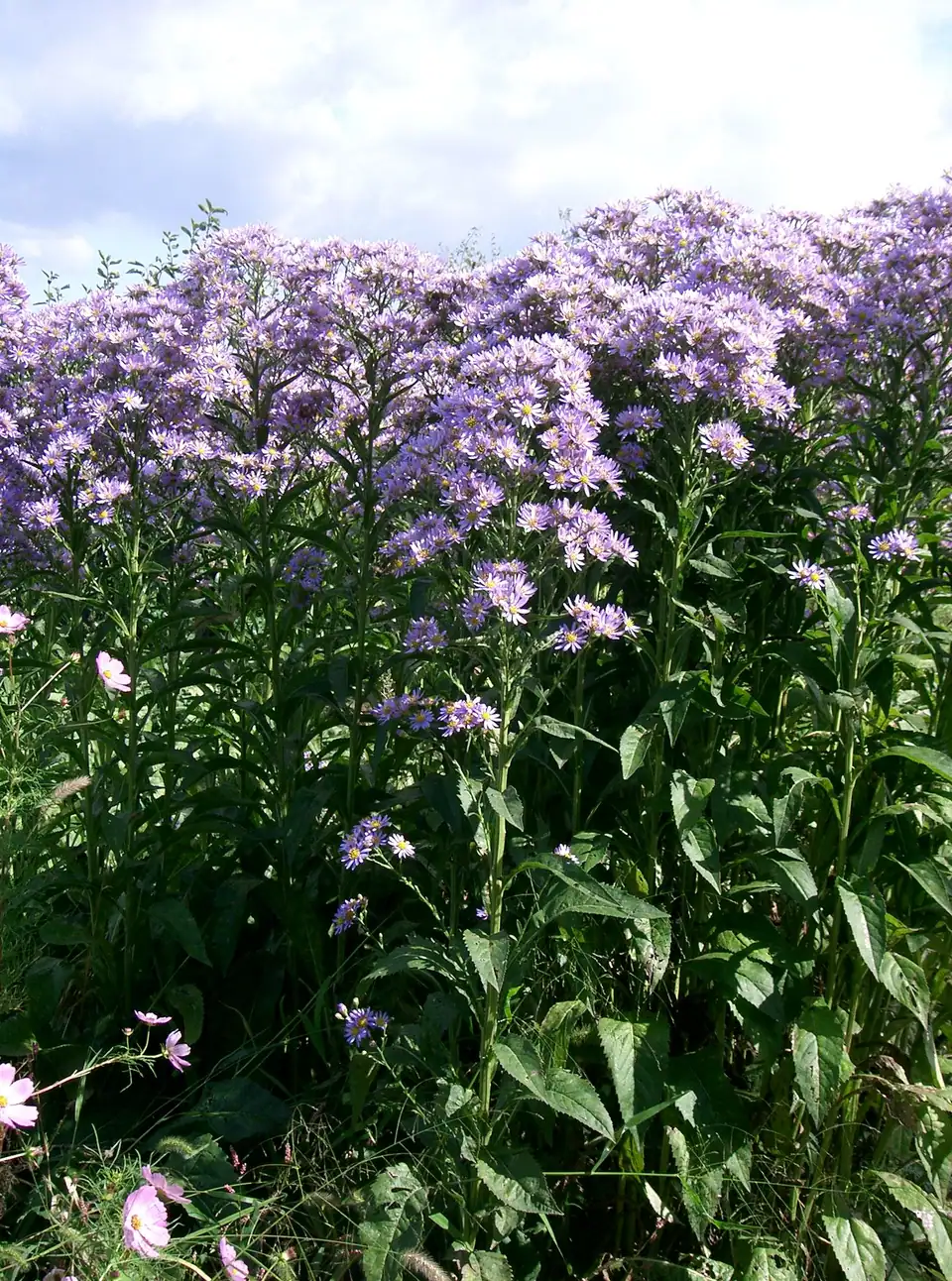
Tatarian aster is a tall herbaceous perennial with showy purple flowers in the late-season garden. [1] It spreads by rhizomes and can be aggressive, so the root ball can be divided every three to four years. [1]
This record is incomplete: the sources we read do not cover every field yet.
Not yet covered by our sources: Light
Tatarian Aster care
How to water Tatarian Aster
Watering
Once established, occasional rain is enough; fair drought tolerance
What the sources say (1)
Once established, plants that receive occasional rain do not need supplemental water and demonstrate a fair amount of drought tolerance.Watering notes
Maintain even moisture during the initial phase to help acclimation to the garden
What the sources say (1)
Maintain even moisture during the initial phase, to facilitate acclimation to the garden.How much light Tatarian Aster needs
Not stated in the sources we read.
How much cold Tatarian Aster can take
Hardiness, coldest zone
3a [winter low −40 to −37.2 °C (−40 to −35 °F)]
What the sources say (1)
3a, 3b, 4a, 4b, 5a, 5b, 6a, 6b, 7a, 7b, 8a, 8b, 9a, 9bHardiness, warmest zone
9b [winter low −3.9 to −1.1 °C (25 to 30 °F)]
What the sources say (1)
3a, 3b, 4a, 4b, 5a, 5b, 6a, 6b, 7a, 7b, 8a, 8b, 9a, 9bWhere to grow Tatarian Aster
At least 91.4 cm (3 ft)
What the sources say (1)
so leave at least three feet between plants.How to propagate Tatarian Aster
Cuttings (new shoots in spring), division
What the sources say (2)
To start with a cutting, snip off a new shoot in springtime, place it in rooting hormone, and then place it in potting medium to grow roots.You may also divide a mature plant by slicing down through the rootsHow to grow Tatarian Aster
The plant
Life cycle
perennial
What the sources say (1)
Tatarian aster is a herbaceous perennial wildflower in the sunflower family.Pests and diseases
Diseases
wilt, powdery mildew, botrytis
What the sources say (1)
Wilt, powdery mildew, and botrytis are occasional problems.Tatarian Aster pests and problems
Wilt, powdery mildew, botrytis
Symptom: Occasional fungal problems
What the sources say (1)
Wilt, powdery mildew, and botrytis are occasional problems.
— Crinitaria tatarica (Tatarian Aster, Tatarian Daisy, Tatarinow's Aster) | North Carolina Extension Gardener Plant Toolbox [1]
Remedies
Each remedy shows what official sources say about it; traditional remedies without an official source are marked as such. Harmful ones are listed so you know to avoid them.
Treating the plant
aggressive spreading
dividing the root ball Official source, not independently tested
How: If the aggressively growing rhizomes become too large, divide the root ball every three to four years.
If the aggressively growing rhizomes become too large you can divide the root ball every three to four
— Crinitaria tatarica (Tatarian Aster, Tatarian Daisy, Tatarinow's Aster) | North Carolina Extension Gardener Plant Toolbox [1]
powdery mildew
removing infected plant debris Not verified
Traditional remedy, not verified by an official source.
How: Remove plant debris and dispose of infected plants; keep the surrounding area free of weeds and volunteer plants.
Calendar
Planting
After the last frost date in early spring
What the sources say (1)
After the last frost date in early spring, you may put rooted cuttings, divisions, or nursery plants into the ground.Pruning
Mid-summer (pinching back true species plants)
What the sources say (1)
Consider pruning or “pinching back” true species plants in mid-summer to maintain a bushy shape.Months as given by the sources, which are mostly from the United States (northern hemisphere). In the southern hemisphere they shift by about six months.
Edibility
Reported by the source, quoted verbatim. Do not eat a plant on the basis of this page alone: identification mistakes can be dangerous.
an edible vegetable in Korea
[4]
Indicative values
Values from a secondary source, not checked word for word like the rest of this page. Use them as a starting point.
- Mature height
- 91.4-182.9 cm (3-6 ft)Indicative value, adapt it to your climate · Secondary source
- Light
- Full sunIndicative value, adapt it to your climate · Secondary source
- Hours of sun
- 6-8 hoursIndicative value, adapt it to your climate · Secondary source
- Soil pH
- 5.5-7.5Indicative value, adapt it to your climate · Secondary source
- Care level
- MediumIndicative value, adapt it to your climate · Secondary source
- Growth rate
- LowIndicative value, adapt it to your climate · Secondary source
Similar plants
- Alpine aster Aster alpinus
- European Michaelmas-daisy Aster amellus
- Japanese Aster Aster iinumae
- Aaron's Beard Hypericum calycinum
- Abies grandis Abies grandis
- Abraham Trachystemon orientalis
- Abyssinian banana Ensete ventricosum
- Acacia longifolia Acacia longifolia
Sources
Every value above is quoted from these documents. Links lead to the original publisher.
- Crinitaria tatarica (Tatarian Aster, Tatarian Daisy, Tatarinow's Aster) | North Carolina Extension Gardener Plant Toolbox · plants.ces.ncsu.edu, consulted
- How to Grow and Care for Tatarian Aster | Gardener’s Path · gardenerspath.com, consulted
- Aster tataricus - Useful Temperate Plants · temperate.theferns.info, consulted
- Tatarian Aster | Duke Gardens · gardens.duke.edu, consulted
- Tatarian aster - Fine Gardening · finegardening.com, consulted
- Aster tataricus - FNA · floranorthamerica.org, consulted
- Aster tataricus (Tatarian aster): Go Botany · gobotany.nativeplanttrust.org, consulted
Written by Emilio Marruso · last checked