
How to Grow and Care for Bergenia ciliata
Bergenia ciliata
Written by Emilio Marruso · last checked
At a glance
Bergenia ciliata is a rewarding plant that grows in full sun or light shade, in deep, fertile soil that never dries out completely. Its flowers can even be boiled and pickled. If a spring frost nips the flowers and young leaves, don't worry: fresh leaves usually come back soon. You can start new plants from seed, by division or from rhizome cuttings.
- Sun
Full sun or light shade
What the sources say (2)
- Water
Water so the soil never dries out completely
What the sources say (1)
Watering: Prefers a deep fertile soil that does not dry out fully
Succeeds in full sun or light shade in most soils [6] but prefers a deep fertile soil that does not dry out fully [1] .
— Bergenia ciliata — Practical Plants [2] - Cold
Survives winters down to 0 °F (−17.8 °C)
Hardy in very cold winters · USDA 7 · RHS H6 · Z7
What the sources say (1)
Hardiness, coldest zone: 7 [winter low −17.8 to −12.2 °C (0 to 10 °F)]
Hardiness Zone 7+
— Bergenia ciliata — Practical Plants [2] - Soil
Deep, fertile soil
What the sources say (1)
Watering: Prefers a deep fertile soil that does not dry out fully
Succeeds in full sun or light shade in most soils [6] but prefers a deep fertile soil that does not dry out fully [1] .
— Bergenia ciliata — Practical Plants [2] - Planting
Plant seedlings in late spring or early summer, after the last frosts
What the sources say (1)
Planting: Late spring or early summer, after the last expected frosts (seedlings)
Plant them out into their permanent positions in late spring or early summer, after the last expected frosts.
— Bergenia ciliata — Practical Plants [2] - Harvest
The flowers can be boiled and then pickled
- Watch out
Spring frost hurts flowers and young leaves; shade it from early morning sun
- Propagation
By seed, by division or from rhizome cuttings
What the sources say (2)
Propagation: Seed; division; cuttings taken from the rhizome
Division in late spring after flowering [4] or in autumn [6] . Very easy, larger divisions can be planted straight into their permanent positions whilst smaller clumps are best potted up and kept in a cold frame until they are growing away well.
— Bergenia ciliata — Practical Plants [2] It grows well in the UK and can be propagated either by cuttings taken from the rhizome or by seeds.
— Bergenia ciliata – Botanics Stories [3] - Sowing
Sow in late spring, as soon as the seed is ripe
What the sources say (1)
Sowing: Late spring, as soon as the seed is ripe
Fresh seed, sown as soon as it is ripe in late spring is liable to germinate better than stored seed.
— Bergenia ciliata — Practical Plants [2]
Overview
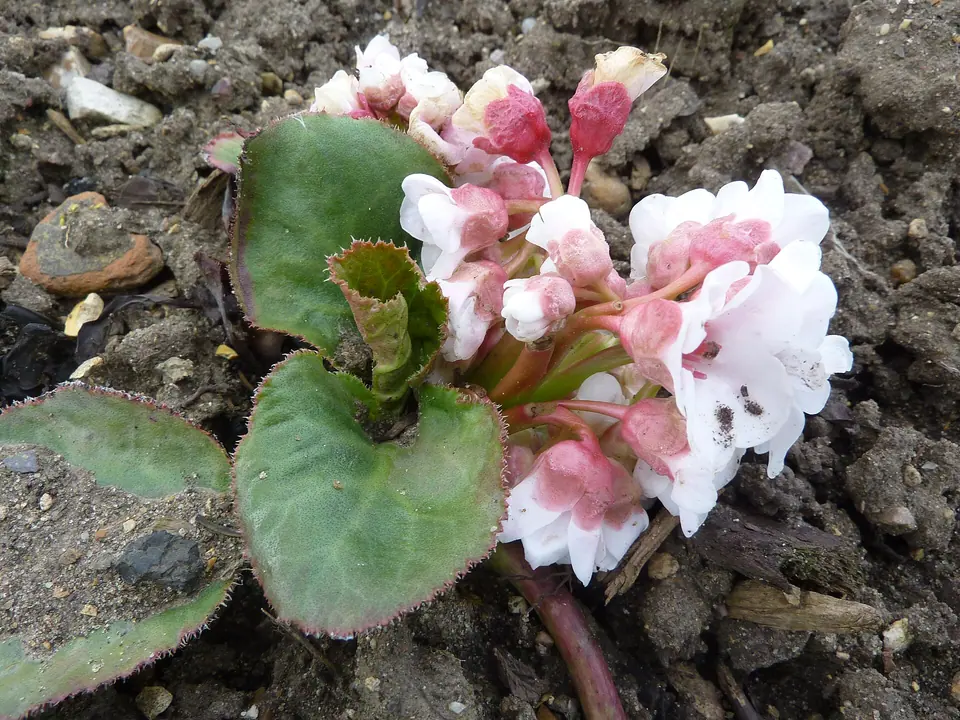
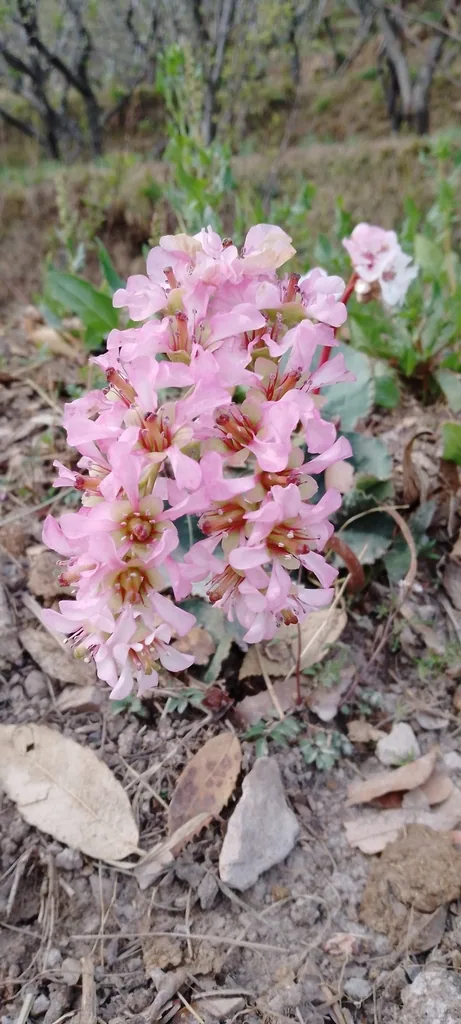
Bergenia ciliata is a low-growing rhizomatous evergreen perennial from the Himalayas that is used as ground cover. [1] It succeeds in full sun or light shade, but its spring flowers and young leaves are sensitive to frost. [2][1]
This record is incomplete: the sources we read do not cover every field yet.
Not yet covered by our sources: Hardiness, warmest zone, Pruning
Bergenia ciliata care
How to water Bergenia ciliata
Prefers a deep fertile soil that does not dry out fully
What the sources say (1)
Succeeds in full sun or light shade in most soils [6] but prefers a deep fertile soil that does not dry out fully [1] .How much light Bergenia ciliata needs
Full sun or light shade
How much cold Bergenia ciliata can take
Hardiness, coldest zone
7 [winter low −17.8 to −12.2 °C (0 to 10 °F)]
What the sources say (1)
Hardiness
Zone 7+Hardiness, warmest zone
Not stated in the sources we read.
How to propagate Bergenia ciliata
Seed; division; cuttings taken from the rhizome
What the sources say (2)
Division in late spring after flowering [4] or in autumn [6] . Very easy, larger divisions can be planted straight into their permanent positions whilst smaller clumps are best potted up and kept in a cold frame until they are growing away well.It grows well in the UK and can be propagated either by cuttings taken from the rhizome or by seeds.Bergenia ciliata pests and problems
Frost damage
Symptom: The flowers and young leaves in spring are rather sensitive to frost.
What to do: Choose a position with shade from the early morning sun; if the leaves are cut back by frost they are usually soon replaced by fresh leaves in the spring.
What the sources say (2)
but the flowers and young leaves in spring are rather sensitive to frost and so it is best to choose a position with shade from the early morning sun
— Bergenia ciliata - Useful Temperate Plants [1] If the leaves are cut back by frost then they are usually soon replaced by fresh leaves in the spring
— Bergenia ciliata - Useful Temperate Plants [1]
Remedies
Each remedy shows what official sources say about it; traditional remedies without an official source are marked as such. Harmful ones are listed so you know to avoid them.
Treating the plant
slugs and snails
leaf litter removal Works
How: clear away any decaying foliage beneath the leaves, where slugs and snails lurk
Slugs and snails can lurk under the leaves and make holes in them. Clear away any decaying foliage beneath the leaves, where they tend to lurk.
— gardenersworld.com [5] What the evidence says Discourage snails and slugs by removing mulch and leaf litter near plants. When found, these pests can be removed by handpicking or by making simple, effective traps.
— hgic.clemson.edu [6]
vine weevil larvae
beneficial nematodes Partly works
How: if the problem is severe, apply Steinernema kraussei to the soil in August or September and again in spring
If the problem is severe, apply a biological control ( Steinernema kraussei) to the soil in August or September and again in spring.
— gardenersworld.com [5] What the evidence says Parasitic (entomopathogenic) nematodes (e.g., Heterorhabditis or Steinernema spp.) can be drenched onto soil beneath infested plants to reduce larval abundance if soil is well drained (e.g., high in organic matter or sandy) and not compacted.
— ipm.ucanr.edu [7]
leaf spot
remove affected leaves Not verified
Traditional remedy, not verified by an official source.
How: remove any affected leaves promptly and increase spacing between plants to improve air circulation
water at the base in the morning Not verified
Traditional remedy, not verified by an official source.
How: water at the base of the plant without splashing the leaves, in the morning so the leaves dry before evening
rhizome rot
divide and replant healthy rhizomes Not verified
Traditional remedy, not verified by an official source.
How: dig the plant up and divide it, saving firm and healthy rhizomes, and replant elsewhere in the garden
Calendar
Sowing
Late spring, as soon as the seed is ripe
What the sources say (1)
Fresh seed, sown as soon as it is ripe in late spring is liable to germinate better than stored seed.Planting
Late spring or early summer, after the last expected frosts (seedlings)
What the sources say (1)
Plant them out into their permanent positions in late spring or early summer, after the last expected frosts.Pruning
Not stated in the sources we read.
Months as given by the sources, which are mostly from the United States (northern hemisphere). In the southern hemisphere they shift by about six months.
Edibility
Reported by the source, quoted verbatim. Do not eat a plant on the basis of this page alone: identification mistakes can be dangerous.
Indicative values
Values from a secondary source, not checked word for word like the rest of this page. Use them as a starting point.
- Life cycle
- Herbaceous PerennialIndicative value, adapt it to your climate · Secondary source
- Mature height
- 22.9-30.5 cm (0.75-1 ft)Indicative value, adapt it to your climate · Secondary source
- Drought tolerant
- yesIndicative value, adapt it to your climate · Secondary source
- Soil pH
- 5.5-7.5Indicative value, adapt it to your climate · Secondary source
- Care level
- MediumIndicative value, adapt it to your climate · Secondary source
- Growth rate
- LowIndicative value, adapt it to your climate · Secondary source
- Pruning
- December, January, February, February, March, AprilIndicative value, adapt it to your climate · Secondary source
Similar plants
- Bergenia Bergenia crassifolia
- Abies grandis Abies grandis
- Abraham Trachystemon orientalis
- Abyssinian banana Ensete ventricosum
- Acacia longifolia Acacia longifolia
- Acanthus hungaricus Acanthus hungaricus
- Aconite Aconitum napellus
- Adam's Needle Yucca flaccida
Sources
Every value above is quoted from these documents. Links lead to the original publisher.
- Bergenia ciliata - Useful Temperate Plants · temperate.theferns.info, consulted
- Bergenia ciliata — Practical Plants · practicalplants.org, consulted
- Bergenia ciliata – Botanics Stories · stories.rbge.org.uk, consulted
- How to grow bergenias or elephant's ears for lovely spring borders · gardensillustrated.com, consulted
- gardenersworld.com · gardenersworld.com
- hgic.clemson.edu · hgic.clemson.edu
- ipm.ucanr.edu · ipm.ucanr.edu
Written by Emilio Marruso · last checked