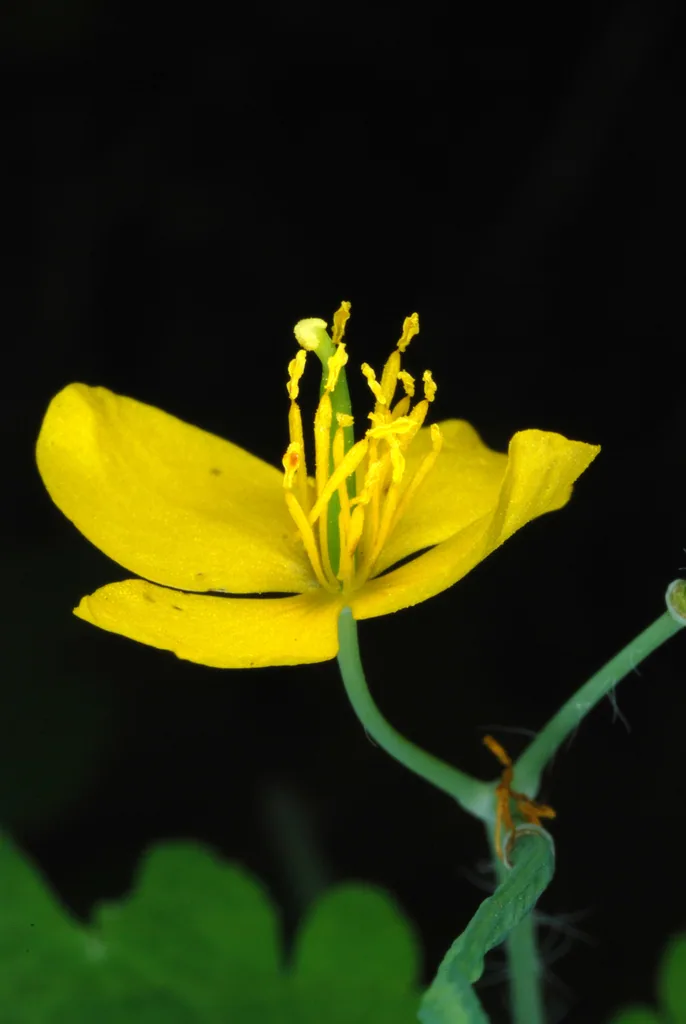
How to Grow and Care for Celandine
Chelidonium majus
Written by Emilio Marruso · last checked
Toxic to: People · Why
At a glance
A member of the poppy family, celandine is happy where many plants struggle: in partial to full shade, in moist but well-drained soil. This short-lived perennial or biennial stays compact, 1 to 2 feet tall, and reseeds readily on its own. Just wear gloves when you handle it, because its orange-yellow sap irritates skin and eyes.
- Sun
Partial to full shade; full sun only where summers are cool
What the sources say (3)
Light: Partial shade to full shade; tolerates full sun in cool summer areas
According to NC State Extension: prefers partial shade to full shade, but tolerates full sun in cool summer areas.
— Chelidonium majus (Celandine, Greater Celandine, Rock-Poppy, St. John's Wort) | North Carolina Extension Gardener Plant Toolbox [1] cool summer areas: prefers partial shade to full shade, but tolerates full sun in cool summer areas.
— Chelidonium majus (Celandine, Greater Celandine, Rock-Poppy, St. John's Wort) | North Carolina Extension Gardener Plant Toolbox [1] Greater celandine will grow up to 2 feet tall and 1 foot wide and prefers partial shade to full shade, but tolerates full sun in cool summer areas.
— Chelidonium majus (Celandine, Greater Celandine, Rock-Poppy, St. John's Wort) | North Carolina Extension Gardener Plant Toolbox [1] - Water
Keep the soil moist but not wet, with good drainage
What the sources say (1)
Watering: Prefers moist but not wet, well-drained soils
It prefers moist but not wet, well-drained soils and tolerates poor soils. It readily reseeds and can spread rapidly.
— Chelidonium majus (Celandine, Greater Celandine, Rock-Poppy, St. John's Wort) | North Carolina Extension Gardener Plant Toolbox [1] - Cold
Survives winters down to −30 °F (−34.4 °C)
Very hardy · USDA 4a · RHS H7 · Z4
What the sources say (2)
Hardiness, coldest zone: 4a [winter low −34.4 to −31.7 °C (−30 to −25 °F)]
4a, 4b, 5a, 5b, 6a, 6b, 7a, 7b, 8a, 8b
— Chelidonium majus (Celandine, Greater Celandine, Rock-Poppy, St. John's Wort) | North Carolina Extension Gardener Plant Toolbox [1] Hardiness, warmest zone: 8b [winter low −9.4 to −6.7 °C (15 to 20 °F)]
4a, 4b, 5a, 5b, 6a, 6b, 7a, 7b, 8a, 8b
— Chelidonium majus (Celandine, Greater Celandine, Rock-Poppy, St. John's Wort) | North Carolina Extension Gardener Plant Toolbox [1] - Watch out
Spreads fast and reseeds easily; pull it by hand before it flowers
- Size
1 to 2 ft tall and 8 in to 1 ft wide
What the sources say (3)
Mature height: 30-61 cm (1 to 2 ft)
Greater celandine will grow up to 2 feet tall and 1 foot wide and prefers partial shade to full shade, but tolerates full sun in cool summer areas.
— Chelidonium majus (Celandine, Greater Celandine, Rock-Poppy, St. John's Wort) | North Carolina Extension Gardener Plant Toolbox [1] Height: 1 ft. 0 in. - 2 ft. 0 in.
— Chelidonium majus (Celandine, Greater Celandine, Rock-Poppy, St. John's Wort) | North Carolina Extension Gardener Plant Toolbox [1] Mature width: 20-30 cm (8 in to 1 ft)
Width: 0 ft. 8 in. - 1 ft. 0 in.
— Chelidonium majus (Celandine, Greater Celandine, Rock-Poppy, St. John's Wort) | North Carolina Extension Gardener Plant Toolbox [1] - Propagation
Grows from seed
What the sources say (2)
Propagation: Seed
Recommended Propagation Strategy: Seed Country Or Region Of Origin:
— Chelidonium majus (Celandine, Greater Celandine, Rock-Poppy, St. John's Wort) | North Carolina Extension Gardener Plant Toolbox [1] It readily reseeds and can spread rapidly. It is considered a noxious weed in WI, Ml and NH.
— Chelidonium majus (Celandine, Greater Celandine, Rock-Poppy, St. John's Wort) | North Carolina Extension Gardener Plant Toolbox [1] - Safety
Poisonous if eaten; the sap irritates skin and eyes, so wear gloves
Overview
Greater celandine is a herbaceous, short-lived perennial or biennial in the poppy family, native to Europe and Western Asia. [1] Its broken stems exude an irritating orange-yellow sap, and the plant is listed as having high severity poison characteristics. [1] It is not recommended for garden use because it spreads very fast and can escape gardens and become invasive. [1]
This record is incomplete: the sources we read do not cover every field yet.
Not yet covered by our sources: Pruning
Celandine care
How to water Celandine
Prefers moist but not wet, well-drained soils
What the sources say (1)
It prefers moist but not wet, well-drained soils and tolerates poor soils. It readily reseeds and can spread rapidly.How much light Celandine needs
Partial shade to full shade; tolerates full sun in cool summer areas
What each source says
According to NC State Extension: Partial shade to full shade
cool summer areas: Full sun
What the sources say (3)
According to NC State Extension: prefers partial shade to full shade, but tolerates full sun in cool summer areas.cool summer areas: prefers partial shade to full shade, but tolerates full sun in cool summer areas.Greater celandine will grow up to 2 feet tall and 1 foot wide and prefers partial shade to full shade, but tolerates full sun in cool summer areas.How much cold Celandine can take
Hardiness, coldest zone
4a [winter low −34.4 to −31.7 °C (−30 to −25 °F)]
What the sources say (1)
4a, 4b, 5a, 5b, 6a, 6b, 7a, 7b, 8a, 8bHardiness, warmest zone
8b [winter low −9.4 to −6.7 °C (15 to 20 °F)]
What the sources say (1)
4a, 4b, 5a, 5b, 6a, 6b, 7a, 7b, 8a, 8bHow to propagate Celandine
Seed
What the sources say (2)
Recommended Propagation Strategy:
Seed
Country Or Region Of Origin:It readily reseeds and can spread rapidly. It is considered a noxious weed in WI, Ml and NH.How to grow Celandine
The plant
Life cycle
short-lived perennial or biennial
What the sources say (1)
Greater celandine is a herbaceous flowering short-lived perennial or biennial in the poppy family (Papaveraceae) native to Europe and Western Asia.Family
Papaveraceae (poppy family)
What the sources say (1)
Greater celandine is a herbaceous flowering short-lived perennial or biennial in the poppy family (Papaveraceae) native to Europe and Western Asia.Mature height
30-61 cm (1 to 2 ft)
What the sources say (2)
Greater celandine will grow up to 2 feet tall and 1 foot wide and prefers partial shade to full shade, but tolerates full sun in cool summer areas.Height: 1 ft. 0 in. - 2 ft. 0 in.Mature width
20-30 cm (8 in to 1 ft)
What the sources say (1)
Width: 0 ft. 8 in. - 1 ft. 0 in.Celandine pests and problems
Invasive spread
Symptom: Spreads very fast, readily reseeds and can escape gardens; considered a noxious weed in WI, MI and NH
What to do: Best control is hand-pulling before it flowers; wear gloves when dealing with the plant
What the sources say (1)
has the potential to escape gardens and become invasive. Best control is hand-pulling before it flowers.
— Chelidonium majus (Celandine, Greater Celandine, Rock-Poppy, St. John's Wort) | North Carolina Extension Gardener Plant Toolbox [1]
Remedies
Each remedy shows what official sources say about it; traditional remedies without an official source are marked as such. Harmful ones are listed so you know to avoid them.
Getting rid of it
invasive spread
hand pulling Works
Wear gloves when dealing with this plant
— Chelidonium majus (Celandine, Greater Celandine, Rock-Poppy, St. John's Wort) | North Carolina Extension Gardener Plant Toolbox [1] The sap is extremely irritating to the skin and eyes.
— Chelidonium majus (Celandine, Greater Celandine, Rock-Poppy, St. John's Wort) | North Carolina Extension Gardener Plant Toolbox [1] How: Pull the plants by hand before they flower, wearing gloves.
Best control is hand-pulling before it flowers.
— Chelidonium majus (Celandine, Greater Celandine, Rock-Poppy, St. John's Wort) | North Carolina Extension Gardener Plant Toolbox [1] What the evidence says Best control is hand-pulling before it flowers.
— Chelidonium majus (Celandine, Greater Celandine, Rock-Poppy, St. John's Wort) | North Carolina Extension Gardener Plant Toolbox [1] digging up before seed set Official source, not independently tested
Wear gloves when dealing with this plant
— Chelidonium majus (Celandine, Greater Celandine, Rock-Poppy, St. John's Wort) | North Carolina Extension Gardener Plant Toolbox [1] The sap is extremely irritating to the skin and eyes.
— Chelidonium majus (Celandine, Greater Celandine, Rock-Poppy, St. John's Wort) | North Carolina Extension Gardener Plant Toolbox [1] Since greater celandine can regrow from root fragments, it’s crucial to remove as much of the root system as possible.
— thepoolandlawn.com [5] How: Hand pull or dig up the plants before seed set and dispose of them in a landfill; use a sharp shovel to cut the root below the soil surface before seeds set.
The DNR recommends hand pulling or digging up before seed set and disposing of in a landfill or by burning
— ask.extension.org [4] repeated mowing Official source, not independently tested
How: Mow several times throughout the growing season to deplete root reserves.
Mow several times throughout growing season to deplete root reserves.
— ask.extension.org [4] deep mulch or groundcovers Not verified
Traditional remedy, not verified by an official source.
How: Apply a deep layer of mulch or use groundcovers to shade the soil and prevent germination and growth of seedlings.
landscape fabric or plastic sheeting Not verified
Traditional remedy, not verified by an official source.
How: Use physical barriers such as landscape fabric or plastic sheeting to help prevent the roots and seeds from spreading to other areas.
competitive groundcovers Not verified
Traditional remedy, not verified by an official source.
How: Use competitive groundcovers or other plants that can outcompete greater celandine to suppress its growth.
Is Celandine poisonous?
Reported by the source, quoted verbatim. This is not medical or veterinary advice: if a person or an animal may have eaten this plant, contact a poison control centre or a veterinarian.
Can cause nausea, vomiting and liver failure. The sap is extremely irritating to the skin and eyes.
[1]- Poisonous parts
Causes Contact Dermatitis: Yes Poison Part: Flowers Leaves Roots Sap/Juice
[1]- Toxic principle
Poison Toxic Principle: Isoquinoline alkaloids Causes Contact Dermatitis: Yes
[1]- Symptoms
Can cause nausea, vomiting and liver failure. The sap is extremely irritating to the skin and eyes.
[1]- Severity
Poison Severity: High Poison Symptoms: Can cause nausea, vomiting and liver failure. The sap is extremely irritating to the skin and eyes.
[1]
the stems, when broken, exude an irritating orange-yellow sap. Wear gloves when dealing with this plant
[1]- Poisonous parts
Causes Contact Dermatitis: Yes Poison Part: Flowers Leaves Roots Sap/Juice
[1]- Toxic principle
Poison Toxic Principle: Isoquinoline alkaloids Causes Contact Dermatitis: Yes
[1]- Symptoms
The sap is extremely irritating to the skin and eyes.
[1]- Severity
Poison Severity: High Poison Symptoms: Can cause nausea, vomiting and liver failure. The sap is extremely irritating to the skin and eyes.
[1]
Calendar
Pruning
Not stated in the sources we read.
Months as given by the sources, which are mostly from the United States (northern hemisphere). In the southern hemisphere they shift by about six months.
Indicative values
Values from a secondary source, not checked word for word like the rest of this page. Use them as a starting point.
- Hours of sun
- 6-8 hoursIndicative value, adapt it to your climate · Secondary source
- Soil
- Clay, Sand, LoamIndicative value, adapt it to your climate · Secondary source
- Soil pH
- 6-7Indicative value, adapt it to your climate · Secondary source
- Care level
- MediumIndicative value, adapt it to your climate · Secondary source
- Growth rate
- LowIndicative value, adapt it to your climate · Secondary source
- Pruning
- March, AprilIndicative value, adapt it to your climate · Secondary source
Similar plants
- Abraham Trachystemon orientalis
- Acacia longifolia Acacia longifolia
- Adam's Needle Yucca flaccida
- Afghan Cherry Prunus jacquemontii
- African Blood Lily Scadoxus multiflorus
- African Blue Lily Agapanthus praecox
- African lily Dietes bicolor
- African lovegrass Eragrostis curvula
Sources
Every value above is quoted from these documents. Links lead to the original publisher.
- Chelidonium majus (Celandine, Greater Celandine, Rock-Poppy, St. John's Wort) | North Carolina Extension Gardener Plant Toolbox · plants.ces.ncsu.edu, consulted
- Greater Celandine - Chelidonium majus | North Carolina Extension Gardener Plant Toolbox · plants.ces.ncsu.edu, consulted
- St. John's Wort - Chelidonium majus | North Carolina Extension Gardener Plant Toolbox · plants.ces.ncsu.edu, consulted
- ask.extension.org · ask.extension.org
- thepoolandlawn.com · thepoolandlawn.com
Written by Emilio Marruso · last checked