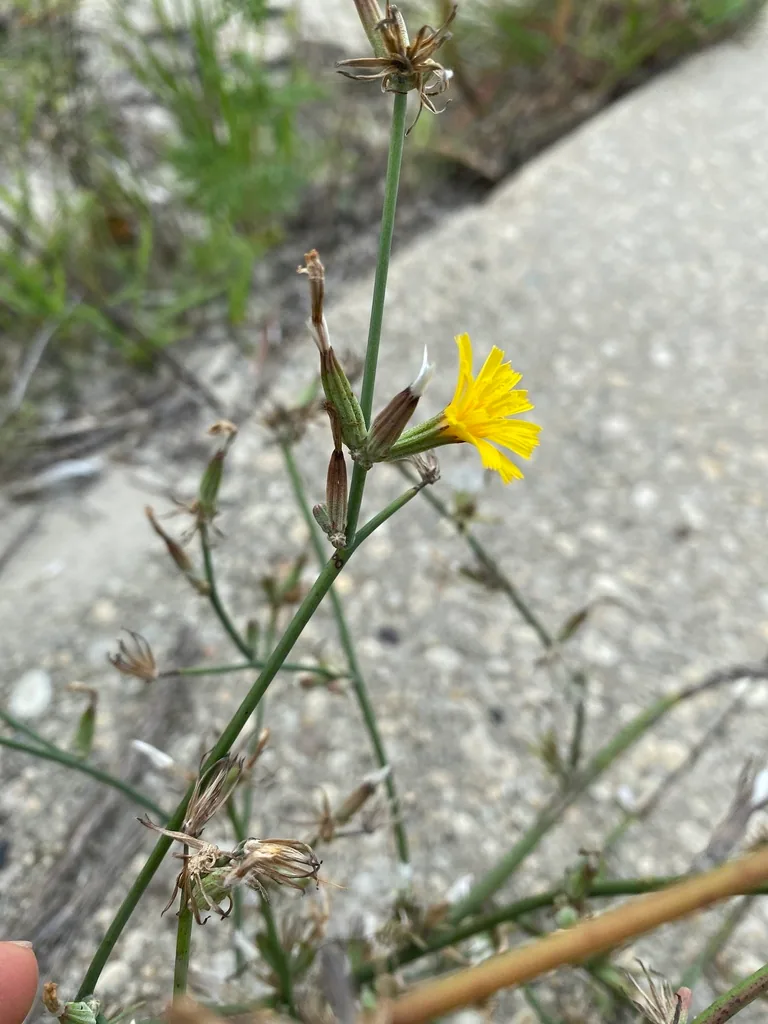
How to Grow and Care for Rush skeletonweed
Chondrilla juncea
Written by Emilio Marruso · last checked
At a glance
Rush skeletonweed is a tough perennial in the daisy family that handles both drought and soggy soil. It grows up to 4 feet tall and spreads from seed and from pieces of root. Its young leaf rosettes make tasty, nutritious fodder for sheep and goats, especially at times of the year when little else is available.
- Water
Handles both drought and waterlogged soil
What the sources say (1)
Watering notes: Tolerant to drought and waterlogging
The plant is tolerant to drought, frost and waterlogging.
— Skeleton weed | Weeds information | Weeds | Biosecurity | Agriculture Victoria [4] - Harvest
Young leaf rosettes are nutritious fodder for sheep and goats
- Pests
Gall mites, gall midges and rust
What the sources say (2)
Pests: gall mite (Eriophyes chondrillae), gall midge (Cystiphora schmidti)
These agents include the gall mite ( Eriophyes chondrillae ), the gall midge ( Cystiphora schmidti ), and the rust fungus ( Puccinia chondrillina ); the latter being the most effective [ 38 ].
— Chondrilla juncea [6] Diseases: rust fungus (Puccinia chondrillina)
These agents include the gall mite ( Eriophyes chondrillae ), the gall midge ( Cystiphora schmidti ), and the rust fungus ( Puccinia chondrillina ); the latter being the most effective [ 38 ].
— Chondrilla juncea [6] - Size
Up to 4 ft tall
What the sources say (1)
Mature height: up to 120 cm (4 ft)
Rush skeletonweed is an invasive perennial forb that can grow up to 4 ft. (1.2 m) tall.
— Chondrilla juncea, Rush Skeletonweed – Invasive Species [1] - Propagation
Grows from seed and from pieces of root
What the sources say (2)
Propagation: Seed and root fragments
Skeleton weed reproduces from a long tap-root and by seed.
— Skeleton weed | Weeds information | Weeds | Biosecurity | Agriculture Victoria [4] All parts of the root system, especially deeper parts, are brittle and easily broken, and new plants can grow from root fragments.
— AgroAtlas - Weeds - Chondrilla juncea L. - Rush Skeletonweed [5]
Overview
Rush skeletonweed is an invasive perennial forb that grows up to 1.2 m [4 ft] tall. [1] It invades dry rangelands and displaces native species. [1] It is native to Europe, Asia and Africa and reached the United States as a fodder contaminant. [2] It prefers well drained sandy to moderately textured soils and does not readily establish on heavy textured soils. [4]
This record is incomplete: the sources we read do not cover every field yet.
Not yet covered by our sources: Light, Hardiness, coldest zone, Hardiness, warmest zone
Rush skeletonweed care
Measurements in square brackets are our conversion into the other unit system; the quoted text is unchanged.
How to water Rush skeletonweed
Tolerant to drought and waterlogging
What the sources say (1)
The plant is tolerant to drought, frost and waterlogging.How much light Rush skeletonweed needs
Not stated in the sources we read.
How much cold Rush skeletonweed can take
Hardiness, coldest zone
Not stated in the sources we read.
Hardiness, warmest zone
Not stated in the sources we read.
Best soil for Rush skeletonweed
Soil pH, minimum
The sources give different values depending on region, zone or growing conditions.
What each source says
sandy soils (review by Panetta and Dodd): 5.3
Australia (Moore): 4.5
What the sources say (2)
sandy soils (review by Panetta and Dodd): Panetta and Dodd [ 67 ] provide evidence of rush skeletonweed
occurrence on sandy soils with pH values in the range of 5.3 to 8.9,Australia (Moore): Moore [ 60 ]
indicates rush skeletonweed occurrence on soils with pH ranges from 4.5
to 8.0 in Australia.Soil pH, maximum
The sources give different values depending on region, zone or growing conditions.
What each source says
sandy soils (review by Panetta and Dodd): 8.9
Australia (Moore): 8.0
What the sources say (2)
sandy soils (review by Panetta and Dodd): Panetta and Dodd [ 67 ] provide evidence of rush skeletonweed
occurrence on sandy soils with pH values in the range of 5.3 to 8.9,Australia (Moore): Moore [ 60 ]
indicates rush skeletonweed occurrence on soils with pH ranges from 4.5
to 8.0 in Australia.How to propagate Rush skeletonweed
Seed and root fragments
What the sources say (2)
Skeleton weed reproduces from a long tap-root and by seed.All parts of the root system, especially deeper parts, are brittle and easily broken, and new plants can grow from root fragments.How to grow Rush skeletonweed
The plant
Life cycle
perennial
What the sources say (1)
Rush skeletonweed is an invasive perennial forb that can grow up to 4 ft. (1.2 m) tall.Family
Asteraceae
What the sources say (1)
Asterales > Asteraceae > Chondrilla juncea L.
Synonym(s): skeletonweed
Chondrilla juncea – USDA PLANTS ProfileMature height
up to 120 cm (4 ft)
What the sources say (1)
Rush skeletonweed is an invasive perennial forb that can grow up to 4 ft. (1.2 m) tall.Pests and diseases
Pests
gall mite (Eriophyes chondrillae), gall midge (Cystiphora schmidti)
What the sources say (1)
These agents include the gall mite ( Eriophyes chondrillae ),
the gall midge ( Cystiphora schmidti ), and the rust fungus
( Puccinia chondrillina ); the latter being the most effective [ 38 ].Diseases
rust fungus (Puccinia chondrillina)
What the sources say (1)
These agents include the gall mite ( Eriophyes chondrillae ),
the gall midge ( Cystiphora schmidti ), and the rust fungus
( Puccinia chondrillina ); the latter being the most effective [ 38 ].Remedies
Each remedy shows what official sources say about it; traditional remedies without an official source are marked as such. Harmful ones are listed so you know to avoid them.
Getting rid of it
rush skeletonweed
hand pulling Partly works
How: Pull two to three times a year as plants reappear, for several years; remove taproots when soil is damp.
For new or small infestations, hand pulling two to three times a year (as plants re-appear) for several years can be effective.
— kingcounty.gov [9] What the evidence says For new or small infestations, hand pulling two to three times a year (as plants re-appear) for several years can be effective.
— kingcounty.gov [9] repeated mowing Partly works
How: Repeated mowing decreases biomass and seed production; effective only before flowering.
Repeated mowing (mechanical control) is effective only before flowering.
— smallgrains.wsu.edu [10] What the evidence says Repeated mowing can decrease biomass and seed production but will likely not eradicate the weed.
— kingcounty.gov [9] tilling Harmful
How: Tilling is not recommended: the plant reproduces from root fragments.
Tilling is not recommended as the plant can reproduce from root fragments and tilling may produce more.
— kingcounty.gov [9] What the evidence says Tilling is not recommended as the plant can reproduce from root fragments and tilling may produce more.
— kingcounty.gov [9] burning Harmful
How: Burning is not recommended.
Burning is also not recommend as multiple iterations are needed and multiple burnings in one season is unsafe and damaging to the ecosystem.
— kingcounty.gov [9] What the evidence says Burning is also not recommend as multiple iterations are needed and multiple burnings in one season is unsafe and damaging to the ecosystem.
— kingcounty.gov [9] rust fungus biocontrol Partly works
How: Rust fungus Puccinia chondrillina released as biological control; infected rosettes can be dug and transplanted among uninfested plants.
Infected rosettes can be dug and transplanted among uninfested plants in the spring and fall.
— invasives.wsu.edu [11] What the evidence says There has been some success at suppression but not eradication of rush skeletonweed using biocontrol.
— kingcounty.gov [9] re-seeding with non-invasive grasses Partly works
How: Maintain healthy pastures, prevent bare spots, re-seed with non-invasive grasses; only in combination with other methods.
Maintain healthy pastures and prevent bare spots caused by overgrazing. Re-seed with verified native or non-invasive grasses.
— kingcounty.gov [9] What the evidence says Note: re-seeding and other cultural control methods will not work on their own in established infestations, and should be used only in combination with other methods or as a preventative measure.
— kingcounty.gov [9]
Edibility
Reported by the source, quoted verbatim. Do not eat a plant on the basis of this page alone: identification mistakes can be dangerous.
Similar plants
- American Burnweed Erechtites hieraciifolius
- Autumn Goldenrod Solidago sphacelata
- Blessed milkthistle Silybum marianum
- Blue Wood Aster Symphyotrichum cordifolium
- Brown knapweed Centaurea jacea
- Bull Thistle Cirsium vulgare
- Bur Marigold Bidens laevis
- Canary Island Marguerite Argyranthemum foeniculaceum
Sources
Every value above is quoted from these documents. Links lead to the original publisher.
- Chondrilla juncea, Rush Skeletonweed – Invasive Species · invasive-species.extension.org, consulted
- Chondrilla juncea Profile – California Invasive Plant Council · cal-ipc.org, consulted
- Skeleton weed · herbiguide.com.au, consulted
- Skeleton weed | Weeds information | Weeds | Biosecurity | Agriculture Victoria · agriculture.vic.gov.au, consulted
- AgroAtlas - Weeds - Chondrilla juncea L. - Rush Skeletonweed · agroatlas.ru, consulted
- Chondrilla juncea · fs.usda.gov, consulted
- Chondrilla juncea page · missouriplants.com, consulted
- Flora of New Zealand | Taxon Profile | Chondrilla juncea · nzflora.info, consulted
- kingcounty.gov · kingcounty.gov
- smallgrains.wsu.edu · smallgrains.wsu.edu
- invasives.wsu.edu · invasives.wsu.edu
Written by Emilio Marruso · last checked