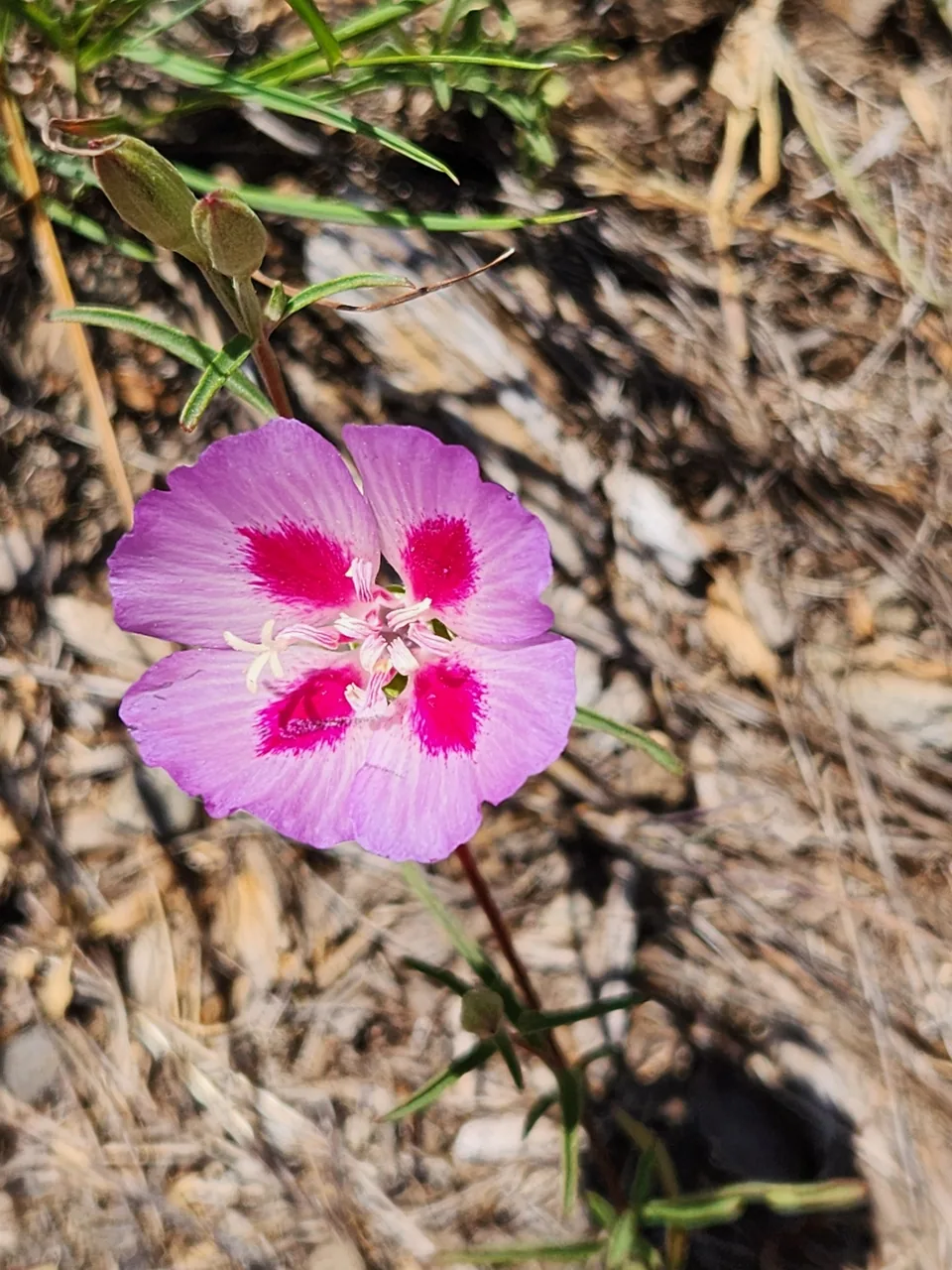
How to Grow and Care for Farewell to spring
Clarkia amoena
Written by Emilio Marruso · last checked
At a glance
Clarkia is an easy annual you grow from seed: sow it right in the garden in spring or fall, after the last frost. It's happy in full sun or partial shade, tolerates drought and grows 16–24 inches tall. Skip the rich soil: in soil that's too rich it grows tall and leafy and gives you fewer flowers.
- Sun
Full sun to partial shade
What the sources say (2)
Light: Full sun to partial shade
Plants grow best in full sun, but are able to grow in partial-shaded conditions.
— Plant Propagation Protocol for Clarkia amoena [3] Habitat preferences: full or partial sun, well-drained soil, dry grassy areas
— Plant Data Sheet http://depts.washington.edu/propplnt/Plants/clarkia amoena.htm [2] - Water
Tolerates drought; water regularly, but don't overwater
What the sources say (2)
Watering: Drought tolerant; water regularly but do not over-water
Care requirements after installed (water weekly, water once etc.): Drought tolerant. Water regularly but do not over-water.
— Plant Data Sheet http://depts.washington.edu/propplnt/Plants/clarkia amoena.htm [2] C. amoena are drought-tolerant and exhibit better success if not transplanted due to their taproot system.
— Plant Propagation Protocol for Clarkia amoena [3] - Soil
Not fussy about soil: pH 5.2–8.5
What the sources say (2)
Soil pH, minimum: 5.2
5.2-8.5 pH; some tolerance to saline and alkaline soil conditions.
— Plant Propagation Protocol for Clarkia amoena [3] Soil pH, maximum: 8.5
5.2-8.5 pH; some tolerance to saline and alkaline soil conditions.
— Plant Propagation Protocol for Clarkia amoena [3] - Spacing
12–24 in between young plants
What the sources say (1)
Spacing: 30.5-61.0 cm (12-24 in), for plugs
Installation form (form, potential for successful outcomes, cost): plugs or seed Recommended planting density: 12-24 inches for plugs
— Plant Data Sheet http://depts.washington.edu/propplnt/Plants/clarkia amoena.htm [2] - Planting
Set out young plants as soon as you can after the last freeze
What the sources say (1)
Planting: As soon as possible after the last freeze date (bedding plants)
Because it grows early in the season, bedding plants should be planted as soon as possible after the last freeze date.
— Farewell to Spring [1] - Harvest
Its seeds were once toasted and ground into a meal to eat
- Watch out
Rich soil makes it tall and leafy, with fewer flowers
- Size
16–24 in tall
What the sources say (1)
Mature height: 41-61 cm (16-24 in)
Farewell to Spring grows 16 to 24 (to 36 inches in some hybrids) inches tall with an erect but sprawling habit with little lateral branching.
— Farewell to Spring [1] - Propagation
Grows from seed
What the sources say (2)
Propagation: Seed
Sow seeds in situ in spring or fall, sown in vented containers in a coldframe, indoors before last frost, or direct sow after last frost.
— Plant Data Sheet http://depts.washington.edu/propplnt/Plants/clarkia amoena.htm [2] Under most conditions, C. amoena readily reseeds itself.
— Plant Propagation Protocol for Clarkia amoena [3] - Sowing
Sow outdoors in spring or fall, after the last frost; seeds need plenty of water and sun to sprout
What the sources say (4)
Sowing: Spring or fall
According to University of Washington (ESRM 412 protocol): Sow seeds in situ in spring or fall, sown in vented containers in a coldframe, indoors before last frost, or direct sow after last frost.
— Plant Data Sheet http://depts.washington.edu/propplnt/Plants/clarkia amoena.htm [2] According to University of Arkansas Division of Agriculture: It can be seeded directly, where it is to grow with seeds lightly raked into the soil in March.
— Farewell to Spring [1] Sow seeds in situ in spring or fall, sown in vented containers in a coldframe, indoors before last frost, or direct sow after last frost.
— Plant Data Sheet http://depts.washington.edu/propplnt/Plants/clarkia amoena.htm [2] Watering notes: Seeds require ample water and sunlight to break dormancy
Seeds require ample water and sunlight to break dormancy.
— Plant Propagation Protocol for Clarkia amoena [3]
Overview
Farewell to spring is a western North American annual wildflower sometimes grown as a springtime garden annual. [1] It grows best in full sun, tolerates partial shade, and is drought-tolerant. [3] It is grown from seed sown in spring or fall and readily reseeds itself. [2][3]
This record is incomplete: the sources we read do not cover every field yet.
Not yet covered by our sources: Hardiness, coldest zone, Hardiness, warmest zone, Pruning
Farewell to spring care
How to water Farewell to spring
Watering
Drought tolerant; water regularly but do not over-water
What the sources say (2)
Care requirements after installed (water weekly, water once etc.): Drought tolerant. Water regularly but do not over-water.C. amoena are drought-tolerant and exhibit better success if not transplanted due to their taproot system.Watering notes
Seeds require ample water and sunlight to break dormancy
What the sources say (1)
Seeds require ample water and sunlight to break dormancy.How much light Farewell to spring needs
Full sun to partial shade
What the sources say (2)
Plants grow best in full sun, but are able to grow in partial-shaded conditions.Habitat preferences: full or partial sun, well-drained soil, dry grassy areasHow much cold Farewell to spring can take
Hardiness, coldest zone
Not stated in the sources we read.
Hardiness, warmest zone
Not stated in the sources we read.
Best soil for Farewell to spring
Soil pH, minimum
5.2
What the sources say (1)
5.2-8.5 pH; some tolerance to saline and alkaline soil conditions.Soil pH, maximum
8.5
What the sources say (1)
5.2-8.5 pH; some tolerance to saline and alkaline soil conditions.Where to grow Farewell to spring
30.5-61.0 cm (12-24 in), for plugs
What the sources say (1)
Installation form (form, potential for successful outcomes, cost): plugs or seed Recommended planting density: 12-24 inches for plugsHow to propagate Farewell to spring
Seed
What the sources say (2)
Sow seeds in situ in spring or fall, sown in vented containers in a coldframe, indoors before last frost, or direct sow after last frost.Under most conditions, C. amoena readily reseeds itself.How to grow Farewell to spring
The plant
Life cycle
annual
What the sources say (1)
All species are annual herbs of the evening primrose family.Mature height
41-61 cm (16-24 in)
What the sources say (1)
Farewell to Spring grows 16 to 24 (to 36 inches in some hybrids) inches tall with an erect but sprawling habit with little lateral branching.Fertilizing
Mineral fertilizers
The sources give different values depending on region, zone or growing conditions.
What each source says
nursery propagation from seed: Slow-release fertilizer in a soilless peat-based medium
What the sources say (1)
nursery propagation from seed: 95% germination occurs within the first two weeks after planting seed in a soil-less peat-based media, amended with micronutrients, slow-release fertilizerMicronutrients
The sources give different values depending on region, zone or growing conditions.
What each source says
nursery propagation from seed: Micronutrients added to the seedling medium
What the sources say (1)
nursery propagation from seed: 95% germination occurs within the first two weeks after planting seed in a soil-less peat-based media, amended with micronutrients, slow-release fertilizerFarewell to spring pests and problems
Nutrient-rich soil
Symptom: Fewer flower heads and taller vegetative growth.
What the sources say (1)
Nutrient-rich soils inhibit the number of flower heads produced and encourage taller vegetative growth
— Plant Propagation Protocol for Clarkia amoena [3]
Remedies
The sources we checked give no remedies for this plant.
Calendar
Sowing
Spring or fall
What each source says
According to University of Washington (ESRM 412 protocol): Spring or fall; direct sow after last frost
According to University of Arkansas Division of Agriculture: March
What the sources say (3)
According to University of Washington (ESRM 412 protocol): Sow seeds in situ in spring or fall, sown in vented containers in a coldframe, indoors before last frost, or direct sow after last frost.According to University of Arkansas Division of Agriculture: It can be seeded directly, where it is to grow with seeds lightly raked
into the soil in March.Sow seeds in situ in spring or fall, sown in vented containers in a coldframe, indoors before last frost, or direct sow after last frost.Planting
As soon as possible after the last freeze date (bedding plants)
What the sources say (1)
Because it grows
early in the season, bedding plants should be planted as soon as possible after the
last freeze date.Pruning
Not stated in the sources we read.
Months as given by the sources, which are mostly from the United States (northern hemisphere). In the southern hemisphere they shift by about six months.
Edibility
Reported by the source, quoted verbatim. Do not eat a plant on the basis of this page alone: identification mistakes can be dangerous.
The seeds were parched and then pounded into a dry seed meal and eaten by the Sierra Miwok
[3]
Indicative values
Values from a secondary source, not checked word for word like the rest of this page. Use them as a starting point.
- Drought tolerant
- yesIndicative value, adapt it to your climate · Secondary source
- USDA hardiness zones
- 2-11 [winter low −45.6 to 10 °C (−50 to 50 °F)]Indicative value, adapt it to your climate · Secondary source
- Care level
- MediumIndicative value, adapt it to your climate · Secondary source
- Growth rate
- LowIndicative value, adapt it to your climate · Secondary source
Similar plants
- Pinkfairies Clarkia pulchella
- Abies grandis Abies grandis
- Abraham Trachystemon orientalis
- Abyssinian banana Ensete ventricosum
- Acacia longifolia Acacia longifolia
- Acanthus hungaricus Acanthus hungaricus
- Achlys triphylla Achlys triphylla
- Aconite Aconitum napellus
Sources
Every value above is quoted from these documents. Links lead to the original publisher.
- Farewell to Spring · uaex.uada.edu, consulted
- Plant Data Sheet http://depts.washington.edu/propplnt/Plants/clarkia amoena.htm · courses.washington.edu, consulted
- Plant Propagation Protocol for Clarkia amoena · courses.washington.edu, consulted
- Clarkia amoena | Farewell-to-spring | Wildflowers of the Pacific Northwest · pnwflowers.com, consulted
- Clarkia Wildflowers: Growing and Care · plantcaretoday.com, consulted
- Lady Bird Johnson Wildflower Center - The University of Texas at Austin · wildflower.org, consulted
- Plant Data Sheet · depts.washington.edu, consulted
Written by Emilio Marruso · last checked