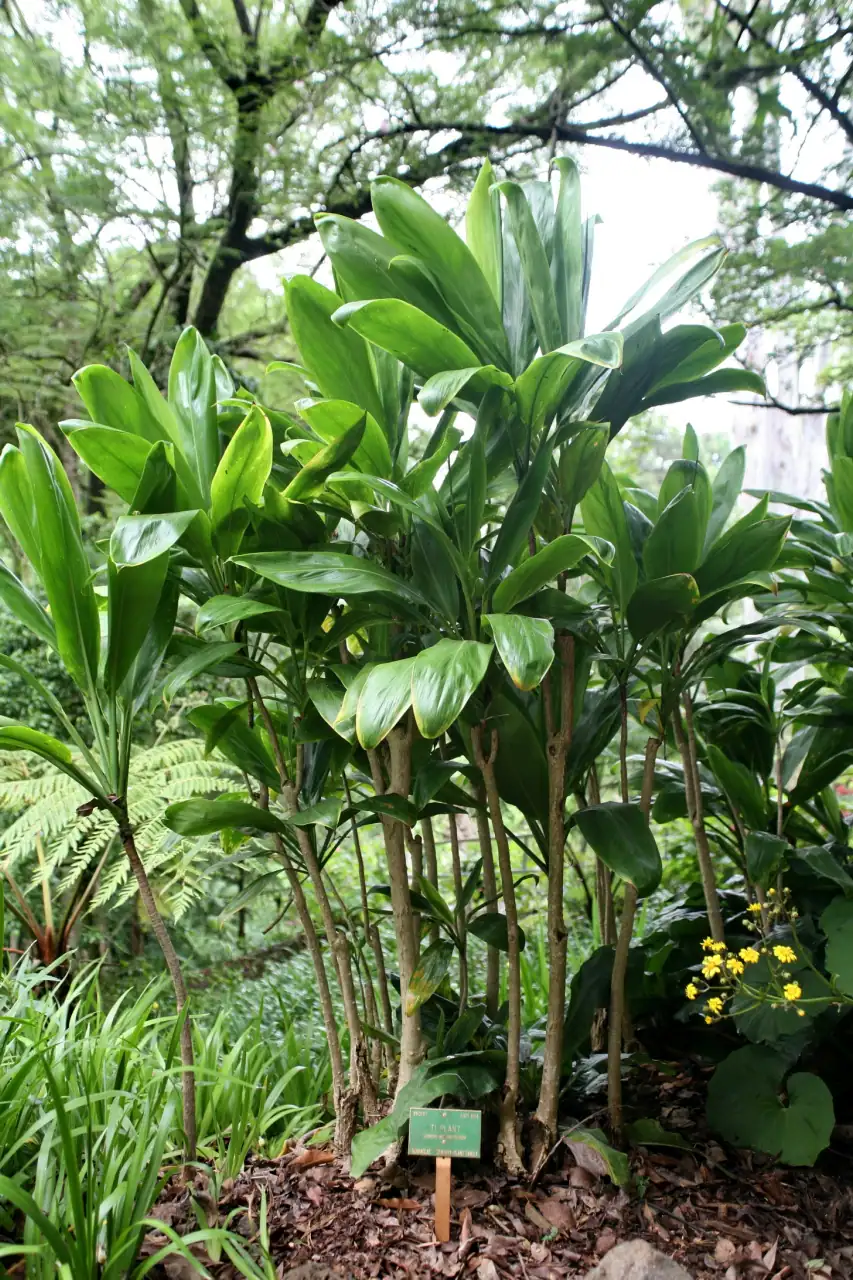


How to Grow and Care for Ti Plant
Cordyline fruticosa
Written by Emilio Marruso · last checked
Toxic to: Cats, Dogs, Horses, People · Why
At a glance
The Ti plant brings bold color to your home or garden: it thrives in containers, grows indoors, and loves bright indirect light. Water it regularly, let it dry a little between drinks, and feed it several times a year to keep its leaf colors bright. In Hawaiian cooking, its leaves are even used to wrap food.
- Sun
Bright indirect light; it also takes dappled sun or shade
What the sources say (3)
Light: Bright indirect light
According to NC State Extension, description: This plant requires bright indirect light to maintain its bright foliage colors.
— Cordyline fruticosa (Baby Doll Ti Plant, Cabbage Palm, Cabbage Tree, Good-Luck Plant, Hawaiian Good Luck Plant, Hawaiian Ti Plant, Hawiian Ti, Ti Plant) | North Carolina Extension Gardener Plant Toolbox [1] According to NC State Extension, cultural conditions: Light: Dappled Sunlight (Shade through upper canopy all day) Deep shade (Less than 2 hours to no direct sunlight)
— Cordyline fruticosa (Baby Doll Ti Plant, Cabbage Palm, Cabbage Tree, Good-Luck Plant, Hawaiian Good Luck Plant, Hawaiian Ti Plant, Hawiian Ti, Ti Plant) | North Carolina Extension Gardener Plant Toolbox [1] This plant requires bright indirect light to maintain its bright foliage colors.
— Cordyline fruticosa (Baby Doll Ti Plant, Cabbage Palm, Cabbage Tree, Good-Luck Plant, Hawaiian Good Luck Plant, Hawaiian Ti Plant, Hawiian Ti, Ti Plant) | North Carolina Extension Gardener Plant Toolbox [1] - Water
Water regularly, letting it dry a bit in between; water less from late fall to late winter
What the sources say (2)
Watering: Water regularly, allowing the plant to dry out a bit between waterings
It should be watered regularly, but allow the plant to dry out a bit between watering.
— Cordyline fruticosa (Baby Doll Ti Plant, Cabbage Palm, Cabbage Tree, Good-Luck Plant, Hawaiian Good Luck Plant, Hawaiian Ti Plant, Hawiian Ti, Ti Plant) | North Carolina Extension Gardener Plant Toolbox [1] Watering notes: Reduce watering from late fall to late winter
Watering should be reduced from late fall to late winter. This plant prefers high humidity and humidifier may be required when grown indoors.
— Cordyline fruticosa (Baby Doll Ti Plant, Cabbage Palm, Cabbage Tree, Good-Luck Plant, Hawaiian Good Luck Plant, Hawaiian Ti Plant, Hawiian Ti, Ti Plant) | North Carolina Extension Gardener Plant Toolbox [1] - Cold
Survives winters down to 30 °F (−1.1 °C)
Half hardy: mild winters or an unheated greenhouse · USDA 10a · RHS H3 · Z10
What the sources say (2)
Hardiness, coldest zone: 10a [winter low −1.1 to 1.7 °C (30 to 35 °F)]
USDA Plant Hardiness Zone: 10a, 10b, 11a, 11b, 12a, 12b
— Cordyline fruticosa (Baby Doll Ti Plant, Cabbage Palm, Cabbage Tree, Good-Luck Plant, Hawaiian Good Luck Plant, Hawaiian Ti Plant, Hawiian Ti, Ti Plant) | North Carolina Extension Gardener Plant Toolbox [1] Hardiness, warmest zone: 12b [winter low 12.8 to 15.6 °C (55 to 60 °F)]
USDA Plant Hardiness Zone: 10a, 10b, 11a, 11b, 12a, 12b
— Cordyline fruticosa (Baby Doll Ti Plant, Cabbage Palm, Cabbage Tree, Good-Luck Plant, Hawaiian Good Luck Plant, Hawaiian Ti Plant, Hawiian Ti, Ti Plant) | North Carolina Extension Gardener Plant Toolbox [1] - Feeding
Feed several times a year to keep the leaf colors bright
What the sources say (1)
How often: Several times a year, which helps the plant keep its leaf colors
Fertilizing the plant several times a year will also help it to maintain its colors.
— Cordyline fruticosa (Baby Doll Ti Plant, Cabbage Palm, Cabbage Tree, Good-Luck Plant, Hawaiian Good Luck Plant, Hawaiian Ti Plant, Hawiian Ti, Ti Plant) | North Carolina Extension Gardener Plant Toolbox [1] - Harvest
In Hawaiian cooking, the leaves are used to wrap food
- Pests
Aphids, scale, spider mites and mealybugs; avoid soggy soil to prevent leaf spot
What the sources say (2)
Pests: aphids, scale insects, spider mites, fungus gnats, thrips, mealybugs
Monitor for aphids, scale insects, spider mites, fungus gnats, thrips, and mealybugs.
— Cordyline fruticosa (Baby Doll Ti Plant, Cabbage Palm, Cabbage Tree, Good-Luck Plant, Hawaiian Good Luck Plant, Hawaiian Ti Plant, Hawiian Ti, Ti Plant) | North Carolina Extension Gardener Plant Toolbox [1] Diseases: leaf spot and other fungal diseases
It may be susceptible to leaf spot and other fungal diseases.
— Cordyline fruticosa (Baby Doll Ti Plant, Cabbage Palm, Cabbage Tree, Good-Luck Plant, Hawaiian Good Luck Plant, Hawaiian Ti Plant, Hawiian Ti, Ti Plant) | North Carolina Extension Gardener Plant Toolbox [1] - Watch out
Dry air turns leaf tips brown: keep humidity high, indoors too
- Size
9 to 15 ft tall and 3 to 8 ft wide
What the sources say (4)
Mature height: 274-457 cm (9 to 15 ft)
Height: 9 ft. 0 in. - 15 ft. 0 in.
— Cordyline fruticosa (Baby Doll Ti Plant, Cabbage Palm, Cabbage Tree, Good-Luck Plant, Hawaiian Good Luck Plant, Hawaiian Ti Plant, Hawiian Ti, Ti Plant) | North Carolina Extension Gardener Plant Toolbox [1] The Ti plant can grow up to 9 to 15 feet tall and 3 to 8 feet wide
— Cordyline fruticosa (Baby Doll Ti Plant, Cabbage Palm, Cabbage Tree, Good-Luck Plant, Hawaiian Good Luck Plant, Hawaiian Ti Plant, Hawiian Ti, Ti Plant) | North Carolina Extension Gardener Plant Toolbox [1] Mature width: 91-244 cm (3 to 8 ft)
Width: 3 ft. 0 in. - 8 ft. 0 in.
— Cordyline fruticosa (Baby Doll Ti Plant, Cabbage Palm, Cabbage Tree, Good-Luck Plant, Hawaiian Good Luck Plant, Hawaiian Ti Plant, Hawiian Ti, Ti Plant) | North Carolina Extension Gardener Plant Toolbox [1] The Ti plant can grow up to 9 to 15 feet tall and 3 to 8 feet wide
— Cordyline fruticosa (Baby Doll Ti Plant, Cabbage Palm, Cabbage Tree, Good-Luck Plant, Hawaiian Good Luck Plant, Hawaiian Ti Plant, Hawiian Ti, Ti Plant) | North Carolina Extension Gardener Plant Toolbox [1] - Propagation
Divide the plant or root pieces of stem
What the sources say (1)
Propagation: Division; stem sections (Ti logs)
It has a rhizomatous root system and can be propagated by division. The plants can also be grown from stem sections that are available commercially and are known as Ti logs.
— Cordyline fruticosa (Baby Doll Ti Plant, Cabbage Palm, Cabbage Tree, Good-Luck Plant, Hawaiian Good Luck Plant, Hawaiian Ti Plant, Hawiian Ti, Ti Plant) | North Carolina Extension Gardener Plant Toolbox [1] - Containers
Grows well in containers and indoors
What the sources say (2)
In containers: Yes
This plant may be used for garden borders, as a container planting, or as a houseplant.
— Cordyline fruticosa (Baby Doll Ti Plant, Cabbage Palm, Cabbage Tree, Good-Luck Plant, Hawaiian Good Luck Plant, Hawaiian Ti Plant, Hawiian Ti, Ti Plant) | North Carolina Extension Gardener Plant Toolbox [1] Indoors: Yes
The Ti plant is a broadleaf evergreen shrub or small tree with multi-colored leaves and is popular as a houseplant.
— Cordyline fruticosa (Baby Doll Ti Plant, Cabbage Palm, Cabbage Tree, Good-Luck Plant, Hawaiian Good Luck Plant, Hawaiian Ti Plant, Hawiian Ti, Ti Plant) | North Carolina Extension Gardener Plant Toolbox [1] - Safety
Toxic to dogs, cats and horses; in people it can upset the stomach if eaten
Overview
Ti plant is a broadleaf evergreen shrub or small tree grown for its multi-colored foliage and popular as a houseplant. [1] It needs bright indirect light and regular watering with a slight drying between waterings, and is winter hardy in USDA Zones 10 to 12. [1] It is toxic to dogs, cats and horses and has low toxicity in humans. [1]
Ti Plant care
How to water Ti Plant
Watering
Water regularly, allowing the plant to dry out a bit between waterings
What the sources say (1)
It should be watered regularly, but allow the plant to dry out a bit between watering.Watering notes
Reduce watering from late fall to late winter
What the sources say (1)
Watering should be reduced from late fall to late winter. This plant prefers high humidity and humidifier may be required when grown indoors.How much light Ti Plant needs
Bright indirect light
What each source says
According to NC State Extension, description: Bright indirect light
According to NC State Extension, cultural conditions: Dappled sunlight, deep shade, partial shade
What the sources say (3)
According to NC State Extension, description: This plant requires bright indirect light to maintain its bright foliage colors.According to NC State Extension, cultural conditions: Light: Dappled Sunlight (Shade through upper canopy all day) Deep shade (Less than 2 hours to no direct sunlight)This plant requires bright indirect light to maintain its bright foliage colors.How much cold Ti Plant can take
Hardiness, coldest zone
10a [winter low −1.1 to 1.7 °C (30 to 35 °F)]
What the sources say (1)
USDA Plant Hardiness Zone:
10a, 10b, 11a, 11b, 12a, 12bHardiness, warmest zone
12b [winter low 12.8 to 15.6 °C (55 to 60 °F)]
What the sources say (1)
USDA Plant Hardiness Zone:
10a, 10b, 11a, 11b, 12a, 12bWhere to grow Ti Plant
Indoors
Yes
What the sources say (1)
The Ti plant is a broadleaf evergreen shrub or small tree with multi-colored leaves and is popular as a houseplant.In containers
Yes
What the sources say (1)
This plant may be used for garden borders, as a container planting, or as a houseplant.How to propagate Ti Plant
Division; stem sections (Ti logs)
What the sources say (1)
It has a rhizomatous root system and can be propagated by division. The plants can also be grown from stem sections that are available commercially and are known as Ti logs.How to grow Ti Plant
The plant
Life cycle
perennial
What the sources say (1)
Life Cycle: PerennialFamily
Asparagaceae
What the sources say (1)
Family: AsparagaceaeMature height
274-457 cm (9 to 15 ft)
What the sources say (2)
Height: 9 ft. 0 in. - 15 ft. 0 in.The Ti plant can grow up to 9 to 15 feet tall and 3 to 8 feet wideMature width
91-244 cm (3 to 8 ft)
What the sources say (2)
Width: 3 ft. 0 in. - 8 ft. 0 in.The Ti plant can grow up to 9 to 15 feet tall and 3 to 8 feet widePests and diseases
Pests
aphids, scale insects, spider mites, fungus gnats, thrips, mealybugs
What the sources say (1)
Monitor for aphids, scale insects, spider mites, fungus gnats, thrips, and mealybugs.Diseases
leaf spot and other fungal diseases
What the sources say (1)
It may be susceptible to leaf spot and other fungal diseases.Fertilizing
How often
Several times a year, which helps the plant keep its leaf colors
What the sources say (1)
Fertilizing the plant several times a year will also help it to maintain its colors.Ti Plant pests and problems
Pests and fungal disease
Symptom: Aphids, scale insects, spider mites, fungus gnats, thrips, mealybugs; leaf spot and other fungal diseases.
What to do: Provide good air circulation and avoid overwatering or soggy wet soil.
What the sources say (2)
Monitor for aphids, scale insects, spider mites, fungus gnats, thrips, and mealybugs. It may be susceptible to leaf spot and other fungal diseases.
— Cordyline fruticosa (Baby Doll Ti Plant, Cabbage Palm, Cabbage Tree, Good-Luck Plant, Hawaiian Good Luck Plant, Hawaiian Ti Plant, Hawiian Ti, Ti Plant) | North Carolina Extension Gardener Plant Toolbox [1] Provide good air circulation and avoid overwatering or soggy wet soil. The leaf tips will turn brown if the air is too dry.
— Cordyline fruticosa (Baby Doll Ti Plant, Cabbage Palm, Cabbage Tree, Good-Luck Plant, Hawaiian Good Luck Plant, Hawaiian Ti Plant, Hawiian Ti, Ti Plant) | North Carolina Extension Gardener Plant Toolbox [1] Brown leaf tips
Symptom: Leaf tips turn brown when the air is too dry.
What to do: Keep humidity high; a humidifier may be required indoors.
What the sources say (2)
Provide good air circulation and avoid overwatering or soggy wet soil. The leaf tips will turn brown if the air is too dry.
— Cordyline fruticosa (Baby Doll Ti Plant, Cabbage Palm, Cabbage Tree, Good-Luck Plant, Hawaiian Good Luck Plant, Hawaiian Ti Plant, Hawiian Ti, Ti Plant) | North Carolina Extension Gardener Plant Toolbox [1] Watering should be reduced from late fall to late winter. This plant prefers high humidity and humidifier may be required when grown indoors.
— Cordyline fruticosa (Baby Doll Ti Plant, Cabbage Palm, Cabbage Tree, Good-Luck Plant, Hawaiian Good Luck Plant, Hawaiian Ti Plant, Hawiian Ti, Ti Plant) | North Carolina Extension Gardener Plant Toolbox [1]
Remedies
Each remedy shows what official sources say about it; traditional remedies without an official source are marked as such. Harmful ones are listed so you know to avoid them.
Treating the plant
aphids
strong blast of water Not verified
Traditional remedy, not verified by an official source.
How: Dislodge aphids, mites and spittle-bug nymphs with a strong blast of water.
adhesive tape Not verified
Traditional remedy, not verified by an official source.
How: Wrap a long piece of tape around your fingers (sticky side out), and blot off the bugs.
yellow dish with soapy water Not verified
Traditional remedy, not verified by an official source.
How: Set a yellow dish filled with soapy water near the plant; aphids are drawn to the color yellow.
vegetable oil and dish soap spray Harmful
All of these products will kill plants if applied at a high enough concentration and with repeated applications
— extension.usu.edu [5] How: Mix 1 cup of vegetable oil with 1 Tblsp. of dish washing liquid, then mix 1 Tblsp. of this concoction with 1 cup of water and spray.
if you mix 1 cup of vegetable oil with 1 Tblsp. of dish washing liquid together and then take 1 Tblsp. of this concoction and mix it with 1 Cup of water, you've created a formula that gets rid of aphids.
— fransorin.com [3] What the evidence says spraying home remedies that contain dish detergent on plants on a sunny day can injure the plant, essentially burning it.
— extension.psu.edu [4]
spider mites
buttermilk and flour spray Not verified
Traditional remedy, not verified by an official source.
How: Combine 1/4 cup of buttermilk and 2 cups of wheat flour in 2-1/2 gallons of water, shake thoroughly and spray it on your plants.
dish soap spray Harmful
All of these products will kill plants if applied at a high enough concentration and with repeated applications
— extension.usu.edu [5] How: Mix 1 Tblsp. of the dish washing liquid with 1 gallon of water.
Mix 1 Tblsp. of the dish washing liquid with 1 gallon of water.
— fransorin.com [3] What the evidence says spraying home remedies that contain dish detergent on plants on a sunny day can injure the plant, essentially burning it.
— extension.psu.edu [4] rubbing alcohol on cotton balls Not verified
Traditional remedy, not verified by an official source.
All of these products will kill plants if applied at a high enough concentration and with repeated applications
— extension.usu.edu [5] How: Rub cotton balls soaked in rubbing alcohol on the infested area; it may take a few times before the pests are gone.
Is Ti Plant toxic to pets?
Reported by the source, quoted verbatim. This is not medical or veterinary advice: if a person or an animal may have eaten this plant, contact a poison control centre or a veterinarian.
Animals
This plant is toxic to dogs, cats, and horses. The Ti plant is considered to have a low toxicity in humans and can cause gastro-intestinal discomfort, if ingested.
[1]- Poisonous parts
Poison Part: Sap/Juice
[1]- Toxic principle
Poison Toxic Principle: Saponins
[1]- Symptoms
Poison Symptoms: Vomiting (occasionally with blood), diarrhea, lethargy, depression, anorexia, hypersalivation, dilated pupils (cats); Skin irritation or rash can occur with contact of the plant's sap.
[1]- Severity
Poison Severity: Low
[1]
People
Wear gloves when handling the plant due to the risk of skin irritation.
[1]- Poisonous parts
Poison Part: Sap/Juice
[1]- Toxic principle
Poison Toxic Principle: Saponins
[1]- Symptoms
Poison Symptoms: Vomiting (occasionally with blood), diarrhea, lethargy, depression, anorexia, hypersalivation, dilated pupils (cats); Skin irritation or rash can occur with contact of the plant's sap.
[1]- Severity
Poison Severity: Low
[1]
Edibility
Reported by the source, quoted verbatim. Do not eat a plant on the basis of this page alone: identification mistakes can be dangerous.
Used as a medicine, fuel, and food. The leaves are used as a food wrapper in Hawaiian cooking.
[1]
Indicative values
Values from a secondary source, not checked word for word like the rest of this page. Use them as a starting point.
- Soil pH
- 6-6.5Indicative value, adapt it to your climate · Secondary source
- Care level
- MediumIndicative value, adapt it to your climate · Secondary source
- Growth rate
- LowIndicative value, adapt it to your climate · Secondary source
- Pruning
- February, March, AprilIndicative value, adapt it to your climate · Secondary source
Similar plants
- Cabbage Tree Cordyline australis
- Mountain Cabbage Tree Cordyline indivisa
- Palm Lily Cordyline rubra
- Adam's Needle Yucca flaccida
- African Spear Dracaena angolensis
- Alpine squill Scilla bifolia
- American Agave Agave virginica
- Asparagus Asparagus officinalis
Sources
Every value above is quoted from these documents. Links lead to the original publisher.
- Cordyline fruticosa (Baby Doll Ti Plant, Cabbage Palm, Cabbage Tree, Good-Luck Plant, Hawaiian Good Luck Plant, Hawaiian Ti Plant, Hawiian Ti, Ti Plant) | North Carolina Extension Gardener Plant Toolbox · plants.ces.ncsu.edu, consulted
- Ti Plant - Cordyline fruticosa | North Carolina Extension Gardener Plant Toolbox · plants.ces.ncsu.edu, consulted
- fransorin.com · fransorin.com
- extension.psu.edu · extension.psu.edu
- extension.usu.edu · extension.usu.edu
Written by Emilio Marruso · last checked