How to Grow and Care for Cannonball tree
Couroupita guianensis
Written by Emilio Marruso · last checked
Toxic to: People · Why
At a glance
This striking tree loves full to part sun and deep, moist soil rich in organic matter. Give it regular water and plenty of room, 20–30 ft from its neighbors, and it will grow happily. Its large fruits fall without warning, so pick a spot well away from paths and roads, then sit back and enjoy it from a safe distance.
- Sun
Full sun to part sun
- Water
Regular, moderate watering for the best growth
What the sources say (2)
- Cold
Survives winters down to 40 °F (4.4 °C)
Tender: needs a frost-free greenhouse · USDA 11 · RHS H2 · Z11
What the sources say (2)
Hardiness, coldest zone: 11 [winter low 4.4 to 10 °C (40 to 50 °F)]
they only thrive in USDA plant hardiness zones 11 and 12.
— Learn About The Tropical Cannonball Tree | Gardening Know How [4] Hardiness, warmest zone: 12 [winter low 10 to 15.6 °C (50 to 60 °F)]
they only thrive in USDA plant hardiness zones 11 and 12.
— Learn About The Tropical Cannonball Tree | Gardening Know How [4] - Soil
Deep, moist soil rich in organic matter that drains well
What the sources say (2)
Watering notes: Well-drained soil rich in organic content; deep, moist, humus-rich soils preferred
Plant the tree in well-drained soil that is rich in organic content.
— Learn About The Tropical Cannonball Tree | Gardening Know How [4] It is a fuss-free tree and prefers deep, moist and humus-rich soils.
— NParks | Couroupita guianensis [2] - Spacing
20–30 ft between trees
What the sources say (1)
Spacing: 600-900 cm (6 m to 9 m [29.5 ft])
Planting Distance | 6 m to 9 m
— NParks | Couroupita guianensis [2] - Watch out
Big fruits fall without warning: keep it away from roads and paths
- Propagation
Grow new plants from seed or from woody stem cuttings
What the sources say (1)
Propagation: Seed; woody stem cuttings
It can be propagated by seeds from ripe fruits (although germination may be difficult), or woody stem cuttings.
— NParks | Couroupita guianensis [2] - Safety
Handle with care: flower pollen and fruit pulp may irritate or cause allergies
Overview
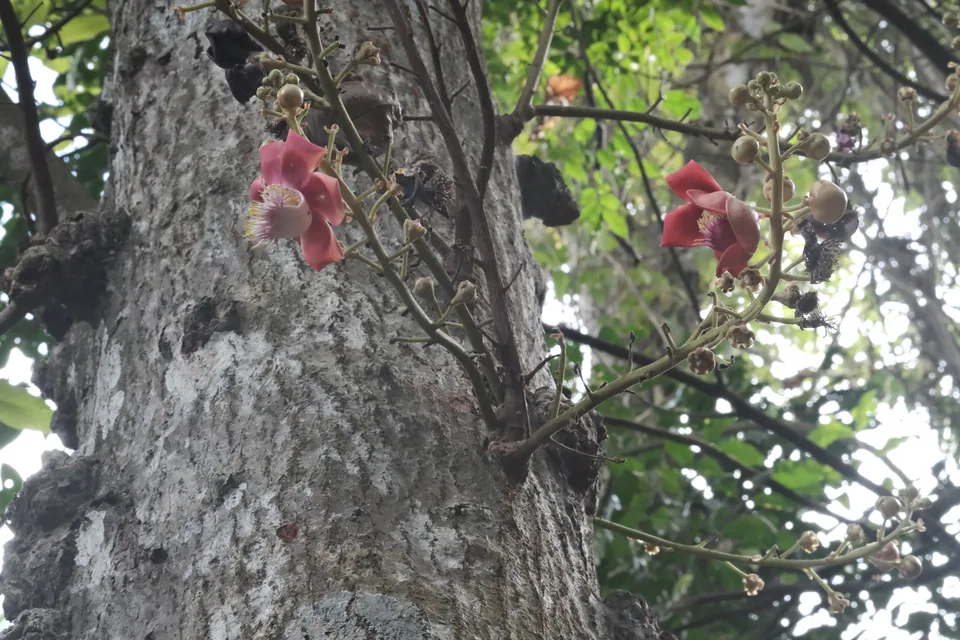
Cannonball tree is a large tropical tree from tropical South America with fragrant flowers borne on the trunk and large woody fruits. [2] It prefers full sun, regular water and deep, moist, humus-rich soils. [2][4] The large fruits fall without warning, and flower pollen and fruit pulp may irritate susceptible people. [2]
This record is incomplete: the sources we read do not cover every field yet.
Not yet covered by our sources: Pruning
Cannonball tree care
Measurements in square brackets are our conversion into the other unit system; the quoted text is unchanged.
How to water Cannonball tree
Watering
Regular water for optimal growth; moderate water preference
Watering notes
Well-drained soil rich in organic content; deep, moist, humus-rich soils preferred
How much light Cannonball tree needs
How much cold Cannonball tree can take
Hardiness, coldest zone
11 [winter low 4.4 to 10 °C (40 to 50 °F)]
What the sources say (1)
they only thrive in USDA plant hardiness zones 11 and 12.Hardiness, warmest zone
12 [winter low 10 to 15.6 °C (50 to 60 °F)]
What the sources say (1)
they only thrive in USDA plant hardiness zones 11 and 12.Where to grow Cannonball tree
600-900 cm (6 m to 9 m [29.5 ft])
What the sources say (1)
Planting Distance
| 6 m to 9 mHow to propagate Cannonball tree
Seed; woody stem cuttings
What the sources say (1)
It can be propagated by seeds from ripe fruits (although germination may be difficult), or woody stem cuttings.How to grow Cannonball tree
The plant
Family
Lecythidaceae
What the sources say (1)
Cannon Ball Tree ## Family - LECYTHIDACEAE ## Scientific Name - Couroupita guianensisCannonball tree pests and problems
Heavy falling fruit
Symptom: Fruits are large and fall without warning.
What to do: Tree should not be planted too closely to roads or paths where clearance is needed.
Remedies
The sources we checked give no remedies for this plant.
Is Cannonball tree poisonous?
Reported by the source, quoted verbatim. This is not medical or veterinary advice: if a person or an animal may have eaten this plant, contact a poison control centre or a veterinarian.
Calendar
Pruning
Not stated in the sources we read.
Months as given by the sources, which are mostly from the United States (northern hemisphere). In the southern hemisphere they shift by about six months.
Indicative values
Values from a secondary source, not checked word for word like the rest of this page. Use them as a starting point.
- Life cycle
- PerennialIndicative value, adapt it to your climate · Secondary source
- Mature height
- 1524-2286 cm (50-75 ft)Indicative value, adapt it to your climate · Secondary source
- Hours of sun
- 6-8 hoursIndicative value, adapt it to your climate · Secondary source
- Soil pH
- 5.5-6.5Indicative value, adapt it to your climate · Secondary source
- Care level
- HighIndicative value, adapt it to your climate · Secondary source
- Growth rate
- LowIndicative value, adapt it to your climate · Secondary source
- Pruning
- May, June, July, AugustIndicative value, adapt it to your climate · Secondary source
Similar plants
- Abies grandis Abies grandis
- Abraham Trachystemon orientalis
- Abyssinian banana Ensete ventricosum
- Acacia longifolia Acacia longifolia
- Acanthus hungaricus Acanthus hungaricus
- Achlys triphylla Achlys triphylla
- Aconite Aconitum napellus
- Adam's Needle Yucca flaccida
Sources
Every value above is quoted from these documents. Links lead to the original publisher.
- Plants of Hawai'i | Bishop Museum · plantsofhawaii.org, consulted
- NParks | Couroupita guianensis · nparks.gov.sg, consulted
- Cannon Ball Tree | National Herbarium of Trinidad and Tobago · sta.uwi.edu, consulted
- Learn About The Tropical Cannonball Tree | Gardening Know How · gardeningknowhow.com, consulted
Written by Emilio Marruso · last checked