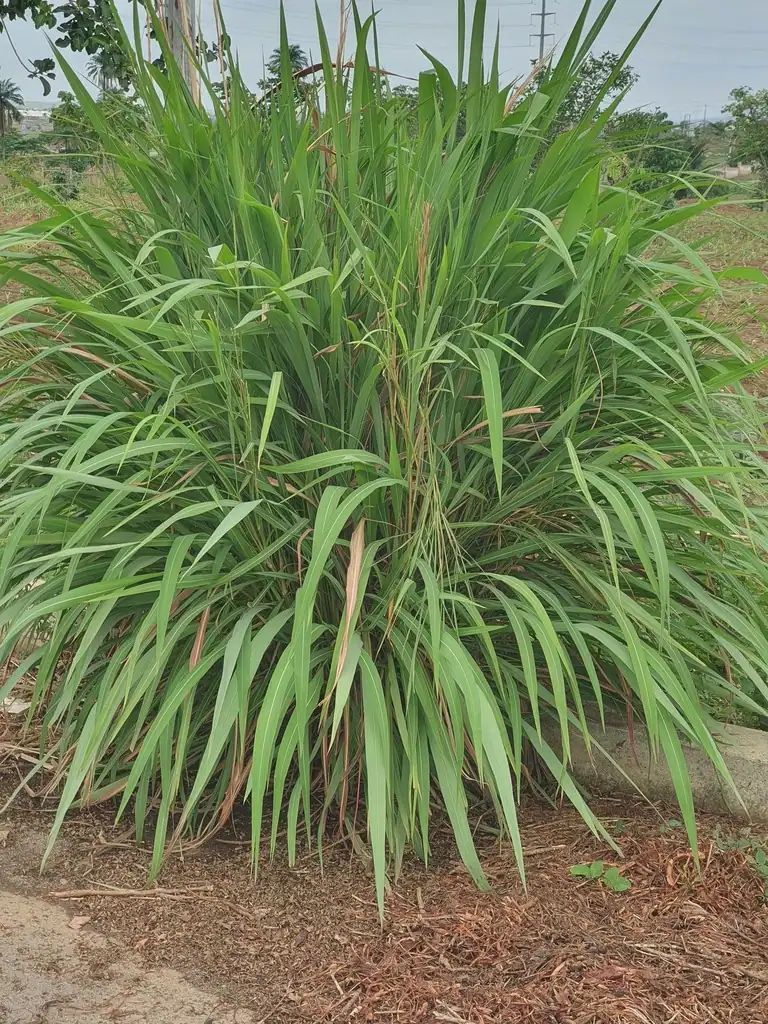
How to Grow and Care for Lemon grass
Cymbopogon citratus
Written by Emilio Marruso · last checked
Toxic to: Cats, Dogs, Horses · Why
At a glance
Lemongrass is a sun-loving perennial grass with strongly lemon-scented leaves that flavor teas, soups and sauces. Plant it once the danger of frost has passed, give it plenty of water, and start cutting stalks as soon as they are 1/2 inch thick. It grows happily in containers too, and you can even root stalks from the grocery store in water.
- Sun
Full sun to part sun
- Water
Needs lots of water, so water regularly at the base; too much can rot the roots
What the sources say (6)
Watering: Water regularly; requires a great deal of water, so water regularly if rainfall is sparse; water by hand or use flood irrigation rather than sprinklers
Lemongrass requires a great deal of water, so water regularly if rainfall is sparse.
— Lemongrass, Cymbopogon spp. – Wisconsin Horticulture [4] Water lemongrass by hand or use flood irrigation rather than irrigate with sprinklers.
— How to Grow Lemongrass in Your Garden | USU [3] Watering notes: Prefers regular rainfall and humid conditions; in a dry climate it should be misted and regularly watered; if grown in a container, water regularly so the pots do not dry out; do not let it dry out when overwintered as a container plant; do not overwater as that can lead to root rot
Lemongrass is native to tropical climates, so it prefers regular rainfall and more humid conditions.
— How to Grow Lemongrass in Your Garden | USU [3] If grown in a container, water regularly so the pots do not dry out.
— How to Grow Lemongrass in Your Garden | USU [3] overwinter as a container plant but do not let it dry out.
— Cymbopogon citratus (Lemongrass, Lemon Grass, Oil Grass) | North Carolina Extension Gardener Plant Toolbox [1] Do not overwater as that can lead to root rot.
— Lemon Grass | Herbs | Illinois Extension | Illinois [6] - Cold
Survives winters down to 15 °F (−9.4 °C)
Hardy in average winters · USDA 8b · RHS H4 · Z8
What the sources say (2)
Hardiness, coldest zone: 8b [winter low −9.4 to −6.7 °C (15 to 20 °F)]
USDA Plant Hardiness Zone: 8b, 9a, 9b, 10a, 10b, 11a, 11b
— Cymbopogon citratus (Lemongrass, Lemon Grass, Oil Grass) | North Carolina Extension Gardener Plant Toolbox [1] Hardiness, warmest zone: 11b [winter low 7.2 to 10 °C (45 to 50 °F)]
USDA Plant Hardiness Zone: 8b, 9a, 9b, 10a, 10b, 11a, 11b
— Cymbopogon citratus (Lemongrass, Lemon Grass, Oil Grass) | North Carolina Extension Gardener Plant Toolbox [1] - Spacing
3 ft between plants
What the sources say (1)
Spacing: 91.4 cm (3 feet) apart
Lemongrass divisions should be spaced 3 feet apart in the garden since it can grow 3 to 6 feet tall and 3 feet wide
— How to Grow Lemongrass in Your Garden | USU [3] - Planting
Plant out once the danger of frost has passed
What the sources say (2)
- Feeding
Compost before planting; half-strength balanced fertilizer from June to September
What the sources say (8)
When: Through the summer growing season, June to September; less often indoors in winter
Water and feed regularly from June through September to maximize growth.
— How to Grow Lemongrass in Your Garden | USU [3] Water and feed regularly from June through September to maximize growth.
— Fact sheet: Lemongrass - UF/IFAS Extension Nassau County [5] While indoors, water as need and reduce the frequency of fertilizer applications.
— Lemon Grass | Herbs | Illinois Extension | Illinois [6] Mineral fertilizers: Balanced water-soluble fertilizer at half strength, rich in nitrogen for summer growth; in the ground, worked into the top 15.2 cm [6 in] of soil according to a soil test
Like other grasses, lemongrass requires lots of nitrogen during the summer.
— How to Grow Lemongrass in Your Garden | USU [3] It should be feed weekly with a half-strength solution of a balanced soluble fertilizer from June through September.
— How to Grow Lemongrass in Your Garden | USU [3] If fertilizer are needed, work the fertilizer into the top 6 inches of soil.
— How to Grow Lemongrass in Your Garden | USU [3] Natural fertilizers: Well-composted organic matter worked into the soil before planting
If you fertilize with compost, apply no more than 1 inch of well-composted organic matter per 100 square feet of garden area.
— How to Grow Lemongrass in Your Garden | USU [3] Soil Preparation : Before planting, amend soils with 2 to 4 inches of organically rich compost.
— Fact sheet: Lemongrass - UF/IFAS Extension Nassau County [5] - Harvest
Cut stalks at ground level once they are 1/2 inch thick; leaves flavor teas and soups
What the sources say (6)
Harvest: At any time once the stalks have reached 1/2 inch [1.3 cm] thick; in cooler areas at the end of the growing season just before the first fall frost
cooler areas of Utah: In cooler areas of Utah, harvesting occurs at the end of the growing season just before the first fall frost.
— How to Grow Lemongrass in Your Garden | USU [3] According to Utah State University Extension: However, lemongrass can be harvested at any time, once the plant stalks have reached ½ inch thick.
— How to Grow Lemongrass in Your Garden | USU [3] According to University of Wisconsin Extension: The entire clump can be harvested (such as at the end of the season just before the first frost)
— Lemongrass, Cymbopogon spp. – Wisconsin Horticulture [4] In cooler areas of Utah, harvesting occurs at the end of the growing season just before the first fall frost.
— How to Grow Lemongrass in Your Garden | USU [3] However, lemongrass can be harvested at any time, once the plant stalks have reached ½ inch thick.
— How to Grow Lemongrass in Your Garden | USU [3] How to harvest: Cut stems at ground level, or push an outside stem to the side, twist and pull it off, or cut with a knife; harvest once the stalks are 1.3 cm (1/2 inch) thick. Discard the outer woody layers and the leaves.
lemongrass can be harvested at any time, once the plant stalks have reached ½ inch thick. To harvest, cut stems at ground level, or push an outside stem to the side, twist and pull off, or cut with a knife.
— How to Grow Lemongrass in Your Garden | USU [3] - Pests
Spider mites, mostly indoors, and leaf blight; a strong jet of water knocks mites off
What the sources say (3)
Pests: spider mites
Piercing type pest that feed on plants cell contents causing tiny yellow or white speckling. Mostly an indoor plant problem.
— How to Grow Lemongrass in Your Garden | USU [3] Diseases: leaf blight, little leaf (grassy shoot)
Leaf Blight: Reddish brown spots on leaf tips and margins; appear to be prematurely drying.
— Fact sheet: Lemongrass - UF/IFAS Extension Nassau County [5] Little Leaf or Grassy Shoot: Stunted growth of normal inflorescence. Spray with registered fungicides if positively identified.
— Fact sheet: Lemongrass - UF/IFAS Extension Nassau County [5] - Watch out
Pull weeds by hand while the plants are small
- Propagation
Divide clumps, take cuttings, or root grocery-store stalks in water
What the sources say (4)
Propagation: Division of clumps, seed (rarely grown from seed), stem cuttings, grocery-store stalks rooted in water
Recommended Propagation Strategy: Division Seed Country Or Region Of Origin:
— Cymbopogon citratus (Lemongrass, Lemon Grass, Oil Grass) | North Carolina Extension Gardener Plant Toolbox [1] Divide last year’s lemongrass clumps or purchase starter plants from local nurseries. Lemongrass is rarely grown from seed.
— How to Grow Lemongrass in Your Garden | USU [3] Lemon grass is easily grown from stem cuttings or divisions.
— Lemon Grass | Herbs | Illinois Extension | Illinois [6] Fresh stalks of lemongrass (leaves and roots absent) can be purchased at grocery stores specializing in Asian cuisine and will root in a glass of water in about 2 weeks.
— How to Grow Lemongrass in Your Garden | USU [3] - Containers
Grows in containers; water often so the pot never dries out, even in winter
What the sources say (5)
In containers: Yes
Because lemon grass is not winter hardy in colder climates, it is best grown as a container plant.
— Lemon Grass | Herbs | Illinois Extension | Illinois [6] Watering notes: Prefers regular rainfall and humid conditions; in a dry climate it should be misted and regularly watered; if grown in a container, water regularly so the pots do not dry out; do not let it dry out when overwintered as a container plant; do not overwater as that can lead to root rot
Lemongrass is native to tropical climates, so it prefers regular rainfall and more humid conditions.
— How to Grow Lemongrass in Your Garden | USU [3] If grown in a container, water regularly so the pots do not dry out.
— How to Grow Lemongrass in Your Garden | USU [3] overwinter as a container plant but do not let it dry out.
— Cymbopogon citratus (Lemongrass, Lemon Grass, Oil Grass) | North Carolina Extension Gardener Plant Toolbox [1] Do not overwater as that can lead to root rot.
— Lemon Grass | Herbs | Illinois Extension | Illinois [6] - Safety
Keep away from cats, dogs and horses: it is harmful to them
Overview
Lemongrass is a tender perennial herb that needs warm, humid conditions, full sun and plenty of moisture. [3] It is propagated mainly by dividing clumps or from stem cuttings and is rarely grown from seed. [3] It is not winter hardy in colder climates, so it is grown as an annual or in containers brought indoors before frost. [6][3]
Lemon grass care
Measurements in square brackets are our conversion into the other unit system; the quoted text is unchanged.
How to water Lemon grass
Watering
Water regularly; requires a great deal of water, so water regularly if rainfall is sparse; water by hand or use flood irrigation rather than sprinklers
What the sources say (2)
Lemongrass requires a great deal of water, so water regularly if rainfall is sparse.Water lemongrass by hand or use flood irrigation rather than irrigate with sprinklers.Watering notes
Prefers regular rainfall and humid conditions; in a dry climate it should be misted and regularly watered; if grown in a container, water regularly so the pots do not dry out; do not let it dry out when overwintered as a container plant; do not overwater as that can lead to root rot
What the sources say (4)
Lemongrass is native to tropical climates, so it prefers regular rainfall and more humid conditions.If grown in a container, water regularly so the pots do not dry out.overwinter as a container plant but do not let it dry out.Do not overwater as that can lead to root rot.How much light Lemon grass needs
How much cold Lemon grass can take
Hardiness, coldest zone
8b [winter low −9.4 to −6.7 °C (15 to 20 °F)]
What the sources say (1)
USDA Plant Hardiness Zone:
8b, 9a, 9b, 10a, 10b, 11a, 11bHardiness, warmest zone
11b [winter low 7.2 to 10 °C (45 to 50 °F)]
What the sources say (1)
USDA Plant Hardiness Zone:
8b, 9a, 9b, 10a, 10b, 11a, 11bWhere to grow Lemon grass
Indoors
Under review: our second check questioned this value.
In containers
Yes
What the sources say (1)
Because lemon grass is not winter hardy in colder climates, it is best grown as a container plant.Spacing
91.4 cm (3 feet) apart
What the sources say (1)
Lemongrass divisions should be spaced 3 feet apart in the garden since it can grow 3 to 6 feet tall and 3 feet wideHow to propagate Lemon grass
Division of clumps, seed (rarely grown from seed), stem cuttings, grocery-store stalks rooted in water
What the sources say (4)
Recommended Propagation Strategy:
Division
Seed
Country Or Region Of Origin:Divide last year’s lemongrass clumps or purchase starter plants from local nurseries. Lemongrass is rarely grown from seed.Lemon grass is easily grown from stem cuttings or divisions.Fresh stalks of lemongrass (leaves and roots absent) can be purchased at grocery stores specializing in Asian cuisine and will root in a glass of water in about 2 weeks.How to grow Lemon grass
The plant
Life cycle
perennial
What the sources say (1)
It is a tender perennial that is commonly grown as an annual in cooler areas of Utah.Family
Poaceae
What the sources say (1)
Genus: Cymbopogon Species: citratus Family: Poaceae Uses (Ethnobotany): Flavoring in cuisine Life Cycle: PerennialMature height
The sources disagree:
Harvest and storage
How to harvest
Cut stems at ground level, or push an outside stem to the side, twist and pull it off, or cut with a knife; harvest once the stalks are 1.3 cm (1/2 inch) thick. Discard the outer woody layers and the leaves.
What the sources say (1)
lemongrass can be harvested at any time, once the plant stalks have reached ½ inch thick. To harvest, cut stems at ground level, or push an outside stem to the side, twist and pull off, or cut with a knife.Storage
Dry the leaves in the sun or oven; the stalks can be frozen for up to 6 months.
What the sources say (1)
Dry lemongrass leaves in the sun or oven and use like bay leaf in soups and teas. Lemongrass can be frozen up to 6 months.Pests and diseases
Pests
spider mites
What the sources say (1)
Piercing type pest that feed on plants cell contents causing tiny yellow or white speckling. Mostly an indoor plant problem.Diseases
leaf blight, little leaf (grassy shoot)
What the sources say (2)
Leaf Blight: Reddish brown spots on leaf tips and margins; appear to be prematurely drying.Little Leaf or Grassy Shoot: Stunted growth of normal inflorescence. Spray with registered fungicides if positively identified.Fertilizing
When
Through the summer growing season, June to September; less often indoors in winter
What the sources say (3)
Water and feed regularly from June through September to maximize growth.Water and feed regularly from June through September to maximize growth.While indoors, water as need and reduce the frequency of fertilizer applications.How often
The sources disagree:
What each source says
in the ground: Monthly
indoor potted plants: Monthly
What the sources say (2)
in the ground: Supply a similar fertilizer monthly for plants in the ground. For indoor potted plants, feed monthly.indoor potted plants: Supply a similar fertilizer monthly for plants in the ground. For indoor potted plants, feed monthly.Natural fertilizers
Well-composted organic matter worked into the soil before planting
What the sources say (2)
If you fertilize with compost, apply no more than 1 inch of well-composted organic matter per 100 square feet of garden area.Soil Preparation : Before planting, amend soils with 2 to 4 inches of organically rich compost.Mineral fertilizers
Balanced water-soluble fertilizer at half strength, rich in nitrogen for summer growth; in the ground, worked into the top 15.2 cm [6 in] of soil according to a soil test
What the sources say (3)
Like other grasses, lemongrass requires lots of nitrogen during the summer.It should be feed weekly with a half-strength solution of a balanced soluble fertilizer from June through September.If fertilizer are needed, work the fertilizer into the top 6 inches of soil.Lemon grass pests and problems
Spider mites
Symptom: Tiny yellow or white speckling caused by piercing pests feeding on plant cell contents; mostly an indoor plant problem.
What to do: Use insecticidal soaps, registered insecticides or spray the plant with a forceful jet of water to dislodge the insects.
What the sources say (2)
Piercing type pest that feed on plants cell contents causing tiny yellow or white speckling. Mostly an indoor plant problem.
— How to Grow Lemongrass in Your Garden | USU [3] Use insecticidal soaps, registered insecticides or spray plant with a forceful jet of water to dislodge the insects.
— How to Grow Lemongrass in Your Garden | USU [3] Leaf blight
Symptom: Reddish brown spots on leaf tips and margins; leaves appear to prematurely dry out.
What to do: Spray with registered fungicides if positively identified or hand remove blighted leaves.
Weeds
Symptom: Weeds do not compete well with mature lemongrass but may be a problem when plants are small.
What to do: Hand weeding may be required when plants are small.
What the sources say (1)
Weeds don’t compete well with mature lemongrass. Hand weeding may be required when plants are small.
— How to Grow Lemongrass in Your Garden | USU [3]
Remedies
Each remedy shows what official sources say about it; traditional remedies without an official source are marked as such. Harmful ones are listed so you know to avoid them.
Treating the plant
spider mites
forceful jet of water Works
How: Spray the plant with a forceful jet of water to dislodge the insects.
Use insecticidal soaps, registered insecticides or spray plant with a forceful jet of water to dislodge the insects.
— How to Grow Lemongrass in Your Garden | USU [3] What the evidence says Spider Mites: Piercing type pest that feed on plants cell contents causing tiny yellow or white speckling. Problem mostly on indoor plants. Use insecticidal soaps, registered insecticides or spray plant with a forceful jet of water to dislodge the insects.
— Fact sheet: Lemongrass - UF/IFAS Extension Nassau County [5]
leaf blight
removing blighted leaves by hand Official source, not independently tested
How: Hand remove blighted leaves.
Spray with registered fungicides if positively identified or hand remove blighted leaves.
— Fact sheet: Lemongrass - UF/IFAS Extension Nassau County [5]
weeds
hand weeding Official source, not independently tested
How: Hand weeding may be required when plants are small; weeds do not compete well with mature lemongrass.
Weeds don’t compete well with mature lemongrass. Hand weeding may be required when plants are small.
— How to Grow Lemongrass in Your Garden | USU [3]
Is Lemon grass toxic to pets?
Reported by the source, quoted verbatim. This is not medical or veterinary advice: if a person or an animal may have eaten this plant, contact a poison control centre or a veterinarian.
#problem for horses #problem for dogs #problem for cats
[1]The source flags the risk for this animal but does not explain why.
Calendar
Harvest
At any time once the stalks have reached 1/2 inch [1.3 cm] thick; in cooler areas at the end of the growing season just before the first fall frost
What each source says
cooler areas of Utah: At the end of the growing season just before the first fall frost
According to Utah State University Extension: At any time, once the plant stalks have reached 1/2 inch [1.3 cm] thick
According to University of Wisconsin Extension: Cut stems when about 1/2 inch [1.3 cm] thick; entire clump at the end of the season just before the first frost
What the sources say (5)
cooler areas of Utah: In cooler areas of Utah, harvesting occurs at the end of the growing season just before the first fall frost.According to Utah State University Extension: However, lemongrass can be harvested at any time, once the plant stalks have reached ½ inch thick.According to University of Wisconsin Extension: The entire clump can be harvested (such as at the end of the season just before the first frost)In cooler areas of Utah, harvesting occurs at the end of the growing season just before the first fall frost.However, lemongrass can be harvested at any time, once the plant stalks have reached ½ inch thick.Months as given by the sources, which are mostly from the United States (northern hemisphere). In the southern hemisphere they shift by about six months.
Relative to frost
Less precise estimate: there is no weather station within 300 km.
Find frost dates by ZIP code or city
Plant: around the last frost
Plant the divisions after the danger from frost has passed.
— How to Grow Lemongrass in Your Garden | USU [3] Transplant: around the last frost
Place plants outside as soon as the danger from frost is past.
— Lemongrass, Cymbopogon spp. – Wisconsin Horticulture [4]
Count from the average frost dates where you live.
Edibility
Reported by the source, quoted verbatim. Do not eat a plant on the basis of this page alone: identification mistakes can be dangerous.
Strongly scented lemon leaves used in India and Southern Asian cuisine; overwinter as a container plant but do not let it dry out.
[1]The whole stalk itself is too hard to be eaten, so it is usually smashed and simmered in liquid to impart the lemony flavor to the dish, then removed before serving.
[4]Leaves and the stems can be harvested for use.
[6]The lemongrass leaves are used to flavor teas, soups and sauces.
[3]
Indicative values
Values from a secondary source, not checked word for word like the rest of this page. Use them as a starting point.
- Hours of sun
- 6-8 hoursIndicative value, adapt it to your climate · Secondary source
- Drought tolerant
- yesIndicative value, adapt it to your climate · Secondary source
- Soil pH
- 5.5-7.5Indicative value, adapt it to your climate · Secondary source
- Growth rate
- LowIndicative value, adapt it to your climate · Secondary source
- Pruning
- March, April, MayIndicative value, adapt it to your climate · Secondary source
Similar plants
- African lovegrass Eragrostis curvula
- Aristida purpurea Aristida purpurea
- Autumn Moor Grass Sesleria autumnalis
- Bamboo Phyllostachys aurea
- Beaked Panicgrass Coleataenia anceps
- Bermuda grass Cynodon dactylon
- Big Bluestem Andropogon gerardi
- Bigtop Lovegrass Eragrostis hirsuta
Sources
Every value above is quoted from these documents. Links lead to the original publisher.
- Cymbopogon citratus (Lemongrass, Lemon Grass, Oil Grass) | North Carolina Extension Gardener Plant Toolbox · plants.ces.ncsu.edu, consulted
- Lemongrass - Cymbopogon citratus | North Carolina Extension Gardener Plant Toolbox · plants.ces.ncsu.edu, consulted
- How to Grow Lemongrass in Your Garden | USU · extension.usu.edu, consulted
- Lemongrass, Cymbopogon spp. – Wisconsin Horticulture · hort.extension.wisc.edu, consulted
- Fact sheet: Lemongrass - UF/IFAS Extension Nassau County · blogs.ifas.ufl.edu, consulted
- Lemon Grass | Herbs | Illinois Extension | Illinois · extension.illinois.edu, consulted
- Lemongrass – Gardening Solutions · gardeningsolutions.ifas.ufl.edu, consulted
Written by Emilio Marruso · last checked