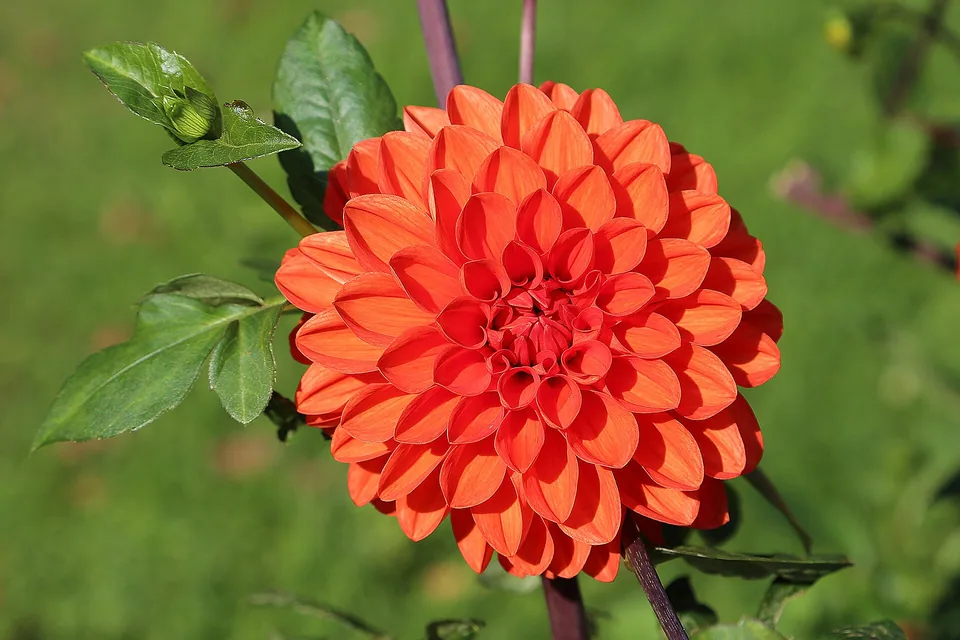
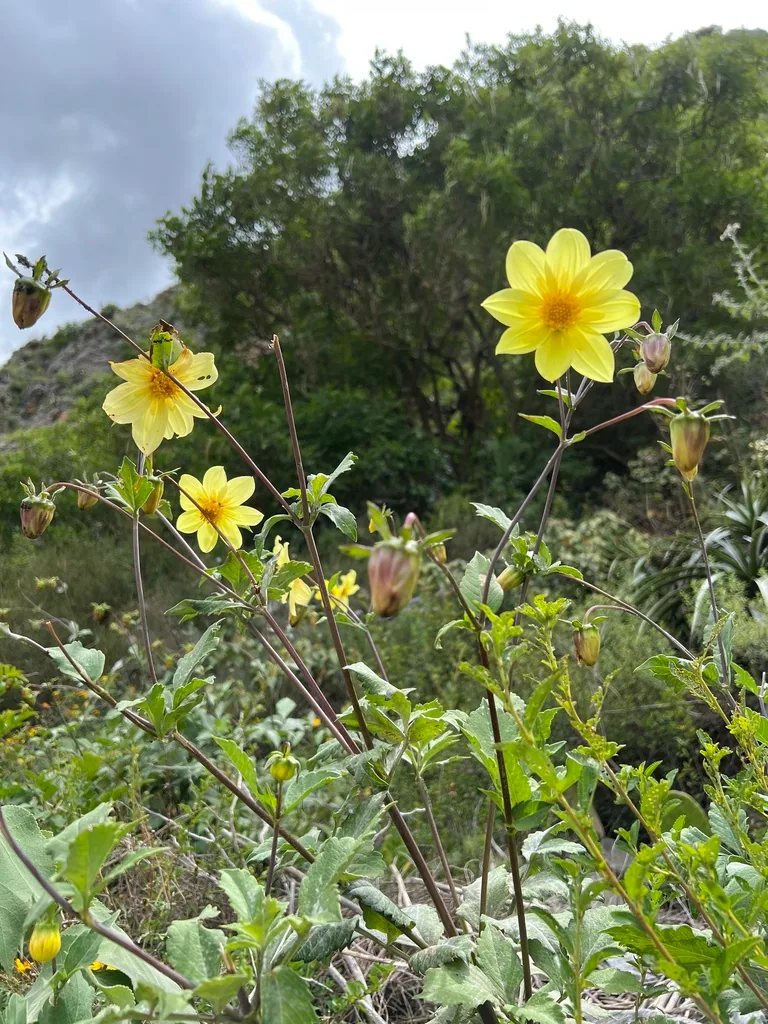

How to Grow and Care for Pinnate dahlia
Dahlia pinnata
Written by Emilio Marruso · last checked
Toxic to: Cats, Dogs, Horses, People · Why
At a glance
Dahlias bring a summer of flowers to a sunny, sheltered spot. Replant the stored tubers in spring, give them 1 inch of water a week, and never let the soil dry out. You can even toss the flowers into salads, and one dahlia happily fills a 20-inch-wide pot, so a patio is enough to start.
- Sun
Full sun, sheltered from wind
- Water
1 inch of water a week in summer; never let the soil dry out, water more when hot and dry
What the sources say (6)
Watering: Water abundantly in summer; do not let the soil dry out (about 2.5 cm / 1 inch of water per week)
According to Useful Tropical Plants: An easily grown plant so long as the soil does not dry out
— Dahlia pinnata - Useful Tropical Plants [3] According to World of Flowering Plants: Make sure your Dahlia s get an inch of water per week. Track rainfall so watering stays consistent.
— Dahlia pinnata (Garden Dahlia) - World of Flowering Plants [4] An easily grown plant so long as the soil does not dry out
— Dahlia pinnata - Useful Tropical Plants [3] Make sure your Dahlia s get an inch of water per week. Track rainfall so watering stays consistent.
— Dahlia pinnata (Garden Dahlia) - World of Flowering Plants [4] Drought: Not suited to very dry conditions; plants in the ground need extra watering in dry, hot weather.
They like fertile soil that is moist, yet free-draining. They won’t thrive in very dry conditions and may rot in waterlogged soil
— [8] Dahlias are thirsty plants and those growing in the ground need additional watering in dry and hot weather.
— [8] - Cold
Survives winters down to 10 °F (−12.2 °C)
Hardy in cold winters · USDA 8a · RHS H5 · Z8
What the sources say (2)
Hardiness, coldest zone: 8a [winter low −12.2 to −9.4 °C (10 to 15 °F)]
Hardiness: USDA hardiness zone 8a to 11b: from 10°F (-12.2°C) to 50°F (10°C).
— Dahlia pinnata (Garden Dahlia) - World of Flowering Plants [4] Hardiness, warmest zone: 11b [winter low 7.2 to 10 °C (45 to 50 °F)]
Hardiness: USDA hardiness zone 8a to 11b: from 10°F (-12.2°C) to 50°F (10°C).
— Dahlia pinnata (Garden Dahlia) - World of Flowering Plants [4] - Soil
Well-drained soil, so water doesn't pool around the roots
What the sources say (1)
Watering notes: Well-drained soil so that water does not accumulate around the roots
Thrives in temperate climates with full sun and well-drained soil.
— The Living Mountain Lab [2] - Spacing
At least 2 ft between plants, more for big varieties
What the sources say (3)
Between plants: At least 60 cm [24 in] between plants, more for larger cultivars.
rooted cuttings: growing in containers – plant a few millimetres lower than they were in the container. Space plants 50–60cm (20in–2ft) apart
— [8] in containers: Aim for a larger container – around 50cm (20in) wide. This will take one standard sized dahlia, but for small bedding dahlias, up to three can be planted together in a pot this size
— [8] Make sure there is plenty of space between plants – at least 60cm (2ft), and more for larger cultivars
— [8] - Planting
Replant the stored tubers in spring
What the sources say (1)
Planting: Spring (replanting stored tubers)
In colder climates, dig up and store the tubers in a basement or garage, then divide and replant them in the spring.
— Dahlia pinnata (Garden Dahlia) - World of Flowering Plants [4] - Pruning
Pinch young plants while small; cut back after the first heavy frost
What the sources say (2)
Pruning: After the first heavy frost (cut back where hardy); pinch young plants when small
If Dahlia s are hardy in your zone, cut them back after the first heavy frost and apply an extra layer of mulch to protect them from the cold.
— Dahlia pinnata (Garden Dahlia) - World of Flowering Plants [4] For a more natural look, pinch back Dahlia plants when small to encourage branching.
— Dahlia pinnata (Garden Dahlia) - World of Flowering Plants [4] - Harvest
The flowers go in salads, and the roots can be eaten as a vegetable
- Watch out
It may struggle in the heat of summer
What the sources say (2)
Heat: Dahlias may languish during the heat of summer; seed-grown dwarf selections are often not heat tolerant.
Despite their tropical origins, dahlias may languish during the heat of summer.
— Dahlia (Bedding Dahlia, Dahlia) | North Carolina Extension Gardener Plant Toolbox [5] Dahlias can also be grown from seed-germinated selections, but these are typically dwarfs, often not heat tolerant, and are poor bloomers.
— Dahlia (Bedding Dahlia, Dahlia) | North Carolina Extension Gardener Plant Toolbox [5] - Propagation
Divide the tubers so each piece has a bud, or take cuttings from young shoots
What the sources say (6)
Propagation: Seed; cuttings of young shoots; division of tubers (each piece with a bud)
According to World of Flowering Plants: You can divide dahlias in fall or spring. Dig up the tubers and use a sharp knife to cut them into sections, ensuring each section has at least one eye.
— Dahlia pinnata (Garden Dahlia) - World of Flowering Plants [4] Cuttings of young shoots as new growth begins.
— Dahlia pinnata - Useful Tropical Plants [3] Division of the tubers when dormant. Each portion should have a growing point
— Dahlia pinnata - Useful Tropical Plants [3] Seed - usually germinates in 1 - 3 weeks at 20°c
— Dahlia pinnata - Useful Tropical Plants [3] Cuttings: Start dormant tubers into growth in warm conditions in late winter to early spring, then take basal or softwood cuttings from healthy, vigorous shoots.
Pot up dormant tubers and start them into growth in warm conditions (e.g. a heated propagator
— [8] on a windowsill) in late winter to early spring - Select healthy, vigorous shoots and take basal or softwood cuttings
— [8] - Sowing
Sow in early to mid-spring in a covered seed tray; plant out after the last frost
What the sources say (1)
Germination: Sow seeds in early to mid-spring in a propagator and plant out after the last frosts.
Seeds should be sown in early to mid-spring in a propagator – see Propagating , below – and planted out after the last frosts
— [8] - Containers
One dahlia per 20-inch-wide pot, or up to three small bedding dahlias
What the sources say (3)
Between plants: At least 60 cm [24 in] between plants, more for larger cultivars.
rooted cuttings: growing in containers – plant a few millimetres lower than they were in the container. Space plants 50–60cm (20in–2ft) apart
— [8] in containers: Aim for a larger container – around 50cm (20in) wide. This will take one standard sized dahlia, but for small bedding dahlias, up to three can be planted together in a pot this size
— [8] Make sure there is plenty of space between plants – at least 60cm (2ft), and more for larger cultivars
— [8] - Safety
Leaves are harmful if eaten in large amounts and irritate skin; a problem for cats, dogs and horses
Overview
Dahlia pinnata is a tuberous herbaceous perennial native to Mexico and a parent of the cultivated garden dahlias. [4][3] It needs full sun and rich, well-drained soil that does not dry out. [3] The top growth is very frost-tender, while the tubers are somewhat hardier. [3]
Pinnate dahlia care
Measurements in square brackets are our conversion into the other unit system; the quoted text is unchanged.
How to water Pinnate dahlia
Watering
Water abundantly in summer; do not let the soil dry out (about 2.5 cm / 1 inch of water per week)
What each source says
According to Useful Tropical Plants: Soil should not dry out
According to World of Flowering Plants: 1 inch [2.5 cm] of water per week
What the sources say (4)
According to Useful Tropical Plants: An easily grown plant so long as the soil does not dry outAccording to World of Flowering Plants: Make sure your Dahlia s get an inch of water per week. Track rainfall so watering stays consistent.An easily grown plant so long as the soil does not dry outMake sure your Dahlia s get an inch of water per week. Track rainfall so watering stays consistent.Watering notes
Well-drained soil so that water does not accumulate around the roots
What the sources say (1)
Thrives in temperate climates with full sun and well-drained soil.How much light Pinnate dahlia needs
How much cold Pinnate dahlia can take
Hardiness, coldest zone
8a [winter low −12.2 to −9.4 °C (10 to 15 °F)]
What the sources say (1)
Hardiness: USDA hardiness zone 8a to 11b: from 10°F (-12.2°C) to 50°F (10°C).Hardiness, warmest zone
11b [winter low 7.2 to 10 °C (45 to 50 °F)]
What the sources say (1)
Hardiness: USDA hardiness zone 8a to 11b: from 10°F (-12.2°C) to 50°F (10°C).How to propagate Pinnate dahlia
Seed; cuttings of young shoots; division of tubers (each piece with a bud)
What each source says
According to World of Flowering Plants: Division in fall or spring
What the sources say (4)
According to World of Flowering Plants: You can divide dahlias in fall or spring. Dig up the tubers and use a sharp knife to cut them into sections, ensuring each section has at least one eye.Cuttings of young shoots as new growth begins.Division of the tubers when dormant. Each portion should have a growing pointSeed - usually germinates in 1 - 3 weeks at 20°cHow to grow Pinnate dahlia
Fertilizing
When
The sources give different values depending on region, zone or growing conditions.
What each source says
Dahlia in general: before planting, and as a top dressing soon after sprouts emerge
Dahlia in general: at planting; extra nitrogen later as the buds form, if needed
Dahlia in general, in containers: from early July to early September
What the sources say (3)
Dahlia in general: Fertilizer may be used to condition the soil
before planting, as described earlier. Soon
after sprouts emerge, you may add a top
dressing of 5-10-10 or 2-12-12.Dahlia in general: If nitrogen is needed, you can apply it
later as the buds form. Scatter it lightly
about a foot away from the plant.Dahlia in general, in containers: A potassium-rich liquid feed to encourage flowering and fruiting in various plants, not just tomatoes. Take care to follow the instructions on the packet.
, fortnightly from early July to early SeptemberHow often
The sources give different values depending on region, zone or growing conditions.
What each source says
Dahlia in general: monthly after planting
Dahlia in general, in containers: every two weeks (fortnightly)
What the sources say (2)
Dahlia in general: Each month thereafter, fertilize the dahlias with 1/8 to 1/4 cup per plant of balanced fertilizer.Dahlia in general, in containers: A potassium-rich liquid feed to encourage flowering and fruiting in various plants, not just tomatoes. Take care to follow the instructions on the packet.
, fortnightly from early July to early SeptemberNatural fertilizers
The sources give different values depending on region, zone or growing conditions.
What each source says
Dahlia in general, in the ground: an organic mulch, preferably homemade compost, should be sufficient
Dahlia in general: well-rotted cow manure as soil amendment; with it no fertilizer is needed at planting
Dahlia in general: well-rotted manure dug in at least 2 to 3 weeks before planting
What the sources say (3)
Dahlia in general, in the ground: Dahlias are vigorous, fast-growing plants that perform best when given additional feeding:
- For dahlias planted in the ground, mulching with organic matter – preferably homemade compostDahlia in general: If cow manure is used as a soil amendment, it is not necessary to add fertilizer at planting time.Dahlia in general: If the soil
needs enriching, spade in well-rotted
manure at least 2 or 3 weeks before planting.Mineral fertilizers
The sources give different values depending on region, zone or growing conditions.
What each source says
Dahlia in general, at planting: 0-20-20 at 244–293 g/m², or a handful under and beside each planting hole
Dahlia in general, before planting: 5-10-5 at 97.6–146 g/m²
Dahlia in general, after sprouts emerge: top dressing of 5-10-10 or 2-12-12
Dahlia in general: balanced fertilizer, 29.6–59.3 mL per plant each month
Dahlia in general, large plants (1.5–1.8 m): 1-1-1 ratio such as 8-8-8, 118 mL per plant
Dahlia in general: ammonium sulfate or ammonium nitrate to supply nitrogen as the buds form
Dahlia in general, in containers: potassium-rich liquid fertilizer to boost flowering
What the sources say (7)
Dahlia in general, at planting: A good fertilizer practice would be to
apply 5 or 6 pounds of a 0-20-20
fertilizer per 100 square feet or a
handful under and around the holeDahlia in general, before planting: A 5-10-5 commercial fertilizer can also be
used for this purpose at a rate of about 2 or 3
pounds per 100 square feet.Dahlia in general, after sprouts emerge: Fertilizer may be used to condition the soil
before planting, as described earlier. Soon
after sprouts emerge, you may add a top
dressing of 5-10-10 or 2-12-12.Dahlia in general: Each month thereafter, fertilize the dahlias with 1/8 to 1/4 cup per plant of balanced fertilizer.Dahlia in general, large plants (1.5–1.8 m): When the plants are large (5 to 6 ft), increase the rate to 1/2 cup per plant. An analysis with a 1-1-1 ratio such as 8-8-8 is good.Dahlia in general: Scatter it lightly
about a foot away from the plant.
Ammonium sulfate or ammonium
nitrate would be a good fertilizer to
supply nitrogen.Dahlia in general, in containers: To boost flowering in containers, apply a potassium-rich liquid fertiliser, such as tomato feedAvoid
The sources give different values depending on region, zone or growing conditions.
What each source says
Dahlia in general: fertilizer in direct contact with the tubers
Dahlia in general: fertilizer against the base of the plant
Dahlia in general: lime applied with fresh manure, or more often than every 3 to 4 years
Dahlia in general: manure contaminated by hormonal weedkillers
What the sources say (4)
Dahlia in general: Mix
the fertilizer so that it does not come in
direct contact with the tubers.Dahlia in general: The
fertilizer you use will depend on the amount
of nitrogen already in the soil.
Rake into the soil a - 1 cup of fertilizer per
plant. Keep the fertilizer away from the base
of each plant.Dahlia in general: Lime also tends to loosen the soil, but
don’t apply it more often than every
3 or 4 years—and never with fresh
barnyard manure.Dahlia in general: Plants can be damaged by manure contaminated by hormonal weedkillers. Weedkiller damage usually shows as distorted foliage.Signs of excess
The sources give different values depending on region, zone or growing conditions.
What each source says
Dahlia in general: too much nitrogen: weak growth, late blooming and poor keeping quality of the tubers
Dahlia in general: lots of leafy growth but few flowers from nitrogen-rich overfeeding
What the sources say (2)
Dahlia in general: If too much
nitrogen is applied, weak growth,
late blooming, and poor keeping
quality of the tubers results.Dahlia in general: Lots of leafy growth but few flowers can be due to overfeeding with nitrogen-rich fertiliserSpacing
Between plants
At least 60 cm [24 in] between plants, more for larger cultivars.
What each source says
rooted cuttings: 50–60 cm [20–24 in] apart
in containers: One standard dahlia, or up to three small bedding dahlias, in a container 50 cm [20 in] wide
What the sources say (3)
rooted cuttings: growing in containers – plant a few millimetres lower than they were in the container. Space plants 50–60cm (20in–2ft) apartin containers: Aim for a larger container – around 50cm (20in) wide. This will take one standard sized dahlia, but for small bedding dahlias, up to three can be planted together in a pot this sizeMake sure there is plenty of space between plants – at least 60cm (2ft), and more for larger cultivarsPropagation
Germination
Sow seeds in early to mid-spring in a propagator and plant out after the last frosts.
What the sources say (1)
Seeds should be sown in early to mid-spring in a propagator – see Propagating , below – and planted out after the last frostsCuttings
Start dormant tubers into growth in warm conditions in late winter to early spring, then take basal or softwood cuttings from healthy, vigorous shoots.
After harvest
Storage
The sources give different values depending on region, zone or growing conditions.
What each source says
overwintering tubers (USDA zones below 7): Dig up the tubers in fall, dry carefully without washing, store in vermiculite or dry sand at 1.7–7.2 °C [35–45 °F]
overwintering tubers (United Kingdom): Store dried tubers in shallow crates covered with dry compost, sand, straw or newspaper, in a dark, cool, frost-free place
What the sources say (2)
overwintering tubers (USDA zones below 7): To grow dahlias as perennials in zones below 7, dig up the tubers in fall, dry carefully (do not wash), and store in vermiculite or dry sand at 35 to 45 degrees F.overwintering tubers (United Kingdom): Place the tubers in shallow crates or open-topped boxes, covering them with an insulating material such as dry spent potting compost, sand, straw or newspaper - Store in a dark, cool but frost-free place, such as a shed or garage.Heat and drought
Heat
Dahlias may languish during the heat of summer; seed-grown dwarf selections are often not heat tolerant.
What the sources say (2)
Despite their tropical origins, dahlias may languish during the heat of summer.Dahlias can also be grown from seed-germinated selections, but these are typically dwarfs, often not heat tolerant, and are poor bloomers.Drought
Not suited to very dry conditions; plants in the ground need extra watering in dry, hot weather.
Remedies
The sources we checked give no remedies for this plant.
Is Pinnate dahlia toxic to pets?
Reported by the source, quoted verbatim. This is not medical or veterinary advice: if a person or an animal may have eaten this plant, contact a poison control centre or a veterinarian.
Animals
Problems: Contact Dermatitis Poisonous to Humans Problem for Cats Problem for Dogs Problem for Horses
[5]Genus-level warning: refers to the whole genus, not documented for this species
- Severity
This plant has low severity poison characteristics.
[5]
People
Poisonous to Humans: Poison Severity: Low Poison Symptoms: Foliage is toxic if eaten in large quantities. Skin irritation following repeated handling of the tubers and contact with leaves and sunlight (phototoxicity). Mild gastrointestinal signs.
[5]Genus-level warning: refers to the whole genus, not documented for this species
Calendar
Planting
Spring (replanting stored tubers)
What the sources say (1)
In colder climates, dig up and store the tubers in a basement or garage, then divide and replant them in the spring.Pruning
After the first heavy frost (cut back where hardy); pinch young plants when small
What the sources say (2)
If Dahlia s are hardy in your zone, cut them back after the first heavy frost and apply an extra layer of mulch to protect them from the cold.For a more natural look, pinch back Dahlia plants when small to encourage branching.Months as given by the sources, which are mostly from the United States (northern hemisphere). In the southern hemisphere they shift by about six months.
Edibility
Reported by the source, quoted verbatim. Do not eat a plant on the basis of this page alone: identification mistakes can be dangerous.
Similar plants
- Abies grandis Abies grandis
- Abraham Trachystemon orientalis
- Abyssinian banana Ensete ventricosum
- Acacia longifolia Acacia longifolia
- Acanthus hungaricus Acanthus hungaricus
- Aconite Aconitum napellus
- Adam's Needle Yucca flaccida
- Adriatic lizard orchid Himantoglossum adriaticum
Sources
Every value above is quoted from these documents. Links lead to the original publisher.
- HortFlora · hortflora.rbg.vic.gov.au, consulted
- The Living Mountain Lab · lml-database.icimod.org, consulted
- Dahlia pinnata - Useful Tropical Plants · tropical.theferns.info, consulted
- Dahlia pinnata (Garden Dahlia) - World of Flowering Plants · worldoffloweringplants.com, consulted
- Dahlia (Bedding Dahlia, Dahlia) | North Carolina Extension Gardener Plant Toolbox · plants.ces.ncsu.edu, consulted
- extension.usu.edu · extension.usu.edu
- extension.oregonstate.edu · extension.oregonstate.edu
- rhs.org.uk · rhs.org.uk
- fieldreport.caes.uga.edu · fieldreport.caes.uga.edu
Written by Emilio Marruso · last checked