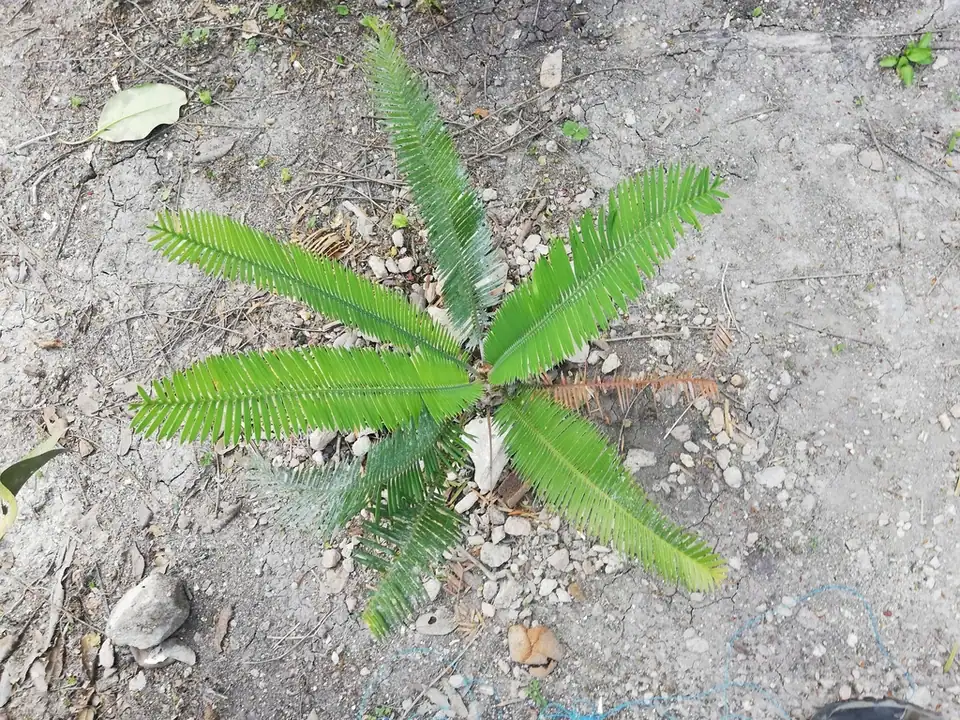
How to Grow and Care for Dioon edule
Dioon edule
Written by Emilio Marruso · last checked
At a glance
This plant from Mexico and Central America is easy to please: give it full sun or partial shade and well-drained soil, and it enjoys regular watering yet handles dry spells quite well. It grows happily in a container, you can start it from seed, and its starch-rich seeds can even be eaten boiled or roasted.
- Sun
Full sun to partial shade
- Water
Likes regular watering but is quite drought-tolerant
What the sources say (1)
Watering: Well-drained soil that receives irrigation; also quite drought-tolerant
Both species will perform best when planted in a well-drained soil that receives irrigation, but they are also quite drought-tolerant.
— Dioon – Gardening Solutions [1] - Cold
Survives winters down to 10 °F (−12.2 °C)
Hardy in cold winters · USDA 8 · RHS H5 · Z8
What the sources say (2)
Hardiness, coldest zone: 8 [winter low −12.2 to −6.7 °C (10 to 20 °F)]
Chestnut dioon is the more cold-hardy of the two species and is suitable for USDA zones 8-11.
— Dioon – Gardening Solutions [1] Hardiness, warmest zone: 11 [winter low 4.4 to 10 °C (40 to 50 °F)]
Chestnut dioon is the more cold-hardy of the two species and is suitable for USDA zones 8-11.
— Dioon – Gardening Solutions [1] - Soil
Needs well-drained soil
What the sources say (2)
Watering notes: Requires a well-drained soil
Requires a well-drained soil
— Dioon edule - Useful Tropical Plants [3] Watering: Well-drained soil that receives irrigation; also quite drought-tolerant
Both species will perform best when planted in a well-drained soil that receives irrigation, but they are also quite drought-tolerant.
— Dioon – Gardening Solutions [1] - Harvest
The starch-rich seeds can be eaten boiled or roasted
- Propagation
Grow new plants from seed
What the sources say (1)
Propagation: Seed
Seed - surface sow on damp sand at a temperature of 24 - 32
— Dioon edule - Useful Tropical Plants [3] - Containers
Grows in containers too
What the sources say (1)
In containers: Yes
It can grow up to 9 feet tall but does well in containers.
— Cycads – Wisconsin Horticulture [2]
Overview
Dioon edule (chestnut dioon) is a slow-growing cycad used as a specimen plant, suitable for USDA zones 8-11. [1][3] It prefers full sun to partial shade and well-drained soil, and does well in containers. [1][2]
This record is incomplete: the sources we read do not cover every field yet.
Not yet covered by our sources: Pruning
Dioon edule care
How to water Dioon edule
Watering
Well-drained soil that receives irrigation; also quite drought-tolerant
What the sources say (1)
Both species will perform best when planted in a well-drained soil that receives irrigation, but they are also quite drought-tolerant.Watering notes
Requires a well-drained soil
What the sources say (1)
Requires a well-drained soilHow much light Dioon edule needs
How much cold Dioon edule can take
Hardiness, coldest zone
8 [winter low −12.2 to −6.7 °C (10 to 20 °F)]
What the sources say (1)
Chestnut dioon is the more cold-hardy of the two species and is suitable for USDA zones 8-11.Hardiness, warmest zone
11 [winter low 4.4 to 10 °C (40 to 50 °F)]
What the sources say (1)
Chestnut dioon is the more cold-hardy of the two species and is suitable for USDA zones 8-11.Where to grow Dioon edule
Yes
What the sources say (1)
It can grow up to 9 feet tall but does well in containers.How to propagate Dioon edule
Seed
What the sources say (1)
Seed - surface sow on damp sand at a temperature of 24 - 32How to grow Dioon edule
Remedies
The sources we checked give no remedies for this plant.
Calendar
Pruning
Not stated in the sources we read.
Months as given by the sources, which are mostly from the United States (northern hemisphere). In the southern hemisphere they shift by about six months.
Edibility
Reported by the source, quoted verbatim. Do not eat a plant on the basis of this page alone: identification mistakes can be dangerous.
Indicative values
Values from a secondary source, not checked word for word like the rest of this page. Use them as a starting point.
- Life cycle
- PerennialIndicative value, adapt it to your climate · Secondary source
- Drought tolerant
- yesIndicative value, adapt it to your climate · Secondary source
- Soil pH
- 6-7.5Indicative value, adapt it to your climate · Secondary source
- Care level
- HighIndicative value, adapt it to your climate · Secondary source
- Growth rate
- LowIndicative value, adapt it to your climate · Secondary source
- Pruning
- March, April, May, June, July, AugustIndicative value, adapt it to your climate · Secondary source
Similar plants
- Abies grandis Abies grandis
- Abraham Trachystemon orientalis
- Abyssinian banana Ensete ventricosum
- Acacia longifolia Acacia longifolia
- Acanthus hungaricus Acanthus hungaricus
- Achlys triphylla Achlys triphylla
- Aconite Aconitum napellus
- Adam's Needle Yucca flaccida
Sources
Every value above is quoted from these documents. Links lead to the original publisher.
- Dioon – Gardening Solutions · gardeningsolutions.ifas.ufl.edu, consulted
- Cycads – Wisconsin Horticulture · hort.extension.wisc.edu, consulted
- Dioon edule - Useful Tropical Plants · tropical.theferns.info, consulted
- Dioon edule · www-archiv.fdm.uni-hamburg.de, consulted
Written by Emilio Marruso · last checked