
How to Grow and Care for Wild Teasel
Dipsacus fullonum
Written by Emilio Marruso · last checked
Toxic to: People · Why
At a glance
Teasel is an easy biennial that asks for almost nothing: give it full sun or partial shade, water it after planting until it settles in, and it looks after itself. Its leaves draw aphids, which in turn bring ladybugs and birds to your garden. Just cut back the dead stems at the end of winter.
- Sun
Full sun to partial shade
- Water
Water after planting until it settles in; after that it needs no care
What the sources say (3)
Watering: No care needed apart from watering after planting
Teasel needs no care apart from watering after planting
— How to Grow Teasel | BBC Gardeners World Magazine [4] Watering notes: Moist or moist but well-drained soil; keep watered until established
Grow Dispacus fullonum in moist or moist but well-drained soil in full sun to partial shade
— Dipsacus fullonum | BBC Gardeners World Magazine [5] 45-60cm apart and keep watered until established
— How to Grow Teasel | BBC Gardeners World Magazine [4] - Soil
Moist soil, or moist but well-drained
What the sources say (2)
Watering notes: Moist or moist but well-drained soil; keep watered until established
Grow Dispacus fullonum in moist or moist but well-drained soil in full sun to partial shade
— Dipsacus fullonum | BBC Gardeners World Magazine [5] 45-60cm apart and keep watered until established
— How to Grow Teasel | BBC Gardeners World Magazine [4] - Spacing
18–24 in between plants
What the sources say (1)
Spacing: 45-60 cm [18–24 in]
Plant out as soon as they are large enough to handle, 45-60cm apart and keep watered until established
— How to Grow Teasel | BBC Gardeners World Magazine [4] - Planting
Plant in summer, while small, as soon as the seedlings are big enough to handle
What the sources say (1)
Planting: Summer, when small (as soon as large enough to handle)
Sow seed in spring or autumn or plant when small in summer
— How to Grow Teasel | BBC Gardeners World Magazine [4] - Pruning
Remove the dead stems at the end of winter
What the sources say (1)
Pruning: End of winter (remove dead stems)
Allow to self-seed if the site suits, then remove dead stems at the end of winter
— How to Grow Teasel | BBC Gardeners World Magazine [4] - Pests
Leaves attract aphids, but these bring ladybugs and birds that eat them
- Watch out
Self-seeds easily and can crowd out other plants; mow before it sets seed
What the sources say (2)
Propagation: Seed; sow direct where it is to grow, or in modular cell trays; self-seeds readily
Seed germinates readily and the easiest way to grow teasel is to sow the seed direct where it is to grow
— How to Grow Teasel | BBC Gardeners World Magazine [4] sow in modular cell trays of moist seed compost
— How to Grow Teasel | BBC Gardeners World Magazine [4] - Propagation
From seed, sown right where it will grow or in seed trays
What the sources say (2)
Propagation: Seed; sow direct where it is to grow, or in modular cell trays; self-seeds readily
Seed germinates readily and the easiest way to grow teasel is to sow the seed direct where it is to grow
— How to Grow Teasel | BBC Gardeners World Magazine [4] sow in modular cell trays of moist seed compost
— How to Grow Teasel | BBC Gardeners World Magazine [4] - Safety
No known harm to people
Overview
Common teasel is a biennial that invades open, disturbed areas and produces up to 3,000 seeds per plant per year. [1] It is also grown as a wildlife and architectural garden plant that thrives in sun or partial shade and self-seeds readily. [4] The plant is biennial: a rosette forms in the first year and flowers appear in the second. [4]
This record is incomplete: the sources we read do not cover every field yet.
Not yet covered by our sources: Hardiness, coldest zone, Hardiness, warmest zone
Wild Teasel care
Measurements in square brackets are our conversion into the other unit system; the quoted text is unchanged.
How to water Wild Teasel
Watering
No care needed apart from watering after planting
What the sources say (1)
Teasel needs no care apart from watering after plantingWatering notes
Moist or moist but well-drained soil; keep watered until established
How much light Wild Teasel needs
How much cold Wild Teasel can take
Hardiness, coldest zone
Not stated in the sources we read.
Hardiness, warmest zone
Not stated in the sources we read.
Where to grow Wild Teasel
45-60 cm [18–24 in]
What the sources say (1)
Plant out as soon as they are large enough to handle, 45-60cm apart and keep watered until establishedHow to propagate Wild Teasel
Seed; sow direct where it is to grow, or in modular cell trays; self-seeds readily
How to grow Wild Teasel
The plant
Life cycle
biennial
What the sources say (1)
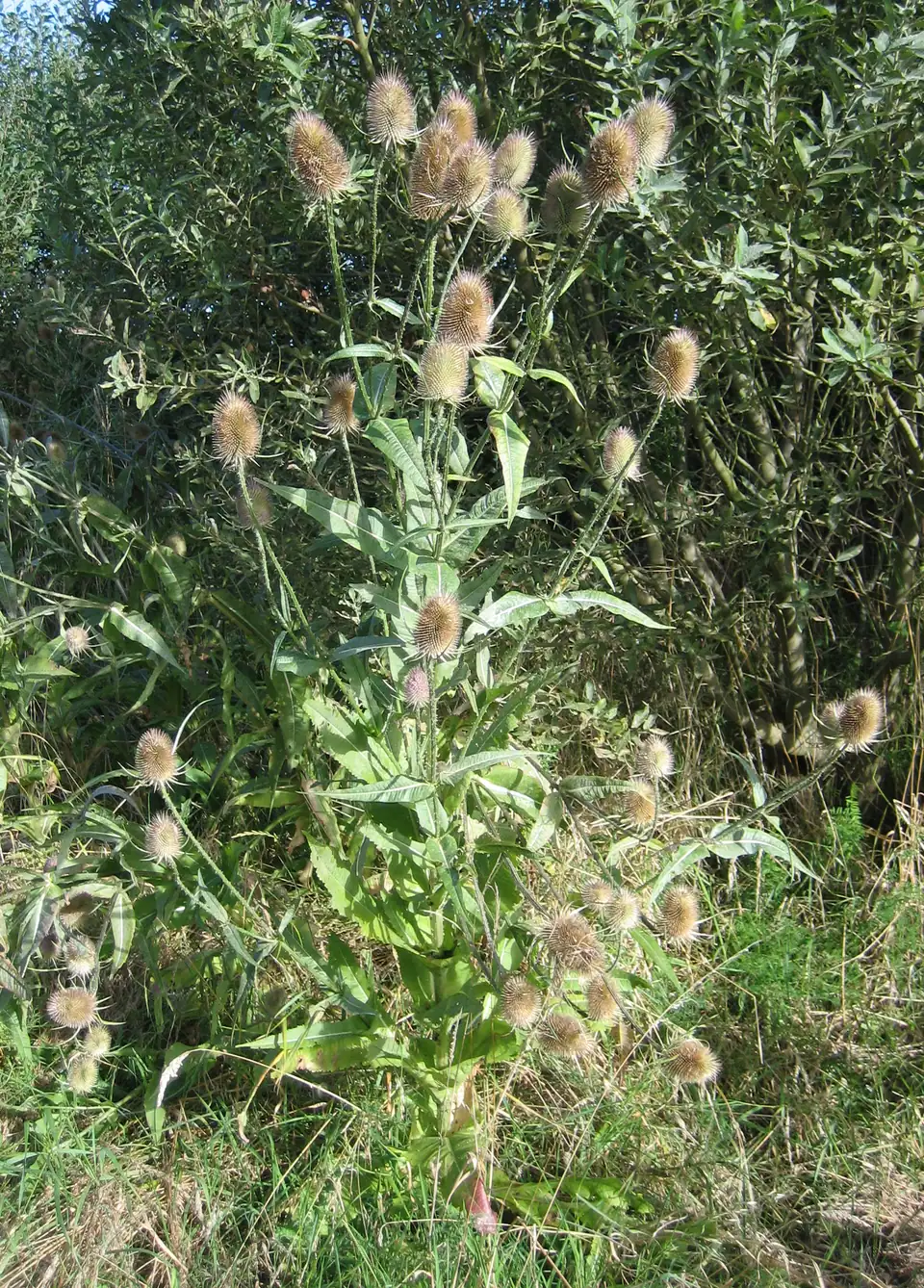
Biennial plant which produces a rosette of basal, wrinkled leaves the first year. The second year it produces long, branched stems with long narrow leaves and spiny flower heads.Family
Dipsacaceae
What the sources say (1)
Scientific Family
Dipsacaceae
Synonyms
Dipsacus sylvestris, D. fullonum ssp. sylvestris, D. fullonum ssp. fullonumWild Teasel pests and problems
Aphids
Symptom: Foliage attracts aphids
What to do: Aphids attract natural predators such as ladybirds and birds
What the sources say (1)
It does attract aphids, but these in turn attract natural predators, such as ladybirds and birds
— How to Grow Teasel | BBC Gardeners World Magazine [4] Invasive spread
Symptom: Infestation thins existing desirable plants and reduces habitat value
What to do: Mowing is an effective way to prevent seed production
Remedies
Each remedy shows what official sources say about it; traditional remedies without an official source are marked as such. Harmful ones are listed so you know to avoid them.
Getting rid of it
invasive teasel
hand-pulling and digging Partly works
How: Hand-pulling and digging are options for small infestations; flowers and seedheads need to be bagged and disposed of.
Hand-pulling and digging are management options for small infestations, but the large, fleshy taproots are difficult to remove.
— mda.state.mn.us [9] What the evidence says Hand-pulling and digging are management options for small infestations, but the large, fleshy taproots are difficult to remove.
— mda.state.mn.us [9] frequent mowing before flowering Partly works
dead flower heads retain seeds, be careful not to spread seeds through mowing.
— montana.edu [10] How: Mow frequently throughout the growing season to prevent flowering, and remove any stalks that were flattened but not cut by the mower.
Frequent mowing throughout the growing season that prevents flowering can deplete food reserves in the taproots and reduce stands over time.
— mda.state.mn.us [9] What the evidence says Mowing will have little effect on the rosettes primarily because they are very low-growing and unlikely to be cut. Mowing is an effective way to prevent seed production.
— Wildland Weed Management [1] cutting flowering plants and collecting seed heads Official source, not independently tested
How: Cut down flowering plants and collect the seed heads to keep them from going to seed; also treat first-year rosettes.
If you see plants that are flowering right now, you'll want to cut those down and collect the seed heads to keep them from going to seed.
— ask.extension.org [11]
Is Wild Teasel poisonous?
Reported by the source, quoted verbatim. This is not medical or veterinary advice: if a person or an animal may have eaten this plant, contact a poison control centre or a veterinarian.
Calendar
Sowing
The sources give different values depending on region, zone or growing conditions.
What each source says
According to BBC Gardeners World (grow guide): Spring or autumn
According to Useful Temperate Plants: Early spring in situ; also late winter to May or August to early autumn
According to BBC Gardeners World (plant profile): Summer
What the sources say (4)
According to BBC Gardeners World (grow guide): Sow seed in spring or autumn or plant when small in summerAccording to Useful Temperate Plants: The seed can also be sown from late winter to May or from August to early autumnAccording to BBC Gardeners World (plant profile): Biennial, sow seed in summer to encourage flowering the following yearSow seed in spring or autumn or plant when small in summerPlanting
Summer, when small (as soon as large enough to handle)
What the sources say (1)
Sow seed in spring or autumn or plant when small in summerPruning
End of winter (remove dead stems)
What the sources say (1)
Allow to self-seed if the site suits, then remove dead stems at the end of winterMonths as given by the sources, which are mostly from the United States (northern hemisphere). In the southern hemisphere they shift by about six months.
Indicative values
Values from a secondary source, not checked word for word like the rest of this page. Use them as a starting point.
- Hours of sun
- 6-8 hoursIndicative value, adapt it to your climate · Secondary source
- Soil pH
- 6-7.5Indicative value, adapt it to your climate · Secondary source
- USDA hardiness zones
- 3-8 [winter low −40 to −6.7 °C (−40 to 20 °F)]Indicative value, adapt it to your climate · Secondary source
- Care level
- MediumIndicative value, adapt it to your climate · Secondary source
- Growth rate
- LowIndicative value, adapt it to your climate · Secondary source
Similar plants
- Bluebuttons Knautia arvensis
- Abies grandis Abies grandis
- Abraham Trachystemon orientalis
- Abyssinian banana Ensete ventricosum
- Acacia longifolia Acacia longifolia
- Acanthus hungaricus Acanthus hungaricus
- Achlys triphylla Achlys triphylla
- Aconite Aconitum napellus
Sources
Every value above is quoted from these documents. Links lead to the original publisher.
- Wildland Weed Management · plantscience.psu.edu, consulted
- Dipsacus fullonum - Useful Temperate Plants · temperate.theferns.info, consulted
- Dipsacus fullonum | common teasel · rhs.org.uk, consulted
- How to Grow Teasel | BBC Gardeners World Magazine · gardenersworld.com, consulted
- Dipsacus fullonum | BBC Gardeners World Magazine · gardenersworld.com, consulted
- Dipsacus fullonum • New Zealand Plant Conservation Network · nzpcn.org.nz, consulted
- Dipsacus fullonum - Fuller's teasel | Yavapai County Native and Naturalized Plants · yavapaiplants.extension.arizona.edu, consulted
- Common Teasel | New Mexico Weeds · nmweeds.taosswcd-nm.gov, consulted
- mda.state.mn.us · mda.state.mn.us
- montana.edu · montana.edu
- ask.extension.org · ask.extension.org
Written by Emilio Marruso · last checked