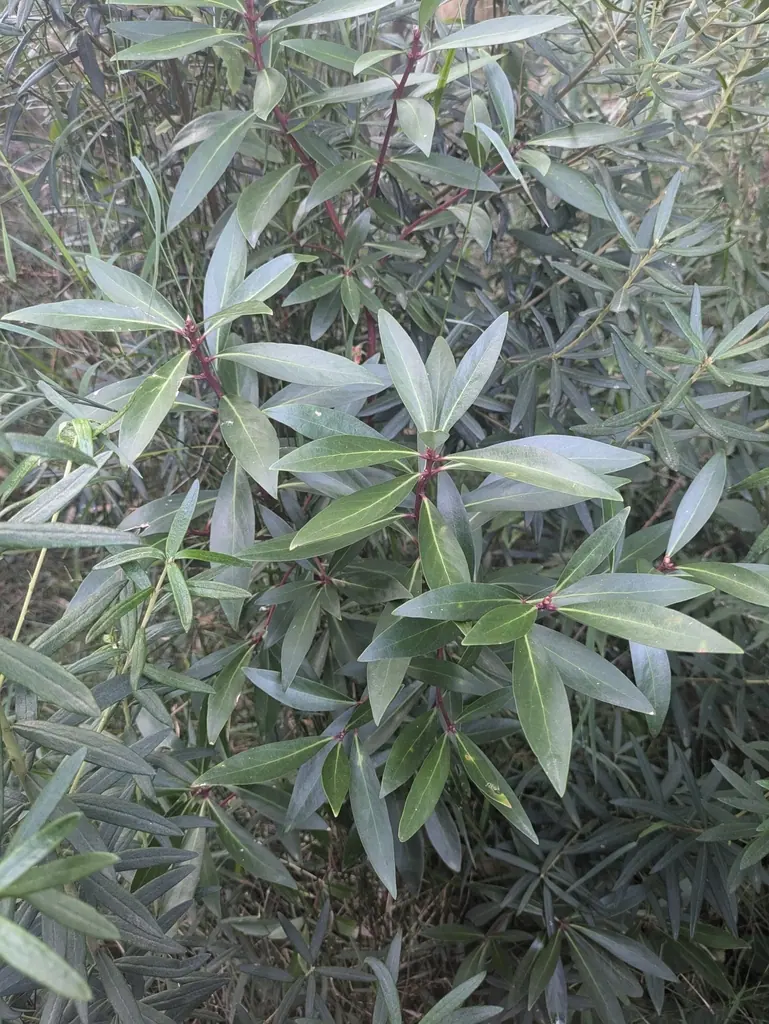
How to Grow and Care for Mountain pepper
Drimys lanceolata
Written by Emilio Marruso · last checked
At a glance
Tasmanian pepper brings spice to your garden: its fruit and seed are used in place of pepper and allspice. It is happy in partial shade, tolerates full sun, and once settled it copes with some dry spells. Plant it in late spring or early summer, after the last frosts, and give it a light trim each spring.
- Sun
Partial shade; full sun is fine too
What the sources say (1)
Light: Partial shade (tolerates full sun)
Although mountain peppers tolerate full sunlight, they prefer partial shade, especially where afternoons are hot.
— Mountain Pepper Info - Learn About Growing Drimys Mountain Peppers | Gardening Know How [4] - Water
Water deeply at first and regularly in heat; let the soil dry a little between waterings
What the sources say (2)
Watering: Water regularly once planted, especially in extreme heat; somewhat drought-tolerant once established
Once planted, water regularly, especially during periods of extreme heat. Mountain pepper is somewhat drought-tolerant once established.
— Mountain Pepper Info - Learn About Growing Drimys Mountain Peppers | Gardening Know How [4] Watering notes: Water deeply during the first few months, letting the soil dry slightly between waterings to prevent root rot
Water deeply during the first few months to establish a deep root system, but allow the soil to dry slightly between watering to prevent root rot
— Mountain Pepper Info - Learn About Growing Drimys Mountain Peppers | Gardening Know How [4] - Cold
Survives winters down to 0 °F (−17.8 °C)
Hardy in very cold winters · USDA 7 · RHS H6 · Z7
What the sources say (2)
Hardiness, coldest zone: 7 [winter low −17.8 to −12.2 °C (0 to 10 °F)]
mountain pepper ( Drimys aromatica ) is a sturdy, mostly trouble-free plant that grows in the relatively mild climates of USDA plant hardiness zones 7 through 10.
— Mountain Pepper Info - Learn About Growing Drimys Mountain Peppers | Gardening Know How [4] Hardiness, warmest zone: 10 [winter low −1.1 to 4.4 °C (30 to 40 °F)]
mountain pepper ( Drimys aromatica ) is a sturdy, mostly trouble-free plant that grows in the relatively mild climates of USDA plant hardiness zones 7 through 10.
— Mountain Pepper Info - Learn About Growing Drimys Mountain Peppers | Gardening Know How [4] - Planting
Late spring or early summer, after the last frosts
What the sources say (1)
Planting: Late spring or early summer, after the last expected frosts
Plant them out into their permanent positions in late spring or early summer, after the last expected frosts.
— Drimys lanceolata - Useful Temperate Plants [2] - Pruning
Light pruning in spring
What the sources say (1)
Pruning: Spring (light pruning)
Prune mountain pepper lightly in spring to maintain the shrub’s natural form.
— Mountain Pepper Info - Learn About Growing Drimys Mountain Peppers | Gardening Know How [4] - Harvest
Fruit and seed are used in place of pepper and allspice
- Propagation
From seed, cuttings or layering
What the sources say (3)
Propagation: Seed; cuttings of half-ripe or mature wood; layering
Cuttings of half-ripe wood, 10 - 15 cm with a heel, mid summer in a frame.
— Drimys lanceolata - Useful Temperate Plants [2] Cuttings of mature wood of the current year's growth with a heel of older wood, late autumn in a cold frame
— Drimys lanceolata - Useful Temperate Plants [2] Otherwise, plant mountain pepper seeds in the garden as soon as they ripen, as the seeds don’t store well and germinate best when fresh.
— Mountain Pepper Info - Learn About Growing Drimys Mountain Peppers | Gardening Know How [4] - Sowing
Sow in autumn, as soon as the seed is ripe, in a greenhouse
What the sources say (1)
Sowing: As soon as the seed is ripe (autumn), in a greenhouse
Seed - best sown as soon as it is ripe in the autumn in a greenhouse
— Drimys lanceolata - Useful Temperate Plants [2]
Overview
Drimys lanceolata (mountain pepper) is an evergreen shrub used as a hedge or garden focal point. [2][4] It prefers partial shade and its fruit and seed are used as a pepper substitute. [4][2]
Mountain pepper care
How to water Mountain pepper
Watering
Water regularly once planted, especially in extreme heat; somewhat drought-tolerant once established
What the sources say (1)
Once planted, water regularly, especially during periods of extreme heat. Mountain pepper is somewhat drought-tolerant once established.Watering notes
Water deeply during the first few months, letting the soil dry slightly between waterings to prevent root rot
What the sources say (1)
Water deeply during the first few months to establish a deep root system, but allow the soil to dry slightly between watering to prevent root rotHow much light Mountain pepper needs
Partial shade (tolerates full sun)
What the sources say (1)
Although mountain peppers tolerate full sunlight, they prefer partial shade, especially where afternoons are hot.How much cold Mountain pepper can take
Hardiness, coldest zone
7 [winter low −17.8 to −12.2 °C (0 to 10 °F)]
What the sources say (1)
mountain pepper ( Drimys aromatica ) is a sturdy, mostly trouble-free plant that grows in the relatively mild climates of USDA plant hardiness zones 7 through 10.Hardiness, warmest zone
10 [winter low −1.1 to 4.4 °C (30 to 40 °F)]
What the sources say (1)
mountain pepper ( Drimys aromatica ) is a sturdy, mostly trouble-free plant that grows in the relatively mild climates of USDA plant hardiness zones 7 through 10.How to propagate Mountain pepper
Seed; cuttings of half-ripe or mature wood; layering
What the sources say (3)
Cuttings of half-ripe wood, 10 - 15 cm with a heel, mid summer in a frame.Cuttings of mature wood of the current year's growth with a heel of older wood, late autumn in a cold frameOtherwise, plant mountain pepper seeds in the garden as soon as they ripen, as the seeds don’t store well and germinate best when fresh.Remedies
The sources we checked give no remedies for this plant.
Calendar
Sowing
As soon as the seed is ripe (autumn), in a greenhouse
What the sources say (1)
Seed - best sown as soon as it is ripe in the autumn in a greenhousePlanting
Late spring or early summer, after the last expected frosts
What the sources say (1)
Plant them out into their permanent positions in late spring or early summer, after the last expected frosts.Pruning
Spring (light pruning)
What the sources say (1)
Prune mountain pepper lightly in spring to maintain the shrub’s natural form.Months as given by the sources, which are mostly from the United States (northern hemisphere). In the southern hemisphere they shift by about six months.
Edibility
Reported by the source, quoted verbatim. Do not eat a plant on the basis of this page alone: identification mistakes can be dangerous.
The fruit and seed are used as a pepper and allspice substitute
[2]
Indicative values
Values from a secondary source, not checked word for word like the rest of this page. Use them as a starting point.
- Life cycle
- PerennialIndicative value, adapt it to your climate · Secondary source
- Mature height
- 457.2-457.2 cm (15-15 ft)Indicative value, adapt it to your climate · Secondary source
- Hours of sun
- 4-5 hoursIndicative value, adapt it to your climate · Secondary source
- Drought tolerant
- yesIndicative value, adapt it to your climate · Secondary source
- Soil pH
- 5.5-6.5Indicative value, adapt it to your climate · Secondary source
- Care level
- MediumIndicative value, adapt it to your climate · Secondary source
- Growth rate
- LowIndicative value, adapt it to your climate · Secondary source
Similar plants
- Abies grandis Abies grandis
- Abraham Trachystemon orientalis
- Abyssinian banana Ensete ventricosum
- Acacia longifolia Acacia longifolia
- Acanthus hungaricus Acanthus hungaricus
- Achlys triphylla Achlys triphylla
- Aconite Aconitum napellus
- Adam's Needle Yucca flaccida
Sources
Every value above is quoted from these documents. Links lead to the original publisher.
- Drimys lanceolata | Landscape Plants | Oregon State University · landscapeplants.oregonstate.edu, consulted
- Drimys lanceolata - Useful Temperate Plants · temperate.theferns.info, consulted
- Tasmannia lanceolata - Trees and Shrubs Online · treesandshrubsonline.org, consulted
- Mountain Pepper Info - Learn About Growing Drimys Mountain Peppers | Gardening Know How · gardeningknowhow.com, consulted
Written by Emilio Marruso · last checked