
How to Grow and Care for Thunberg's gardenia
Gardenia thunbergia
Written by Emilio Marruso · last checked
At a glance
This gardenia is happy in full sun or semi-shade, and it grows in containers too, so it fits almost any garden or patio. Give it regular watering without ever flooding it, and a light trim after flowering. You can even grow new plants yourself, from seeds in spring or summer or from cuttings in summer.
- Sun
Full sun or semi-shade
- Water
Water regularly, but never flood it
What the sources say (2)
- Pruning
Prune lightly after flowering or in late winter
What the sources say (1)
Pruning: Lightly after flowering or in late winter
Prune lightly after flowering or in late winter.
— Gardenia thunbergia or White Gardenia | Care and Growing [3] - Pests
Watch out for twig wilters, insects that make the twigs wilt
- Propagation
From seeds in spring or summer, or from cuttings in summer
What the sources say (2)
Propagation: Seeds sown in spring or summer; cuttings in summer
Forest Gardenia propagates easily by seeds sown in spring or summer and by cuttings in summer.
— Gardenia thunbergia or White Gardenia | Care and Growing [3] Propagation is easy from seed or truncheons (stem cutting from a selected plant
— Gardenia thunbergia | Tree SA [2] - Sowing
Sow in spring or summer
What the sources say (1)
Sowing: Spring or summer
Forest Gardenia propagates easily by seeds sown in spring or summer and by cuttings in summer.
— Gardenia thunbergia or White Gardenia | Care and Growing [3] - Containers
Grows in containers too
What the sources say (1)
In containers: Yes
White Gardenia is used as isolated specimens, next to a wall, to form informal hedges, in bushy groups, next to a pond, in large pots for patios and terraces and as bonsai.
— Gardenia thunbergia or White Gardenia | Care and Growing [3]
Overview
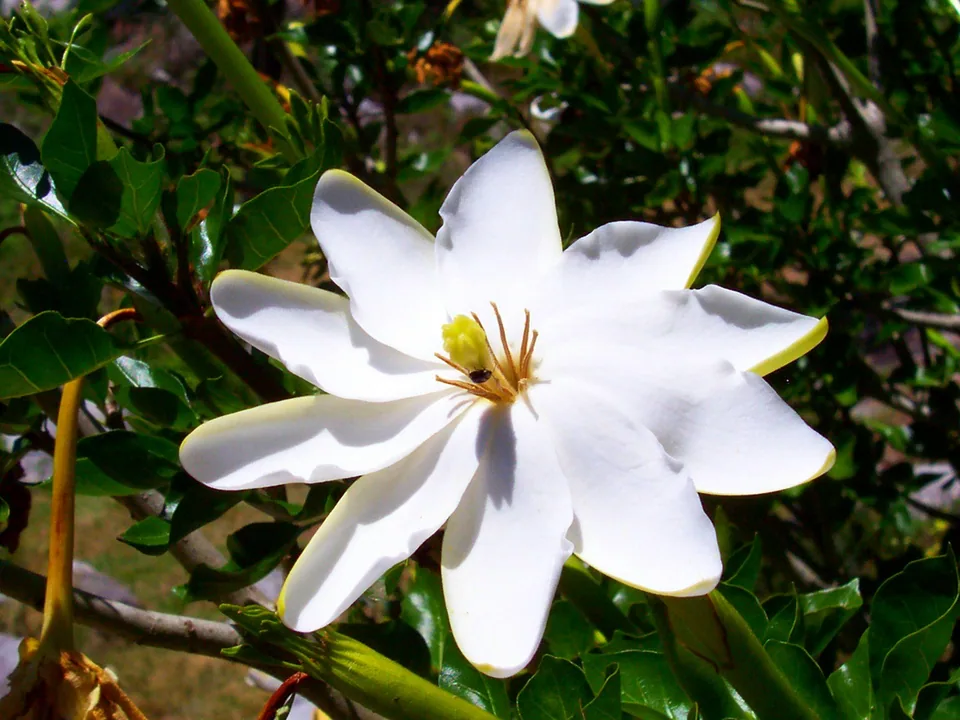
White gardenia is an evergreen shrub or small tree growing 2 to 5 m [6.6–16.4 ft] tall, with large, creamy white, heavily perfumed flowers. [1] It is grown as a specimen, hedge or large-pot plant in full sun or semi-shade with regular watering. [3] It propagates easily from seed or cuttings. [2]
This record is incomplete: the sources we read do not cover every field yet.
Not yet covered by our sources: Hardiness, coldest zone, Hardiness, warmest zone
Thunberg's gardenia care
Measurements in square brackets are our conversion into the other unit system; the quoted text is unchanged.
How to water Thunberg's gardenia
Regular watering, without ever flooding
How much light Thunberg's gardenia needs
How much cold Thunberg's gardenia can take
Hardiness, coldest zone
Not stated in the sources we read.
Hardiness, warmest zone
Not stated in the sources we read.
Where to grow Thunberg's gardenia
Yes
What the sources say (1)
White Gardenia is used as isolated specimens, next to a wall, to form informal hedges, in bushy groups, next to a pond, in large pots for patios and terraces and as bonsai.How to propagate Thunberg's gardenia
Seeds sown in spring or summer; cuttings in summer
Thunberg's gardenia pests and problems
Twig wilters (Carlisis wahlbergi)
What the sources say (1)
These insects may withdraw so much liquid that a young stem may wilt.
— Gardenia thunbergia | Tree SA [2]
Remedies
Each remedy shows what official sources say about it; traditional remedies without an official source are marked as such. Harmful ones are listed so you know to avoid them.
Treating the plant
spider mites
neem Partly works
How: Shake leaves over white paper; small red smudges mean mites; treat with neem.
Open the paper up; if you see small red smudges, you have mites. Treat your plant with Neem.
— travaldo.blogspot.com [6] What the evidence says Some benefits of neem include low mammalian toxicity and limited persistence in the environment. However, neem oil is not effective against every insect and disease
— extension.unh.edu [7]
scale
horticultural oil Not verified
Traditional remedy, not verified by an official source.
How: Treat the plant with horticultural oil.
mealybugs
soap spray Works
How: Mealybugs can be treated with a soap spray.
Mealy bugs can be treated with a soap spray, horticultural oil, or by using a steady stream of water to remove the masses.
— travaldo.blogspot.com [6] What the evidence says insecticidal soap is a safe, effective organic insecticide with minimal environmental impact.
— extension.psu.edu [8] steady stream of water Not verified
Traditional remedy, not verified by an official source.
How: Use a steady stream of water to remove the masses.
whiteflies
neem Partly works
How: Neem helps reduce the population but does not eliminate the whiteflies.
Neem will help reduce the population, but it will not completely eliminate the whiteflies.
— travaldo.blogspot.com [6] What the evidence says Some benefits of neem include low mammalian toxicity and limited persistence in the environment. However, neem oil is not effective against every insect and disease
— extension.unh.edu [7]
aphids
strong stream of water Not verified
Traditional remedy, not verified by an official source.
How: Prune off heavily infested shoot tips, then wash foliage with a strong but gentle stream of water, repeating every few days.
insecticidal soap Works
How: For persistent colonies, spray insecticidal soap with thorough coverage of shoot tips and leaf undersides, early morning or evening.
for persistent colonies, use an insecticidal soap or neem oil spray, ensuring thorough coverage of shoot tips and leaf undersides in the early morning or evening.
— botanapp.com [9] What the evidence says insecticidal soap is a safe, effective organic insecticide with minimal environmental impact.
— extension.psu.edu [8]
sooty mold
washing leaves with dilute soap solution Not verified
Traditional remedy, not verified by an official source.
How: Control the insects, then gently wash affected leaves with lukewarm water and a mild, dilute soap solution.
Calendar
Sowing
Spring or summer
What the sources say (1)
Forest Gardenia propagates easily by seeds sown in spring or summer and by cuttings in summer.Pruning
Lightly after flowering or in late winter
What the sources say (1)
Prune lightly after flowering or in late winter.Months as given by the sources, which are mostly from the United States (northern hemisphere). In the southern hemisphere they shift by about six months.
Indicative values
Values from a secondary source, not checked word for word like the rest of this page. Use them as a starting point.
- Life cycle
- PerennialIndicative value, adapt it to your climate · Secondary source
- Mature height
- 182.9-457.2 cm (6-15 ft)Indicative value, adapt it to your climate · Secondary source
- Soil pH
- 5-6.5Indicative value, adapt it to your climate · Secondary source
- USDA hardiness zones
- 10-12 [winter low −1.1 to 15.6 °C (30 to 60 °F)]Indicative value, adapt it to your climate · Secondary source
- Growth rate
- LowIndicative value, adapt it to your climate · Secondary source
Similar plants
- Gardenia Gardenia jasminoides
- Abies grandis Abies grandis
- Abraham Trachystemon orientalis
- Abyssinian banana Ensete ventricosum
- Acacia longifolia Acacia longifolia
- Acanthus hungaricus Acanthus hungaricus
- Aconite Aconitum napellus
- Adam's Needle Yucca flaccida
Sources
Every value above is quoted from these documents. Links lead to the original publisher.
- Gardenia thunbergia - Plant Detail - Tropical Plants Database - NTBG Database · ntbg.org, consulted
- Gardenia thunbergia | Tree SA · treesa.org, consulted
- Gardenia thunbergia or White Gardenia | Care and Growing · consultaplantas.com, consulted
- Star Gardenia (Gardenia thunbergia) · desert-tropicals.com, consulted
- Gardenia thunbergia | Buenos Aires Ciudad - Gobierno de la Ciudad Autónoma de Buenos Aires · buenosaires.gob.ar, consulted
- travaldo.blogspot.com · travaldo.blogspot.com
- extension.unh.edu · extension.unh.edu
- extension.psu.edu · extension.psu.edu
- botanapp.com · botanapp.com
Written by Emilio Marruso · last checked