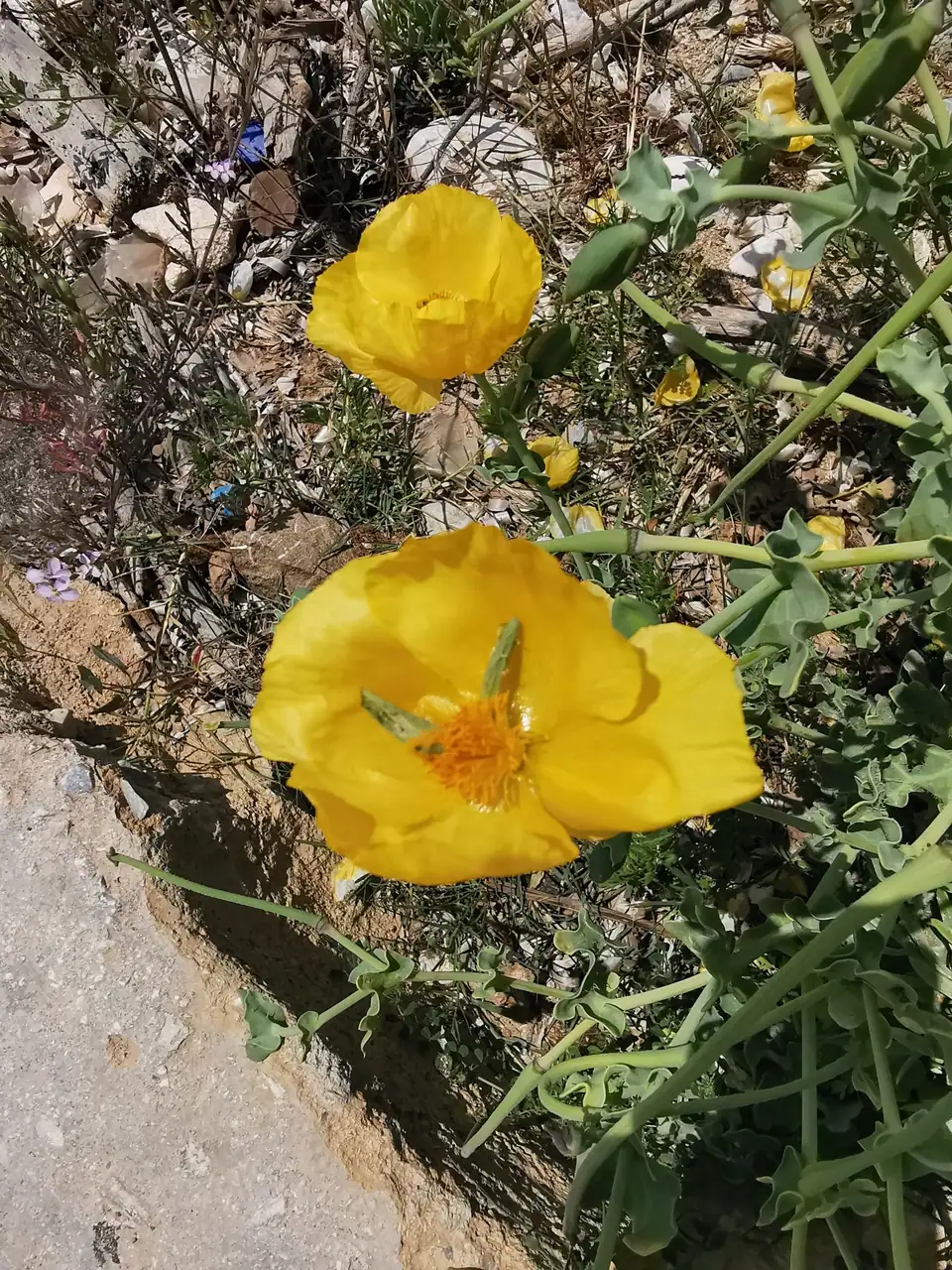
How to Grow and Care for Yellow horned poppy
Glaucium flavum
Written by Emilio Marruso · last checked
Toxic to: People · Why
At a glance
The yellow horned poppy is a true sun lover that shrugs off drought, as long as its soil drains very well. Plant it in late spring or early summer, after the last frosts, or sow it right where it will grow in mid spring. If its leaves turn big and floppy in summer, cut them back and a fresh, smaller rosette grows.
- Sun
Full sun; it dislikes shade
What the sources say (1)
Light: Sun; dislikes shade
Light Requirements sun
— Yellow Hornpoppy [2] - Water
Drought tolerant: needs little watering
What the sources say (1)
Watering: Drought tolerant
Yellow horned poppy is a drought-tolerant perennial flower grown for its scalloped blue-green leaves and yellow flowers.
— Yellow Hornpoppy [2] - Soil
Needs very well-drained soil
What the sources say (1)
Watering notes: Requires very well-drained soil
Requires a very well-drained poor soil
— Glaucium flavum - Useful Temperate Plants [1] - Planting
Plant in late spring or early summer, after the last frosts
What the sources say (1)
Planting: Late spring or early summer, after the last expected frosts
Plant them out into their permanent positions in late spring or early summer, after the last expected frosts
— Glaucium flavum - Useful Temperate Plants [1] - Pruning
Cut leaves to the ground before spring growth; remove old flower stalks after blooming
What the sources say (2)
Pruning: Cut leaves to ground level before new growth starts in spring; cut off old flower stalks after blooming; cut back in mid summer if leaves get large, floppy and brown
Cut leaves to ground level before new growth starts in spring. Cut off old flower stalks after blooming.
— Yellow Hornpoppy [2] The leaves may need to be cut back in mid summer as well if they get too large, floppy and brown.
— Yellow Hornpoppy [2] - Harvest
The seeds give a clear yellow edible oil
- Watch out
Big, floppy, brown leaves? Cut back in mid summer and a smaller rosette grows
- Propagation
Grows from seed; a cold period helps the seeds sprout
What the sources say (2)
- Sowing
Sow outdoors in mid spring, or in a cold frame in mid spring or autumn
What the sources say (2)
- Safety
The root is poisonous to people
Overview
Glaucium flavum is a drought-tolerant, short-lived perennial grown for blue-green leaves and yellow flowers. [2][1] It needs sun and very well-drained poor soil and dislikes shade. [1][2] The root is reported as poisonous, and the species has spread into natural areas in some regions. [1][2]
This record is incomplete: the sources we read do not cover every field yet.
Not yet covered by our sources: Hardiness, coldest zone
Yellow horned poppy care
How to water Yellow horned poppy
Watering
Drought tolerant
What the sources say (1)
Yellow horned poppy is a drought-tolerant perennial flower grown for its scalloped blue-green leaves and yellow flowers.Watering notes
Requires very well-drained soil
What the sources say (1)
Requires a very well-drained poor soilHow much light Yellow horned poppy needs
Sun; dislikes shade
What the sources say (1)
Light Requirements
sunHow much cold Yellow horned poppy can take
Hardiness, coldest zone
Not stated in the sources we read.
Hardiness, warmest zone
9 [winter low −6.7 to −1.1 °C (20 to 30 °F)]
What the sources say (1)
Cold Hardiness
USDA zones 4-9How to propagate Yellow horned poppy
Yellow horned poppy pests and problems
Large, floppy, brown leaves
Symptom: Leaves get too large, floppy and brown.
What to do: Cut back in mid summer; a new, smaller rosette grows and lasts through the rest of the season.
Remedies
Each remedy shows what official sources say about it; traditional remedies without an official source are marked as such. Harmful ones are listed so you know to avoid them.
First aid
First aid: not a substitute for a doctor
poisoning by root (ingestion or contact)
remove clothing and flush skin with water Official source, not independently tested
The local poison control center can be reached directly by calling the national toll-free Poison Help hotline (1-800-222-1222) from anywhere in the United States.
— medlineplus.gov [7] DO NOT make a person throw up unless told to do so by poison control or a health care professional.
— medlineplus.gov [7] How: If the poison has spilled on the person, remove the clothing and flush the skin with water.
If the poison has spilled on the person's clothes, remove the clothing and flush the skin with water.
— medlineplus.gov [7]
Getting rid of it
horned poppy (weedy)
hand-pulling small patches Not verified
Traditional remedy, not verified by an official source.
How: Pull out small patches in spring-summer, then monitor the site and pull out any seedlings.
shading with local native plants Not verified
Traditional remedy, not verified by an official source.
How: After removal, plant local native plants where appropriate to produce shade and stop it coming back.
Is Yellow horned poppy poisonous?
Reported by the source, quoted verbatim. This is not medical or veterinary advice: if a person or an animal may have eaten this plant, contact a poison control centre or a veterinarian.
Calendar
Sowing
Middle of spring or autumn (cold frame); outdoor sowing in situ in mid spring
Planting
Late spring or early summer, after the last expected frosts
What the sources say (1)
Plant them out into their permanent positions in late spring or early summer, after the last expected frostsPruning
Cut leaves to ground level before new growth starts in spring; cut off old flower stalks after blooming; cut back in mid summer if leaves get large, floppy and brown
Months as given by the sources, which are mostly from the United States (northern hemisphere). In the southern hemisphere they shift by about six months.
Edibility
Reported by the source, quoted verbatim. Do not eat a plant on the basis of this page alone: identification mistakes can be dangerous.
A clear yellow edible oil is obtained from the seed
[1]
Similar plants
- Aaron's Beard Hypericum calycinum
- Abies grandis Abies grandis
- Abraham Trachystemon orientalis
- Abyssinian banana Ensete ventricosum
- Acacia longifolia Acacia longifolia
- Acacia retinodes Acacia retinodes
- Acanthus hungaricus Acanthus hungaricus
- Achlys triphylla Achlys triphylla
Sources
Every value above is quoted from these documents. Links lead to the original publisher.
- Glaucium flavum - Useful Temperate Plants · temperate.theferns.info, consulted
- Yellow Hornpoppy · waterwiseplants.org, consulted
- · cretanflora.com, consulted
- Glaucium flavum • New Zealand Plant Conservation Network · nzpcn.org.nz, consulted
- SCHEDA · sigecweb.beniculturali.it, consulted
- Glaucium flavum Crantz - Flora of New Zealand Series · floraseries.landcareresearch.co.nz, consulted
- medlineplus.gov · medlineplus.gov
Written by Emilio Marruso · last checked