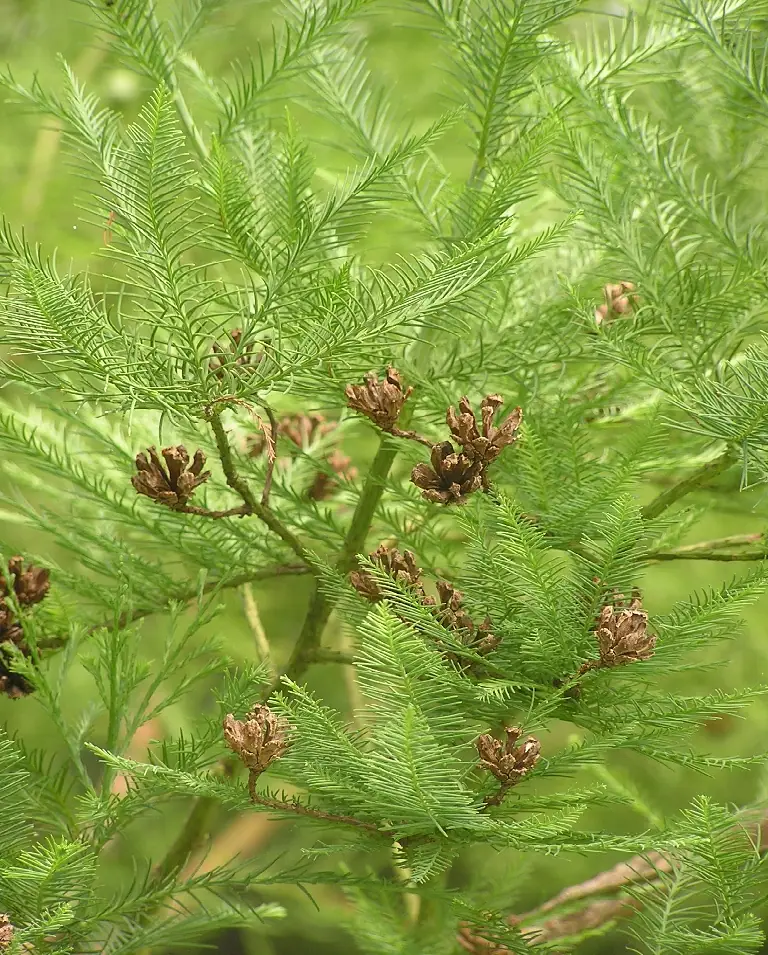

How to Grow and Care for Chinese Swamp Cypress
Glyptostrobus pensilis
Written by Emilio Marruso · last checked
At a glance
Chinese swamp cypress is made for the wettest corner of your garden: it loves full sun and soil that stays soaked, ideally with standing water. It is even hardier growing in up to 2 feet of water, so the edge of a pond or a boggy spot that nothing else enjoys can become its perfect home.
- Sun
Full sun
What the sources say (1)
Light: Full sun
River deltas, etc., on flooded or waterlogged soil in full sun near sea level
— Chinese Swamp Cypress (Glyptostrobus pensilis) — Practical Plants [3] - Water
Keep the soil wet, best with standing water; it is hardier in up to 2 ft of water
What the sources say (3)
Watering: Wet soil, preferably standing water
It must be given a wet soil, preferably standing water
— Glyptostrobus pensilis - Useful Temperate Plants [2] Watering notes: Needs very damp soil and is hardier standing in up to 60 cm [24 in] of water; dies within 2 years in a dry site
plants require a very damp soil and will prove hardier if they are standing in up to 60cm of water
— Glyptostrobus pensilis - Useful Temperate Plants [2] will die within 2 years if they are planted in a dry site
— Glyptostrobus pensilis - Useful Temperate Plants [2] - Cold
Survives winters down to 10 °F (−12.2 °C)
Hardy in cold winters · USDA 8 · RHS H5 · Z8
What the sources say (1)
Hardiness, coldest zone: 8 [winter low −12.2 to −6.7 °C (10 to 20 °F)]
Although said to succeed in zone 8, this species is barely hardy in colder zones without hot humid summers (to ripen the wood)
— Glyptostrobus pensilis - Useful Temperate Plants [2] - Watch out
Never plant it in a dry spot: there it dies within 2 years
What the sources say (2)
Watering notes: Needs very damp soil and is hardier standing in up to 60 cm [24 in] of water; dies within 2 years in a dry site
plants require a very damp soil and will prove hardier if they are standing in up to 60cm of water
— Glyptostrobus pensilis - Useful Temperate Plants [2] will die within 2 years if they are planted in a dry site
— Glyptostrobus pensilis - Useful Temperate Plants [2] - Propagation
Grow new plants from cuttings or other plant parts; good seed is hard to find
What the sources say (2)
Propagation: Vegetative propagation; viable seed is limited
No viable seed has been produced for more than 20 years so that vegetative propagation is necessary for any restoration or ex-situ work.
— Glyptostrobus pensilis | Threatened Conifers of the World (en-GB) [1] however, propagation is proving challenging. In particular, the availability of viable seed is limited.
— Collaborating to conserve the Chinese Swamp Cypress | Botanic Gardens Conservation International [4]
Overview
Chinese swamp cypress needs a wet soil, preferably standing water. [2] It is critically endangered in the wild and viable seed is limited, so vegetative propagation is necessary for restoration work. [1]
This record is incomplete: the sources we read do not cover every field yet.
Not yet covered by our sources: Hardiness, warmest zone, Pruning
Chinese Swamp Cypress care
Measurements in square brackets are our conversion into the other unit system; the quoted text is unchanged.
How to water Chinese Swamp Cypress
Watering
Wet soil, preferably standing water
What the sources say (1)
It must be given a wet soil, preferably standing waterWatering notes
Needs very damp soil and is hardier standing in up to 60 cm [24 in] of water; dies within 2 years in a dry site
How much light Chinese Swamp Cypress needs
Full sun
What the sources say (1)
River deltas, etc., on flooded or waterlogged soil in full sun near sea levelHow much cold Chinese Swamp Cypress can take
Hardiness, coldest zone
8 [winter low −12.2 to −6.7 °C (10 to 20 °F)]
What the sources say (1)
Although said to succeed in zone 8, this species is barely hardy in colder zones without hot humid summers (to ripen the wood)Hardiness, warmest zone
Not stated in the sources we read.
How to propagate Chinese Swamp Cypress
Vegetative propagation; viable seed is limited
What the sources say (2)
No viable seed has been produced for more than 20 years so that vegetative propagation is necessary for any restoration or ex-situ work.however, propagation is proving challenging. In particular, the availability of viable seed is limited.Remedies
The sources we checked give no remedies for this plant.
Calendar
Pruning
Not stated in the sources we read.
Months as given by the sources, which are mostly from the United States (northern hemisphere). In the southern hemisphere they shift by about six months.
Indicative values
Values from a secondary source, not checked word for word like the rest of this page. Use them as a starting point.
- Life cycle
- PerennialIndicative value, adapt it to your climate · Secondary source
- Mature height
- 1828.8-2743.2 cm (60-90 ft)Indicative value, adapt it to your climate · Secondary source
- Hours of sun
- 3-4 hoursIndicative value, adapt it to your climate · Secondary source
- Soil pH
- 5.5-6.5Indicative value, adapt it to your climate · Secondary source
- Care level
- MediumIndicative value, adapt it to your climate · Secondary source
- Growth rate
- LowIndicative value, adapt it to your climate · Secondary source
- Pruning
- May, August, May, AugustIndicative value, adapt it to your climate · Secondary source
Similar plants
- Abies grandis Abies grandis
- Abraham Trachystemon orientalis
- Abyssinian banana Ensete ventricosum
- Acacia longifolia Acacia longifolia
- Acanthus hungaricus Acanthus hungaricus
- Aconite Aconitum napellus
- Adam's Needle Yucca flaccida
- Adriatic lizard orchid Himantoglossum adriaticum
Sources
Every value above is quoted from these documents. Links lead to the original publisher.
- Glyptostrobus pensilis | Threatened Conifers of the World (en-GB) · threatenedconifers.rbge.org.uk, consulted
- Glyptostrobus pensilis - Useful Temperate Plants · temperate.theferns.info, consulted
- Chinese Swamp Cypress (Glyptostrobus pensilis) — Practical Plants · practicalplants.org, consulted
- Collaborating to conserve the Chinese Swamp Cypress | Botanic Gardens Conservation International · bgci.org, consulted
Written by Emilio Marruso · last checked