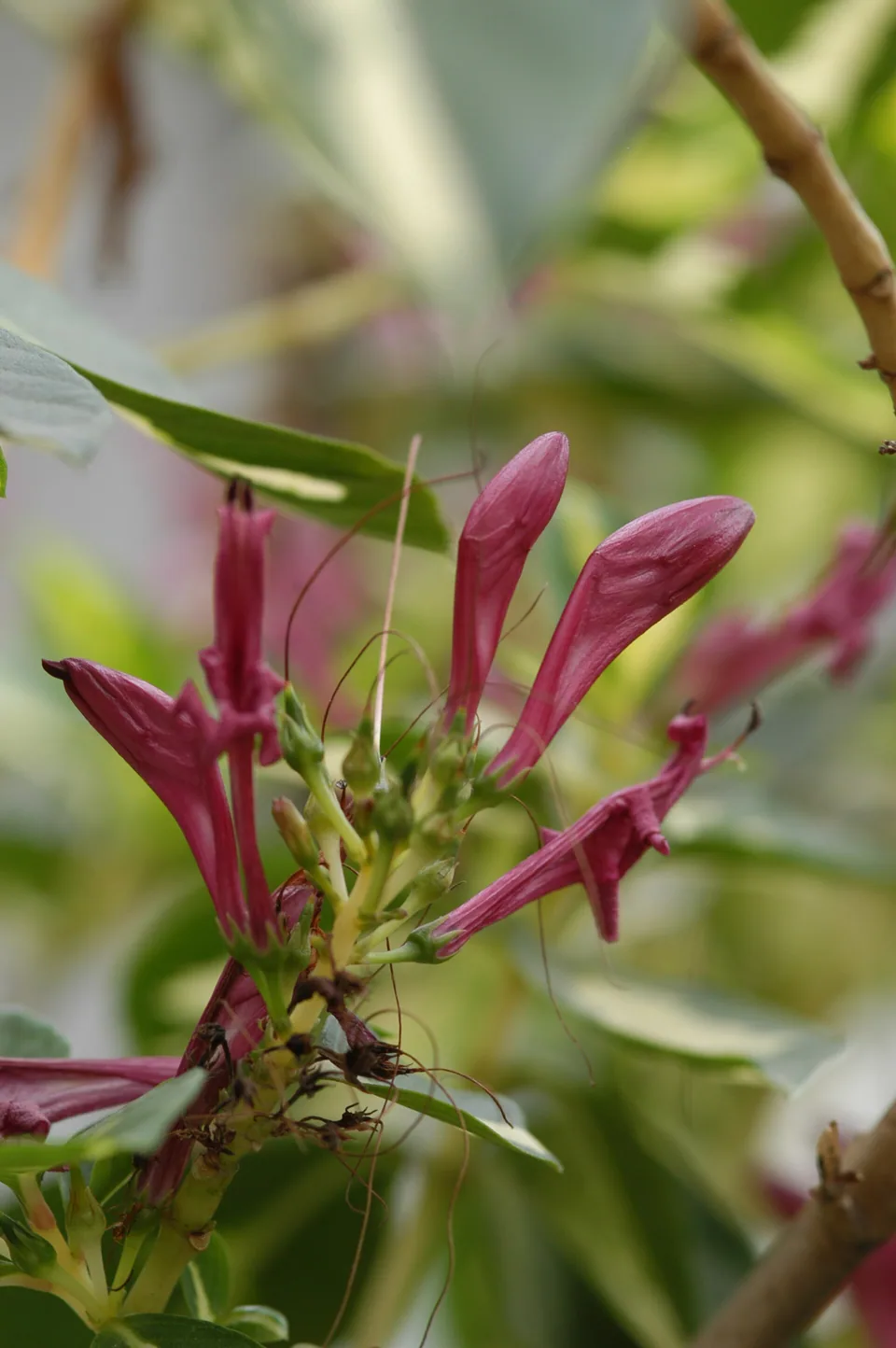
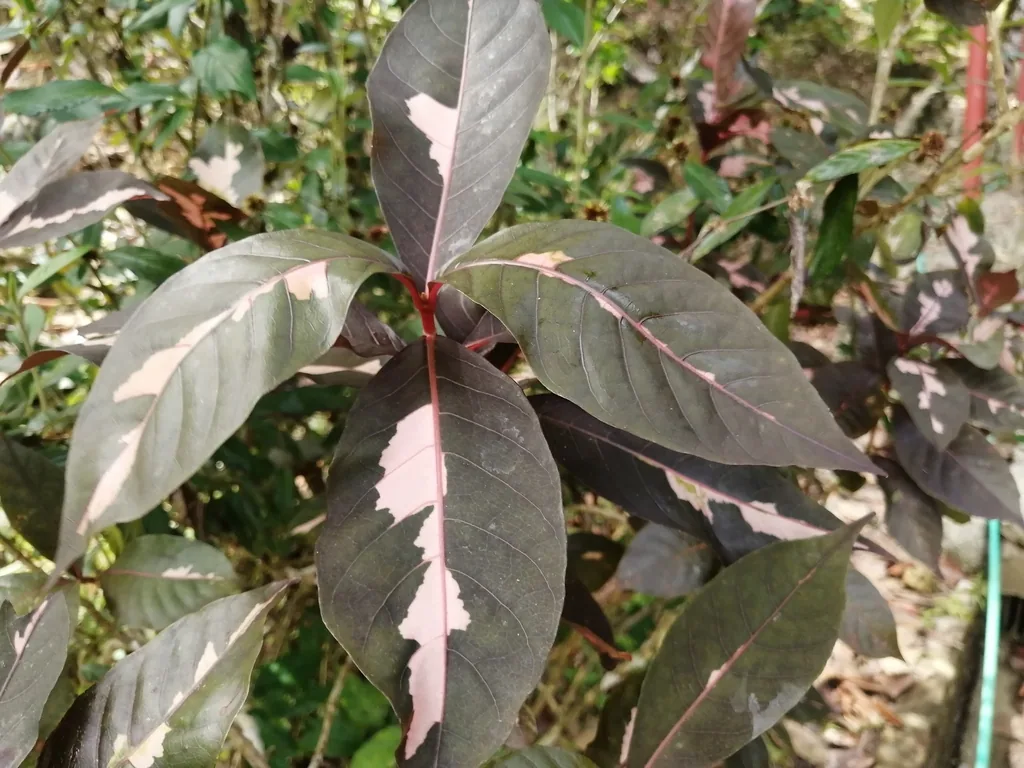

How to Grow and Care for Caricature-plant
Graptophyllum pictum
Written by Emilio Marruso · last checked
At a glance
This plant is easy to keep and easy to share: a simple softwood cutting will even root in a glass of water. Keep the soil evenly moist, then water sparingly in winter. It can grow indoors, and in tropical and subtropical climates you can plant it outside any time of the year, 2–3 feet apart.
- Water
Keep the soil evenly moist; water sparingly in winter
What the sources say (3)
Watering: Keep soil uniformly moist
Watering Needs: Does better when the soil is kept uniformly moist
— Caricature Plant (Graptophyllum pictum) [1] Graptophyllum wants an evenly moist potting medium.
— How to Grow Graptophyllum [2] Watering notes: Water sparingly in winter
Water Graptophyllum sparingly in winter.
— How to Grow Graptophyllum [2] - Spacing
24–36 in between plants
What the sources say (1)
Spacing: 61.0-91.4 cm (24-36 in)
Graptophyllum 24 to 36 inches (60-90cm) apart.
— How to Grow Graptophyllum [2] - Planting
In tropical and subtropical climates, plant any time of the year
What the sources say (1)
Planting: Any time of the year in tropical and subtropical regions
any time of the year in tropical and subtropical regions.
— How to Grow Graptophyllum [2] - Propagation
Take softwood stem cuttings; they even root in water
- Containers
Grows indoors too
What the sources say (1)
Indoors: Yes
is an erect evergreen tropical shrub commonly grown as a foliage houseplant in temperate regions
— How to Grow Graptophyllum [2]
Overview
Caricature plant is an evergreen tropical shrub from New Guinea, grown as a foliage houseplant and ornamental. [1][2] It does best with uniformly moist soil and is propagated from softwood stem cuttings. [1]
This record is incomplete: the sources we read do not cover every field yet.
Not yet covered by our sources: Light, In containers
Caricature-plant care
How to water Caricature-plant
Watering
Keep soil uniformly moist
Watering notes
Water sparingly in winter
What the sources say (1)
Water Graptophyllum sparingly in winter.How much light Caricature-plant needs
Not stated in the sources we read.
Where to grow Caricature-plant
Indoors
Yes
What the sources say (1)
is an erect evergreen tropical shrub commonly grown as a foliage houseplant in temperate regionsIn containers
Not stated in the sources we read.
Spacing
61.0-91.4 cm (24-36 in)
What the sources say (1)
Graptophyllum 24 to 36 inches (60-90cm) apart.How to propagate Caricature-plant
How to grow Caricature-plant
The plant
Family
Acanthaceae
What the sources say (1)
Family
Acanthaceae (
1ACAF )
Subfamily
Acanthoideae (
1ACAS )
Genus
Graptophyllum (
1GRTG )
Species
Graptophyllum pictum (
GRTHO )Fertilizing
How often
The sources give different values depending on region, zone or growing conditions.
What each source says
cultivar 'Tricolor': Once a month outdoors, twice a month in containers
cultivar 'Aureum Variegatum': Once a month outdoors, twice a month in containers
What the sources say (2)
cultivar 'Tricolor': Apply a complete, balanced fertilizer once a month for outdoor plants and twice a month for potted plants.cultivar 'Aureum Variegatum': Apply a complete, balanced fertilizer once a month for outdoor plants and twice a month for potted plants.Natural fertilizers
The sources give different values depending on region, zone or growing conditions.
What each source says
cultivar 'Aureum Variegatum': Soil enriched with compost at planting
What the sources say (1)
cultivar 'Aureum Variegatum': Specimens should ideally be planted 1.2 - 1.8 m apart in well-drained, slightly acidic to slightly alkaline soil enriched with compost.Mineral fertilizers
The sources give different values depending on region, zone or growing conditions.
What each source says
cultivar 'Tricolor': Complete, balanced fertilizer
cultivar 'Aureum Variegatum': Complete, balanced fertilizer
What the sources say (2)
cultivar 'Tricolor': Apply a complete, balanced fertilizer once a month for outdoor plants and twice a month for potted plants.cultivar 'Aureum Variegatum': Apply a complete, balanced fertilizer once a month for outdoor plants and twice a month for potted plants.Remedies
Each remedy shows what official sources say about it; traditional remedies without an official source are marked as such. Harmful ones are listed so you know to avoid them.
Treating the plant
mealybugs and aphids
cotton swab dipped in rubbing alcohol Official source, not independently tested
How: Use a cotton swab dipped in rubbing alcohol to wipe off insects such as aphids and mealybugs.
Use a cotton swab dipped in rubbing alcohol to wipe off insects such as aphids and mealybugs. Scale insects may need to be scraped off with a fingernail.
— hgic.clemson.edu [8] insecticidal soap spray Works
Insecticidal soaps are contact insecticides and are only effective when they make direct contact with insects. Once the soap solution dries, it has no effect against pests.
— hgic.clemson.edu [8] How: Spray the plant with insecticidal soap; it works only on direct contact and more than one treatment is often needed.
Spraying the plant with insecticidal soap can often eliminate a pest infestation in its early stages.
— hgic.clemson.edu [8] What the evidence says Insecticidal soaps are most effective against soft-bodied insects and related pests, such as aphids, mealybugs, immature scales (crawlers), thrips, whiteflies, and spider mites.
— hgic.clemson.edu [8] water spray Official source, not independently tested
How: Spray a sturdy plant with water on all plant surfaces to remove many pests.
Spraying a sturdy plant with water will remove many pests. Be sure to spray all plant surfaces.
— hgic.clemson.edu [8] handpicking Official source, not independently tested
How: Remove early infestations by handpicking.
Early infestations can often be removed by handpicking.
— hgic.clemson.edu [8]
Calendar
Planting
Any time of the year in tropical and subtropical regions
What the sources say (1)
any time of the year in tropical and subtropical regions.Months as given by the sources, which are mostly from the United States (northern hemisphere). In the southern hemisphere they shift by about six months.
Indicative values
Values from a secondary source, not checked word for word like the rest of this page. Use them as a starting point.
- Life cycle
- PerennialIndicative value, adapt it to your climate · Secondary source
- Mature height
- 61-121.9 cm (2-4 ft)Indicative value, adapt it to your climate · Secondary source
- Light
- Full sun, part shadeIndicative value, adapt it to your climate · Secondary source
- Hours of sun
- 2-5 hoursIndicative value, adapt it to your climate · Secondary source
- Soil pH
- 5.5-6.5Indicative value, adapt it to your climate · Secondary source
- USDA hardiness zones
- 10-11 [winter low −1.1 to 10 °C (30 to 50 °F)]Indicative value, adapt it to your climate · Secondary source
- Care level
- MediumIndicative value, adapt it to your climate · Secondary source
- Growth rate
- HighIndicative value, adapt it to your climate · Secondary source
- Pruning
- February, March, AprilIndicative value, adapt it to your climate · Secondary source
Similar plants
- American Water-willow Dianthera americana
- Bear's Breeches Acanthus mollis
- Bear's Breeches Acanthus spinosus
- Bengal clock vine Thunbergia grandiflora
- Black-eyed Susan Vine Thunbergia alata
- Carolina Wild-petunia Ruellia caroliniensis
- Crossandra Crossandra infundibuliformis
- Dicliptera Dicliptera squarrosa
Sources
Every value above is quoted from these documents. Links lead to the original publisher.
- Caricature Plant (Graptophyllum pictum) · desert-tropicals.com, consulted
- How to Grow Graptophyllum · harvesttotable.com, consulted
- Caricature-Plant (Graptophyllum pictum) - bplant.org · bplant.org, consulted
- Graptophyllum pictum (GRTHO)[Overview]| EPPO Global Database · gd.eppo.int, consulted
- Graptophyllum pictum / [Species detail] / Plant Atlas · florida.plantatlas.usf.edu, consulted
- nparks.gov.sg · nparks.gov.sg
- nparks.gov.sg · nparks.gov.sg
- hgic.clemson.edu · hgic.clemson.edu
Written by Emilio Marruso · last checked