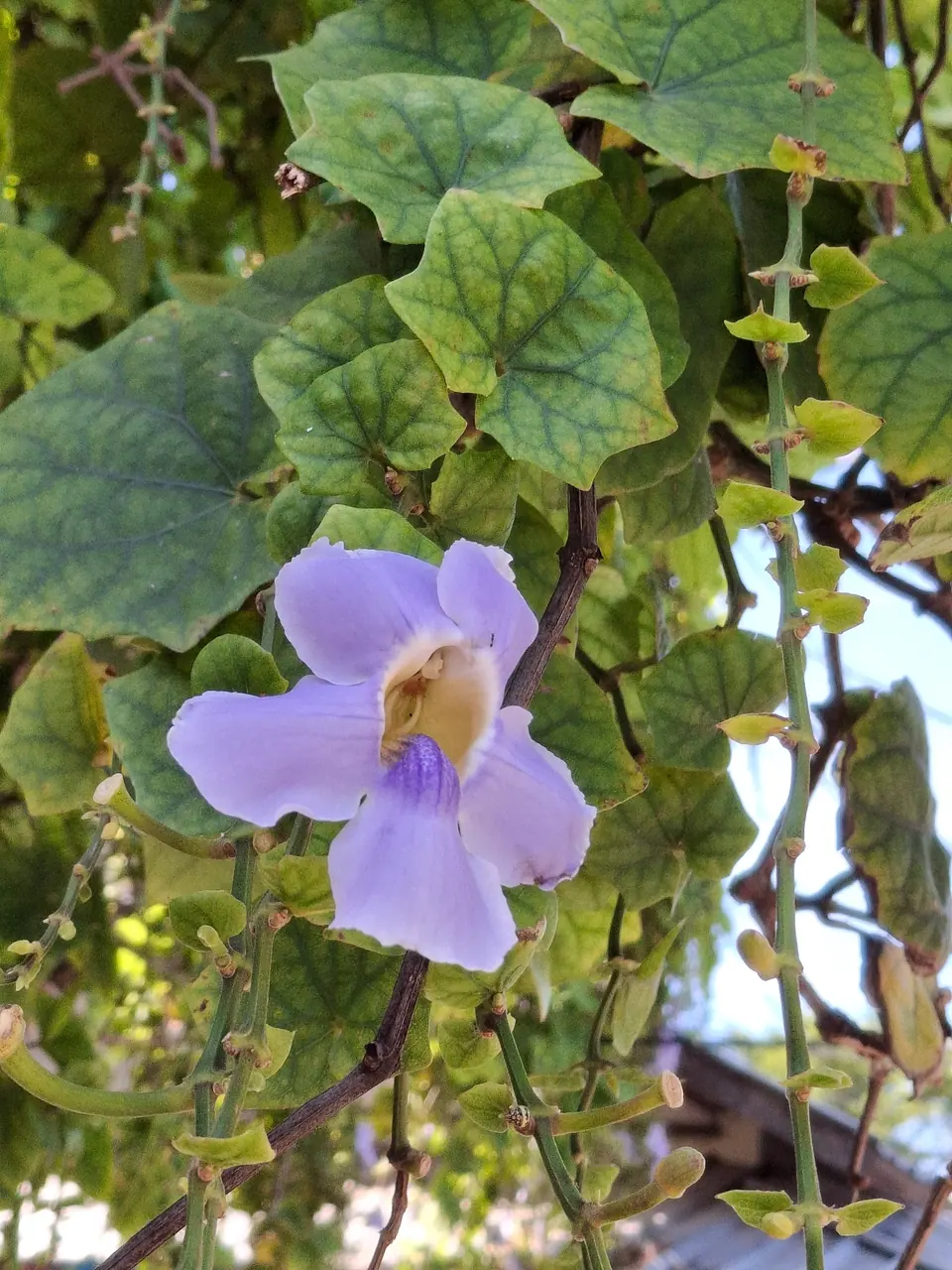
How to Grow and Care for Bengal clock vine
Thunbergia grandiflora
Written by Emilio Marruso · last checked
At a glance
This plant is happy anywhere from full sun to partial shade, and it grows in containers too. Start the seeds indoors six weeks before the last spring frost, then move it outside once nights stay above 50 °F (10 °C). A trim after each bloom cycle keeps it tidy, and you can multiply it from seed or cuttings.
- Sun
Full sun to partial shade
What the sources say (3)
Light: Full sun to partial shade
Light Needs: Full sun - partial shade.
— Sky Vine – Port St. Lucie Botanical Gardens [7] Growing in sun or part- shade, it is known to do well even with some shade especially during the heat of the summer.
— A fine vine is the sky vine - UF/IFAS Extension Charlotte County [6] This vigorous vine grows in full sun, with a southern exposure, but stays greener and prettier with a little shade protection from the blazing afternoon sunshine, especially in warmer climates.
— Care Of Sky Vine Thunbergia - Learn About Sky Vine Propagation And Growing Info | Gardening Know How [5] - Water
Water less in winter, when growth slows down
What the sources say (1)
Watering notes: In winter, when growth slows, cut down on watering
The plants might go into slow-growth mode in winter, when you can cut down on watering and fertilization.
— Thunbergia grandiflora | Bengal clockvine - Flowering plants - GCI [8] - Soil
Soil from slightly acidic to slightly alkaline, pH 6.1–7.8
What the sources say (2)
Soil pH, minimum: 6.1
Grows best in organically rich soil but will tolerate many soils (slightly acidic - slightly alkaline (pH 6.1 - 7.8).
— Sky Vine – Port St. Lucie Botanical Gardens [7] Soil pH, maximum: 7.8
Grows best in organically rich soil but will tolerate many soils (slightly acidic - slightly alkaline (pH 6.1 - 7.8).
— Sky Vine – Port St. Lucie Botanical Gardens [7] - Planting
Plant out when nights stay above 50 °F (10 °C)
What the sources say (1)
Planting: When the night-time temperature is above 10 C (50 F)
Plant the seedlings when the night-time temperature is above 50 degrees F. (10 C.).
— Care Of Sky Vine Thunbergia - Learn About Sky Vine Propagation And Growing Info | Gardening Know How [5] - Pruning
Prune after it finishes blooming, and again in late summer
What the sources say (1)
Pruning: After the blooming cycle is over, and again in late summer
Prune after the blooming cycle is over to encourage a quick re-sprout, and prune again in late summer.
— Care Of Sky Vine Thunbergia - Learn About Sky Vine Propagation And Growing Info | Gardening Know How [5] - Pests
Watch for spider mites and whiteflies; leaf edges can burn
- Watch out
Invasive: it can smother other plants and regrow from bits of stem or root, so keep it in check
- Propagation
By seed, stem cuttings, layering or dividing the root ball
What the sources say (3)
Propagation: Seed, stem cuttings, layering, air-layering, root ball division
sky vine plants can be propagated by seeds , cuttings , and layering .
— Care Of Sky Vine Thunbergia - Learn About Sky Vine Propagation And Growing Info | Gardening Know How [5] It is incredibly easy to propagate from cuttings or air-layering.
— A fine vine is the sky vine - UF/IFAS Extension Charlotte County [6] Propagation: By dividing root ball, leaf or stem cuttings and seed.
— Sky Vine – Port St. Lucie Botanical Gardens [7] - Sowing
Sow indoors six weeks before the last spring frost
What the sources say (1)
Sowing: Indoors, six weeks before the last spring frost date
Sky vine thunbergia can be grown from seed started indoors six weeks before the last spring frost date.
— Care Of Sky Vine Thunbergia - Learn About Sky Vine Propagation And Growing Info | Gardening Know How [5] - Containers
Grows in containers too
What the sources say (2)
In containers: Yes
They can also thrive in pots.
— Care Of Sky Vine Thunbergia - Learn About Sky Vine Propagation And Growing Info | Gardening Know How [5] Besides using the sky vine on a trellis or fence, also consider using it as a container plant, as a screen
— A fine vine is the sky vine - UF/IFAS Extension Charlotte County [6]
Overview
Sky vine (Thunbergia grandiflora) is a fast-growing evergreen twining vine native to India with lavender-blue trumpet flowers. [6][4] It grows in full sun to partial shade in rich, moist, well-drained soil, with regular watering and a support to climb. [7][6] Its aggressive growth makes it invasive in warm climates, so it must be managed to prevent its escape. [6][7]
Bengal clock vine care
How to water Bengal clock vine
Watering
The sources give different values depending on region, zone or growing conditions.
What each source says
According to UF/IFAS Extension Charlotte County: Regular watering
According to Port St. Lucie Botanical Gardens: Medium moisture in a well-drained soil, stays moist and does not dry out
According to Gardening Know How: Water when the soil is dry
What the sources say (5)
According to UF/IFAS Extension Charlotte County: The sky vine will benefit from regular watering and may require some pruning to keep it in bounds.According to Port St. Lucie Botanical Gardens: Soil Moisture: Medium moisture in a well-drained soil, likes to stay moist and not dry out.According to Gardening Know How: Water the plant when the soil is dry and fertilize in spring and fall with a granular fertilizer.The sky vine will benefit from regular watering and may require some pruning to keep it in bounds.Soil Moisture: Medium moisture in a well-drained soil, likes to stay moist and not dry out.Watering notes
In winter, when growth slows, cut down on watering
What the sources say (1)
The plants might go into slow-growth mode in winter, when you can cut down on watering and fertilization.How much light Bengal clock vine needs
Full sun to partial shade
What the sources say (3)
Light Needs: Full sun - partial shade.Growing in sun or part- shade, it is known to do well even with some shade especially during the heat of the summer.This vigorous vine grows in full sun, with a southern exposure, but stays greener and prettier with a little shade protection from the blazing afternoon sunshine, especially in warmer climates.How much cold Bengal clock vine can take
Hardiness, coldest zone
The sources give different values depending on region, zone or growing conditions.
What each source says
According to Gardening Know How: 8 [winter low −12.2 to −6.7 °C (10 to 20 °F)]
According to Port St. Lucie Botanical Gardens: 10a [winter low −1.1 to 1.7 °C (30 to 35 °F)]
What the sources say (2)
According to Gardening Know How: It is hardy in zones 8 to 11.According to Port St. Lucie Botanical Gardens: Zone: 10A - 11
- Light Needs: Full sun - partial shade.Hardiness, warmest zone
11 [winter low 4.4 to 10 °C (40 to 50 °F)]
Best soil for Bengal clock vine
Soil pH, minimum
6.1
What the sources say (1)
Grows best in organically rich soil but will tolerate many soils (slightly acidic - slightly alkaline (pH 6.1 - 7.8).Soil pH, maximum
7.8
What the sources say (1)
Grows best in organically rich soil but will tolerate many soils (slightly acidic - slightly alkaline (pH 6.1 - 7.8).Where to grow Bengal clock vine
Yes
What the sources say (2)
They can also thrive in pots.Besides using the sky vine on a trellis or fence, also consider using it as a container plant, as a screenHow to propagate Bengal clock vine
Seed, stem cuttings, layering, air-layering, root ball division
What the sources say (3)
sky vine plants can be propagated by seeds , cuttings , and layering .It is incredibly easy to propagate from cuttings or air-layering.Propagation: By dividing root ball, leaf or stem cuttings and seed.How to grow Bengal clock vine
The plant
Family
Acanthaceae
What the sources say (1)
Classification
Order
LAMIALES
Family
ACANTHACEAEBengal clock vine pests and problems
Invasive growth
Symptom: It can smother vegetation and regenerate from stem fragments or portions of the tuberous roots
What to do: Manage the plant to prevent its escape
What the sources say (2)
this woody-stemmed, twining evergreen can be invasive, as it can easily regenerate from stem fragments or portions of the tuberous roots.
— Care Of Sky Vine Thunbergia - Learn About Sky Vine Propagation And Growing Info | Gardening Know How [5] Its aggressive nature can make it a bit invasive, so manage this plant to prevent its escape.
— A fine vine is the sky vine - UF/IFAS Extension Charlotte County [6] Pests
Symptom: Spider mites, whiteflies and edge burn may damage the plant
What the sources say (1)
Spider mites , whiteflies , and edge burn may damage the plant.
— Care Of Sky Vine Thunbergia - Learn About Sky Vine Propagation And Growing Info | Gardening Know How [5]
Remedies
Each remedy shows what official sources say about it; traditional remedies without an official source are marked as such. Harmful ones are listed so you know to avoid them.
Getting rid of it
invasive spread
digging out small plants Official source, not independently tested
How: Dig out small plants, removing the tubers and all of the roots.
Dig out small plants. Remove the tubers and all of the roots.
— weeds.dpi.nsw.gov.au [9] cutting vines at ground level Partly works
How: Cutting vines at ground level helps smothered plants survive, but follow-up control is required.
Cutting vines at ground level will help smothered plants survive but laurel clock vine will regrow from tubers.
— weeds.dpi.nsw.gov.au [9] What the evidence says Cutting vines at ground level will help smothered plants survive but laurel clock vine will regrow from tubers.
— weeds.dpi.nsw.gov.au [9]
Calendar
Sowing
Indoors, six weeks before the last spring frost date
What the sources say (1)
Sky vine thunbergia can be grown from seed started indoors six weeks before the last spring frost date.Planting
When the night-time temperature is above 10 C (50 F)
What the sources say (1)
Plant the seedlings when the night-time temperature is above 50 degrees F. (10 C.).Pruning
After the blooming cycle is over, and again in late summer
What the sources say (1)
Prune after the blooming cycle is over to encourage a quick re-sprout, and prune again in late summer.Months as given by the sources, which are mostly from the United States (northern hemisphere). In the southern hemisphere they shift by about six months.
Indicative values
Values from a secondary source, not checked word for word like the rest of this page. Use them as a starting point.
- Life cycle
- PerennialIndicative value, adapt it to your climate · Secondary source
- Mature height
- 457.2-914.4 cm (15-30 ft)Indicative value, adapt it to your climate · Secondary source
- Hours of sun
- 4-6 hoursIndicative value, adapt it to your climate · Secondary source
- Drought tolerant
- yesIndicative value, adapt it to your climate · Secondary source
- Care level
- MediumIndicative value, adapt it to your climate · Secondary source
- Growth rate
- HighIndicative value, adapt it to your climate · Secondary source
Similar plants
- Black-eyed Susan Vine Thunbergia alata
- American Water-willow Dianthera americana
- Bear's Breeches Acanthus mollis
- Bear's Breeches Acanthus spinosus
- Dicliptera Dicliptera squarrosa
- Fringe-Leaf Wild Petunia Ruellia humilis
- Lollipop-plant Pachystachys lutea
- Mexican Petunia Ruellia simplex
Sources
Every value above is quoted from these documents. Links lead to the original publisher.
- Thunbergia grandiflora / [Species detail] / Plant Atlas · florida.plantatlas.usf.edu, consulted
- Flora of New Zealand | Taxon Profile | Thunbergia grandiflora · nzflora.info, consulted
- HortFlora · hortflora.rbg.vic.gov.au, consulted
- Plant 24 Thunbergia grandiflora | Kranji Primary School · kranjipri.moe.edu.sg, consulted
- Care Of Sky Vine Thunbergia - Learn About Sky Vine Propagation And Growing Info | Gardening Know How · gardeningknowhow.com, consulted
- A fine vine is the sky vine - UF/IFAS Extension Charlotte County · blogs.ifas.ufl.edu, consulted
- Sky Vine – Port St. Lucie Botanical Gardens · pslbg.org, consulted
- Thunbergia grandiflora | Bengal clockvine - Flowering plants - GCI · greencoverinitiative.com, consulted
- weeds.dpi.nsw.gov.au · weeds.dpi.nsw.gov.au
Written by Emilio Marruso · last checked