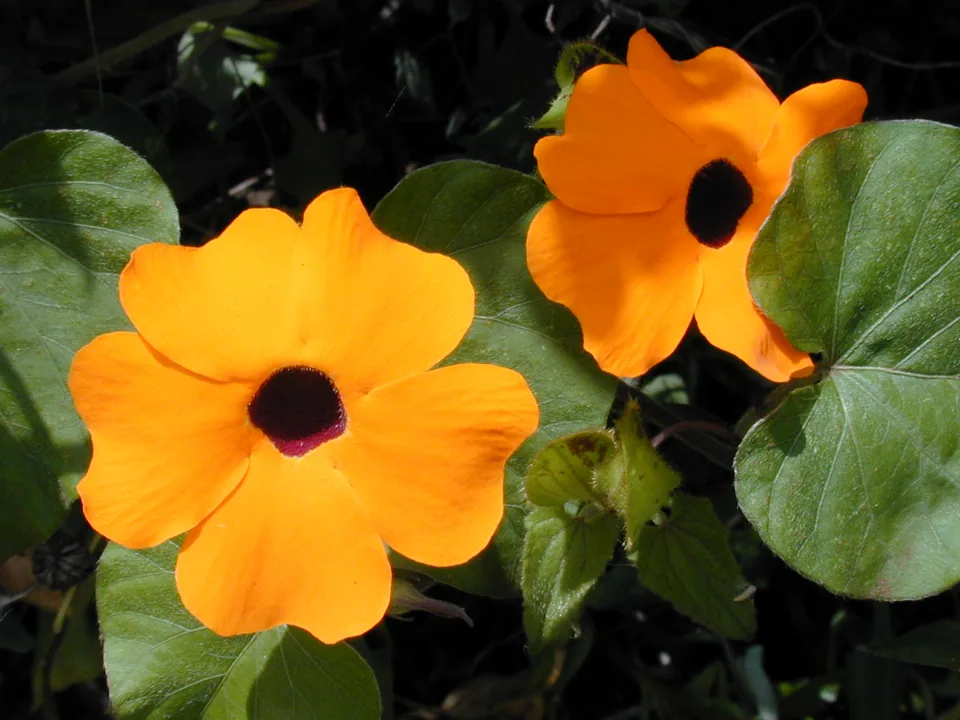


How to Grow and Care for Black-eyed Susan Vine
Thunbergia alata
Written by Emilio Marruso · last checked
At a glance
This cheerful vine climbs a trellis up to 3 to 8 feet and thrives in full sun or partial shade, in the garden, in containers or even indoors. Start the seeds indoors 6 to 8 weeks before the last frost, keep the soil evenly moist, and trim long shoots to keep it tidy and full of blooms.
- Sun
Full sun to partial shade
What the sources say (3)
Light: Full sun to partial shade
Plant in full sun with some afternoon shade, in rich, medium moisture, well-drained soils.
— Thunbergia alata (Black-eyed Susan Vine, Thunbergia) | North Carolina Extension Gardener Plant Toolbox [1] Thunbergia alata grows best in fertile, moist soil in full sun. It tolerates partial shade but flowering may be reduced.
— Black-eyed Susan Vine, Thunbergia alata – Wisconsin Horticulture [2] Full sun to partail shade. Moist, well drained soils are best.
— Black Eyed Susan Vine (Thunbergia alata)-Hort Answers - University of Illinois Extension [3] - Water
Keep soil evenly moist; it wilts quickly when dry, and dryness invites spider mites
What the sources say (4)
Watering: Medium moisture; wilts quickly if it gets dry
Plant in full sun with some afternoon shade, in rich, medium moisture, well-drained soils.
— Thunbergia alata (Black-eyed Susan Vine, Thunbergia) | North Carolina Extension Gardener Plant Toolbox [1] Like other members of the acanthus family, black-eyed Susan vine wilts quickly if it gets dry.
— Black-Eyed Susan Vine [4] Watering notes: When it begins to get dry it shows exaggerated afternoon wilting that disappears when the sun goes down; dryness worsens spider mite problems
As it begins to get dry, it shows an exaggerated afternoon wilting that disappears as soon as the sun goes down.
— Black-Eyed Susan Vine [4] Spider mites are a common problem during the hottest part of the summer. This problem is made worse if the plant is allowed to get too dry.
— Black-Eyed Susan Vine [4] - Cold
Frost-tender: often grown as an annual
What the sources say (2)
Life cycle: perennial (tender evergreen; often grown as an annual)
Thunbergia alata is a tender evergreen perennial in the acanthus family (Acanthaceae) native from tropical East Africa to eastern South Africa that is hardy only in zone 9a and 10a.
— Black-eyed Susan Vine, Thunbergia alata – Wisconsin Horticulture [2] Planting: Outside once all danger of frost has passed and night temperatures remain above 50 °F [10 °C]
plant outside once all danger of frost has passed and night temperatures remain above 50 °F
— Black-eyed Susan Vine, Thunbergia alata – Wisconsin Horticulture [2] - Spacing
14–16 in between plants
What the sources say (1)
Spacing: 35.6-40.6 cm (14-16 in)
Transplant near a trellis, fence, or other support structure, 14 to 16 inches apart.
— Black-eyed Susan Vine, Thunbergia alata – Wisconsin Horticulture [2] - Planting
Plant out once frost danger is past and nights stay above 50 °F (10 °C)
What the sources say (1)
Planting: Outside once all danger of frost has passed and night temperatures remain above 50 °F [10 °C]
plant outside once all danger of frost has passed and night temperatures remain above 50 °F
— Black-eyed Susan Vine, Thunbergia alata – Wisconsin Horticulture [2] - Pruning
Trim long shoots to keep it under control and focus the blooms
- Pests
Spider mites, scale and whiteflies, mostly indoors; mites peak in the hottest part of summer
What the sources say (1)
Pests: spider mites, scale, white flies
Indoor plants can suffer from spider mites, scale, or white flies.
— Thunbergia alata (Black-eyed Susan Vine, Thunbergia) | North Carolina Extension Gardener Plant Toolbox [1] - Watch out
Reseeds easily and can turn invasive in warm, frost-free climates
- Size
3–8 ft tall and 3–6 ft wide
What the sources say (2)
Mature height: 91-244 cm (3-8 ft)
Height: 3 ft. 0 in. - 8 ft. 0 in.
— Thunbergia alata (Black-eyed Susan Vine, Thunbergia) | North Carolina Extension Gardener Plant Toolbox [1] Mature width: 91-183 cm (3-6 ft)
Width: 3 ft. 0 in. - 6 ft. 0 in.
— Thunbergia alata (Black-eyed Susan Vine, Thunbergia) | North Carolina Extension Gardener Plant Toolbox [1] - Propagation
From seed, softwood stem cuttings or layering
What the sources say (2)
Propagation: Seed; stem cuttings (softwood); layering
This plant is most commonly propagated from seed (although softwood cuttings can be taken or stems layered, too, but plants grown from seed tend to be more vigorous).
— Black-eyed Susan Vine, Thunbergia alata – Wisconsin Horticulture [2] It grows from seeds or stem cuttings and because it reseeds itself easily and in frost-free areas, it can be weedy.
— Thunbergia alata (Black-eyed Susan Vine, Thunbergia) | North Carolina Extension Gardener Plant Toolbox [1] - Sowing
Sow indoors 6–8 weeks before last frost, or outside once soil hits 60 °F (16 °C); sprouts in 10–21 days
What the sources say (5)
Sowing: Indoors 6 to 8 weeks before the average last frost; directly outdoors in spring once soil temperature reaches 60 °F [16 °C]
indoors (upper Midwest transplants): Start seeds indoors 6 to 8 weeks before the average last frost
— Black-eyed Susan Vine, Thunbergia alata – Wisconsin Horticulture [2] directly where the plants are to be grown: Seed can be sown directly where the plants are to be grown once soil temperature reaches 60 °F in the spring
— Black-eyed Susan Vine, Thunbergia alata – Wisconsin Horticulture [2] Start seeds indoors 6 to 8 weeks before the average last frost
— Black-eyed Susan Vine, Thunbergia alata – Wisconsin Horticulture [2] Seed can be sown directly where the plants are to be grown once soil temperature reaches 60 °F in the spring
— Black-eyed Susan Vine, Thunbergia alata – Wisconsin Horticulture [2] Days to germination: 10-21
Press the seeds into the soil, covering completely. Seeds should germinate in 10 to 21 days.
— Black-eyed Susan Vine, Thunbergia alata – Wisconsin Horticulture [2] - Containers
Grows in containers and even indoors
What the sources say (3)
In containers: Yes
This vine can be used in a large container with a small trellis, and can be grown as an indoor plant
— Black-eyed Susan Vine, Thunbergia alata – Wisconsin Horticulture [2] It can be grown in hanging baskets or mixed containers, but its nature is to climb so it seems to bloom best when allowed to climb up a trellis.
— Black-Eyed Susan Vine [4] Indoors: Yes
This vine can be used in a large container with a small trellis, and can be grown as an indoor plant
— Black-eyed Susan Vine, Thunbergia alata – Wisconsin Horticulture [2]
Overview
Black-eyed Susan vine is a showy tropical tender evergreen that is best grown as an annual and replaced each year. [1] It grows best in fertile, moist soil in full sun and tolerates partial shade with reduced flowering. [2] As a twining vine it does best with support such as an arbor, trellis or fence, or can trail from a hanging basket. [1]
This record is incomplete: the sources we read do not cover every field yet.
Not yet covered by our sources: Pruning
Black-eyed Susan Vine care
Measurements in square brackets are our conversion into the other unit system; the quoted text is unchanged.
How to water Black-eyed Susan Vine
Watering
Medium moisture; wilts quickly if it gets dry
What the sources say (2)
Plant in full sun with some afternoon shade, in rich, medium moisture, well-drained soils.Like
other members of the acanthus family, black-eyed Susan vine wilts quickly if it gets
dry.Watering notes
When it begins to get dry it shows exaggerated afternoon wilting that disappears when the sun goes down; dryness worsens spider mite problems
What the sources say (2)
As it begins to get dry, it shows an exaggerated afternoon wilting that disappears
as soon as the sun goes down.Spider mites are a common problem during the hottest part of the summer. This problem
is made worse if the plant is allowed to get too dry.How much light Black-eyed Susan Vine needs
Full sun to partial shade
What the sources say (3)
Plant in full sun with some afternoon shade, in rich, medium moisture, well-drained soils.Thunbergia alata grows best in fertile, moist soil in full sun. It tolerates partial shade but flowering may be reduced.Full sun to partail shade. Moist, well drained soils are best.How much cold Black-eyed Susan Vine can take
Hardiness, coldest zone
The sources give different values depending on region, zone or growing conditions.
What each source says
According to NC State Extension: 10a [winter low −1.1 to 1.7 °C (30 to 35 °F)]
According to University of Wisconsin Extension: 9a [winter low −6.7 to −3.9 °C (20 to 25 °F)]
What the sources say (2)
According to NC State Extension: USDA Plant Hardiness Zone:
10a, 10b, 11a, 11bAccording to University of Wisconsin Extension: that is hardy only in zone 9a and 10a.Hardiness, warmest zone
The sources give different values depending on region, zone or growing conditions.
What each source says
According to NC State Extension: 11b [winter low 7.2 to 10 °C (45 to 50 °F)]
According to University of Wisconsin Extension: 10a [winter low −1.1 to 1.7 °C (30 to 35 °F)]
What the sources say (2)
According to NC State Extension: USDA Plant Hardiness Zone:
10a, 10b, 11a, 11bAccording to University of Wisconsin Extension: that is hardy only in zone 9a and 10a.Where to grow Black-eyed Susan Vine
Indoors
Yes
What the sources say (1)
This vine can be used in a large container with a small trellis, and can be grown as an indoor plantIn containers
Yes
What the sources say (2)
This vine can be used in a large container with a small trellis, and can be grown as an indoor plantIt can be grown in hanging baskets or mixed containers,
but its nature is to climb so it seems to bloom best when allowed to climb up a trellis.Spacing
35.6-40.6 cm (14-16 in)
What the sources say (1)
Transplant near a trellis, fence, or other support structure, 14 to 16 inches apart.How to propagate Black-eyed Susan Vine
Seed; stem cuttings (softwood); layering
What the sources say (2)
This plant is most commonly propagated from seed (although softwood cuttings can be taken or stems layered, too, but plants grown from seed tend to be more vigorous).It grows from seeds or stem cuttings and because it reseeds itself easily and in frost-free areas, it can be weedy.How to grow Black-eyed Susan Vine
The plant
Life cycle
perennial (tender evergreen; often grown as an annual)
What the sources say (1)
Thunbergia alata is a tender evergreen perennial in the acanthus family (Acanthaceae) native from tropical East Africa to eastern South Africa that is hardy only in zone 9a and 10a.Family
Acanthaceae
What the sources say (1)
Thunbergia alata is a tender evergreen perennial in the acanthus family (Acanthaceae) native from tropical East Africa to eastern South Africa that is hardy only in zone 9a and 10a.Mature height
91-244 cm (3-8 ft)
What the sources say (1)
Height: 3 ft. 0 in. - 8 ft. 0 in.Mature width
91-183 cm (3-6 ft)
What the sources say (1)
Width: 3 ft. 0 in. - 6 ft. 0 in.Sowing and growth
Days to germination
10-21
What the sources say (1)
Press the seeds into the soil, covering completely. Seeds should germinate in 10 to 21 days.Pests and diseases
Pests
spider mites, scale, white flies
What the sources say (1)
Indoor plants can suffer from spider mites, scale, or white flies.Fertilizing
When
The sources give different values depending on region, zone or growing conditions.
What each source says
in containers: While in bloom
What the sources say (1)
in containers: Transplant near a trellis, fence, or other support structure, 14 to 16 inches apart. Fertilize every 2 to 3 weeks when in bloom if grown in containers.How often
The sources give different values depending on region, zone or growing conditions.
What each source says
in containers: Every 2 to 3 weeks
What the sources say (1)
in containers: Transplant near a trellis, fence, or other support structure, 14 to 16 inches apart. Fertilize every 2 to 3 weeks when in bloom if grown in containers.Black-eyed Susan Vine pests and problems
Spider mites, scale and whiteflies
Symptom: Indoor plants can suffer from spider mites, scale or white flies; spider mites are common in the hottest part of summer.
What to do: Do not let the plant get too dry, which worsens the mite problem.
What the sources say (2)
Indoor plants can suffer from spider mites, scale, or white flies.
— Thunbergia alata (Black-eyed Susan Vine, Thunbergia) | North Carolina Extension Gardener Plant Toolbox [1] Spider mites are a common problem during the hottest part of the summer. This problem is made worse if the plant is allowed to get too dry.
— Black-Eyed Susan Vine [4] Weediness and invasiveness
Symptom: Reseeds easily and can be weedy in frost-free areas; invasive in many warm locations.
What to do: Grow with caution in frost-free regions.
What the sources say (1)
It should be grown with caution in frost-free regions, as it has become invasive in many warm locations throughout the world.
— Black-eyed Susan Vine, Thunbergia alata – Wisconsin Horticulture [2] Tangled growth
Symptom: Vines can become a tangled mess and overrun neighbors.
What to do: Trimming back long shoots keeps it under control and concentrates the blooms; allow it to climb a trellis.
What the sources say (1)
Trimming back long shoots keeps it under control and concentrates the blooms.
— Black-Eyed Susan Vine [4]
Remedies
Each remedy shows what official sources say about it; traditional remedies without an official source are marked as such. Harmful ones are listed so you know to avoid them.
Getting rid of it
unwanted spread
hand-pulling roots and heavy mulch Official source, not independently tested
How: Hand-pull the roots and mulch heavily to prevent regrowth.
Hand-pull roots. - Mulch heavily to prevent regrowth.
— business.qld.gov.au [5]
Calendar
Sowing
Indoors 6 to 8 weeks before the average last frost; directly outdoors in spring once soil temperature reaches 60 °F [16 °C]
What each source says
indoors (upper Midwest transplants): Indoors 6 to 8 weeks before the average last frost
directly where the plants are to be grown: Directly outdoors in spring once soil temperature reaches 60 °F [16 °C]
What the sources say (4)
indoors (upper Midwest transplants): Start seeds indoors 6 to 8 weeks before the average last frostdirectly where the plants are to be grown: Seed can be sown directly where the plants are to be grown once soil temperature reaches 60 °F in the springStart seeds indoors 6 to 8 weeks before the average last frostSeed can be sown directly where the plants are to be grown once soil temperature reaches 60 °F in the springPlanting
Outside once all danger of frost has passed and night temperatures remain above 50 °F [10 °C]
What the sources say (1)
plant outside once all danger of frost has passed and night temperatures remain above 50 °FPruning
Not stated in the sources we read.
Months as given by the sources, which are mostly from the United States (northern hemisphere). In the southern hemisphere they shift by about six months.
Relative to frost
Less precise estimate: there is no weather station within 300 km.
Find frost dates by ZIP code or city
Sow indoors: 6 to 8 weeks before the last frost
Start seeds indoors 6 to 8 weeks before the average last frost , and plant outside once all danger of frost has passed
— Black-eyed Susan Vine, Thunbergia alata – Wisconsin Horticulture [2] Transplant: around the last frost
and plant outside once all danger of frost has passed and night temperatures remain above 50 °F
— Black-eyed Susan Vine, Thunbergia alata – Wisconsin Horticulture [2]
Count from the average frost dates where you live.
Indicative values
Values from a secondary source, not checked word for word like the rest of this page. Use them as a starting point.
- Hours of sun
- 6-8 hoursIndicative value, adapt it to your climate · Secondary source
- Drought tolerant
- yesIndicative value, adapt it to your climate · Secondary source
- Soil
- Well-drainedIndicative value, adapt it to your climate · Secondary source
- Soil pH
- 6-7.5Indicative value, adapt it to your climate · Secondary source
- Care level
- MediumIndicative value, adapt it to your climate · Secondary source
- Growth rate
- HighIndicative value, adapt it to your climate · Secondary source
- Pruning
- February, March, April, May, MayIndicative value, adapt it to your climate · Secondary source
Similar plants
- Bengal clock vine Thunbergia grandiflora
- American Water-willow Dianthera americana
- Bear's Breeches Acanthus mollis
- Bear's Breeches Acanthus spinosus
- Dicliptera Dicliptera squarrosa
- Fringe-Leaf Wild Petunia Ruellia humilis
- Lollipop-plant Pachystachys lutea
- Mexican Petunia Ruellia simplex
Sources
Every value above is quoted from these documents. Links lead to the original publisher.
- Thunbergia alata (Black-eyed Susan Vine, Thunbergia) | North Carolina Extension Gardener Plant Toolbox · plants.ces.ncsu.edu, consulted
- Black-eyed Susan Vine, Thunbergia alata – Wisconsin Horticulture · hort.extension.wisc.edu, consulted
- Black Eyed Susan Vine (Thunbergia alata)-Hort Answers - University of Illinois Extension · web.extension.illinois.edu, consulted
- Black-Eyed Susan Vine · uaex.uada.edu, consulted
- business.qld.gov.au · business.qld.gov.au
Written by Emilio Marruso · last checked