
How to Grow and Care for Umbrella Tree
Heptapleurum actinophyllum
Written by Emilio Marruso · last checked
Toxic to: Cats, Dogs, Horses, Animals, People · Why
At a glance
This leafy perennial is happy indoors or in a container and can reach 4–6 ft tall and 3–6 ft wide. Give it a bright, sunny spot sheltered from hot afternoon sun, rich soil that drains well, and regular drinks of rainwater or filtered water. Cut it back in winter if it gets too big, and enjoy a lush green showpiece.
- Sun
Bright spot, full sun to partial shade; keep it out of hot afternoon sun
What the sources say (3)
Light: Bright sunny location; full sun to partial shade; best protected from hot afternoon sun
As a houseplant , it prefers a bright sunny location with high humidity and temperatures above 60 degrees Fahrenheit. The preferred temperature range is from 65 to 90 degrees Fahrenheit. It thrives in rich, moist, and well-drained soil.
— Heptapleurum actinophyllum (Australian Ivy Palm, Octopus Tree, Schefflera, Starleaf, Umbrella Tree) | North Carolina Extension Gardener Plant Toolbox [1] It does best when protected from the hot afternoon sun.
— Heptapleurum actinophyllum (Australian Ivy Palm, Octopus Tree, Schefflera, Starleaf, Umbrella Tree) | North Carolina Extension Gardener Plant Toolbox [1] Light: Full sun (6 or more hours of direct sunlight a day) Partial Shade (Direct sunlight only part of the day, 2-6 hours)
— Heptapleurum actinophyllum (Australian Ivy Palm, Octopus Tree, Schefflera, Starleaf, Umbrella Tree) | North Carolina Extension Gardener Plant Toolbox [1] - Water
Water regularly with rainwater or filtered water; too little makes it drop its leaves
What the sources say (2)
Watering: Water regularly with rainwater or filtered water; thrives in rich, moist, well-drained soil
It thrives in rich, moist, and well-drained soil. Water the plant regularly with rainwater or filtered water.
— Heptapleurum actinophyllum (Australian Ivy Palm, Octopus Tree, Schefflera, Starleaf, Umbrella Tree) | North Carolina Extension Gardener Plant Toolbox [1] Watering notes: Underwatered plants drop their leaves; bacterial leaf spot and soft rot occur when soils are too wet
Insects, Diseases, and Other Plant Problems: No serious problems but suffers occasionally from aphids, mealybugs, spider mites, thrips, and scale. Bacterial leaf spot and soft rot occur when soils are too wet. Underwatered plants will drop their leaves.
— Heptapleurum actinophyllum (Australian Ivy Palm, Octopus Tree, Schefflera, Starleaf, Umbrella Tree) | North Carolina Extension Gardener Plant Toolbox [1] - Cold
Survives winters down to 30 °F (−1.1 °C)
Half hardy: mild winters or an unheated greenhouse · USDA 10a · RHS H3 · Z10
What the sources say (2)
Hardiness, coldest zone: 10a [winter low −1.1 to 1.7 °C (30 to 35 °F)]
USDA Plant Hardiness Zone: 10a, 10b, 11a, 11b, 12a, 12b
— Heptapleurum actinophyllum (Australian Ivy Palm, Octopus Tree, Schefflera, Starleaf, Umbrella Tree) | North Carolina Extension Gardener Plant Toolbox [1] Hardiness, warmest zone: 12b [winter low 12.8 to 15.6 °C (55 to 60 °F)]
USDA Plant Hardiness Zone: 10a, 10b, 11a, 11b, 12a, 12b
— Heptapleurum actinophyllum (Australian Ivy Palm, Octopus Tree, Schefflera, Starleaf, Umbrella Tree) | North Carolina Extension Gardener Plant Toolbox [1] - Soil
Rich, moist soil that drains well
What the sources say (1)
Watering: Water regularly with rainwater or filtered water; thrives in rich, moist, well-drained soil
It thrives in rich, moist, and well-drained soil. Water the plant regularly with rainwater or filtered water.
— Heptapleurum actinophyllum (Australian Ivy Palm, Octopus Tree, Schefflera, Starleaf, Umbrella Tree) | North Carolina Extension Gardener Plant Toolbox [1] - Pruning
You can cut it back in winter
What the sources say (1)
Pruning: Can be cut back in the winter
It can be pruned to control its size and may be cut back in the winter.
— Heptapleurum actinophyllum (Australian Ivy Palm, Octopus Tree, Schefflera, Starleaf, Umbrella Tree) | North Carolina Extension Gardener Plant Toolbox [1] - Pests
Aphids, mealybugs, spider mites, thrips and scale; leaf spot and soft rot
What the sources say (2)
Pests: aphids, mealybugs, spider mites, thrips, scale
No serious problems but suffers occasionally from aphids, mealybugs, spider mites, thrips, and scale.
— Heptapleurum actinophyllum (Australian Ivy Palm, Octopus Tree, Schefflera, Starleaf, Umbrella Tree) | North Carolina Extension Gardener Plant Toolbox [1] Diseases: bacterial leaf spot, soft rot
Bacterial leaf spot and soft rot occur when soils are too wet. Underwatered plants will drop their leaves.
— Heptapleurum actinophyllum (Australian Ivy Palm, Octopus Tree, Schefflera, Starleaf, Umbrella Tree) | North Carolina Extension Gardener Plant Toolbox [1] - Watch out
Don't keep the soil soggy: too much water brings leaf spot and rot
What the sources say (1)
Watering notes: Underwatered plants drop their leaves; bacterial leaf spot and soft rot occur when soils are too wet
Insects, Diseases, and Other Plant Problems: No serious problems but suffers occasionally from aphids, mealybugs, spider mites, thrips, and scale. Bacterial leaf spot and soft rot occur when soils are too wet. Underwatered plants will drop their leaves.
— Heptapleurum actinophyllum (Australian Ivy Palm, Octopus Tree, Schefflera, Starleaf, Umbrella Tree) | North Carolina Extension Gardener Plant Toolbox [1] - Size
4–6 ft tall and 3–6 ft wide
What the sources say (2)
Mature height: 122-183 cm (4 ft - 6 ft)
Dimensions: Height: 4 ft. 0 in. - 6 ft. 0 in. Width: 3 ft. 0 in. - 6 ft. 0 in.
— Heptapleurum actinophyllum (Australian Ivy Palm, Octopus Tree, Schefflera, Starleaf, Umbrella Tree) | North Carolina Extension Gardener Plant Toolbox [1] Mature width: 91-183 cm (3 ft - 6 ft)
Dimensions: Height: 4 ft. 0 in. - 6 ft. 0 in. Width: 3 ft. 0 in. - 6 ft. 0 in.
— Heptapleurum actinophyllum (Australian Ivy Palm, Octopus Tree, Schefflera, Starleaf, Umbrella Tree) | North Carolina Extension Gardener Plant Toolbox [1] - Propagation
From seeds, layering or cuttings
What the sources say (1)
Propagation: Seeds, layering, cuttings
This plant can be propagated by seeds, layering, or cuttings.
— Heptapleurum actinophyllum (Australian Ivy Palm, Octopus Tree, Schefflera, Starleaf, Umbrella Tree) | North Carolina Extension Gardener Plant Toolbox [1] - Containers
Grows well in containers and indoors
What the sources say (2)
In containers: Yes
In North Carolina, these plants can also be grown in protected locations outdoors in containers, but they must be brought in over the winter.
— Heptapleurum actinophyllum (Australian Ivy Palm, Octopus Tree, Schefflera, Starleaf, Umbrella Tree) | North Carolina Extension Gardener Plant Toolbox [1] Indoors: Yes
As a houseplant , it prefers a bright sunny location with high humidity and temperatures above 60 degrees Fahrenheit.
— Heptapleurum actinophyllum (Australian Ivy Palm, Octopus Tree, Schefflera, Starleaf, Umbrella Tree) | North Carolina Extension Gardener Plant Toolbox [1] - Safety
All parts are toxic if eaten, for people and pets; the sap irritates skin
Overview
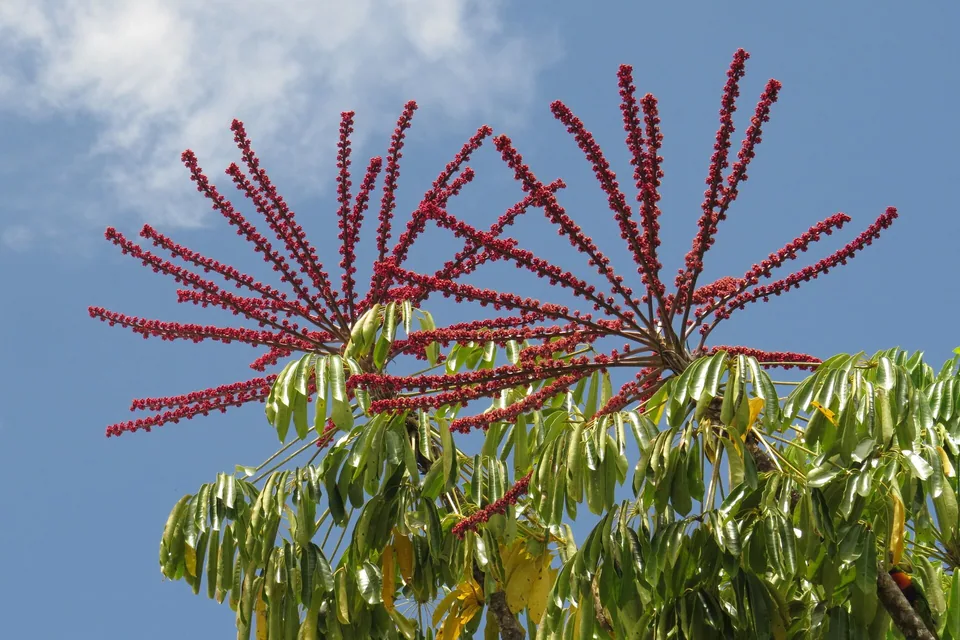
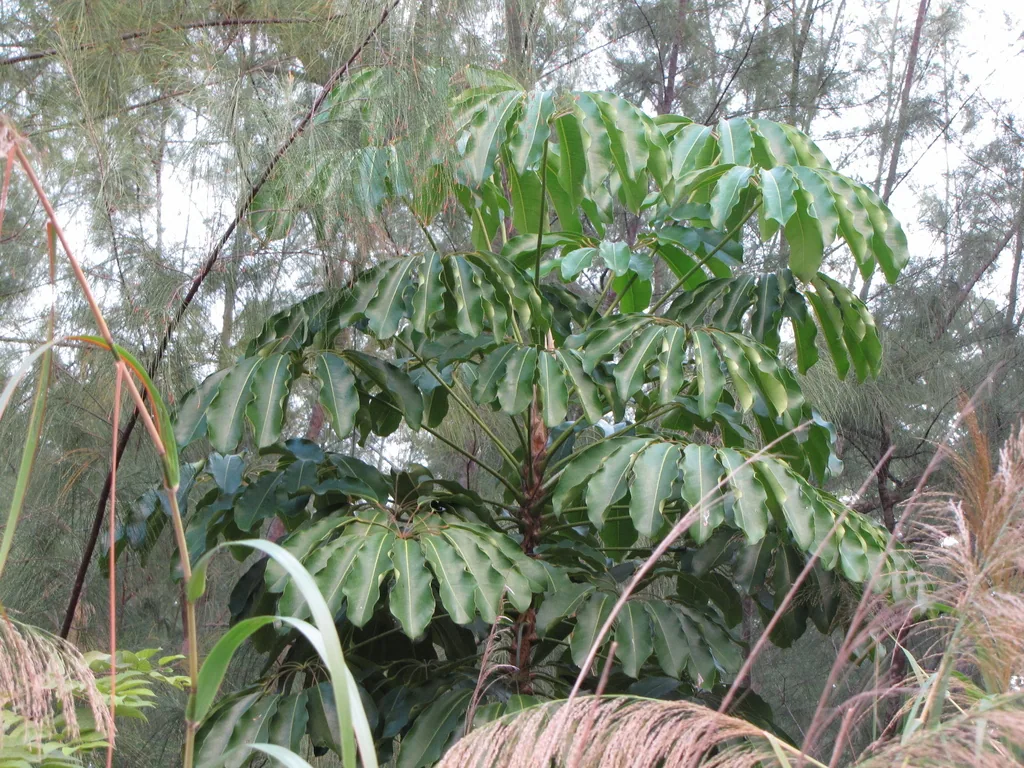
Heptapleurum actinophyllum is an evergreen shrub or multi-stemmed medium-sized tree that can grow up to 40 feet [12.2 m] tall, found in the wet tropical areas of Northern Australia and Southern New Guinea. [1] As a houseplant it prefers a bright sunny location with high humidity and is protected from hot afternoon sun. [1] All parts of the plant are toxic if ingested and should be kept out of the reach of pets and children. [1]
Umbrella Tree care
Measurements in square brackets are our conversion into the other unit system; the quoted text is unchanged.
How to water Umbrella Tree
Watering
Water regularly with rainwater or filtered water; thrives in rich, moist, well-drained soil
What the sources say (1)
It thrives in rich, moist, and well-drained soil. Water the plant regularly with rainwater or filtered water.Watering notes
Underwatered plants drop their leaves; bacterial leaf spot and soft rot occur when soils are too wet
What the sources say (1)
Insects, Diseases, and Other Plant Problems: No serious problems but suffers occasionally from aphids, mealybugs, spider mites, thrips, and scale. Bacterial leaf spot and soft rot occur when soils are too wet. Underwatered plants will drop their leaves.How much light Umbrella Tree needs
Bright sunny location; full sun to partial shade; best protected from hot afternoon sun
What the sources say (3)
As a houseplant , it prefers a bright sunny location with high humidity and temperatures above 60 degrees Fahrenheit. The preferred temperature range is from 65 to 90 degrees Fahrenheit. It thrives in rich, moist, and well-drained soil.It does best when protected from the hot afternoon sun.Light:
Full sun (6 or more hours of direct sunlight a day)
Partial Shade (Direct sunlight only part of the day, 2-6 hours)How much cold Umbrella Tree can take
Hardiness, coldest zone
10a [winter low −1.1 to 1.7 °C (30 to 35 °F)]
What the sources say (1)
USDA Plant Hardiness Zone:
10a, 10b, 11a, 11b, 12a, 12bHardiness, warmest zone
12b [winter low 12.8 to 15.6 °C (55 to 60 °F)]
What the sources say (1)
USDA Plant Hardiness Zone:
10a, 10b, 11a, 11b, 12a, 12bWhere to grow Umbrella Tree
Indoors
Yes
What the sources say (1)
As a houseplant , it prefers a bright sunny location with high humidity and temperatures above 60 degrees Fahrenheit.In containers
Yes
What the sources say (1)
In North Carolina, these plants can also be grown in protected locations outdoors in containers, but they must be brought in over the winter.How to propagate Umbrella Tree
Seeds, layering, cuttings
What the sources say (1)
This plant can be propagated by seeds, layering, or cuttings.How to grow Umbrella Tree
The plant
Life cycle
perennial
What the sources say (1)
Life Cycle: Perennial Woody Recommended Propagation Strategy: Layering Seed Stem CuttingFamily
Araliaceae
What the sources say (1)
This tree is a member of the ivy family (Araliaceae).Mature height
122-183 cm (4 ft - 6 ft)
What the sources say (1)
Dimensions: Height: 4 ft. 0 in. - 6 ft. 0 in. Width: 3 ft. 0 in. - 6 ft. 0 in.Mature width
91-183 cm (3 ft - 6 ft)
What the sources say (1)
Dimensions: Height: 4 ft. 0 in. - 6 ft. 0 in. Width: 3 ft. 0 in. - 6 ft. 0 in.Pests and diseases
Pests
aphids, mealybugs, spider mites, thrips, scale
What the sources say (1)
No serious problems but suffers occasionally from aphids, mealybugs, spider mites, thrips, and scale.Diseases
bacterial leaf spot, soft rot
What the sources say (1)
Bacterial leaf spot and soft rot occur when soils are too wet. Underwatered plants will drop their leaves.Umbrella Tree pests and problems
Pests
Symptom: Occasional aphids, mealybugs, spider mites, thrips, and scale.
What to do: None given.
What the sources say (1)
No serious problems but suffers occasionally from aphids, mealybugs, spider mites, thrips, and scale.
— Heptapleurum actinophyllum (Australian Ivy Palm, Octopus Tree, Schefflera, Starleaf, Umbrella Tree) | North Carolina Extension Gardener Plant Toolbox [1] Bacterial leaf spot and soft rot
Symptom: Occur when soils are too wet.
What to do: Avoid overly wet soil.
What the sources say (1)
Bacterial leaf spot and soft rot occur when soils are too wet. Underwatered plants will drop their leaves.
— Heptapleurum actinophyllum (Australian Ivy Palm, Octopus Tree, Schefflera, Starleaf, Umbrella Tree) | North Carolina Extension Gardener Plant Toolbox [1] Leaf drop from underwatering
Symptom: Underwatered plants will drop their leaves.
What to do: Water regularly.
What the sources say (1)
Bacterial leaf spot and soft rot occur when soils are too wet. Underwatered plants will drop their leaves.
— Heptapleurum actinophyllum (Australian Ivy Palm, Octopus Tree, Schefflera, Starleaf, Umbrella Tree) | North Carolina Extension Gardener Plant Toolbox [1]
Remedies
Each remedy shows what official sources say about it; traditional remedies without an official source are marked as such. Harmful ones are listed so you know to avoid them.
Treating the plant
thrips
washing off with a steady shower of water Not verified
Traditional remedy, not verified by an official source.
How: Sometimes a good steady shower of water will wash them off the plant.
yellow sticky cards and predatory mites Not verified
Traditional remedy, not verified by an official source.
How: Trap with yellow sticky cards or take advantage of natural enemies such as predatory mites.
mealybugs
encouraging lady beetles Not verified
Traditional remedy, not verified by an official source.
How: Encourage natural enemies such as lady beetles in the garden to help reduce population levels of mealy bugs.
aphids
neem oil spray Partly works
How: Sticky leaves often indicate pests like aphids or scale: inspect closely, treat with neem oil, and clean the leaves to prevent reinfestation.
Sticky leaves often indicate pests like aphids or scale. Inspect closely, treat with neem oil, and clean leaves to prevent reinfestation.
— treecarezone.com [5] What the evidence says However, neem oil is not effective against every insect and disease, and often must be frequently reapplied to reach the desired outcome.
— extension.unh.edu [6]
pest infestation
insecticidal soap spray Works
For example, spraying home remedies that contain dish detergent on plants on a sunny day can injure the plant, essentially burning it.
— extension.psu.edu [9] How: If you notice an infestation, treat it immediately with an appropriate insecticidal soap or horticultural oil.
If you notice an infestation, treat it immediately with an appropriate insecticidal soap or horticultural oil.
— livetoplant.com [7] What the evidence says For example, insecticidal soap is a safe, effective organic insecticide with minimal environmental impact.
— extension.psu.edu [8] strong water spray Not verified
Traditional remedy, not verified by an official source.
How: Treat infestations with neem oil, insecticidal soap, or a strong water spray to dislodge pests.
root rot
trimming affected roots and repotting in fresh soil Not verified
Traditional remedy, not verified by an official source.
How: If you suspect root rot, remove the affected roots and repot the plant in fresh soil.
Is Umbrella Tree toxic to pets?
Reported by the source, quoted verbatim. This is not medical or veterinary advice: if a person or an animal may have eaten this plant, contact a poison control centre or a veterinarian.
Animals
All parts of this plant are toxic if ingested and should be kept out of the reach of pets and children. Skin irritation can result from contact with the plant's sap.
[1]Problems: Contact Dermatitis Poisonous to Humans Problem for Cats Problem for Children Problem for Dogs Problem for Horses
[1]- Poisonous parts
Poison Part: Bark Flowers Fruits Leaves Roots Sap/Juice Seeds Stems
[1]- Toxic principle
Poison Toxic Principle: Terpenoids, saponins, insoluble calcium oxalates
[1]- Symptoms
Oral irritation, pain and swelling of mouth, tongue, and lips, excessive drooling, vomiting, difficulty swallowing, and diarrhea.
[1]
People
All part of this plant are toxic if ingested. Oral irritation, pain and swelling of mouth, tongue, and lips, excessive drooling, vomiting, difficulty swallowing, and diarrhea. Skin irritation can result from contact with the sap of this plant.
[1]- Poisonous parts
Poison Part: Bark Flowers Fruits Leaves Roots Sap/Juice Seeds Stems
[1]- Toxic principle
Poison Toxic Principle: Terpenoids, saponins, insoluble calcium oxalates
[1]- Symptoms
Oral irritation, pain and swelling of mouth, tongue, and lips, excessive drooling, vomiting, difficulty swallowing, and diarrhea.
[1]- Severity
Poison Severity: Medium
[1]
Calendar
Pruning
Can be cut back in the winter
What the sources say (1)
It can be pruned to control its size and may be cut back in the winter.Months as given by the sources, which are mostly from the United States (northern hemisphere). In the southern hemisphere they shift by about six months.
Indicative values
Values from a secondary source, not checked word for word like the rest of this page. Use them as a starting point.
- Hours of sun
- 6-8 hoursIndicative value, adapt it to your climate · Secondary source
- Drought tolerant
- yesIndicative value, adapt it to your climate · Secondary source
- Soil
- Well-drainedIndicative value, adapt it to your climate · Secondary source
- Soil pH
- 6-6.5Indicative value, adapt it to your climate · Secondary source
- Care level
- MediumIndicative value, adapt it to your climate · Secondary source
- Growth rate
- ModerateIndicative value, adapt it to your climate · Secondary source
Similar plants
- Dwarf Umbrella Tree Heptapleurum arboricola
- American ginseng Panax quinquefolius
- American Water-Pennywort Hydrocotyle americana
- Angelica Tree Aralia elata
- Balfour Aralia Polyscias balfouriana
- Castor aralia Kalopanax pictus
- Devil's Walking Stick Aralia spinosa
- Dollarweed Hydrocotyle umbellata
Sources
Every value above is quoted from these documents. Links lead to the original publisher.
- Heptapleurum actinophyllum (Australian Ivy Palm, Octopus Tree, Schefflera, Starleaf, Umbrella Tree) | North Carolina Extension Gardener Plant Toolbox · plants.ces.ncsu.edu, consulted
- Schefflera - Heptapleurum actinophyllum | North Carolina Extension Gardener Plant Toolbox · plants.ces.ncsu.edu, consulted
- Octopus Tree - Heptapleurum actinophyllum | North Carolina Extension Gardener Plant Toolbox · plants.ces.ncsu.edu, consulted
- Umbrella Tree - Heptapleurum actinophyllum | North Carolina Extension Gardener Plant Toolbox · plants.ces.ncsu.edu, consulted
- treecarezone.com · treecarezone.com
- extension.unh.edu · extension.unh.edu
- livetoplant.com · livetoplant.com
- extension.psu.edu · extension.psu.edu
- extension.psu.edu · extension.psu.edu
Written by Emilio Marruso · last checked