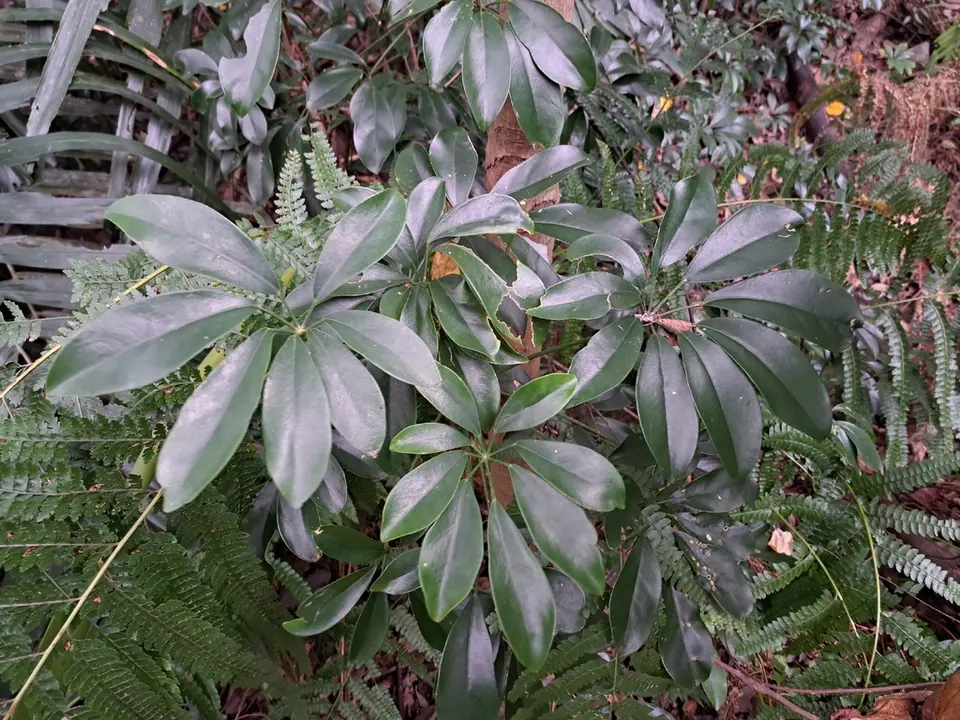
How to Grow and Care for Dwarf Umbrella Tree
Heptapleurum arboricola
Written by Emilio Marruso · last checked
Toxic to: Cats, Dogs, People · Why
At a glance
The dwarf umbrella tree is an easygoing houseplant that also thrives in containers. Give it filtered light for 3 to 4 hours a day, let the soil dry out, then soak it thoroughly. Indoors it grows 4 to 6 feet tall and wide, and you can start new plants from seed or stem cuttings.
- Sun
Indoors, filtered light 3–4 hours a day; bright direct light burns leaves; outdoors, full sun to part shade
What the sources say (4)
Light: Filtered light for 3 to 4 hours daily as a houseplant; full sun to part shade outdoors
Houseplant (fonte: NC State Extension): filtered light (eg. sheer curtain) for 3 to 4 hours daily. While it can tolerate some full sun outdoors, as a houseplant, bright, direct light will burn the leaves.
— Heptapleurum arboricola (Dwarf Schefflera, Dwarf Umbrella Tree, Hawaiian Umbrella Tree, Octopus Tree, Parasol Plant, Umbrella Plant, Umbrella Tree) | North Carolina Extension Gardener Plant Toolbox [1] Florida (outdoors): This plant has many additional landscaping attributes including doing well from full sun to part-shade sites.
— The right schefflera - UF/IFAS Extension Charlotte County [2] It should be placed in a southern, western, or eastern exposure with filtered light (eg. sheer curtain) for 3 to 4 hours daily.
— Heptapleurum arboricola (Dwarf Schefflera, Dwarf Umbrella Tree, Hawaiian Umbrella Tree, Octopus Tree, Parasol Plant, Umbrella Plant, Umbrella Tree) | North Carolina Extension Gardener Plant Toolbox [1] This plant has many additional landscaping attributes including doing well from full sun to part-shade sites.
— The right schefflera - UF/IFAS Extension Charlotte County [2] - Water
Let the soil dry out, then soak it; soil too wet or too dry makes the leaves drop
What the sources say (6)
Watering: Allow the soil to dry out, then soak thoroughly (houseplant); drought tolerant once established (outdoors)
Houseplant (fonte: NC State Extension): Allow the soil to dry out and then thoroughly soak it with water.
— Heptapleurum arboricola (Dwarf Schefflera, Dwarf Umbrella Tree, Hawaiian Umbrella Tree, Octopus Tree, Parasol Plant, Umbrella Plant, Umbrella Tree) | North Carolina Extension Gardener Plant Toolbox [1] Florida (outdoors): dwarf schefflera likes sandy, well-drained soil and does best on the dry side once established. Highly drought-tolerant once established
— The right schefflera - UF/IFAS Extension Charlotte County [2] Allow the soil to dry out and then thoroughly soak it with water.
— Heptapleurum arboricola (Dwarf Schefflera, Dwarf Umbrella Tree, Hawaiian Umbrella Tree, Octopus Tree, Parasol Plant, Umbrella Plant, Umbrella Tree) | North Carolina Extension Gardener Plant Toolbox [1] dwarf schefflera likes sandy, well-drained soil and does best on the dry side once established.
— The right schefflera - UF/IFAS Extension Charlotte County [2] Watering notes: Leaves drop if the soil is too wet or too dry; humidity can be raised by placing the container on a tray of wet pebbles, with the water line below the surface of the pebbles
If the soil is too wet or too dry the leave will drop off.
— Heptapleurum arboricola (Dwarf Schefflera, Dwarf Umbrella Tree, Hawaiian Umbrella Tree, Octopus Tree, Parasol Plant, Umbrella Plant, Umbrella Tree) | North Carolina Extension Gardener Plant Toolbox [1] The humidity around the plant can be raised by placing the container on a tray of wet pebbles (the water line should be below the surface of the pebbles so that the pot is not sitting directly in water).
— Heptapleurum arboricola (Dwarf Schefflera, Dwarf Umbrella Tree, Hawaiian Umbrella Tree, Octopus Tree, Parasol Plant, Umbrella Plant, Umbrella Tree) | North Carolina Extension Gardener Plant Toolbox [1] - Cold
Survives winters down to 25 °F (−3.9 °C)
Half hardy: mild winters or an unheated greenhouse · USDA 9b · RHS H3 · Z9
What the sources say (2)
Hardiness, coldest zone: 9b [winter low −3.9 to −1.1 °C (25 to 30 °F)]
USDA Plant Hardiness Zone: 9b, 10a, 10b, 11a, 11b, 12a, 12b
— Heptapleurum arboricola (Dwarf Schefflera, Dwarf Umbrella Tree, Hawaiian Umbrella Tree, Octopus Tree, Parasol Plant, Umbrella Plant, Umbrella Tree) | North Carolina Extension Gardener Plant Toolbox [1] Hardiness, warmest zone: 12b [winter low 12.8 to 15.6 °C (55 to 60 °F)]
USDA Plant Hardiness Zone: 9b, 10a, 10b, 11a, 11b, 12a, 12b
— Heptapleurum arboricola (Dwarf Schefflera, Dwarf Umbrella Tree, Hawaiian Umbrella Tree, Octopus Tree, Parasol Plant, Umbrella Plant, Umbrella Tree) | North Carolina Extension Gardener Plant Toolbox [1] - Pests
Watch for red spider mites, mealybugs and scale
What the sources say (1)
Pests: red spider mites, mealybugs, scale
Red spider mites, mealybugs and scale can be a serious problem. If the soil is too wet or too dry the leave will drop off.
— Heptapleurum arboricola (Dwarf Schefflera, Dwarf Umbrella Tree, Hawaiian Umbrella Tree, Octopus Tree, Parasol Plant, Umbrella Plant, Umbrella Tree) | North Carolina Extension Gardener Plant Toolbox [1] - Size
10–25 ft tall outdoors; 4–6 ft tall and wide in a pot indoors
What the sources say (5)
Mature height: 305-762 cm (10-25 ft) outdoors
grown indoors in a container: this tropical plant can be grown indoors and will only get from 4 to 6 feet high and wide in a container.
— Heptapleurum arboricola (Dwarf Schefflera, Dwarf Umbrella Tree, Hawaiian Umbrella Tree, Octopus Tree, Parasol Plant, Umbrella Plant, Umbrella Tree) | North Carolina Extension Gardener Plant Toolbox [1] landscape use in Florida: Seldom bigger than ten feet tall, this large shrub occasionally sports colorful orange-yellow inedible fruit in the winter.
— The right schefflera - UF/IFAS Extension Charlotte County [2] Dimensions: Height: 10 ft. 0 in. - 25 ft. 0 in. Width: 4 ft. 0 in. - 8 ft. 0 in.
— Heptapleurum arboricola (Dwarf Schefflera, Dwarf Umbrella Tree, Hawaiian Umbrella Tree, Octopus Tree, Parasol Plant, Umbrella Plant, Umbrella Tree) | North Carolina Extension Gardener Plant Toolbox [1] Mature width: 122-244 cm (4-8 ft)
grown indoors in a container: this tropical plant can be grown indoors and will only get from 4 to 6 feet high and wide in a container.
— Heptapleurum arboricola (Dwarf Schefflera, Dwarf Umbrella Tree, Hawaiian Umbrella Tree, Octopus Tree, Parasol Plant, Umbrella Plant, Umbrella Tree) | North Carolina Extension Gardener Plant Toolbox [1] Dimensions: Height: 10 ft. 0 in. - 25 ft. 0 in. Width: 4 ft. 0 in. - 8 ft. 0 in.
— Heptapleurum arboricola (Dwarf Schefflera, Dwarf Umbrella Tree, Hawaiian Umbrella Tree, Octopus Tree, Parasol Plant, Umbrella Plant, Umbrella Tree) | North Carolina Extension Gardener Plant Toolbox [1] - Propagation
From seed or stem cuttings
What the sources say (1)
Propagation: Seed, stem cutting
Life Cycle: Perennial Woody Recommended Propagation Strategy: Seed Stem Cutting
— Heptapleurum arboricola (Dwarf Schefflera, Dwarf Umbrella Tree, Hawaiian Umbrella Tree, Octopus Tree, Parasol Plant, Umbrella Plant, Umbrella Tree) | North Carolina Extension Gardener Plant Toolbox [1] - Containers
Grows well indoors and in containers
What the sources say (3)
Indoors: Yes
this tropical plant can be grown indoors and will only get from 4 to 6 feet high and wide in a container.
— Heptapleurum arboricola (Dwarf Schefflera, Dwarf Umbrella Tree, Hawaiian Umbrella Tree, Octopus Tree, Parasol Plant, Umbrella Plant, Umbrella Tree) | North Carolina Extension Gardener Plant Toolbox [1] In containers: Yes
this tropical plant can be grown indoors and will only get from 4 to 6 feet high and wide in a container.
— Heptapleurum arboricola (Dwarf Schefflera, Dwarf Umbrella Tree, Hawaiian Umbrella Tree, Octopus Tree, Parasol Plant, Umbrella Plant, Umbrella Tree) | North Carolina Extension Gardener Plant Toolbox [1] the dwarf schefflera is ideal for short to medium hedges, espaliers, outdoor containers or even as an indoor plant.
— The right schefflera - UF/IFAS Extension Charlotte County [2] - Safety
All parts are seriously toxic to dogs and cats; the sap can irritate sensitive skin, so wear gloves
Overview
Dwarf umbrella tree is an evergreen flowering shrub in the ginseng family, native to China and Taiwan. [1] Grown indoors in a container it reaches only 4 to 6 feet [1.2–1.8 m] high and wide. [1] All parts are reported as seriously toxic to dogs and cats. [1]
Dwarf Umbrella Tree care
Measurements in square brackets are our conversion into the other unit system; the quoted text is unchanged.
How to water Dwarf Umbrella Tree
Watering
Allow the soil to dry out, then soak thoroughly (houseplant); drought tolerant once established (outdoors)
What each source says
Houseplant (fonte: NC State Extension): Allow the soil to dry out, then soak thoroughly
Florida (outdoors): Does best on the dry side once established; highly drought tolerant
What the sources say (4)
Houseplant (fonte: NC State Extension): Allow the soil to dry out and then thoroughly soak it with water.Florida (outdoors): dwarf schefflera likes sandy, well-drained soil and does best on the dry side once established. Highly drought-tolerant once establishedAllow the soil to dry out and then thoroughly soak it with water.dwarf schefflera likes sandy, well-drained soil and does best on the dry side once established.Watering notes
Leaves drop if the soil is too wet or too dry; humidity can be raised by placing the container on a tray of wet pebbles, with the water line below the surface of the pebbles
What the sources say (2)
If the soil is too wet or too dry the leave will drop off.The humidity around the plant can be raised by placing the container on a tray of wet pebbles (the water line should be below the surface of the pebbles so that the pot is not sitting directly in water).How much light Dwarf Umbrella Tree needs
Filtered light for 3 to 4 hours daily as a houseplant; full sun to part shade outdoors
What each source says
Houseplant (fonte: NC State Extension): Filtered light for 3 to 4 hours daily; bright, direct light burns the leaves
Florida (outdoors): Full sun to part shade
What the sources say (4)
Houseplant (fonte: NC State Extension): filtered light (eg. sheer curtain) for 3 to 4 hours daily. While it can tolerate some full sun outdoors, as a houseplant, bright, direct light will burn the leaves.Florida (outdoors): This plant has many additional landscaping attributes including doing well from full sun to part-shade sites.It should be placed in a southern, western, or eastern exposure with filtered light (eg. sheer curtain) for 3 to 4 hours daily.This plant has many additional landscaping attributes including doing well from full sun to part-shade sites.How much cold Dwarf Umbrella Tree can take
Hardiness, coldest zone
9b [winter low −3.9 to −1.1 °C (25 to 30 °F)]
What the sources say (1)
USDA Plant Hardiness Zone:
9b, 10a, 10b, 11a, 11b, 12a, 12bHardiness, warmest zone
12b [winter low 12.8 to 15.6 °C (55 to 60 °F)]
What the sources say (1)
USDA Plant Hardiness Zone:
9b, 10a, 10b, 11a, 11b, 12a, 12bWhere to grow Dwarf Umbrella Tree
Indoors
Yes
What the sources say (1)
this tropical plant can be grown indoors and will only get from 4 to 6 feet high and wide in a container.In containers
Yes
What the sources say (2)
this tropical plant can be grown indoors and will only get from 4 to 6 feet high and wide in a container.the dwarf schefflera is ideal for short to medium hedges, espaliers, outdoor containers or even as an indoor plant.How to propagate Dwarf Umbrella Tree
Seed, stem cutting
What the sources say (1)
Life Cycle:
Perennial
Woody
Recommended Propagation Strategy:
Seed
Stem CuttingHow to grow Dwarf Umbrella Tree
The plant
Life cycle
perennial
What the sources say (1)
Life Cycle: Perennial Woody Recommended Propagation Strategy: Seed Stem Cutting Country Or Region Of Origin: Taiwan and Hainan ProvinceFamily
Araliaceae
What the sources say (1)
Dwarf umbrella tree is an evergreen flowering shrub in the ginseng family (Araliaceae) native to China and Taiwan.Mature height
305-762 cm (10-25 ft) outdoors
What each source says
grown indoors in a container: 122-183 cm (4-6 ft) high and wide
landscape use in Florida: seldom bigger than 305 cm (10 ft)
What the sources say (3)
grown indoors in a container: this tropical plant can be grown indoors and will only get from 4 to 6 feet high and wide in a container.landscape use in Florida: Seldom bigger than ten feet tall, this large shrub occasionally sports colorful orange-yellow inedible fruit in the winter.Dimensions: Height: 10 ft. 0 in. - 25 ft. 0 in. Width: 4 ft. 0 in. - 8 ft. 0 in.Mature width
122-244 cm (4-8 ft)
What each source says
grown indoors in a container: 122-183 cm (4-6 ft) high and wide
What the sources say (2)
grown indoors in a container: this tropical plant can be grown indoors and will only get from 4 to 6 feet high and wide in a container.Dimensions: Height: 10 ft. 0 in. - 25 ft. 0 in. Width: 4 ft. 0 in. - 8 ft. 0 in.Pests and diseases
Pests
red spider mites, mealybugs, scale
What the sources say (1)
Red spider mites, mealybugs and scale can be a serious problem. If the soil is too wet or too dry the leave will drop off.Dwarf Umbrella Tree pests and problems
Red spider mites, mealybugs and scale
Symptom: Can be a serious problem
What to do: Not specified in the sources
What the sources say (1)
Red spider mites, mealybugs and scale can be a serious problem.
— Heptapleurum arboricola (Dwarf Schefflera, Dwarf Umbrella Tree, Hawaiian Umbrella Tree, Octopus Tree, Parasol Plant, Umbrella Plant, Umbrella Tree) | North Carolina Extension Gardener Plant Toolbox [1] Leaf drop
Symptom: Leaves drop off when the soil is too wet or too dry
What to do: Allow the soil to dry out and then thoroughly soak it with water
What the sources say (2)
If the soil is too wet or too dry the leave will drop off.
— Heptapleurum arboricola (Dwarf Schefflera, Dwarf Umbrella Tree, Hawaiian Umbrella Tree, Octopus Tree, Parasol Plant, Umbrella Plant, Umbrella Tree) | North Carolina Extension Gardener Plant Toolbox [1] Allow the soil to dry out and then thoroughly soak it with water.
— Heptapleurum arboricola (Dwarf Schefflera, Dwarf Umbrella Tree, Hawaiian Umbrella Tree, Octopus Tree, Parasol Plant, Umbrella Plant, Umbrella Tree) | North Carolina Extension Gardener Plant Toolbox [1]
Remedies
Each remedy shows what official sources say about it; traditional remedies without an official source are marked as such. Harmful ones are listed so you know to avoid them.
Treating the plant
scale insects
hand-picking Works
How: Try picking the insects off with your fingernail or use a soap spray if necessary.
Try picking the insects off with your fingernail or use a soap spray if necessary.
— gardenersworld.com [9] What the evidence says Many insect and disease issues can be solved in the home garden by hand-picking insects or clipping and disposing of diseased plant parts.
— extension.unh.edu [10] soap spray Works
When “oils and soaps” are mentioned in UC IPM publications, we are referring to commercially available oils and soaps that are formulated specifically for use as pesticides- not household oils and soaps meant for cooking, cleaning, or other purposes.
— ucanr.edu [12] How: Try picking the insects off with your fingernail or use a soap spray if necessary.
Try picking the insects off with your fingernail or use a soap spray if necessary.
— gardenersworld.com [9] What the evidence says For example, insecticidal soap is a safe, effective organic insecticide with minimal environmental impact.
— extension.psu.edu [11]
Is Dwarf Umbrella Tree toxic to pets?
Reported by the source, quoted verbatim. This is not medical or veterinary advice: if a person or an animal may have eaten this plant, contact a poison control centre or a veterinarian.
Animals
All parts of this plant are seriously toxic to dogs and cats.
[1]It is harmful to cats and dogs if leaves are chewed. Intense mouth and throat irritation results in excessive drooling, difficulty swallowing, and vomiting.
[1]
People
Sap can be irritating to people with sensitive skin. Use gloves as a precaution.
[1]
Indicative values
Values from a secondary source, not checked word for word like the rest of this page. Use them as a starting point.
- Hours of sun
- 2-4 hoursIndicative value, adapt it to your climate · Secondary source
- Soil
- Well-drainedIndicative value, adapt it to your climate · Secondary source
- Soil pH
- 6-6.5Indicative value, adapt it to your climate · Secondary source
- Care level
- MediumIndicative value, adapt it to your climate · Secondary source
- Growth rate
- ModerateIndicative value, adapt it to your climate · Secondary source
- Pruning
- March, April, May, June, July, August, September, March, April, June, July, August, September, December, January, FebruaryIndicative value, adapt it to your climate · Secondary source
Similar plants
- Umbrella Tree Heptapleurum actinophyllum
- American ginseng Panax quinquefolius
- American Water-Pennywort Hydrocotyle americana
- Angelica Tree Aralia elata
- Balfour Aralia Polyscias balfouriana
- Castor aralia Kalopanax pictus
- Devil's Walking Stick Aralia spinosa
- Dollarweed Hydrocotyle umbellata
Sources
Every value above is quoted from these documents. Links lead to the original publisher.
- Heptapleurum arboricola (Dwarf Schefflera, Dwarf Umbrella Tree, Hawaiian Umbrella Tree, Octopus Tree, Parasol Plant, Umbrella Plant, Umbrella Tree) | North Carolina Extension Gardener Plant Toolbox · plants.ces.ncsu.edu, consulted
- The right schefflera - UF/IFAS Extension Charlotte County · blogs.ifas.ufl.edu, consulted
- Dwarf Schefflera - Heptapleurum arboricola | North Carolina Extension Gardener Plant Toolbox · plants.ces.ncsu.edu, consulted
- Umbrella Plant - Heptapleurum arboricola | North Carolina Extension Gardener Plant Toolbox · plants.ces.ncsu.edu, consulted
- Dwarf Umbrella Tree - Heptapleurum arboricola | North Carolina Extension Gardener Plant Toolbox · plants.ces.ncsu.edu, consulted
- Hawaiian Umbrella Tree - Heptapleurum arboricola | North Carolina Extension Gardener Plant Toolbox · plants.ces.ncsu.edu, consulted
- Octopus Tree - Heptapleurum arboricola | North Carolina Extension Gardener Plant Toolbox · plants.ces.ncsu.edu, consulted
- Parasol Plant - Heptapleurum arboricola | North Carolina Extension Gardener Plant Toolbox · plants.ces.ncsu.edu, consulted
- gardenersworld.com · gardenersworld.com
- extension.unh.edu · extension.unh.edu
- extension.psu.edu · extension.psu.edu
- ucanr.edu · ucanr.edu
Written by Emilio Marruso · last checked