
How to Grow and Care for Sausage tree
Kigelia africana
Written by Emilio Marruso · last checked
Toxic to: People · Why
At a glance
Kigelia is a sun lover that rewards a good start: give it plenty of compost and a thick mulch at planting. Where rain is plentiful it stays green all year, and where rain is scarce it drops its leaves. Start it from seed or from stem cuttings, and shield young plants from cold winds for their first 2–3 years.
- Sun
Full sun
What the sources say (2)
- Water
Keeps its leaves where rain is plentiful; drops them where rain is scarce
What the sources say (2)
Watering notes: Occurs where mean annual rainfall is 900-2,000 mm [35.4–78.7 in]; evergreen in areas of plentiful rainfall, deciduous in areas of scant rain
It is found in areas where the mean annual rainfall is in the range 900 - 2,000mm
— Kigelia africana - Useful Tropical Plants [3] In areas of plentiful rainfall, the Kigelia is an evergreen. In areas of scant rain, sausage trees are deciduous .
— Sausage Tree Info: How To Grow Kigelia Trees In The Landscape | Gardening Know How [6] - Cold
Frost harms it: in colder areas shield young plants from cold winds for 2–3 years
- Feeding
Plenty of compost at planting, plus a good mulch
What the sources say (1)
Natural fertilizers: Plenty of compost at planting, with a good mulch
Plant in full sun, add lots of compost and mulch well.
— [9] - Harvest
Not for eating fresh: the fruit is eaten only after drying, roasting or fermenting
- Propagation
From seed or from stem cuttings
What the sources say (3)
Propagation: Seed; truncheons (stem cuttings)
Propagation is from fresh seeds or truncheons (stem cutting from a selected plant – used to produce genetically identically new plants)
— Kigelia africana | Tree SA [1] Seedlings, direct sowing at site. Cut ripe fruit in half lengthwise and put cut side down on a patch of rich, moist soil.
— Kigelia africana [4] Seeds germinate better at temperatures of 23°c or higher
— Kigelia africana - Useful Tropical Plants [3] - Safety
Raw fruit and seeds are toxic to people, especially unripe: strong purge and mouth blisters
Overview
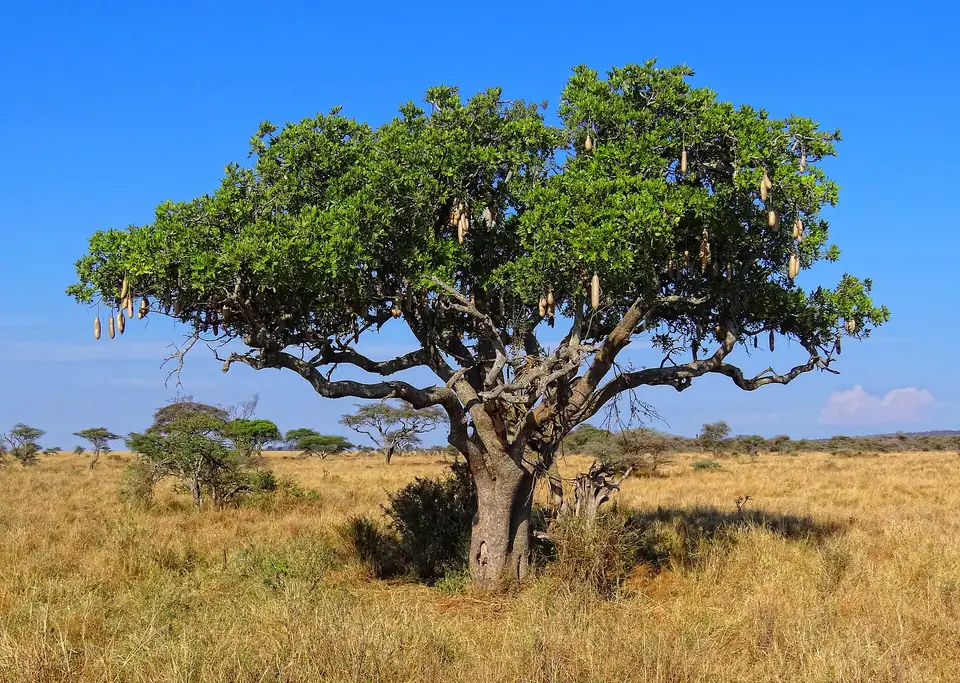
Sausage tree is a tropical African tree planted as an ornamental for its large flowers and sausage-like fruits. [2] It grows best in a sunny position in fertile, well-drained soil, and is not frost resistant. [3] The fruit is not edible raw and unripe fruit is poisonous, but it is prepared by humans in fermented, dried or roasted form. [5][6]
This record is incomplete: the sources we read do not cover every field yet.
Not yet covered by our sources: Watering, Hardiness, coldest zone, Hardiness, warmest zone, Pruning
Sausage tree care
Measurements in square brackets are our conversion into the other unit system; the quoted text is unchanged.
How to water Sausage tree
Watering
Not stated in the sources we read.
Watering notes
Occurs where mean annual rainfall is 900-2,000 mm [35.4–78.7 in]; evergreen in areas of plentiful rainfall, deciduous in areas of scant rain
What the sources say (2)
It is found in areas where the mean annual rainfall is in the range 900 - 2,000mmIn areas of plentiful rainfall, the Kigelia is an evergreen. In areas of scant rain, sausage trees are deciduous .How much light Sausage tree needs
Full sun
What the sources say (2)
Grows best in a sunny position in a fertile, humus-rich, well-drained soilin well-draining sun composed of clay, loam, or sand and in full sun.How much cold Sausage tree can take
Hardiness, coldest zone
Not stated in the sources we read.
Hardiness, warmest zone
Not stated in the sources we read.
How to propagate Sausage tree
Seed; truncheons (stem cuttings)
What the sources say (3)
Propagation is from fresh seeds or truncheons (stem cutting from a selected plant – used to produce genetically identically new plants)Seedlings, direct sowing at site. Cut ripe fruit in half lengthwise and put cut side down on a patch of rich, moist soil.Seeds germinate better at temperatures of 23°c or higherHow to grow Sausage tree
Fertilizing
Natural fertilizers
Plenty of compost at planting, with a good mulch
What the sources say (1)
Plant in full sun, add lots of compost and mulch well.Sausage tree pests and problems
Frost damage
Symptom: Plants are not frost resistant
What to do: Protect young plants for the first 2-3 years from cold winds in colder areas
What the sources say (1)
It is not frost resistant, but if young plants are protected for the first 2 - 3 years from cold winds in colder areas, they will survive
— Kigelia africana - Useful Tropical Plants [3]
Remedies
The sources we checked give no remedies for this plant.
Is Sausage tree poisonous?
Reported by the source, quoted verbatim. This is not medical or veterinary advice: if a person or an animal may have eaten this plant, contact a poison control centre or a veterinarian.
Seeds (especially when unripe) may be poisonous to man.
[1]- Poisonous parts
Seeds (especially when unripe) may be poisonous to man.
[1]
It is a strong purgative and causies mouth blisters but is eaten by domestic animals.
[1]- Symptoms
It is a strong purgative and causies mouth blisters but is eaten by domestic animals.
[1]
The fruits are not edible, even when fully ripe, and are said to be purgative and toxic
[3]- Symptoms
The fruits are not edible, even when fully ripe, and are said to be purgative and toxic
[3]
Some wildlife eat the fruits, but unripe fruit is poisonous, especially to humans.
[5]- Poisonous parts
Some wildlife eat the fruits, but unripe fruit is poisonous, especially to humans.
[5]
The fruit is fibrous and pulpy with many seeds and is toxic to humans.
[6]- Poisonous parts
The fruit is fibrous and pulpy with many seeds and is toxic to humans.
[6]
Calendar
Pruning
Not stated in the sources we read.
Months as given by the sources, which are mostly from the United States (northern hemisphere). In the southern hemisphere they shift by about six months.
Edibility
Reported by the source, quoted verbatim. Do not eat a plant on the basis of this page alone: identification mistakes can be dangerous.
Humans also ingest the fruit, but it must be specially prepared either by drying, roasting, or most commonly fermenting into an alcoholic beverage somewhat like beer.
[6]The seeds are roasted and used as a famine food
[3]Elephants and kudu eat the leaves, and people dry the leaves and eat them as well.
[5]
Indicative values
Values from a secondary source, not checked word for word like the rest of this page. Use them as a starting point.
- Life cycle
- PerennialIndicative value, adapt it to your climate · Secondary source
- Mature height
- 1524-1828.8 cm (50-60 ft)Indicative value, adapt it to your climate · Secondary source
- Watering
- AverageIndicative value, adapt it to your climate · Secondary source
- Soil pH
- 6-7.5Indicative value, adapt it to your climate · Secondary source
- USDA hardiness zones
- 10-12 [winter low −1.1 to 15.6 °C (30 to 60 °F)]Indicative value, adapt it to your climate · Secondary source
- Care level
- MediumIndicative value, adapt it to your climate · Secondary source
- Growth rate
- HighIndicative value, adapt it to your climate · Secondary source
- Pruning
- February, March, April, March, April, May, June, July, August, SeptemberIndicative value, adapt it to your climate · Secondary source
Similar plants
- Abies grandis Abies grandis
- Abraham Trachystemon orientalis
- Abyssinian banana Ensete ventricosum
- Acacia longifolia Acacia longifolia
- Acanthus hungaricus Acanthus hungaricus
- Aconite Aconitum napellus
- Adam's Needle Yucca flaccida
- Adriatic lizard orchid Himantoglossum adriaticum
Sources
Every value above is quoted from these documents. Links lead to the original publisher.
- Kigelia africana | Tree SA · treesa.org, consulted
- PROSEA - Plant Resources of South East Asia · prosea.prota4u.org, consulted
- Kigelia africana - Useful Tropical Plants · tropical.theferns.info, consulted
- Kigelia africana · apps.worldagroforestry.org, consulted
- Sausage Tree | San Diego Zoo Animals & Plants · animals.sandiegozoo.org, consulted
- Sausage Tree Info: How To Grow Kigelia Trees In The Landscape | Gardening Know How · gardeningknowhow.com, consulted
- Kigelia africana (K. aethiopum) Bignoniaceae · apps.worldagroforestry.org, consulted
- New Plant - Fairchild Tropical Botanic Garden · fairchildgarden.org, consulted
- pza.sanbi.org · pza.sanbi.org
Written by Emilio Marruso · last checked