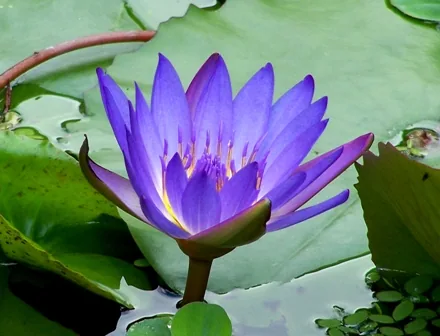
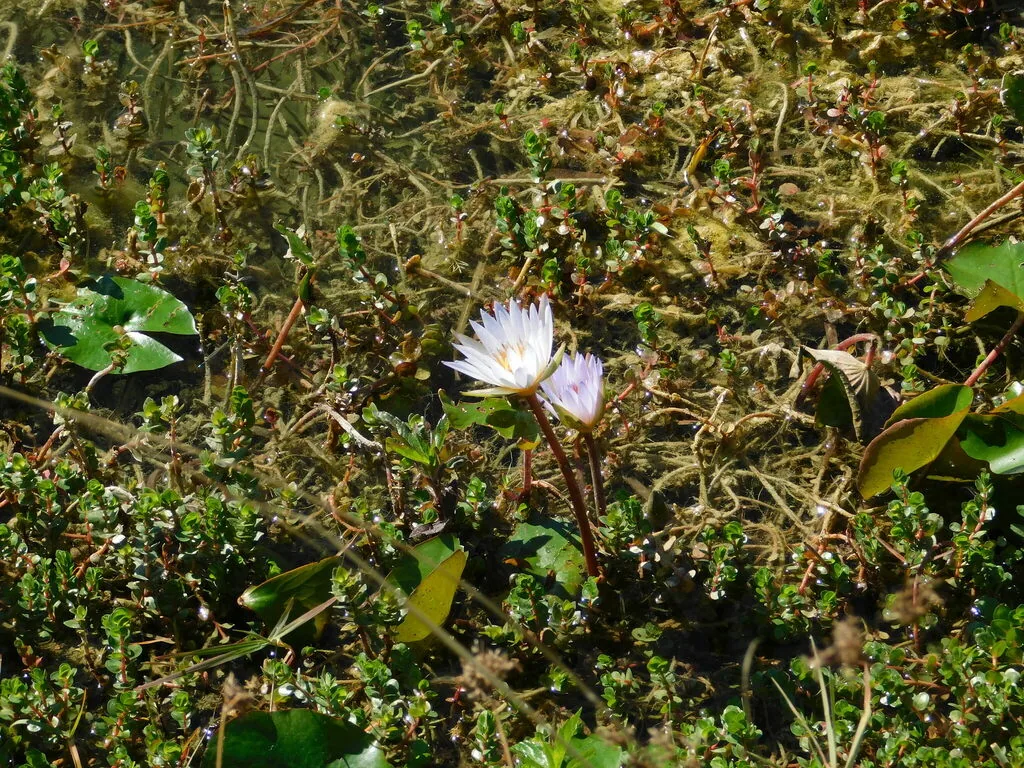

How to Grow and Care for Egyptian lotus
Nymphaea caerulea
Written by Emilio Marruso · last checked
At a glance
The blue water lily turns a patch of water into a garden: it grows in standing water all year, up to 2 feet deep. Give it full sun and warm water, at least 75 °F (24 °C), and it rewards you with flowers. It even grows in a container, and its leaves and flower stalks are eaten as a vegetable.
- Sun
Full sun: at least 6 hours a day for flowers
What the sources say (2)
Light: Full sun (minimum of four to five hours each day)
According to EcuRed: Pleno sol . Necesitan un mínimo de 6 horas para florecer.
— Nenúfar azul - EcuRed [7] Generally, Water Lilies require a minimum of four to five hours of full sun each day to produce the most blooms.
— Nymphaea nouchali var. caerulea - World of Flowering Plants [5] - Water
Lives in standing water all year, up to 2 ft deep
What the sources say (3)
Watering: Wet (year-round standing water)
Wet is defined as year-round standing water, such as a concave area of the ground or pond.
— Nymphaea caerulea ( Blue Lotus ) - Professional Gardening Tips [3] Watering notes: Ideally grown at depths of up to 60 cm [24 in]; plant in water no cooler than 75 F, as cooler water makes the plant dormant
The plants are ideally grown at depths of up to 60 cm.
— Nymphaea nouchali var. caerulea (Savigny) Verdc. - BAP [6] Planting should be done in water no cooler than 75 degrees F. If the water is too cool the plant will enter a dormant state.
— Nymphaea caerulea ( Blue Lotus ) - Professional Gardening Tips [3] - Soil
Slightly acidic to neutral soil, pH 6.1–7.0
What the sources say (2)
Soil pH, minimum: 6.1
Nymphaea nouchali var. caerulea should be planted using a slightly acidic mixture of clay and loam with a pH of 6.1-7.0.
— Nymphaea nouchali var. caerulea (Savigny) Verdc. - BAP [6] Soil pH, maximum: 7.0
Nymphaea nouchali var. caerulea should be planted using a slightly acidic mixture of clay and loam with a pH of 6.1-7.0.
— Nymphaea nouchali var. caerulea (Savigny) Verdc. - BAP [6] - Planting
Plant in water at least 75 °F (24 °C); cooler water makes it rest
What the sources say (2)
Watering notes: Ideally grown at depths of up to 60 cm [24 in]; plant in water no cooler than 75 F, as cooler water makes the plant dormant
The plants are ideally grown at depths of up to 60 cm.
— Nymphaea nouchali var. caerulea (Savigny) Verdc. - BAP [6] Planting should be done in water no cooler than 75 degrees F. If the water is too cool the plant will enter a dormant state.
— Nymphaea caerulea ( Blue Lotus ) - Professional Gardening Tips [3] - Harvest
Leaves and flower stalks are eaten as a vegetable; the flowers are boiled for tea
- Pests
Aphids; ladybugs and lacewings eat them, and keep weeds down
- Propagation
By seed or by dividing the thick underground root
What the sources say (3)
Propagation: Seed; division of the rhizome
Seed - needs to be kept moist prior to sowing. Sow seed, together with the surrounding pulp, in pots covered by about 25mm of water at 23 - 27c
— Nymphaea nouchali - Useful Tropical Plants [1] Division, or the removal of a portion of the rhizome with a sprouting eye
— Nymphaea nouchali - Useful Tropical Plants [1] Se multiplica por semillas y por división de rizomas en primavera , cuando el agua está a una temperatura cálida.
— Nenúfar azul - EcuRed [7] - Containers
Grows in containers too
What the sources say (1)
In containers: Yes
They should be planted in a large, wide pot, using a slightly acidic mixture of clay and loam with a pH of 6.1-7.0.
— Nymphaea nouchali var. caerulea - World of Flowering Plants [5]
Overview
Blue water lily is a clump-forming perennial with tuberous rhizomes anchored in pond mud. [5] It is a tropical water lily of still, deep water that needs full sun and is frost-sensitive. [7] It is propagated by seed and by division of the rhizome. [1]
This record is incomplete: the sources we read do not cover every field yet.
Not yet covered by our sources: Pruning
Egyptian lotus care
Measurements in square brackets are our conversion into the other unit system; the quoted text is unchanged.
How to water Egyptian lotus
Watering
Wet (year-round standing water)
What the sources say (1)
Wet is defined as year-round standing water, such as a concave area of the ground or pond.Watering notes
Ideally grown at depths of up to 60 cm [24 in]; plant in water no cooler than 75 F, as cooler water makes the plant dormant
What the sources say (2)
The plants are ideally grown at depths of up to 60 cm.Planting should be done in water no cooler than 75 degrees F. If the water is too cool the plant will enter a dormant state.How much light Egyptian lotus needs
Full sun (minimum of four to five hours each day)
What each source says
According to EcuRed: Full sun (minimum of 6 hours to flower)
What the sources say (2)
According to EcuRed: Pleno sol . Necesitan un mínimo de 6 horas para florecer.Generally, Water Lilies require a minimum of four to five hours of full sun each day to produce the most blooms.How much cold Egyptian lotus can take
Hardiness, coldest zone
The sources give different values depending on region, zone or growing conditions.
What each source says
According to World of Flowering Plants: 10b [winter low 1.7 to 4.4 °C (35 to 40 °F)]
According to Backyard Gardener: 5 [winter low −28.9 to −23.3 °C (−20 to −10 °F)]
What the sources say (2)
According to World of Flowering Plants: USDA hardiness zone 10b to 11b: from 35 °F (+1.7 °C) to 50 °F (+10 °C).According to Backyard Gardener: USDA Hardiness Zone:
5 to 10Hardiness, warmest zone
The sources give different values depending on region, zone or growing conditions.
What each source says
According to World of Flowering Plants: 11b [winter low 7.2 to 10 °C (45 to 50 °F)]
According to Backyard Gardener: 10 [winter low −1.1 to 4.4 °C (30 to 40 °F)]
What the sources say (2)
According to World of Flowering Plants: USDA hardiness zone 10b to 11b: from 35 °F (+1.7 °C) to 50 °F (+10 °C).According to Backyard Gardener: USDA Hardiness Zone:
5 to 10Best soil for Egyptian lotus
Soil pH, minimum
6.1
What the sources say (1)
Nymphaea nouchali var. caerulea should be planted using a slightly acidic mixture of clay and loam with a pH of 6.1-7.0.Soil pH, maximum
7.0
What the sources say (1)
Nymphaea nouchali var. caerulea should be planted using a slightly acidic mixture of clay and loam with a pH of 6.1-7.0.Where to grow Egyptian lotus
Yes
What the sources say (1)
They should be planted in a large, wide pot, using a slightly acidic mixture of clay and loam with a pH of 6.1-7.0.How to propagate Egyptian lotus
Seed; division of the rhizome
What the sources say (3)
Seed - needs to be kept moist prior to sowing. Sow seed, together with the surrounding pulp, in pots covered by about 25mm of water at 23 - 27cDivision, or the removal of a portion of the rhizome with a sprouting eyeSe multiplica por semillas y por división de rizomas en primavera , cuando el agua está a una temperatura cálida.How to grow Egyptian lotus
The plant
Family
Nymphaeaceae
What the sources say (1)
Nymphaeaceae Nymphaea Nymphaea nouchali ## Nymphaea nouchali var. caerulea (Savigny) Verdc. First published in Fl. Trop. E. Africa, Nymphaeac.: 7 (1989)Fertilizing
Mineral fertilizers
The sources give different values depending on region, zone or growing conditions.
What each source says
tropical day-blooming water lilies in general: Fertilizer for water lilies at the label rate
What the sources say (1)
tropical day-blooming water lilies in general: Provide at least 5 hours of sun in fertile loamy soils and fertilize with an appropriate fertilizer for water lilies according to package directions.Egyptian lotus pests and problems
Aphids
Symptom: Soft-bodied insects that suck plant fluids, causing stunting and deformed leaves and buds
What to do: Keep weeds to a minimum; lady bugs and lacewings feed on aphids
What the sources say (1)
Aphids are small, soft-bodied, slow-moving insects that suck fluids from plants.
— Nymphaea caerulea ( Blue Lotus ) - Professional Gardening Tips [3]
Remedies
Each remedy shows what official sources say about it; traditional remedies without an official source are marked as such. Harmful ones are listed so you know to avoid them.
Treating the plant
waterlily aphids and beetles
wiping off by hand Official source, not independently tested
How: Aphids and beetles can be wiped off the leaves and buds; feasible on small ponds where the lily leaves are within reach from the sides of the pond.
Waterlily aphids and beetles can be wiped off the leaves and buds. This is feasible on small ponds where the lily leaves are within reach from the sides of the pond.
— rhs.org.uk [10]
Calendar
Pruning
Not stated in the sources we read.
Months as given by the sources, which are mostly from the United States (northern hemisphere). In the southern hemisphere they shift by about six months.
Edibility
Reported by the source, quoted verbatim. Do not eat a plant on the basis of this page alone: identification mistakes can be dangerous.
Indicative values
Values from a secondary source, not checked word for word like the rest of this page. Use them as a starting point.
- Life cycle
- Herbaceous PerennialIndicative value, adapt it to your climate · Secondary source
- Mature height
- 22.9-30.5 cm (0.75-1 ft)Indicative value, adapt it to your climate · Secondary source
- Hours of sun
- 6-8 hoursIndicative value, adapt it to your climate · Secondary source
- Care level
- ModerateIndicative value, adapt it to your climate · Secondary source
- Growth rate
- LowIndicative value, adapt it to your climate · Secondary source
- Pruning
- March, April, MayIndicative value, adapt it to your climate · Secondary source
Similar plants
- European white waterlily Nymphaea alba
- Giant Water Lily Victoria amazonica
- Santa Cruz Water Lily Victoria cruziana
- Abies grandis Abies grandis
- Abraham Trachystemon orientalis
- Abyssinian banana Ensete ventricosum
- Acacia longifolia Acacia longifolia
- Acanthus hungaricus Acanthus hungaricus
Sources
Every value above is quoted from these documents. Links lead to the original publisher.
- Nymphaea nouchali - Useful Tropical Plants · tropical.theferns.info, consulted
- Nymphaea caerulea (Cultivated) – eFlora of India · efloraofindia.com, consulted
- Nymphaea caerulea ( Blue Lotus ) - Professional Gardening Tips · backyardgardener.com, consulted
- Nymphaea nouchali var. caerulea (Savigny) Verdc. | Plants of the World Online | Kew Science · powo.science.kew.org, consulted
- Nymphaea nouchali var. caerulea - World of Flowering Plants · worldoffloweringplants.com, consulted
- Nymphaea nouchali var. caerulea (Savigny) Verdc. - BAP · biotopeaquariumproject.com, consulted
- Nenúfar azul - EcuRed · ecured.cu, consulted
- Plants of South Eastern New South Wales · apps.lucidcentral.org, consulted
- plants.ces.ncsu.edu · plants.ces.ncsu.edu
- rhs.org.uk · rhs.org.uk
Written by Emilio Marruso · last checked