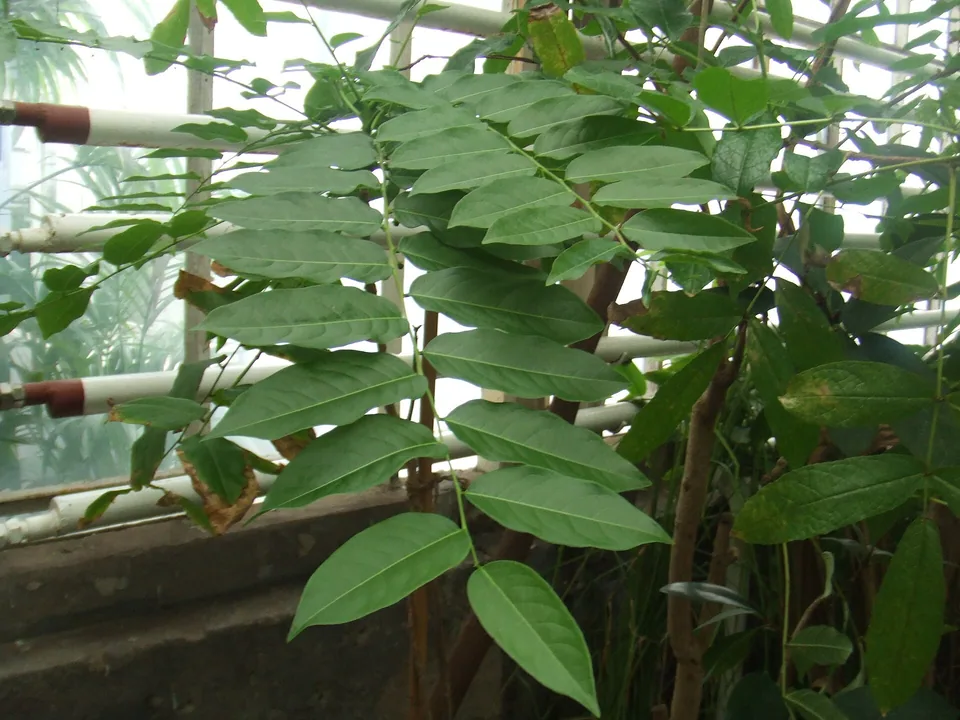
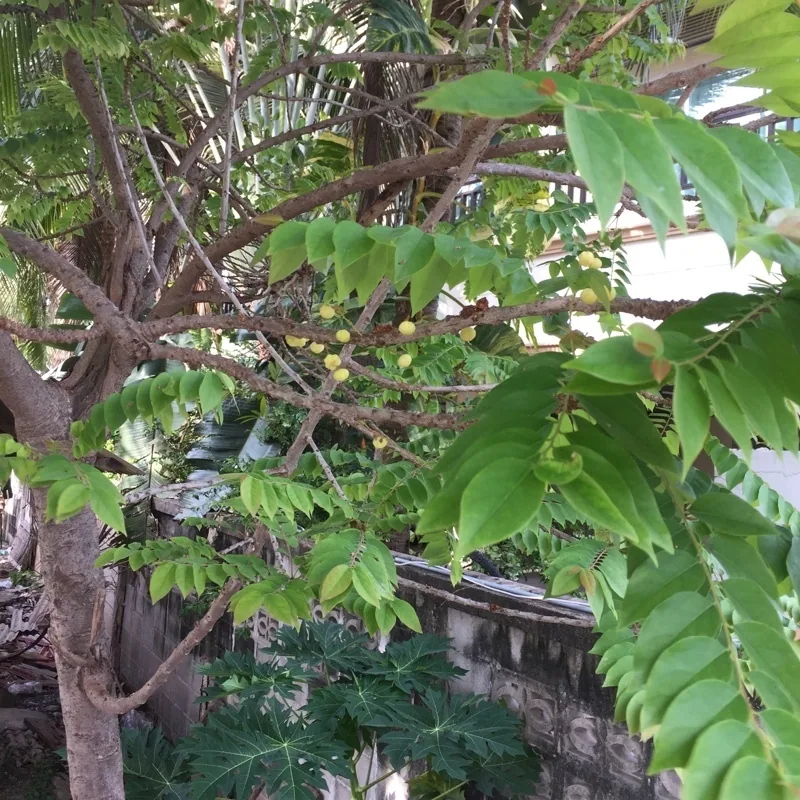

How to Grow and Care for Tahitian gooseberry tree
Phyllanthus acidus
Written by Emilio Marruso · last checked
Toxic to: People · Why
At a glance
The Otaheite gooseberry loves full sun and a moist spot, yet once settled it shrugs off dry spells. Its tart fruit can be eaten raw by anyone who enjoys the pucker, or turned into preserves, sweets, pickles and chutneys, and its young leaves are cooked as a vegetable. Give it plenty of room: 26 feet between plants.
- Sun
Full sun
What the sources say (1)
Light: Full sun
Light requirement Full sun 2 Soil tolerances Tolerates a variety of soils including very sandy soils
— Otaheite Gooseberry, Phyllanthus acidus [1] - Water
Likes moist soil; once settled it handles drought
What the sources say (1)
Watering: Prefers a moist site; established plants are drought tolerant
Prefers growing in a moist site, though established plants are drought tolerant
— Otaheite Gooseberry, Phyllanthus acidus [1] - Cold
Survives winters down to 30 °F (−1.1 °C)
Half hardy: mild winters or an unheated greenhouse · USDA 10 · RHS H3 · Z10
What the sources say (2)
Hardiness, coldest zone: 10 [winter low −1.1 to 4.4 °C (30 to 40 °F)]
Origin Brazil, Colombia 7 USDA hardiness zones 10-12 2 Uses Fruit; ornamental; medicinal properties
— Otaheite Gooseberry, Phyllanthus acidus [1] Hardiness, warmest zone: 12 [winter low 10 to 15.6 °C (50 to 60 °F)]
Origin Brazil, Colombia 7 USDA hardiness zones 10-12 2 Uses Fruit; ornamental; medicinal properties
— Otaheite Gooseberry, Phyllanthus acidus [1] - Spacing
26 ft between plants
- Harvest
Tart fruit raw or in preserves and chutneys; young leaves cooked as a vegetable
- Propagation
From seed, budding, green cuttings or air layering
What the sources say (2)
Propagation: Seed; budding; greenwood cuttings; air-layers
The tree is generally grown from seed but may also be multiplied by budding, greenwood cuttings, or air-layers.
— Otaheite Gooseberry, Fruits of Warm Climates [3] The tree is generally grown from seed but may also be multiplied by budding, greenwood cuttings, or air-layers.
— Otaheite Gooseberry, Phyllanthus acidus [1] - Safety
The juice of the root bark is mildly poisonous
Overview
Otaheite gooseberry is a small deciduous tree grown in the tropics for its very sour fruit. [2][1] It grows in full sun, prefers a moist site but is drought tolerant once established, and is propagated mainly by seed. [1][3]
This record is incomplete: the sources we read do not cover every field yet.
Not yet covered by our sources: Planting, Harvest
Tahitian gooseberry tree care
How to water Tahitian gooseberry tree
Prefers a moist site; established plants are drought tolerant
What the sources say (1)
Prefers growing in a moist site, though established plants are drought tolerantHow much light Tahitian gooseberry tree needs
Full sun
What the sources say (1)
Light requirement
Full sun 2
Soil tolerances
Tolerates a variety of soils including very sandy soilsHow much cold Tahitian gooseberry tree can take
Hardiness, coldest zone
10 [winter low −1.1 to 4.4 °C (30 to 40 °F)]
What the sources say (1)
Origin
Brazil, Colombia 7
USDA hardiness zones
10-12 2
Uses
Fruit; ornamental; medicinal propertiesHardiness, warmest zone
12 [winter low 10 to 15.6 °C (50 to 60 °F)]
What the sources say (1)
Origin
Brazil, Colombia 7
USDA hardiness zones
10-12 2
Uses
Fruit; ornamental; medicinal propertiesWhere to grow Tahitian gooseberry tree
800 x 800 cm (26.3 x 26.3 ft)
What each source says
Indonesia: 800 x 800 cm (26.3 x 26.3 ft)
How to propagate Tahitian gooseberry tree
Seed; budding; greenwood cuttings; air-layers
What the sources say (2)
The tree is
generally grown from seed but may also be multiplied by budding,
greenwood cuttings, or air-layers.The tree is generally grown from seed but may also be multiplied by
budding, greenwood cuttings, or air-layers.Remedies
Each remedy shows what official sources say about it; traditional remedies without an official source are marked as such. Harmful ones are listed so you know to avoid them.
Treating the plant
caterpillars
hand picking caterpillars and pruning infested tips Partly works
How: Pick the caterpillars by hand or prune away the tips of heavily infested branches before the caterpillars disperse through the shrub.
Hand picking the caterpillars or pruning away the tips of heavily infested branches before the caterpillars disperse throughout the shrub can immediately reduce caterpillar numbers and may effectively control the infestation.
— edis.ifas.ufl.edu [9] What the evidence says Hand picking the caterpillars or pruning away the tips of heavily infested branches before the caterpillars disperse throughout the shrub can immediately reduce caterpillar numbers and may effectively control the infestation.
— edis.ifas.ufl.edu [9] bacillus thuringiensis Works
Be sure to apply products following label directions and choose products that will suppress your target pest without affecting nearby beneficial organisms.
— edis.ifas.ufl.edu [9] How: A naturally occurring bacterium sold as an insecticide, used against the caterpillar.
Bacillus thuringiensis , a naturally occurring bacteria commonly sold as an insecticide will effectively control this caterpillar pest.
— edis.ifas.ufl.edu [9] What the evidence says Bacillus thuringiensis , a naturally occurring bacteria commonly sold as an insecticide will effectively control this caterpillar pest.
— edis.ifas.ufl.edu [9]
Is Tahitian gooseberry tree poisonous?
Reported by the source, quoted verbatim. This is not medical or veterinary advice: if a person or an animal may have eaten this plant, contact a poison control centre or a veterinarian.
Known hazard Juice of the root bark is weakly poisonous
[1]- Poisonous parts
Known hazard Juice of the root bark is weakly poisonous
[1]- Toxic principle
The juice of the root bark, which contains saponin, gallic acid, tannin and a crystalline substance which may be lupeol, has been employed in criminal poisoning.
[3]- Symptoms
The root is drastically purgative and regarded as toxic in Malaya
[3]
Calendar
Planting
Not stated in the sources we read.
Harvest
The sources give different values depending on region, zone or growing conditions.
What each source says
Philippines: April to June
Caribbean: January-May
South India: April and May, and August and September
What the sources say (3)
Philippines: The
peak fruiting season in the Philippines is in April to June.Caribbean: Flowering and fruiting is mostly in
January-May in the CaribbeanSouth India: The tree often bears
two crops a year in South India, the first in April and May, and the
second in August and September.Months as given by the sources, which are mostly from the United States (northern hemisphere). In the southern hemisphere they shift by about six months.
Edibility
Reported by the source, quoted verbatim. Do not eat a plant on the basis of this page alone: identification mistakes can be dangerous.
Indicative values
Values from a secondary source, not checked word for word like the rest of this page. Use them as a starting point.
- Life cycle
- PerennialIndicative value, adapt it to your climate · Secondary source
- Mature height
- 609.6-914.4 cm (20-30 ft)Indicative value, adapt it to your climate · Secondary source
- Soil pH
- 5.5-6.5Indicative value, adapt it to your climate · Secondary source
- Care level
- MediumIndicative value, adapt it to your climate · Secondary source
- Growth rate
- LowIndicative value, adapt it to your climate · Secondary source
- Pruning
- March, April, March, April, May, June, July, August, SeptemberIndicative value, adapt it to your climate · Secondary source
Similar plants
- Phyllanthus fluitans Phyllanthus fluitans
- Chamberbitter Phyllanthus urinaria
- Longstalked Phyllanthus Phyllanthus tenellus
- Abies grandis Abies grandis
- Abraham Trachystemon orientalis
- Abyssinian banana Ensete ventricosum
- Acacia longifolia Acacia longifolia
- Acanthus hungaricus Acanthus hungaricus
Sources
Every value above is quoted from these documents. Links lead to the original publisher.
- Otaheite Gooseberry, Phyllanthus acidus · growables.org, consulted
- Phyllanthus acidus, Agroforestree Database · growables.org, consulted
- Otaheite Gooseberry, Fruits of Warm Climates · growables.org, consulted
- Phyllanthus acidus, PROSEA Foundation · growables.org, consulted
- Phyllanthus acidus · apps.worldagroforestry.org, consulted
- Phyllanthus acidus - Grosella, Otaheite Gooseberry | ECHOcommunity.org · echocommunity.org, consulted
- Phyllanthus acidus - Leon Levy Native Plant Preserve · levypreserve.org, consulted
- Digital Garden :: UoK · keralauniversity.ac.in, consulted
- edis.ifas.ufl.edu · edis.ifas.ufl.edu
Written by Emilio Marruso · last checked