

How to Grow and Care for Mexican groundcherry
Physalis philadelphica
Written by Emilio Marruso · last checked
Toxic to: People · Why
At a glance
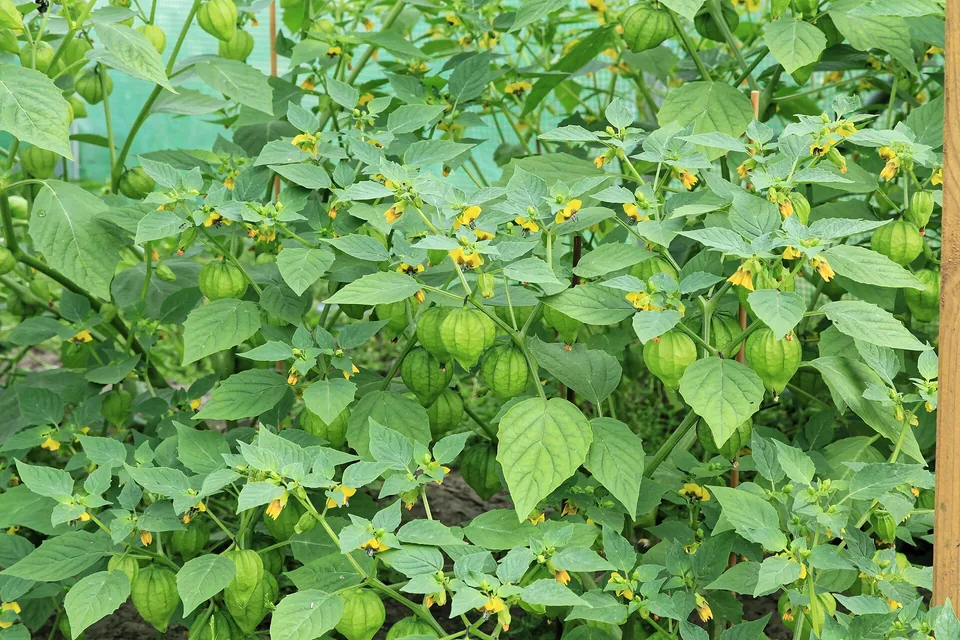
Tomatillos are a rewarding crop: set plants out in full sun once the danger of frost has passed and the soil has warmed in late spring. Give them 1 to 1.5 inches of water a week and a layer of mulch. Pick when the fruit fills its papery husk and drops off easily, then enjoy it raw, with no peeling or seeding needed.
- Sun
Full sun
What the sources say (2)
Light: Full sun
Full sun (6 or more hours of direct sunlight a day)
— Physalis philadelphica (Husk Tomato, Jamberries, Mexican Green Tomato, Mexican Husk Tomato, Miltomates, Strawberry Tomato, Tomatillo) | North Carolina Extension Gardener Plant Toolbox [1] Like most vegetables, tomatillos need 8 hours of sun per day.
— Tomatillo: How to Grow It [4] - Water
1–1.5 inches a week, soaking 6 inches deep; water the soil, not the leaves, and add mulch
What the sources say (5)
Watering: 1 to 1.5 inches [2.5–3.8 cm] of water per week, wetting the whole root area at least 6 inches [15 cm] deep
Apply enough water at each application so that the whole root area is moistened – at least 6-inches deep. Water about 1 to 1.5 inches per week
— Tomatillo: How to Grow It [4] Tomatillos need about 1 to 1.5 inches of water per week to maximize production
— Tomatillos: Harvest and Storage [5] Watering notes: Relatively drought tolerant; mulch helps keep soil moisture consistent; avoid overhead sprinkling
ready for harvest about 60 to 75 days from transplanting. Tomatillos are relatively drought tolerant.
— Physalis philadelphica (Husk Tomato, Jamberries, Mexican Green Tomato, Mexican Husk Tomato, Miltomates, Strawberry Tomato, Tomatillo) | North Carolina Extension Gardener Plant Toolbox [1] a mulch can help keep the soil moisture levels consistent over time
— Tomatillo: How to Grow It [4] Avoid overhead sprinkling, as this can make plants more disease-prone.
— Tomatillo: How to Grow It [4] - Cold
Below 55 °F (13 °C) or above 90 °F (32 °C), flowers drop and no fruit forms
- Spacing
3 ft between plants
What the sources say (1)
Spacing: 91 cm (3 ft) between plants
Tomatillos have a bushy habit and should be transplanted with 3 feet between plants.
— Tomatillo: How to Grow It [4] - Planting
Late spring, after all danger of frost has passed and the soil has warmed
What the sources say (2)
Planting: After all danger of frost has passed and the soil has warmed (late spring)
They are not frost-tolerant, so wait to transplant them until all danger of frost has passed and the soil has warmed
— Tomatillo: How to Grow It [4] as transplants after the threat of frost in the late spring
— Physalis philadelphica (Husk Tomato, Jamberries, Mexican Green Tomato, Mexican Husk Tomato, Miltomates, Strawberry Tomato, Tomatillo) | North Carolina Extension Gardener Plant Toolbox [1] - Feeding
All-purpose fertilizer mixed into the soil; too much nitrogen gives leaves, not fruit
What the sources say (4)
Mineral fertilizers: An all-purpose garden fertilizer incorporated into the top 10.2-15.2 cm [4–6 in] of soil
when a soil test shows only nitrogen is needed: In that case, a lawn fertilizer such as 26-0-0 (be sure it is not a “weed and feed” product, which also contains herbicide) can be used, at a rate of about ¼ pound (4 ounces) per 100 square feet.
— Tomatillo: How to Grow It [4] Any all-purpose garden fertilizer incorporated into the top 4 to 6 inches of soil should be enough to maximize production.
— Tomatillos: Harvest and Storage [5] Avoid: Too much nitrogen and over-fertilizing, which give leaves instead of flowers and fruit
Beware that too much nitrogen can cause a plant to grow more leaves than flowers.
— Tomatillo: How to Grow It [4] Be careful not to over-fertilize, as this will cause an abundance of vegetative growth and no fruit production.
— Tomatillos: Harvest and Storage [5] - Harvest
Pick when the fruit fills the husk and falls off easily; remove the husk and wash before eating
What the sources say (2)
How to harvest: Snip the fruit from the plant with a pruner or scissors, or twist it and pull gently. The fruit is ready when it completely fills the husk and easily falls off the plant when picked.
Tomatillos can be harvested using a pruner or scissors and snipping the fruit from the plant, or by simply twisting the fruit and gently pulling.
— Tomatillos: Harvest and Storage [5] The fruit is ready to harvest when it completely fills the husk and easily falls off the plant when picked.
— Tomatillos: Harvest and Storage [5] - Pests
Flea beetles, cutworms, hornworms, slugs and snails; also early and late blight
What the sources say (4)
Pests: three-lined potato beetle, flea beetles, cutworms, tomato hornworms, slugs, snails
Three-lined potato beetles are interesting, because they rarely do much damage or are considered a pest—unless you have a tomatillo plant!
— Tomatillo: How to Grow It [4] Other insects that can feed on tomatillo plants are flea beetles, cutworms, and tomato hornworms.
— Tomatillo: How to Grow It [4] Insects are not common tomatillo pests due to the papery sheath around the fruit, but keep the fruit off the ground to avoid slug and snail damage.
— Tomatillos: Harvest and Storage [5] Diseases: early blight, anthracnose, late blight, tobacco mosaic virus
Early blight, anthracnose, late blight, and tobacco mosaic virus can affect tomatillos.
— Tomatillo: How to Grow It [4] - Propagation
Grow from seed or buy young plants
What the sources say (1)
Propagation: Seed; transplants
Tomatillos are easily grown from seed, or you can purchase a transplant.
— Tomatillo: How to Grow It [4] - Containers
Grows in containers too
What the sources say (1)
In containers: Yes
They do not do well in heavy, wet, clay soils so plant them in raised beds or containers if necessary.
— Physalis philadelphica (Husk Tomato, Jamberries, Mexican Green Tomato, Mexican Husk Tomato, Miltomates, Strawberry Tomato, Tomatillo) | North Carolina Extension Gardener Plant Toolbox [1] - Safety
Eat only the ripe fruit: unripe fruit, leaves and stems are poisonous
Overview
Tomatillo is a tomato-like vegetable of the nightshade family, native to Mexico and Central America. [1] It is planted in full sun in moist, rich, well drained soil after the threat of frost. [1] More than one plant is needed for good fruit set because plants are not great at self-pollinating. [1]
Mexican groundcherry care
Measurements in square brackets are our conversion into the other unit system; the quoted text is unchanged.
How to water Mexican groundcherry
Watering
1 to 1.5 inches [2.5–3.8 cm] of water per week, wetting the whole root area at least 6 inches [15 cm] deep
What the sources say (2)
Apply enough water at each application so that the whole root area is moistened – at least 6-inches deep. Water about 1 to 1.5 inches per weekTomatillos need about 1 to 1.5 inches of water per week to maximize productionWatering notes
Relatively drought tolerant; mulch helps keep soil moisture consistent; avoid overhead sprinkling
What the sources say (3)
ready for harvest about 60 to 75 days from transplanting. Tomatillos are relatively drought tolerant.a mulch can help keep the soil moisture levels consistent over timeAvoid overhead sprinkling, as this can make plants more disease-prone.How much light Mexican groundcherry needs
Full sun
What the sources say (2)
Full sun (6 or more hours of direct sunlight a day)Like most vegetables, tomatillos need 8 hours of sun per day.Where to grow Mexican groundcherry
In containers
Yes
What the sources say (1)
They do not do well in heavy, wet, clay soils so plant them in raised beds or containers if necessary.Spacing
91 cm (3 ft) between plants
What the sources say (1)
Tomatillos have a bushy habit and should be transplanted with 3 feet between plants.How to propagate Mexican groundcherry
Seed; transplants
What the sources say (1)
Tomatillos are easily grown from seed, or you can purchase a transplant.How to grow Mexican groundcherry
The plant
Life cycle
annual
What the sources say (1)
Tomatillos are an annual, warm-season crop with requirements similar to tomatoes, except that they tend to be more drought and heat tolerant.Family
Solanaceae
What the sources say (1)
The tomatillo is a tomato-like vegetable in the Solanaceae (nightshade) family native to Meixco and Central America.Mature height
Sowing and growth
Harvest and storage
How to harvest
Snip the fruit from the plant with a pruner or scissors, or twist it and pull gently. The fruit is ready when it completely fills the husk and easily falls off the plant when picked.
What the sources say (2)
Tomatillos can be harvested using a pruner or scissors and snipping the fruit from the plant, or by simply twisting the fruit and gently pulling.The fruit is ready to harvest when it completely fills the husk and easily falls off the plant when picked.Storage
Keep in a paper bag in the fridge with the husks on for 1 to 2 weeks (never in an airtight bag). Can be frozen for up to 8 to 12 months after removing the husks, washing and drying the fruit.
Pests and diseases
Pests
three-lined potato beetle, flea beetles, cutworms, tomato hornworms, slugs, snails
What the sources say (3)
Three-lined potato beetles are interesting, because they rarely do much damage or are considered a pest—unless you have a tomatillo plant!Other insects that can feed on tomatillo plants are flea beetles, cutworms, and tomato hornworms.Insects are not common tomatillo pests due to the papery sheath around the fruit, but keep the fruit off the ground to avoid slug and snail damage.Diseases
early blight, anthracnose, late blight, tobacco mosaic virus
What the sources say (1)
Early blight, anthracnose, late blight, and tobacco mosaic virus can affect tomatillos.Fertilizing
Mineral fertilizers
An all-purpose garden fertilizer incorporated into the top 10.2-15.2 cm [4–6 in] of soil
What each source says
when a soil test shows only nitrogen is needed: 26-0-0 nitrogen fertilizer (not a weed-and-feed product) at 12.2 g/m²
What the sources say (2)
when a soil test shows only nitrogen is needed: In that case, a lawn fertilizer such as 26-0-0 (be sure it is not a “weed and feed” product, which also contains herbicide) can be used, at a rate of about ¼ pound (4 ounces) per 100 square feet.Any all-purpose garden fertilizer incorporated into the top 4 to 6 inches of soil should be enough to maximize production.Avoid
Too much nitrogen and over-fertilizing, which give leaves instead of flowers and fruit
Signs of excess
An abundance of leafy growth with few flowers and no fruit
Mexican groundcherry pests and problems
Three-lined potato beetle
Symptom: Beetles feed on tomatillo plants, mostly damaging leaves.
What to do: Handpick adults, larvae and egg clusters; rotate crops; install a floating row cover at planting.
What the sources say (2)
If you only have a few plants, the best management is to handpick adults (Figure 2), larvae, and egg clusters (Figure 3) and squish them, or drop into soapy water.
— Tomatillo: How to Grow It [4] Rotate crops. Do not plant nightshades where you planted nightshades last year.
— Tomatillo: How to Grow It [4] Nightshade family diseases
Symptom: Early blight, anthracnose, late blight and tobacco mosaic virus can affect tomatillos.
What to do: Not stated in the source.
What the sources say (1)
Early blight, anthracnose, late blight, and tobacco mosaic virus can affect tomatillos.
— Tomatillo: How to Grow It [4] Flower drop in heat or cold
Symptom: Temperatures above 90 degrees Fahrenheit or below 55 degrees Fahrenheit can cause flowers to drop and not produce fruit.
What to do: Not stated in the source.
What the sources say (1)
Be aware that temperatures above 90 degrees Fahrenheit or below 55 degrees Fahrenheit can cause flowers to drop and not produce fruit.
— Tomatillo: How to Grow It [4]
Remedies
Each remedy shows what official sources say about it; traditional remedies without an official source are marked as such. Harmful ones are listed so you know to avoid them.
Treating the plant
aphids
strong water spray Not verified
Traditional remedy, not verified by an official source.
How: Blast them off with a strong water spray
insecticidal soap spray Works
How: Apply neem oil or insecticidal soap early in the evening.
Apply neem oil or insecticidal soap early in the evening
— harvesttotable.com [6] What the evidence says insecticidal soap is a safe, effective organic insecticide with minimal environmental impact.
— extension.psu.edu [7] neem oil spray Partly works
Despite these being biological pesticides, it is important to read the directions on the label and wear safety equipment.
— extension.illinois.edu [9] How: Apply neem oil or insecticidal soap early in the evening.
Apply neem oil or insecticidal soap early in the evening
— harvesttotable.com [6] What the evidence says However, neem oil is not effective against every insect and disease, and often must be frequently reapplied to reach the desired outcome.
— extension.unh.edu [8]
flea beetles
radish trap crop Not verified
Traditional remedy, not verified by an official source.
How: Plant radishes nearby as a trap crop
floating row cover Not verified
Traditional remedy, not verified by an official source.
How: Use floating row covers to protect young plants.
diatomaceous earth Not verified
Traditional remedy, not verified by an official source.
How: Apply diatomaceous earth.
tomato hornworms
hand-picking in early morning Works
How: Handpick in early morning
Handpick in early morning (my most effective method)
— harvesttotable.com [6] What the evidence says Many insect and disease issues can be solved in the home garden by hand-picking insects or clipping and disposing of diseased plant parts.
— extension.unh.edu [8] companion planting with borage and daikon radishes Not verified
Traditional remedy, not verified by an official source.
How: Tomato hornworms can be deterred by growing tomatillos with companion plants like borage and daikon radishes. Established infestations are best managed with hand-picking.
whiteflies
yellow sticky traps Not verified
Traditional remedy, not verified by an official source.
How: Yellow sticky traps
strong hose spray Not verified
Traditional remedy, not verified by an official source.
How: Strong hose spray to disrupt colonies
cutworms
cardboard or foil collars Not verified
Traditional remedy, not verified by an official source.
How: Use cardboard or foil collars around seedlings
three-lined potato beetle
handpick and soapy water Works
How: If you only have a few plants, handpick adults, larvae, and egg clusters and squish them, or drop into soapy water. Check your plants regularly.
If you only have a few plants, the best management is to handpick adults (Figure 2), larvae, and egg clusters (Figure 3) and squish them, or drop into soapy water.
— Tomatillo: How to Grow It [4] What the evidence says If you only have a few plants, the best management is to handpick adults (Figure 2), larvae, and egg clusters (Figure 3) and squish them, or drop into soapy water.
— Tomatillo: How to Grow It [4] floating row cover at planting Official source, not independently tested
How: Install a floating row cover at the time of planting, and rotate crops so nightshades are not planted where nightshades grew last year.
Install a floating row cover at the time of planting.
— Tomatillo: How to Grow It [4]
powdery mildew
neem oil spray Partly works
Despite these being biological pesticides, it is important to read the directions on the label and wear safety equipment.
— extension.illinois.edu [9] How: Spray with neem oil every 7–10 days
Spray with neem oil every 7–10 days
— harvesttotable.com [6] What the evidence says However, neem oil is not effective against every insect and disease, and often must be frequently reapplied to reach the desired outcome.
— extension.unh.edu [8] milk spray Not verified
Traditional remedy, not verified by an official source.
Mixing household products to make homemade pesticides can also be dangerous.
— pubs.ext.vt.edu [10] How: Apply a milk spray (1:10 dilution) in mild cases
baking soda spray Not verified
Traditional remedy, not verified by an official source.
Mixing household products to make homemade pesticides can also be dangerous.
— pubs.ext.vt.edu [10] How: Mix 1 tablespoon of baking soda with a gallon of water and add a few drops of liquid soap. Spray this solution on the leaves every week.
fungal diseases
baking soda and vegetable oil spray Not verified
Traditional remedy, not verified by an official source.
Mixing household products to make homemade pesticides can also be dangerous.
— pubs.ext.vt.edu [10] How: Mix one tablespoon of baking soda with 2.5 tablespoons of vegetable oil and a gallon of water. Spray on affected plants every 7-10 days to help control fungal diseases.
early blight
clipping and disposing of diseased plant parts Works
How: Rotating crops, installing mulch to reduce water splashing, and pruning and destroying affected foliage can help you manage this problem naturally.
Rotating crops, installing mulch to reduce water splashing, and pruning and destroying affected foliage can help you manage this problem naturally.
— almanac.com [11] What the evidence says Many insect and disease issues can be solved in the home garden by hand-picking insects or clipping and disposing of diseased plant parts.
— extension.unh.edu [8] crop rotation and mulch Not verified
Traditional remedy, not verified by an official source.
How: Rotating crops, installing mulch to reduce water splashing, and pruning and destroying affected foliage can help you manage this problem naturally.
Is Mexican groundcherry poisonous?
Reported by the source, quoted verbatim. This is not medical or veterinary advice: if a person or an animal may have eaten this plant, contact a poison control centre or a veterinarian.
All parts are toxic except the ripe fruits. Headache, stomach pain, lowered temperature, dilated pupils, vomiting, diarrhea, circulatory and respiratory depression, loss of sensation; may be fatal.
[1]- Poisonous parts
Poison Part: Flowers Fruits Leaves Stems
[1]- Toxic principle
Poison Toxic Principle: Solanine and other solanidine alkaloids.
[1]- Symptoms
Headache, stomach pain, lowered temperature, dilated pupils, vomiting, diarrhea, circulatory and respiratory depression, loss of sensation; may be fatal.
[1]- Severity
Poison Severity: High
[1]
only eat ripe fruits that fall to the ground in their papery husks. Unripe fruits and other plant parts are poisonous and should not be eaten.
[4]
Calendar
Sowing
The sources give different values depending on region, zone or growing conditions.
What each source says
According to SDSU Extension (Tomatillo: How to Grow It): Start indoors 4 to 5 weeks before transplanting
According to SDSU Extension (Tomatillos: Harvest and Storage): Start indoors 6 to 8 weeks before transplanting
What the sources say (2)
According to SDSU Extension (Tomatillo: How to Grow It): If starting indoors, plant them 4 to 5 weeks before transplanting (a week or 2 later than tomatoes).According to SDSU Extension (Tomatillos: Harvest and Storage): Tomatillos should be started indoors 6 to 8 weeks before transplantingPlanting
After all danger of frost has passed and the soil has warmed (late spring)
What the sources say (2)
They are not frost-tolerant, so wait to transplant them until all danger of frost has passed and the soil has warmedas transplants after the threat of frost in the late springHarvest
The sources give different values depending on region, zone or growing conditions.
What each source says
According to NC State Extension: About 60 to 75 days from transplanting
According to SDSU Extension (Tomatillo: How to Grow It): 65 to 100 days after transplanting
According to SDSU Extension (Tomatillos: Harvest and Storage): 75 to 100 days after transplanting
What the sources say (3)
According to NC State Extension: they will be ready for harvest about 60 to 75 days from transplantingAccording to SDSU Extension (Tomatillo: How to Grow It): Tomatillos will be ready to harvest 65 to 100 days after transplanting.According to SDSU Extension (Tomatillos: Harvest and Storage): Tomatillos will be ready to harvest 75 to 100 days after transplanting.Months as given by the sources, which are mostly from the United States (northern hemisphere). In the southern hemisphere they shift by about six months.
Relative to frost
Less precise estimate: there is no weather station within 300 km.
Find frost dates by ZIP code or city
Transplant: around the last frost
They are not frost-tolerant, so wait to transplant them until all danger of frost has passed and the soil has warmed (Figure 1).
— Tomatillo: How to Grow It [4]
Count from the average frost dates where you live.
Edibility
Reported by the source, quoted verbatim. Do not eat a plant on the basis of this page alone: identification mistakes can be dangerous.
Similar plants
- Clammy Ground Cherry Physalis heterophylla
- Cape gooseberry Physalis peruviana
- Ashwagandha Withania somnifera
- Belladonna Atropa belladonna
- Bittersweet Solanum dulcamara
- Bladder cherry Alkekengi officinarum
- Brazilian nightshade Solanum seaforthianum
- Brunfelsia Brunfelsia pauciflora
Sources
Every value above is quoted from these documents. Links lead to the original publisher.
- Physalis philadelphica (Husk Tomato, Jamberries, Mexican Green Tomato, Mexican Husk Tomato, Miltomates, Strawberry Tomato, Tomatillo) | North Carolina Extension Gardener Plant Toolbox · plants.ces.ncsu.edu, consulted
- Tomatillo - Physalis philadelphica | North Carolina Extension Gardener Plant Toolbox · plants.ces.ncsu.edu, consulted
- Miltomates - Physalis philadelphica | North Carolina Extension Gardener Plant Toolbox · plants.ces.ncsu.edu, consulted
- Tomatillo: How to Grow It · extension.sdstate.edu, consulted
- Tomatillos: Harvest and Storage · extension.sdstate.edu, consulted
- harvesttotable.com · harvesttotable.com
- extension.psu.edu · extension.psu.edu
- extension.unh.edu · extension.unh.edu
- extension.illinois.edu · extension.illinois.edu
- pubs.ext.vt.edu · pubs.ext.vt.edu
- almanac.com · almanac.com
Written by Emilio Marruso · last checked