
How to Grow and Care for Zimbabwe creeper
Podranea ricasoliana
Written by Emilio Marruso · last checked
At a glance
Full of energy, this vigorous plant is happy anywhere from full sun to filtered shade and asks only for moderate water and regular helpings of well-rotted compost. It even grows in containers, and you can start new plants from seed or cuttings. Give it a trim in winter and again in early summer, and it will stay generous without taking over.
- Sun
Full sun to filtered shade
What the sources say (4)
Light: Full sun to filtered shade
According to NParks: Light Preference | Full Sun | Water Preference | Moderate Water
— NParks | Podranea ricasoliana [2] According to UF/IFAS Assessment: 1. Full Sun 2. Full sun to filtered shade, will take some reflected sunlight
— Assessment date 21 April 2016 [1] Light Preference | Full Sun | Water Preference | Moderate Water
— NParks | Podranea ricasoliana [2] 1. Full Sun 2. Full sun to filtered shade, will take some reflected sunlight
— Assessment date 21 April 2016 [1] - Water
Moderate water
What the sources say (1)
Watering: Moderate water
Light Preference | Full Sun | Water Preference | Moderate Water
— NParks | Podranea ricasoliana [2] - Cold
Survives winters down to 20 °F (−6.7 °C)
Hardy in average winters · USDA 9 · RHS H4 · Z9
What the sources say (6)
Hardiness, coldest zone: 9 [winter low −6.7 to −1.1 °C (20 to 30 °F)]
Global hardiness zone: Global hardiness zone: 9, 10, 11 ; equivalent to USDA Hardiness zones: USDA Zone 9a
— Assessment date 21 April 2016 [1] Florida North Zone: 2.01 Species suited to Florida's USDA climate zones (0-low; 1-intermediate; 2-high) North Zone: suited to Zones 8, 9 Central Zone: suited to Zones 9, 10 South Zone: suited to Zone 10
— Assessment date 21 April 2016 [1] Global hardiness zone: 9, 10, 11 ; equivalent to USDA Hardiness zones: USDA Zone 9a
— Assessment date 21 April 2016 [1] Hardiness, warmest zone: 11 [winter low 4.4 to 10 °C (40 to 50 °F)]
Global hardiness zone: Global hardiness zone: 9, 10, 11 ; equivalent to USDA Hardiness zones: USDA Zone 9a
— Assessment date 21 April 2016 [1] Florida South Zone: 2.01 Species suited to Florida's USDA climate zones (0-low; 1-intermediate; 2-high) North Zone: suited to Zones 8, 9 Central Zone: suited to Zones 9, 10 South Zone: suited to Zone 10
— Assessment date 21 April 2016 [1] Global hardiness zone: 9, 10, 11 ; equivalent to USDA Hardiness zones: USDA Zone 9a
— Assessment date 21 April 2016 [1] - Feeding
Regular helpings of well-rotted compost
What the sources say (1)
Natural fertilizers: Regular applications of well-rotted compost
It does best in full sun, in nutrient-rich, well-drained soil and benefits greatly from regular applications of well-rotted compost and plenty of water in summer.
— [4] - Pruning
Prune at least in winter and again in early summer to keep its growth in check
What the sources say (2)
Pruning: Winter and again in early summer
Pruning in winter and again in early summer is the minimum requirement, but may not be enough to curb excess growth.
— Assessment date 21 April 2016 [1] When to prune: In winter and again in early summer as a minimum, to curb its vigorous growth.
Pruning in winter and again in early summer is the minimum requirement, but may not be enough to curb excess growth.
— Assessment date 21 April 2016 [1] - Watch out
It can smother nearby plants, send suckers under fences and root from discarded prunings
What the sources say (1)
Suckers: Can send suckers under neighbouring fences.
It can send suckers under the neighbours’ fence.
— Assessment date 21 April 2016 [1] - Propagation
From seed or from stem cuttings
What the sources say (2)
Propagation: Seed; semi-hardwood and hardwood stem cuttings
Rootzone Tolerance | Moist Soils, Well-Drained Soils | Propagation Method | Seed, Stem Cutting (Semi-Hardwood, Hardwood)
— NParks | Podranea ricasoliana [2] 1. Propagated by seed 2. Rarely seen but appears to be viable
— Assessment date 21 April 2016 [1] - Containers
Grows in containers too
What the sources say (2)
In containers: Yes
It is suitable for the coastal garden. It looks good in a large container and is a candidate for espalier
— Podranea ricasoliana - Plant Detail - Tropical Plants Database - NTBG Database [3] The Port St Johns creeper is well-known to gardeners in southern Africa, Mediterranean countries, California, Florida, Australia and Asia, and has become a popular container plant in Europe, where it is over-wintered in heated greenhouses.
— Assessment date 21 April 2016 [1]
Overview
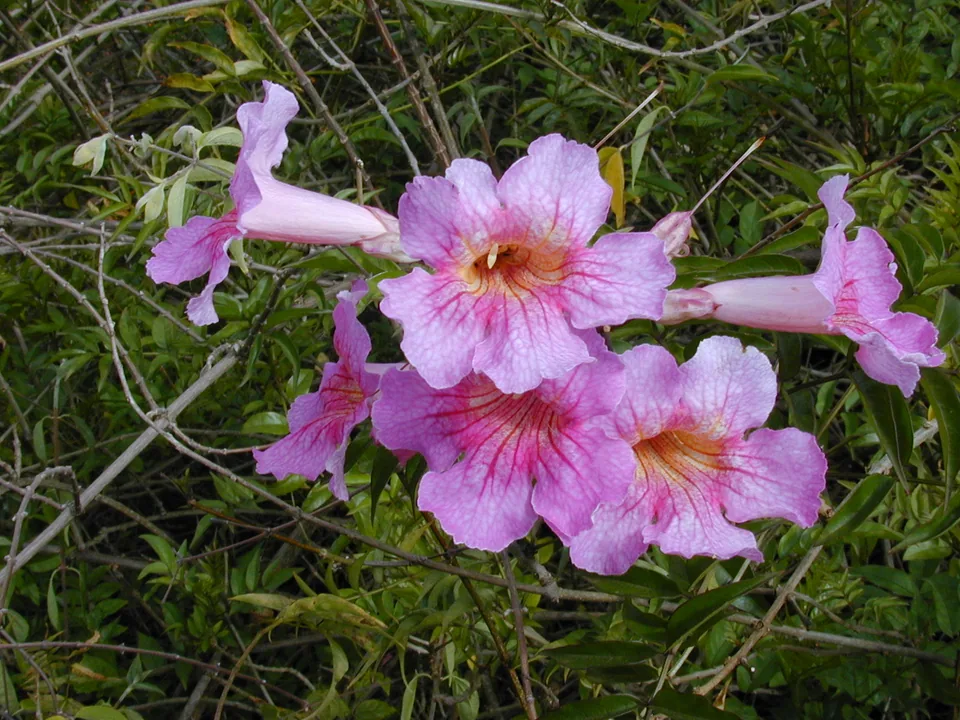
Pink trumpet vine is a vigorous evergreen climber with fragrant pink trumpet flowers, used on pergolas, arbors and fences for screening. [2] It has no tendrils, so it must be tied to supports. [2] It is an invasive garden escape in parts of Queensland, New South Wales and New Zealand. [1]
Zimbabwe creeper care
How to water Zimbabwe creeper
Moderate water
What the sources say (1)
Light Preference
| Full Sun
| Water Preference
| Moderate WaterHow much light Zimbabwe creeper needs
Full sun to filtered shade
What each source says
According to NParks: Full sun
According to UF/IFAS Assessment: Full sun to filtered shade
What the sources say (4)
According to NParks: Light Preference
| Full Sun
| Water Preference
| Moderate WaterAccording to UF/IFAS Assessment: 1. Full Sun 2. Full sun to filtered shade, will take some reflected sunlightLight Preference
| Full Sun
| Water Preference
| Moderate Water1. Full Sun 2. Full sun to filtered shade, will take some reflected sunlightHow much cold Zimbabwe creeper can take
Hardiness, coldest zone
9 [winter low −6.7 to −1.1 °C (20 to 30 °F)]
What each source says
Global hardiness zone: 9 [winter low −6.7 to −1.1 °C (20 to 30 °F)]
Florida North Zone: 8 [winter low −12.2 to −6.7 °C (10 to 20 °F)]
What the sources say (3)
Global hardiness zone: Global hardiness zone: 9, 10, 11 ; equivalent to USDA Hardiness zones: USDA Zone 9aFlorida North Zone: 2.01 Species suited to Florida's USDA climate zones (0-low; 1-intermediate; 2-high) North Zone: suited to Zones 8, 9 Central Zone: suited to Zones 9, 10 South Zone: suited to Zone 10Global hardiness zone: 9, 10, 11 ; equivalent to USDA Hardiness zones: USDA Zone 9aHardiness, warmest zone
11 [winter low 4.4 to 10 °C (40 to 50 °F)]
What each source says
Global hardiness zone: 11 [winter low 4.4 to 10 °C (40 to 50 °F)]
Florida South Zone: 10 [winter low −1.1 to 4.4 °C (30 to 40 °F)]
What the sources say (3)
Global hardiness zone: Global hardiness zone: 9, 10, 11 ; equivalent to USDA Hardiness zones: USDA Zone 9aFlorida South Zone: 2.01 Species suited to Florida's USDA climate zones (0-low; 1-intermediate; 2-high) North Zone: suited to Zones 8, 9 Central Zone: suited to Zones 9, 10 South Zone: suited to Zone 10Global hardiness zone: 9, 10, 11 ; equivalent to USDA Hardiness zones: USDA Zone 9aWhere to grow Zimbabwe creeper
Yes
What the sources say (2)
It is suitable for the coastal garden. It looks good in a large container and is a candidate for espalierThe Port St Johns creeper is well-known to gardeners in southern Africa, Mediterranean countries, California, Florida, Australia and Asia, and has become a popular container plant in Europe, where it is over-wintered in heated greenhouses.How to propagate Zimbabwe creeper
Seed; semi-hardwood and hardwood stem cuttings
How to grow Zimbabwe creeper
Fertilizing
Natural fertilizers
Regular applications of well-rotted compost
What the sources say (1)
It does best in full sun, in nutrient-rich, well-drained soil and benefits greatly from regular applications of well-rotted compost and plenty of water in summer.Roots
Suckers
Can send suckers under neighbouring fences.
What the sources say (1)
It can send suckers under the neighbours’ fence.Pruning
When to prune
In winter and again in early summer as a minimum, to curb its vigorous growth.
What the sources say (1)
Pruning in winter and again in early summer is the minimum requirement, but may not be enough to curb excess growth.Zimbabwe creeper pests and problems
Excess vigour
Symptom: Smothers surrounding vegetation and spreads from discarded prunings
What to do: Prune in winter and again in early summer
What the sources say (2)
In several areas of New Zealand this garden escapee is classed by local councils as a weed as its dense masses of foliage and branches tend to smother surrounding vegetation.
— Assessment date 21 April 2016 [1] Pruning in winter and again in early summer is the minimum requirement, but may not be enough to curb excess growth.
— Assessment date 21 April 2016 [1]
Remedies
Each remedy shows what official sources say about it; traditional remedies without an official source are marked as such. Harmful ones are listed so you know to avoid them.
Treating the plant
excess vigour
hard annual pruning Not verified
Traditional remedy, not verified by an official source.
It is known to sprout where prunings have been thrown, and it is an invasive, garden-escape in parts of Queensland and New South Wales in Australia and in New Zealand.
— pza.sanbi.org [5] How: prune back hard every year to keep it to shrub size, best in winter or early spring
Getting rid of it
invasive spread
cutting vines or digging out Not verified
Traditional remedy, not verified by an official source.
How: cut vines and leave upper stems to die in trees, or dig out
bagging garden waste Not verified
Traditional remedy, not verified by an official source.
How: dispose of all parts in a composting weed bag or at greenwaste or landfill
Calendar
Pruning
Winter and again in early summer
What the sources say (1)
Pruning in winter and again in early summer is the minimum requirement, but may not be enough to curb excess growth.Months as given by the sources, which are mostly from the United States (northern hemisphere). In the southern hemisphere they shift by about six months.
Similar plants
- Abies grandis Abies grandis
- Abraham Trachystemon orientalis
- Abyssinian banana Ensete ventricosum
- Acacia longifolia Acacia longifolia
- Acanthus hungaricus Acanthus hungaricus
- Aconite Aconitum napellus
- Adam's Needle Yucca flaccida
- Adriatic lizard orchid Himantoglossum adriaticum
Sources
Every value above is quoted from these documents. Links lead to the original publisher.
- Assessment date 21 April 2016 · assessment.ifas.ufl.edu, consulted
- NParks | Podranea ricasoliana · nparks.gov.sg, consulted
- Podranea ricasoliana - Plant Detail - Tropical Plants Database - NTBG Database · ntbg.org, consulted
- pza.sanbi.org · pza.sanbi.org
- pza.sanbi.org · pza.sanbi.org
Written by Emilio Marruso · last checked