
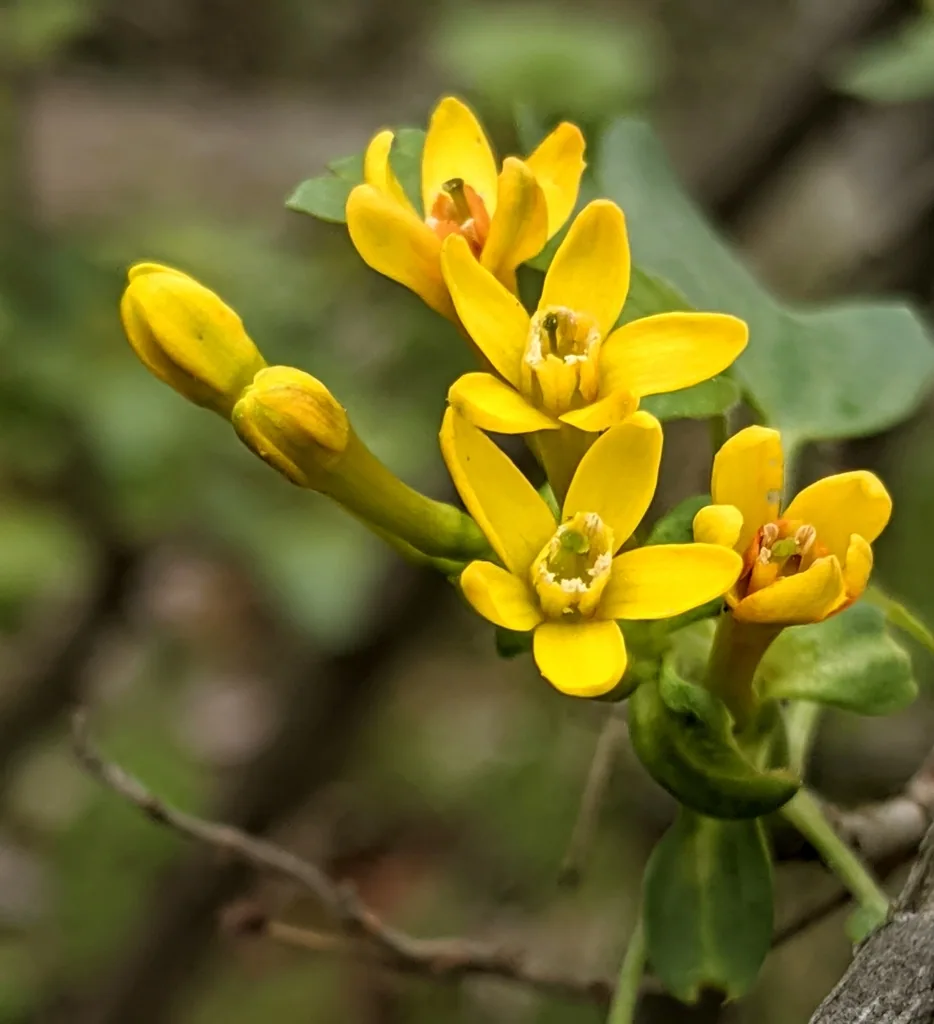

How to Grow and Care for Golden currant
Ribes aureum
Written by Emilio Marruso · last checked
Toxic to: People · Why
At a glance
Golden currant is a hardy shrub that grows happily in full sun or part shade, reaching 3–6 ft tall. Its fruit can be eaten raw or cooked, and the flowers are edible raw with a very sweet flavor. Be patient: the first fruit comes after 3 years, and you pick it from June through August.
- Sun
Full sun to part shade
- Water
Water regularly at first to keep the soil evenly moist, then cut back little by little
What the sources say (1)
Watering notes: Water regularly during establishment, keeping the soil evenly moist, then decrease watering gradually
Initial watering: water regularly, keeping the soil evenly moist. When the plant is established and displays healthy new growth, decrease watering gradually.
— Golden Currant [6] - Cold
Survives winters down to −50 °F (−45.6 °C)
Very hardy · USDA 2 · RHS H7 · Z2
What the sources say (1)
Hardiness, coldest zone: 2 [winter low −45.6 to −40 °C (−50 to −40 °F)]
Hardiness Zone 2+
— Golden Currant (Ribes aureum) — Practical Plants [5] - Planting
Plant out in late spring of the year after sowing
What the sources say (1)
Planting: Late spring of the year after sowing
planting them out in late spring of the following year
— Ribes aureum - Useful Temperate Plants [4] - Pruning
Prune after it blooms
What the sources say (1)
Pruning: After blooming
Pruning: Prune after blooming by cutting older stems that are at least 3 years old down to the ground.
— Golden Currant [6] - Harvest
Fruit from June through August, raw or cooked; first crop after 3 years; sweet flowers are edible raw
What the sources say (2)
Harvest: June through August
Harvest time: June through August
— Golden Currant [6] Years to first fruit: 3 years
Sweet, flavorful fruits are full of seeds but still make tasty jams and jellies. Begins fruiting after 3 years.
— Ribes aureum (R. odoratum) | Tennessee Smart Yards [3] - Pests
Can host white pine blister rust
What the sources say (1)
Diseases: white pine blister rust (alternate host)
May be an alternate host for white pine blister rust so not a desirable plant in areas of commercial pine production.
— Ribes aureum (R. odoratum) | Tennessee Smart Yards [3] - Size
3–6 ft tall and 3–4 ft wide
What the sources say (2)
Mature height: 91.44-182.88 cm (3-6 ft)
3-6 feet height by 3-4 feet spread; blooms in spring; bright yellow flowers; orange fruits at the end of summer.
— Ribes aureum (R. odoratum) | Tennessee Smart Yards [3] Mature width: 91.44-121.92 cm (3-4 ft)
3-6 feet height by 3-4 feet spread; blooms in spring; bright yellow flowers; orange fruits at the end of summer.
— Ribes aureum (R. odoratum) | Tennessee Smart Yards [3] - Propagation
From seed or cuttings: half-ripe wood in midsummer, mature wood November to February
What the sources say (2)
Propagation: Seed; cuttings (half-ripe wood in mid summer, mature wood November to February)
Propagation: Seed germination code C(60). Scarification of seed helps germination. Easy from cuttings.
— Ribes aureum (R. odoratum) | Tennessee Smart Yards [3] Cuttings of half-ripe wood, 10 - 15cm with a heel, mid summer in a frame
— Ribes aureum - Useful Temperate Plants [4] - Sowing
Sow in autumn as soon as the seed is ripe, in a cold frame
What the sources say (1)
Sowing: Autumn as soon as the seed is ripe, in a cold frame
Seed - best sown as soon as it is ripe in the autumn in a cold frame.
— Ribes aureum - Useful Temperate Plants [4] - Safety
No known hazards for people
Overview
Ribes aureum is a deciduous shrub grown as an ornamental and occasionally as a fruit crop. [3][4] It grows in full sun to part shade and tolerates a range of soil types. [3] It may be an alternate host for white pine blister rust. [3]
This record is incomplete: the sources we read do not cover every field yet.
Not yet covered by our sources: Hardiness, warmest zone
Golden currant care
How to water Golden currant
Watering
The sources give different values depending on region, zone or growing conditions.
What each source says
According to Each Green Corner: Water only when the soil is dry
According to Practical Plants: Drought intolerant
Watering notes
Water regularly during establishment, keeping the soil evenly moist, then decrease watering gradually
What the sources say (1)
Initial watering: water regularly, keeping the soil evenly moist. When the plant is established and displays healthy new growth, decrease watering gradually.How much light Golden currant needs
How much cold Golden currant can take
Hardiness, coldest zone
2 [winter low −45.6 to −40 °C (−50 to −40 °F)]
What the sources say (1)
Hardiness
Zone 2+Hardiness, warmest zone
Not stated in the sources we read.
How to propagate Golden currant
Seed; cuttings (half-ripe wood in mid summer, mature wood November to February)
How to grow Golden currant
The plant
Family
Saxifragaceae
What the sources say (1)
Scientific Family
Saxifragaceae
Synonyms
Ribes palmatum, Ribes tenuiflorumMature height
91.44-182.88 cm (3-6 ft)
What the sources say (1)
3-6 feet height by 3-4 feet spread; blooms in spring; bright yellow flowers; orange fruits at the end of summer.Mature width
91.44-121.92 cm (3-4 ft)
What the sources say (1)
3-6 feet height by 3-4 feet spread; blooms in spring; bright yellow flowers; orange fruits at the end of summer.Years to first fruit
3 years
What the sources say (1)
Sweet, flavorful fruits are full of seeds but still make tasty jams and jellies. Begins fruiting after 3 years.Pests and diseases
Diseases
white pine blister rust (alternate host)
What the sources say (1)
May be an alternate host for white pine blister rust so not a desirable plant in areas of commercial pine production.Fertilizing
When
The sources give different values depending on region, zone or growing conditions.
What each source says
currants and gooseberries in general: Spring
What the sources say (1)
currants and gooseberries in general: Young plants should receive 1 to 2 tablespoons of a high nitrogen fertilizer like ammonium sulfate, ammonium nitrate, or urea annually in the spring.Natural fertilizers
The sources give different values depending on region, zone or growing conditions.
What each source says
currants and gooseberries in general: Aged manure as a source of nitrogen
currants and gooseberries in general: Well-rotted manure or compost worked into the soil before planting
currants and gooseberries in general, before planting: 1.27–2.54 cm [0.5–1 in] of manure or compost mixed into the top 15.2 cm [6 in] of soil
What the sources say (3)
currants and gooseberries in general: Older plants should receive 3 to 4 tablespoons of high nitrogen fertil- izer in the spring. Nitrogen can also be supplied by aged manures.currants and gooseberries in general: Build up the organic matter by incorporating well-rotted manure, compost, peat moss or other organic materials.currants and gooseberries in general, before planting: Keep in mind that manures and composts contain nutrients as well as organic matter. Add ½ inch to one inch of one of these materials to your planting bed and mix it into the top 6 inches of soil.Mineral fertilizers
The sources give different values depending on region, zone or growing conditions.
What each source says
currants and gooseberries in general, young plants: 14.8–29.6 mL of high-nitrogen fertilizer each spring
currants and gooseberries in general, older plants: 44.4–59.2 mL of high-nitrogen fertilizer in spring
currants and gooseberries in general, first year, without a soil test: 14.2 g of 10-10-10 over a circle 45.7 cm [18 in] across once growth starts, repeated 4–6 weeks later
currants and gooseberries in general, second year: 28.3 g of 10-10-10 per plant over 61 × 61 cm [24 in], in each of two applications
currants and gooseberries in general, third year and older: 56.6–84.9 g of 10-10-10 per plant in each of two applications
What the sources say (5)
currants and gooseberries in general, young plants: Young plants should receive 1 to 2 tablespoons of a high nitrogen fertilizer like ammonium sulfate, ammonium nitrate, or urea annually in the spring.currants and gooseberries in general, older plants: Older plants should receive 3 to 4 tablespoons of high nitrogen fertil- izer in the spring. Nitrogen can also be supplied by aged manures.currants and gooseberries in general, first year, without a soil test: Without a soil test, apply ½ ounce (1 tbsp.) 10-10-10 (or equivalent) in an area 18 inches in diameter after plants begin growing. Repeat the application 4 to 6 weeks later.currants and gooseberries in general, second year: For individual currant or gooseberry plants, use 1 ounce (2 tbsp.) 10-10-10 (or equivalent) per plant in an area 2 ft. by 2 ft. in each of the two applications.currants and gooseberries in general, third year and older: For individual currant or gooseberry plants, use 2 to 3 ounces (¼ to 1/3 cup) of 10-10-10 (or equivalent) per plant in each of the two applications.Micronutrients
The sources give different values depending on region, zone or growing conditions.
What each source says
currants and gooseberries in general: Magnesium and calcium from dolomitic limestone when the soil needs lime
What the sources say (1)
currants and gooseberries in general: It is generally advisable to use a dolomitic limestone that contains both calcium and magnesium, especially if the soil has below optimum magnesium levels.Signs of deficiency
The sources give different values depending on region, zone or growing conditions.
What each source says
currants and gooseberries in general: Few new canes and poor growth (increase nitrogen by half)
What the sources say (1)
currants and gooseberries in general: If few new canes are pro- duced and growth appears poor, increase nitro- gen application by half. For more detailed fertilizer use suggestions, refer to Extension pub- lication Fertilizing Small Fruits in the Home GardenSigns of excess
The sources give different values depending on region, zone or growing conditions.
What each source says
currants and gooseberries in general: A very vigorous bush producing a lot of new growth (halve the nitrogen)
What the sources say (1)
currants and gooseberries in general: If the bush is very vigorous, producing a lot of new growth, reduce the nitrogen by halfRemedies
Each remedy shows what official sources say about it; traditional remedies without an official source are marked as such. Harmful ones are listed so you know to avoid them.
Treating the plant
powdery mildew
pruning out infected shoots Official source, not independently tested
How: Control can be achieved by pruning and removing of infected shoots. It is also important to maintain good air circulation and maximize plant vigor.
Control can be achieved by pruning and removing of infected shoots. It is also important to maintain good air circulation and maximize plant vigor.
— portal.ct.gov [9]
anthracnose
raking and removing infected leaves Official source, not independently tested
How: Control can be achieved by raking and removing of infected leaves and fruit.
Control can be achieved by raking and removing of infected leaves and fruit. It is also important to maintain good air circulation and maximize plant vigor.
— portal.ct.gov [9]
Is Golden currant poisonous?
Reported by the source, quoted verbatim. This is not medical or veterinary advice: if a person or an animal may have eaten this plant, contact a poison control centre or a veterinarian.
## Known Hazards None known
[4]
Calendar
Autumn as soon as the seed is ripe, in a cold frame
What the sources say (1)
Seed - best sown as soon as it is ripe in the autumn in a cold frame.Late spring of the year after sowing
What the sources say (1)
planting them out in late spring of the following yearJune through August
What the sources say (1)
Harvest time: June through AugustAfter blooming
What the sources say (1)
Pruning: Prune after blooming by cutting older stems that are at least 3 years old down to the ground.Months as given by the sources, which are mostly from the United States (northern hemisphere). In the southern hemisphere they shift by about six months.
Edibility
Reported by the source, quoted verbatim. Do not eat a plant on the basis of this page alone: identification mistakes can be dangerous.
Indicative values
Values from a secondary source, not checked word for word like the rest of this page. Use them as a starting point.
- Life cycle
- PerennialIndicative value, adapt it to your climate · Secondary source
- Soil
- Sandy Loamy ClayIndicative value, adapt it to your climate · Secondary source
- Soil pH
- 6-7.5Indicative value, adapt it to your climate · Secondary source
- Care level
- MediumIndicative value, adapt it to your climate · Secondary source
- Growth rate
- LowIndicative value, adapt it to your climate · Secondary source
Similar plants
- Alpine Currant Ribes alpinum
- European black currant Ribes nigrum
- Flowering Currant Ribes sanguineum
- Gooseberry Ribes uva-crispa
- Redcurrant Ribes rubrum
- Ribes nidigrolaria Ribes nidigrolaria
- Alumroot Heuchera americana
- Bigflower tellima Tellima grandiflora
Sources
Every value above is quoted from these documents. Links lead to the original publisher.
- Ribes aureum - golden currant | Yavapai County Native and Naturalized Plants · yavapaiplants.extension.arizona.edu, consulted
- Golden (Clove) Current | NDSU Agriculture · ndsu.edu, consulted
- Ribes aureum (R. odoratum) | Tennessee Smart Yards · tnyards.utk.edu, consulted
- Ribes aureum - Useful Temperate Plants · temperate.theferns.info, consulted
- Golden Currant (Ribes aureum) — Practical Plants · practicalplants.org, consulted
- Golden Currant · eachgreencorner.org, consulted
- hort.extension.wisc.edu · hort.extension.wisc.edu
- soiltesting.cahnr.uconn.edu · soiltesting.cahnr.uconn.edu
- portal.ct.gov · portal.ct.gov
Written by Emilio Marruso · last checked