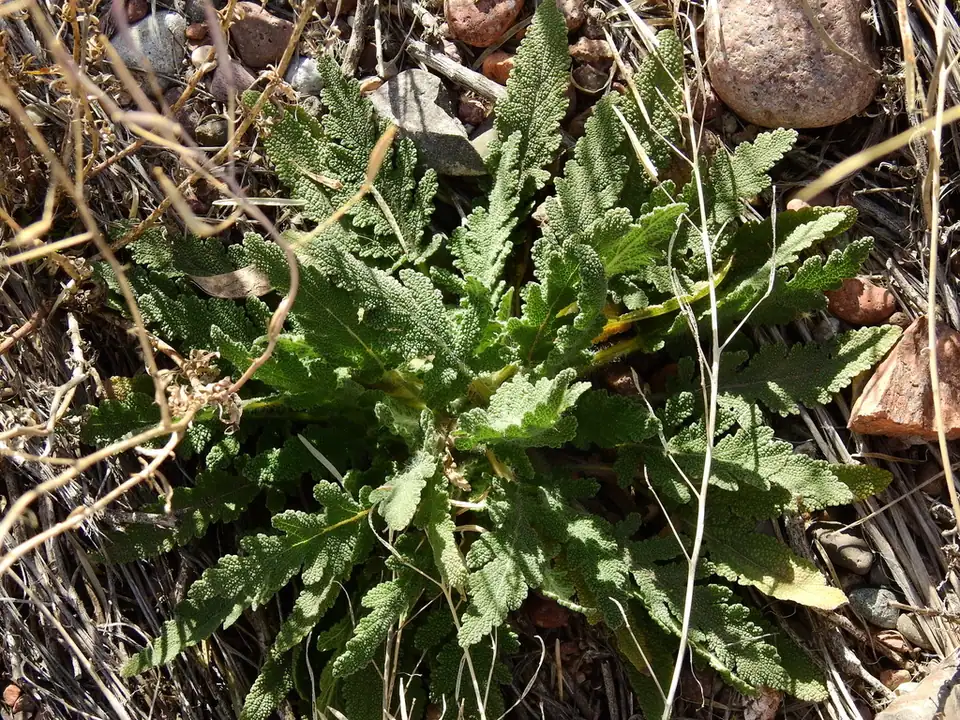
How to Grow and Care for Wild sage
Salvia verbenaca
Written by Emilio Marruso · last checked
At a glance
This sun-loving sage gives you aromatic leaves to eat raw or cooked, and flowers you can toss raw into salads. Sow it in a greenhouse in early to mid spring, then plant the seedlings out in early summer. Give it a sunny spot and very well-drained soil, because too much winter wet can kill it.
- Sun
A sunny spot
What the sources say (1)
Light: Sunny position
Requires a very well-drained light sandy soil in a sunny position
— Salvia verbenaca - Useful Temperate Plants [1] - Water
Keep it dry in winter: too much winter wet can kill it
What the sources say (2)
- Soil
Very well-drained soil
What the sources say (2)
- Planting
Plant out greenhouse-raised seedlings in early summer
What the sources say (1)
Planting: Early summer (seedlings raised in a greenhouse)
Prick out the seedlings into individual pots when they are large enough to handle and plant them out in early summer.
— Salvia verbenaca - Useful Temperate Plants [1] - Harvest
Aromatic leaves to flavor cooked food or eat raw; raw flowers for salads
- Propagation
From seed, or divide the plant in spring
What the sources say (2)
Propagation: Seed; division in spring
Seed - sow early to mid spring in a greenhouse. Germination usually takes place within 2 weeks.
— Salvia verbenaca - Useful Temperate Plants [1] plant them out in late spring of the following year. Division in spring.
— Salvia verbenaca - Useful Temperate Plants [1] - Sowing
Sow in a greenhouse in early to mid spring
What the sources say (1)
Sowing: Early to mid spring (in a greenhouse)
Seed - sow early to mid spring in a greenhouse. Germination usually takes place within 2 weeks.
— Salvia verbenaca - Useful Temperate Plants [1]
Overview
Salvia verbenaca is a herbaceous perennial with erect to ascending stems that grow 15 - 70 cm [6–28 in] tall. [1] It requires a very well-drained light sandy soil in a sunny position and can be killed by excessive winter wet. [1]
This record is incomplete: the sources we read do not cover every field yet.
Not yet covered by our sources: Watering, Harvest
Wild sage care
Measurements in square brackets are our conversion into the other unit system; the quoted text is unchanged.
How to water Wild sage
Watering
Not stated in the sources we read.
Watering notes
Requires very well-drained soil; plants can be killed by excessive winter wet
How much light Wild sage needs
Sunny position
What the sources say (1)
Requires a very well-drained light sandy soil in a sunny positionHow to propagate Wild sage
Seed; division in spring
How to grow Wild sage
The plant
Family
Lamiaceae
What the sources say (1)
Family:
LABIATAE (LAMIACEAE)
Genus:
Salvia
Catalan common name:Remedies
Each remedy shows what official sources say about it; traditional remedies without an official source are marked as such. Harmful ones are listed so you know to avoid them.
Treating the plant
spider mites
strong water spray Official source, not independently tested
How: use a high-pressure water spray to dislodge twospotted spider mites; it can also wash away their webbing
Use a high-pressure water spray to dislodge twospotted spider mites. This can also wash away their protective webbing.
— extension.umn.edu [5] insecticidal soap Works
don’t make a homemade soap solution as this can burn and damage plants
— extension.umn.edu [5] How: spray with insecticidal soap at least twice at 7-10 day intervals, with thorough coverage
Spraying with insecticidal soap will give sufficient control if applied at least twice at 7-10 day intervals.
— portal.ct.gov [6] What the evidence says Spraying with insecticidal soap will give sufficient control if applied at least twice at 7-10 day intervals.
— portal.ct.gov [6] horticultural oil Works
How: target the underside of leaves as well as the top; repeat applications may be needed
Soaps and horticultural oils are reasonably effective against mites and have little impact on people, animals and nontarget insects.
— extension.umn.edu [5] What the evidence says Soaps and horticultural oils are reasonably effective against mites and have little impact on people, animals and nontarget insects.
— extension.umn.edu [5]
powdery mildew
baking soda with horticultural oil Partly works
There is the potential for phytotoxicity (plant damage) when using either vegetable oils or dishwashing detergent.
— homegarden.cahnr.uconn.edu [7] How: sodium bicarbonate in combination with a 1% horticultural oil spray
Sodium bicarbonate in combination with a 1% horticultural oil spray has been reported to be effective against powdery mildew on roses.
— homegarden.cahnr.uconn.edu [7] What the evidence says in a recent study, Maryland researchers reported that the combination of horticultural oil and baking soda was not significantly different from the application of horticultural oil alone in controlling powdery mildew on lilac.
— homegarden.cahnr.uconn.edu [7] sodium bicarbonate (baking soda) Not proven
How: sodium bicarbonate sprayed alone
The application of sodium bicarbonate without oil failed to control powdery mildew.
— homegarden.cahnr.uconn.edu [7] What the evidence says The application of sodium bicarbonate without oil failed to control powdery mildew.
— homegarden.cahnr.uconn.edu [7] neem oil Official source, not independently tested
How: oil from the neem seed
USDA researchers have reported that the oil from the neem seed from the neem tree which is a native of India and Burma controlled powdery mildew on hydrangea, lilac and phlox.
— homegarden.cahnr.uconn.edu [7] removing infected leaves Partly works
How: clean up infected leaves; removing infected plant material in the autumn reduces disease the following year
The cleanup of infected leaves may help to reduce disease inoculums.
— homegarden.cahnr.uconn.edu [7] What the evidence says The cleanup of infected leaves may help to reduce disease inoculums.
— homegarden.cahnr.uconn.edu [7]
caterpillars
handpicking Official source, not independently tested
How: handpick and destroy the caterpillars
Control is seldom needed. Handpicking and destroying caterpillars is easily done.
— portal.ct.gov [6]
Calendar
Sowing
Early to mid spring (in a greenhouse)
What the sources say (1)
Seed - sow early to mid spring in a greenhouse. Germination usually takes place within 2 weeks.Planting
Early summer (seedlings raised in a greenhouse)
What the sources say (1)
Prick out the seedlings into individual pots when they are large enough to handle and plant them out in early summer.Harvest
Not stated in the sources we read.
Months as given by the sources, which are mostly from the United States (northern hemisphere). In the southern hemisphere they shift by about six months.
Edibility
Reported by the source, quoted verbatim. Do not eat a plant on the basis of this page alone: identification mistakes can be dangerous.
Similar plants
- Autumn Sage Salvia greggii
- Clary Sage Salvia sclarea
- Little Leaf Sage Salvia microphylla
- Pineapple Sage Salvia elegans
- Rosemary Salvia rosmarinus
- Sage Salvia officinalis
- Anise Sage Salvia guaranitica
- Arrowleaf Sage Salvia sagittata
Sources
Every value above is quoted from these documents. Links lead to the original publisher.
- Salvia verbenaca - Useful Temperate Plants · temperate.theferns.info, consulted
- Salvia verbenaca L. - Herbari Virtual del Mediterrani Occidental · herbarivirtual.uib.cat, consulted
- VicFlora: Salvia verbenaca · vicflora.rbg.vic.gov.au, consulted
- Salvia verbenaca - wild in Provence · wildflowersprovence.fr, consulted
- extension.umn.edu · extension.umn.edu
- portal.ct.gov · portal.ct.gov
- homegarden.cahnr.uconn.edu · homegarden.cahnr.uconn.edu
Written by Emilio Marruso · last checked