
How to Grow and Care for Naupaka
Scaevola taccada
Written by Emilio Marruso · last checked
At a glance
This sun-loving plant asks for very little: once established it is very drought tolerant and needs little extra fertilizer. It can reach up to 16 ft tall and 6–15 ft wide, yet it also grows in containers. Its young leaves can even be cooked as a leafy green, and you can start new plants from seed, cuttings or air layers.
- Sun
Full sun; it also tolerates some shade
What the sources say (2)
Light: Full sun, tolerates some shade
Prefers a position in full sun, but tolerates some shade
— Scaevola taccada - Useful Tropical Plants [6] Naupaka kahakai is known to tolerate some shade, but produces lankier growth in that environment. Does best in full sun.
— Scaevola taccada | Native Hawaiʻi Plants [8] - Water
Very drought tolerant once established; water cuttings once a day until they root
What the sources say (3)
Watering: Established plants are very drought tolerant
Established plants are very drought tolerant[ 309 Title Institute of Food and Agricultural Sciences
— Scaevola taccada - Useful Tropical Plants [6] Once established watering should be minimal.
— Scaevola taccada | Native Hawaiʻi Plants [8] Watering notes: Keep cuttings moist (watered once a day) until rooted
Keep the medium moist by watering once a day.
— Scaevola sericea (Beach Naupaka) [3] - Cold
Survives winters down to 30 °F (−1.1 °C)
Half hardy: mild winters or an unheated greenhouse · USDA 10a · RHS H3 · Z10
What the sources say (2)
Hardiness, coldest zone: 10a [winter low −1.1 to 1.7 °C (30 to 35 °F)]
Common Synonyms: Scaevola frutescens, Scaevola koenigii, Scaevola sericea USDA Hardiness Zone: 10a-11
— Scaevola taccada - Florida Natural Areas Inventory [2] Hardiness, warmest zone: 11 [winter low 4.4 to 10 °C (40 to 50 °F)]
Common Synonyms: Scaevola frutescens, Scaevola koenigii, Scaevola sericea USDA Hardiness Zone: 10a-11
— Scaevola taccada - Florida Natural Areas Inventory [2] - Feeding
Needs little extra fertilizer: feed now and then through the year, also on the leaves
What the sources say (2)
When: Throughout the year
Naupaka kahakai does not require much extra fertilizer, but will perform better with some periodic applications and foliar feeding throughout the year.
— Scaevola taccada | Native Hawaiʻi Plants [8] How often: Periodic applications, with foliar feeding; the plant needs little extra fertilizer
Naupaka kahakai does not require much extra fertilizer, but will perform better with some periodic applications and foliar feeding throughout the year.
— Scaevola taccada | Native Hawaiʻi Plants [8] - Harvest
Young leaves can be eaten cooked as a leafy green
- Pests
Ants, scale, spider mites and other sucking insects
What the sources say (1)
Pests: ants, scale, spider mites, other sucking insects
These shrubs are prone to ants, as well as scale, spider mites and other sucking insects.
— Scaevola taccada | Native Hawaiʻi Plants [8] - Size
Up to 16 ft tall and 6–15 ft wide
What the sources say (2)
Mature height: up to 488 cm (16 ft)
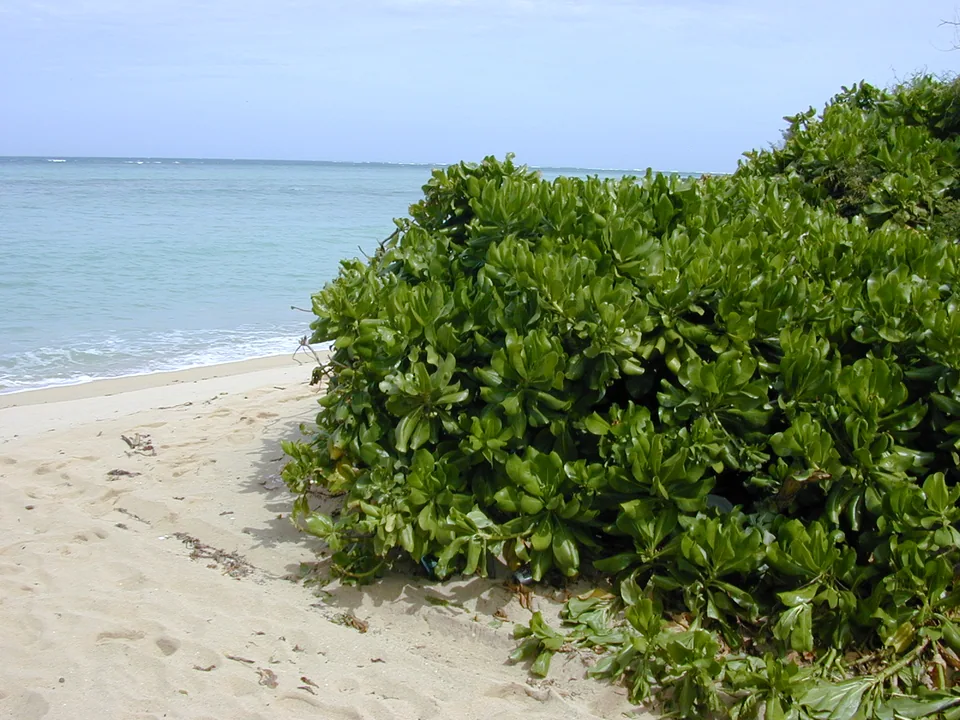
Family: Goodeniaceae Habit: Large, bushy shrub up to 16 ft. tall, often forming dense hemispherical mounds.
— | Center for Aquatic and Invasive Plants | University of Florida, IFAS [1] Mature width: 182-457 cm (6-15 ft)
Scaevola sericea is a dense, spreading shrub that generally grows up to 3 feet tall, but can be up to 10 feet tall and 6 to 15 feet wide.
— Scaevola sericea (Beach Naupaka) [3] - Propagation
From seed, cuttings or air layers
What the sources say (4)
Propagation: Seed (soak in cool water for 24 hours, plant about 1/2 inch [1.3 cm] deep in well drained potting mix); cuttings; air layers
It is easy to grow Scaevola sericea from seed even without a salt water soak.
— Scaevola sericea (Beach Naupaka) [3] Scaevola sericea is easy to propagate from cuttings. Even large cuttings up to 3 feet long can be rooted.
— Scaevola sericea (Beach Naupaka) [3] Scaevola sericea can be grown from air layers.
— Scaevola sericea (Beach Naupaka) [3] Soak the seeds in cool water for 24 hours. Plant them about 1/2 inch deep in a well drained potting mix.
— Scaevola sericea (Beach Naupaka) [3] - Sowing
Soak seeds in cool water for 24 hours, then sow 1/2 inch deep in well-drained potting mix
What the sources say (4)
Propagation: Seed (soak in cool water for 24 hours, plant about 1/2 inch [1.3 cm] deep in well drained potting mix); cuttings; air layers
It is easy to grow Scaevola sericea from seed even without a salt water soak.
— Scaevola sericea (Beach Naupaka) [3] Scaevola sericea is easy to propagate from cuttings. Even large cuttings up to 3 feet long can be rooted.
— Scaevola sericea (Beach Naupaka) [3] Scaevola sericea can be grown from air layers.
— Scaevola sericea (Beach Naupaka) [3] Soak the seeds in cool water for 24 hours. Plant them about 1/2 inch deep in a well drained potting mix.
— Scaevola sericea (Beach Naupaka) [3] - Containers
Grows in containers too
What the sources say (1)
In containers: Yes
Landscape Uses - Accent - Container - Erosion Control - Ground Cover
— Scaevola taccada | Native Hawaiʻi Plants [8]
Overview
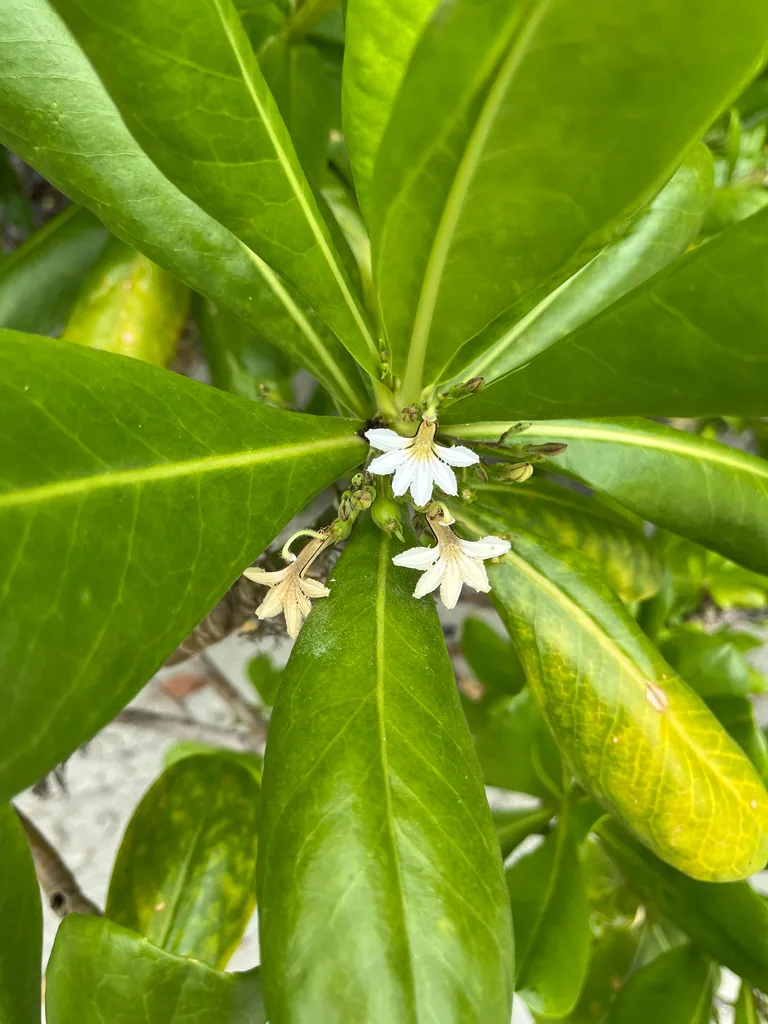
Scaevola taccada is a large, bushy shrub up to 16 ft [4.9 m] tall, often forming dense hemispherical mounds. [1] It is sometimes cultivated, especially as a hedge plant, and used in erosion control. [6] In Florida it escaped cultivation and forms dense stands on coastal dunes. [1] It is hardy only in USDA zones 10a-11 and is reported to be sensitive to frost. [2][7]
This record is incomplete: the sources we read do not cover every field yet.
Not yet covered by our sources: Pruning
Naupaka care
Measurements in square brackets are our conversion into the other unit system; the quoted text is unchanged.
How to water Naupaka
Watering
Established plants are very drought tolerant
Watering notes
Keep cuttings moist (watered once a day) until rooted
What the sources say (1)
Keep the medium moist by watering once a day.How much light Naupaka needs
Full sun, tolerates some shade
How much cold Naupaka can take
Hardiness, coldest zone
10a [winter low −1.1 to 1.7 °C (30 to 35 °F)]
What the sources say (1)
Common Synonyms: Scaevola frutescens, Scaevola koenigii, Scaevola sericea
USDA Hardiness Zone: 10a-11Hardiness, warmest zone
11 [winter low 4.4 to 10 °C (40 to 50 °F)]
What the sources say (1)
Common Synonyms: Scaevola frutescens, Scaevola koenigii, Scaevola sericea
USDA Hardiness Zone: 10a-11Where to grow Naupaka
Yes
What the sources say (1)
Landscape Uses
- Accent
- Container
- Erosion Control
- Ground CoverHow to propagate Naupaka
Seed (soak in cool water for 24 hours, plant about 1/2 inch [1.3 cm] deep in well drained potting mix); cuttings; air layers
What the sources say (4)
It is easy to grow Scaevola sericea from seed even without a salt water soak.Scaevola sericea is easy to propagate from cuttings. Even large cuttings up to 3 feet long can be rooted.Scaevola sericea can be grown from air layers.Soak the seeds in cool water for 24 hours. Plant them about 1/2 inch deep in a well drained potting mix.How to grow Naupaka
The plant
Family
Goodeniaceae
What the sources say (1)
Family: Goodeniaceae
Habit: Large, bushy shrub up to 16 ft. tall, often forming dense hemispherical mounds.Mature height
up to 488 cm (16 ft)
What the sources say (1)
Family: Goodeniaceae
Habit: Large, bushy shrub up to 16 ft. tall, often forming dense hemispherical mounds.Mature width
182-457 cm (6-15 ft)
What the sources say (1)
Scaevola sericea is a dense, spreading shrub that generally grows up to 3 feet tall, but can be up to 10 feet tall and 6 to 15 feet wide.Pests and diseases
Pests
ants, scale, spider mites, other sucking insects
What the sources say (1)
These shrubs are prone to ants, as well as scale, spider mites and other sucking insects.Fertilizing
When
Throughout the year
What the sources say (1)
Naupaka kahakai does not require much extra fertilizer, but will perform better with some periodic applications and foliar feeding throughout the year.How often
Periodic applications, with foliar feeding; the plant needs little extra fertilizer
What the sources say (1)
Naupaka kahakai does not require much extra fertilizer, but will perform better with some periodic applications and foliar feeding throughout the year.Remedies
Each remedy shows what official sources say about it; traditional remedies without an official source are marked as such. Harmful ones are listed so you know to avoid them.
Getting rid of it
invasive weed
hand pulling seedlings Partly works
Monitoring and re-treatment are necessary for at least two to three years.
— | Center for Aquatic and Invasive Plants | University of Florida, IFAS [1] How: Hand pull seedlings carefully, because soft stems and roots break off and resprout; remove and dispose of fruits to reduce spread.
Hand pull seedlings (carefully, soft stems and roots break off and resprout). Remove and dispose of fruits to reduce spread.
— | Center for Aquatic and Invasive Plants | University of Florida, IFAS [1] What the evidence says Hand pull seedlings (carefully, soft stems and roots break off and resprout). Remove and dispose of fruits to reduce spread.
— | Center for Aquatic and Invasive Plants | University of Florida, IFAS [1] mechanical removal of the whole plant including roots Partly works
How: When mechanical treatment is done, all plant material including roots must be removed to be effective.
Given the sensitive habitats it infests, mechanical treatment is not typically feasible. When done, all plant material including roots must be removed to be effective.
— | Center for Aquatic and Invasive Plants | University of Florida, IFAS [1] What the evidence says Given the sensitive habitats it infests, mechanical treatment is not typically feasible. When done, all plant material including roots must be removed to be effective.
— | Center for Aquatic and Invasive Plants | University of Florida, IFAS [1]
Calendar
Pruning
Not stated in the sources we read.
Months as given by the sources, which are mostly from the United States (northern hemisphere). In the southern hemisphere they shift by about six months.
Edibility
Reported by the source, quoted verbatim. Do not eat a plant on the basis of this page alone: identification mistakes can be dangerous.
Young leaves - cooked as a potherb[ 459
[6]
Indicative values
Values from a secondary source, not checked word for word like the rest of this page. Use them as a starting point.
- Life cycle
- PerennialIndicative value, adapt it to your climate · Secondary source
- Drought tolerant
- yesIndicative value, adapt it to your climate · Secondary source
- Soil pH
- 6-7.5Indicative value, adapt it to your climate · Secondary source
- Growth rate
- LowIndicative value, adapt it to your climate · Secondary source
- Pruning
- March, AprilIndicative value, adapt it to your climate · Secondary source
Similar plants
- Fan Flower Scaevola aemula
- Abies grandis Abies grandis
- Abraham Trachystemon orientalis
- Abyssinian banana Ensete ventricosum
- Acacia longifolia Acacia longifolia
- Acanthus hungaricus Acanthus hungaricus
- Aconite Aconitum napellus
- Adam's Needle Yucca flaccida
Sources
Every value above is quoted from these documents. Links lead to the original publisher.
- | Center for Aquatic and Invasive Plants | University of Florida, IFAS · plant-directory.ifas.ufl.edu, consulted
- Scaevola taccada - Florida Natural Areas Inventory · fnai.org, consulted
- Scaevola sericea (Beach Naupaka) · ctahr.hawaii.edu, consulted
- Naupaka kahakai, The right plant for the right place | Plant Pono · plantpono.org, consulted
- Scaevola taccada - Plant Detail - Tropical Plants Database - NTBG Database · ntbg.org, consulted
- Scaevola taccada - Useful Tropical Plants · tropical.theferns.info, consulted
- GISD · iucngisd.org, consulted
- Scaevola taccada | Native Hawaiʻi Plants · nativeplants.hawaii.edu, consulted
Written by Emilio Marruso · last checked