
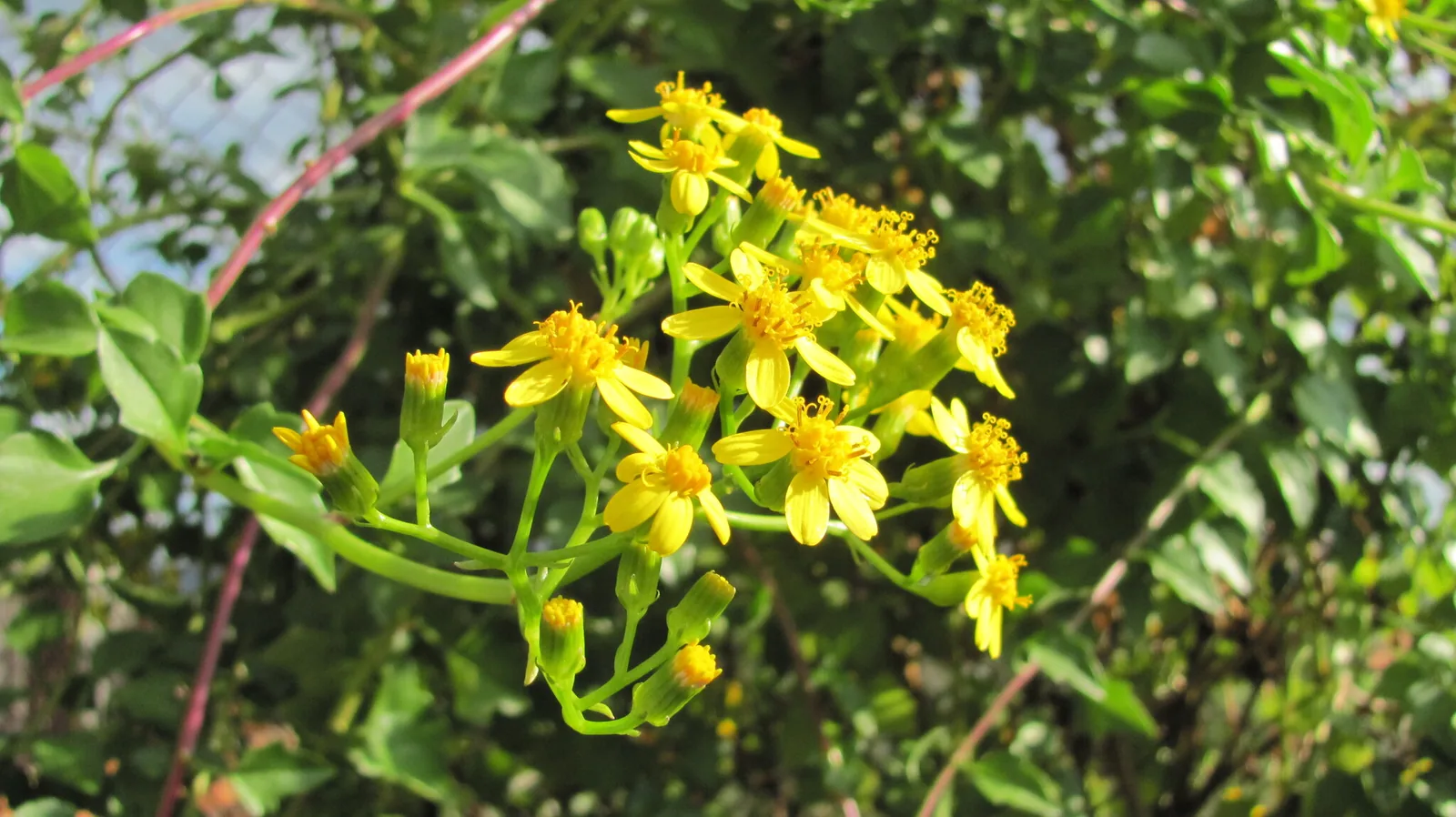

How to Grow and Care for Creeping groundsel
Senecio angulatus
Written by Emilio Marruso · last checked
Toxic to: Animals, People · Why
At a glance
This senecio is happy in full sun outdoors or in medium to bright indirect light indoors, and you can start new plants from stem cuttings or seed. In winter, let the soil dry between waterings, then cut it back to a firm stem in early spring. Just keep it in check: it spreads into dense mats, and it is toxic to people and pets.
- Sun
Full sun outdoors (part shade means more leaves, fewer flowers); medium to bright indirect light indoors
What the sources say (4)
Light: Outdoors: full sun, semi-shade tolerated; indoors: medium to bright indirect light
outdoors (fonte: Consulta Plantas): Senecio angulatus needs full sun exposure ; it can grow in semi-shade but will produce more leaves than flowers.
— Senecio angulatus or Creeping groundsel | Care and Growing [2] indoors (fonte: Home Plants Guide): Scrambling Groundsel grows best in medium to bright indirect light conditions; place it near a large, brightly-lit, sunless window.
— Scrambling Groundsel Care Indoors: Senecio angulatus Indoor Care [5] Senecio angulatus needs full sun exposure ; it can grow in semi-shade but will produce more leaves than flowers.
— Senecio angulatus or Creeping groundsel | Care and Growing [2] Scrambling Groundsel grows best in medium to bright indirect light conditions; place it near a large, brightly-lit, sunless window.
— Scrambling Groundsel Care Indoors: Senecio angulatus Indoor Care [5] - Water
In winter, let the soil dry between waterings; never leave it soggy for long
What the sources say (2)
Watering notes: Allow the soil to dry out between waterings in winter, when plants are somewhat dormant; avoid prolonged wet soil
Allow the soil to dry out between waterings in winter, when they are somewhat dormant.
— Senecio angulatus (Climbing Groundsel) - World of Succulents [1] They need some water during the summer, but do not leave the soil wet for prolonged periods.
— Senecio angulatus (Climbing Groundsel) - World of Succulents [1] - Cold
Survives winters down to 20 °F (−6.7 °C)
Hardy in average winters · USDA 9a · RHS H4 · Z9
What the sources say (2)
Hardiness, coldest zone: 9a [winter low −6.7 to −3.9 °C (20 to 25 °F)]
USDA hardiness zones 9a to 11b: from 20°F
— Senecio angulatus (Climbing Groundsel) - World of Succulents [1] Hardiness, warmest zone:
According to World of Succulents: USDA hardiness zones 9a to 11b: from 20°F
— Senecio angulatus (Climbing Groundsel) - World of Succulents [1] - Pruning
In early spring, cut back to a firm stem
What the sources say (1)
Pruning: Early spring (prune back to a firm stem)
In early spring, you can prune them back to a firm stem and even root the cuttings.
— Senecio angulatus (Climbing Groundsel) - World of Succulents [1] - Watch out
Can be invasive: it forms dense mats; destroy the underground stems before throwing it away
- Propagation
From stem cuttings or seed
What the sources say (2)
- Sowing
Sow in spring
What the sources say (1)
Sowing: Spring
Senecio angulatus is propagated from seeds sown in spring or by stem cuttings.
— Senecio angulatus or Creeping groundsel | Care and Growing [2] - Containers
Can be grown indoors as a houseplant
What the sources say (1)
Indoors: Yes
Scrambling Groundsel (Senecio angulatus) Indoor Care, Propagation & Common Problems
— Scrambling Groundsel Care Indoors: Senecio angulatus Indoor Care [5] - Safety
Toxic to people and pets
Overview
Creeping groundsel is a fast-growing, scrambling, vining perennial herb native to South Africa that is grown as an ornamental but can become an aggressive weed. [4] It needs full sun, tolerates semi-shade with fewer flowers, and grows in any well-drained soil. [2] It is propagated from seed sown in spring or by stem cuttings. [2]
This record is incomplete: the sources we read do not cover every field yet.
Not yet covered by our sources: Watering, Hardiness, warmest zone
Creeping groundsel care
How to water Creeping groundsel
Watering
Not stated in the sources we read.
Watering notes
Allow the soil to dry out between waterings in winter, when plants are somewhat dormant; avoid prolonged wet soil
What the sources say (2)
Allow the soil to dry out between waterings in winter, when they are somewhat dormant.They need some water during the summer, but do not leave the soil wet for prolonged periods.How much light Creeping groundsel needs
Outdoors: full sun, semi-shade tolerated; indoors: medium to bright indirect light
What each source says
outdoors (fonte: Consulta Plantas): Full sun; semi-shade gives more leaves than flowers
indoors (fonte: Home Plants Guide): Medium to bright indirect light
What the sources say (4)
outdoors (fonte: Consulta Plantas): Senecio angulatus needs full sun exposure ; it can grow in semi-shade but will produce more leaves than flowers.indoors (fonte: Home Plants Guide): Scrambling Groundsel grows best in medium to bright indirect light conditions; place it near a large, brightly-lit, sunless window.Senecio angulatus needs full sun exposure ; it can grow in semi-shade but will produce more leaves than flowers.Scrambling Groundsel grows best in medium to bright indirect light conditions; place it near a large, brightly-lit, sunless window.How much cold Creeping groundsel can take
Hardiness, coldest zone
9a [winter low −6.7 to −3.9 °C (20 to 25 °F)]
What the sources say (1)
USDA hardiness zones 9a to 11b: from 20°FHardiness, warmest zone
The sources give different values depending on region, zone or growing conditions.
What each source says
According to World of Succulents: 11b [winter low 7.2 to 10 °C (45 to 50 °F)]
What the sources say (1)
According to World of Succulents: USDA hardiness zones 9a to 11b: from 20°FWhere to grow Creeping groundsel
Yes
What the sources say (1)
Scrambling Groundsel (Senecio angulatus) Indoor Care, Propagation & Common ProblemsHow to propagate Creeping groundsel
Stem cuttings; seed
Creeping groundsel pests and problems
Invasive spread
Symptom: Forms dense tangled mats that can smother native flora
What to do: Control its growth; destroy underground rhizomes before discarding
What the sources say (2)
Plants form dense tangled mats, similar to Cape ivy, and can smother native flora.
— Senecio angulatus Profile – California Invasive Plant Council [4] To counter this invasive nature, always destroy the underground rhizomes before discarding as they easily resprout.
— Scrambling Groundsel Care Indoors: Senecio angulatus Indoor Care [5]
Remedies
Each remedy shows what official sources say about it; traditional remedies without an official source are marked as such. Harmful ones are listed so you know to avoid them.
Getting rid of it
invasive spread
hand pulling or digging out Not verified
Traditional remedy, not verified by an official source.
Cut stumps and dropped stems resprout. Bared areas reseed.
— weedbusters.org.nz [7] How: Hand pull small plants, or dig out the entire plant including roots, and dispose of it at a refuse transfer station, by burning, or by deep burial.
bagging in black plastic Not verified
Traditional remedy, not verified by an official source.
How: Small infestations can be dug out and the plants bagged in black plastic bags left to rot in the sun.
Is Creeping groundsel toxic to pets?
Reported by the source, quoted verbatim. This is not medical or veterinary advice: if a person or an animal may have eaten this plant, contact a poison control centre or a veterinarian.
Calendar
Sowing
Spring
What the sources say (1)
Senecio angulatus is propagated from seeds sown in spring or by stem cuttings.Pruning
Early spring (prune back to a firm stem)
What the sources say (1)
In early spring, you can prune them back to a firm stem and even root the cuttings.Months as given by the sources, which are mostly from the United States (northern hemisphere). In the southern hemisphere they shift by about six months.
Similar plants
- Abies grandis Abies grandis
- Abraham Trachystemon orientalis
- Abyssinian banana Ensete ventricosum
- Acacia longifolia Acacia longifolia
- Acanthus hungaricus Acanthus hungaricus
- Aconite Aconitum napellus
- Adam's Needle Yucca flaccida
- Adriatic lizard orchid Himantoglossum adriaticum
Sources
Every value above is quoted from these documents. Links lead to the original publisher.
- Senecio angulatus (Climbing Groundsel) - World of Succulents · worldofsucculents.com, consulted
- Senecio angulatus or Creeping groundsel | Care and Growing · consultaplantas.com, consulted
- Climbing groundsel · weeds.brisbane.qld.gov.au, consulted
- Senecio angulatus Profile – California Invasive Plant Council · cal-ipc.org, consulted
- Scrambling Groundsel Care Indoors: Senecio angulatus Indoor Care · homeplantsguide.com, consulted
- Senecio angulatus • New Zealand Plant Conservation Network · nzpcn.org.nz, consulted
- weedbusters.org.nz · weedbusters.org.nz
Written by Emilio Marruso · last checked