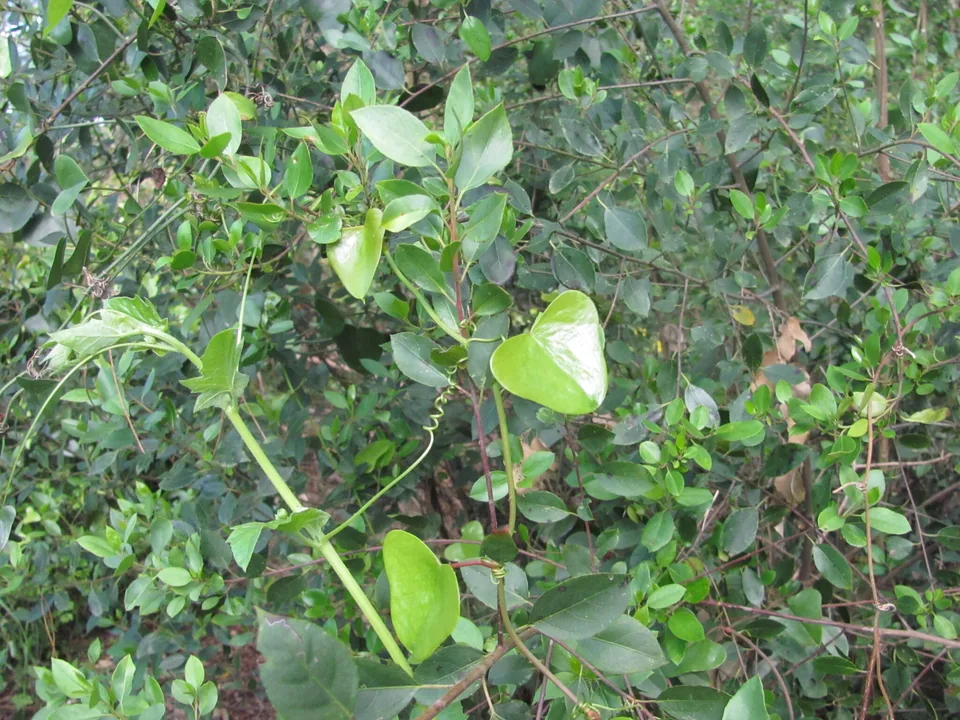
How to Grow and Care for Common smilax
Smilax aspera
Written by Emilio Marruso · last checked
Toxic to: People · Why
At a glance
Smilax aspera is a tough plant often grown to form an impenetrable barrier. It loves full sun but also copes with semi-shade and shade, grows happily in a container, and even gives you a treat: its young shoots can be eaten raw or cooked as a vegetable. Plant it in early summer and prune it in late winter.
- Sun
Full sun is best; it also handles semi-shade and shade
- Cold
Survives winters down to 20 °F (−6.7 °C)
Hardy in average winters · USDA 9 · RHS H4 · Z9
What the sources say (1)
Hardiness, coldest zone: 9 [winter low −6.7 to −1.1 °C (20 to 30 °F)]
Light full sun Shade tolerance light shade Water moderate Hardiness Zone 9+
— Sarsaparilla (Smilax aspera) — Practical Plants [4] - Planting
Plant in early summer
What the sources say (1)
Planting: Early summer
Plant them out into their permanent positions in early summer.
— Sarsaparilla (Smilax aspera) — Practical Plants [4] - Pruning
Prune in late winter
What the sources say (1)
Pruning: Late winter
Prune in late winter to keep it compact and control growth.
— Smilax aspera or Sarsaparille | Care and Growing [3] - Harvest
Young shoots can be eaten raw or cooked as a vegetable
- Propagation
Grow new plants from seed, by dividing the plant or from half-ripe cuttings
What the sources say (3)
Propagation: Seed; division; half-ripe cuttings
Cuttings of half-ripe shoots, July in a frame
— Sarsaparilla (Smilax aspera) — Practical Plants [4] Division in early spring as new growth begins
— Sarsaparilla (Smilax aspera) — Practical Plants [4] Sarsaparille is propagated in early spring from seeds or by division.
— Smilax aspera or Sarsaparille | Care and Growing [3] - Sowing
Sow in early spring, in March in a warm greenhouse
- Containers
Grows in containers too
What the sources say (1)
In containers: Yes
Common smilax is used to cover walls, gates or lattices and in pots and planters.
— Smilax aspera or Sarsaparille | Care and Growing [3] - Safety
No known hazards
Overview
Smilax aspera is an evergreen climbing plant with stems about 3 metres [9.8 ft] long that attach to other plants by tendrils. [1] It is used to cover walls, gates or lattices and can be grown in pots and planters. [3] It is not very cold-hardy and is grown in the mildest areas of Britain. [1]
This record is incomplete: the sources we read do not cover every field yet.
Not yet covered by our sources: Watering, Hardiness, warmest zone
Common smilax care
Measurements in square brackets are our conversion into the other unit system; the quoted text is unchanged.
How to water Common smilax
Not stated in the sources we read.
How much light Common smilax needs
How much cold Common smilax can take
Hardiness, coldest zone
9 [winter low −6.7 to −1.1 °C (20 to 30 °F)]
What the sources say (1)
Light
full sun
Shade tolerance
light shade
Water
moderate
Hardiness
Zone 9+Hardiness, warmest zone
Not stated in the sources we read.
Where to grow Common smilax
Yes
What the sources say (1)
Common smilax is used to cover walls, gates or lattices and in pots and planters.How to propagate Common smilax
Seed; division; half-ripe cuttings
What the sources say (3)
Cuttings of half-ripe shoots, July in a frameDivision in early spring as new growth beginsSarsaparille is propagated in early spring from seeds or by division.Remedies
The sources we checked give no remedies for this plant.
Is Common smilax poisonous?
Reported by the source, quoted verbatim. This is not medical or veterinary advice: if a person or an animal may have eaten this plant, contact a poison control centre or a veterinarian.
The plant is often grown to form an impenetrable barrier. ## Known Hazards None known
[1]
Calendar
Early summer
What the sources say (1)
Plant them out into their permanent positions in early summer.Late winter
What the sources say (1)
Prune in late winter to keep it compact and control growth.Months as given by the sources, which are mostly from the United States (northern hemisphere). In the southern hemisphere they shift by about six months.
Edibility
Reported by the source, quoted verbatim. Do not eat a plant on the basis of this page alone: identification mistakes can be dangerous.
Young shoots - raw or cooked as a vegetable
[1]
Similar plants
- Abies grandis Abies grandis
- Abraham Trachystemon orientalis
- Abyssinian banana Ensete ventricosum
- Acacia longifolia Acacia longifolia
- Acanthus hungaricus Acanthus hungaricus
- Aconite Aconitum napellus
- Adam's Needle Yucca flaccida
- Adriatic lizard orchid Himantoglossum adriaticum
Sources
Every value above is quoted from these documents. Links lead to the original publisher.
- Smilax aspera - Useful Temperate Plants · temperate.theferns.info, consulted
- Smilax aspera - Trees and Shrubs Online · treesandshrubsonline.org, consulted
- Smilax aspera or Sarsaparille | Care and Growing · consultaplantas.com, consulted
- Sarsaparilla (Smilax aspera) — Practical Plants · practicalplants.org, consulted
Written by Emilio Marruso · last checked