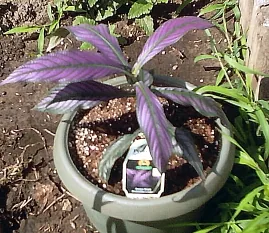

How to Grow and Care for Persian Shield
Strobilanthes dyerianus
Written by Emilio Marruso · last checked
At a glance
Persian shield is an easygoing perennial that grows happily in containers and even indoors, reaching 3 to 4 feet tall. Water it when the top 2 inches of soil are dry, keep the moisture even, and feed it once a month. New plants start easily from leaf or stem cuttings, so one plant can soon become many.
- Water
Water when the top 2 inches of soil are dry; keep moisture even, a bit drier in winter
What the sources say (2)
Watering: Water when the top couple of inches (5 cm) of soil are dry; keep a bit drier in winter
Water the plant when the top couple of inches (5 cm.) of soil are dry and keep a bit drier in winter.
— Persian Shield Care Instructions - How To Grow A Persian Shield Plant Indoors | Gardening Know How [5] Watering notes: Uniform moisture; not considered drought tolerant
This perennial will appreciate uniform moisture as it is not considered drought tolerant
— Shady characters – Persian shields - UF/IFAS Extension Charlotte County [4] - Spacing
18 in between plants
What the sources say (1)
Spacing: 45.7 cm (18 in)
Plant Persian shields in partial shade (bright light with no direct sunlight) to full shade, about eighteen inches apart in compost-enriched, well-drained soil for mass-planting.
— Shady characters – Persian shields - UF/IFAS Extension Charlotte County [4] - Feeding
Feed once a month
What the sources say (1)
How often: Monthly
Provide a soil rich in organic matter, with good drainage and keep the soil moist. Space plants 18 to 24 inches apart. Fertilize monthly.
— [6] - Pests
Watch for spider mites and fungus gnats
What the sources say (1)
Pests: red spider mites, fungus gnats
Insects, Diseases, and Other Plant Problems: Provide good drainage. Watch for red spider mites and fungus gnats when grown indoors.
— Strobilanthes auriculata var. dyeriana (Burmuda coneflower, Persian Shield, Royal Purple Plant) | North Carolina Extension Gardener Plant Toolbox [1] - Size
3–4 ft tall and 2–3 ft wide
What the sources say (2)
Mature height: 91-122 cm (3 to 4 ft)
Persian shield can grow 3 to 4 feet tall and 2 to 3 feet across.
— Persian Shield – Gardening Solutions [2] Mature width: 61-91 cm (2 to 3 ft)
Persian shield can grow 3 to 4 feet tall and 2 to 3 feet across.
— Persian Shield – Gardening Solutions [2] - Propagation
Grow new plants from leaf or stem cuttings, or from seed
What the sources say (1)
Propagation: Leaf or stem cuttings; seed
This plant is typically propagated from leaf or stem cuttings, but it can also be grown from seed.
— Strobilanthes Auriculata Var. Dyeriana (Persian Shield) - Brunswick County Center | N.C. Cooperative Extension [3] - Containers
Grows well in containers and indoors
What the sources say (3)
In containers: Yes
It makes an excellent container plant, however, over time, it will need to be repotted into a larger container.
— Strobilanthes auriculata var. dyeriana (Burmuda coneflower, Persian Shield, Royal Purple Plant) | North Carolina Extension Gardener Plant Toolbox [1] Indoors: Yes
Since it is only suitable for USDA zone 10, growing Persian shield indoors is the best way for most gardeners to enjoy this brilliant plant.
— Persian Shield Care Instructions - How To Grow A Persian Shield Plant Indoors | Gardening Know How [5] The tiny flowers will bloom in the winter months when grown as a houseplant or outdoors in zones 10 and 11.
— Strobilanthes auriculata var. dyeriana (Burmuda coneflower, Persian Shield, Royal Purple Plant) | North Carolina Extension Gardener Plant Toolbox [1]
Overview
Persian shield is a soft-stemmed tropical evergreen shrub or sub-shrub grown for its showy foliage. [1] It can be grown in containers and as an indoor plant. [1][5]
This record is incomplete: the sources we read do not cover every field yet.
Not yet covered by our sources: Hardiness, coldest zone, Pruning
Persian Shield care
How to water Persian Shield
Watering
Water when the top couple of inches (5 cm) of soil are dry; keep a bit drier in winter
What the sources say (1)
Water the plant when the top couple of inches (5 cm.) of soil are dry and keep a bit drier in winter.Watering notes
Uniform moisture; not considered drought tolerant
What the sources say (1)
This perennial will appreciate uniform moisture as it is not considered drought tolerantHow much light Persian Shield needs
The sources give different values depending on region, zone or growing conditions.
What each source says
According to NC State Extension: Bright light with no direct sunlight
Florida: Partial to full shade
According to Gardening Know How: Full sun to partial shade
What the sources say (3)
According to NC State Extension: It grows best when planted in a rich soil and located in an area that receives bright light with no direct sunlight.Florida: Here in Florida, it’s best to plant it in partial to full shade.According to Gardening Know How: The plant performs well in a container inside or outside, in full sun to partial shade.How much cold Persian Shield can take
Hardiness, coldest zone
Not stated in the sources we read.
Hardiness, warmest zone
11 [winter low 4.4 to 10 °C (40 to 50 °F)]
What the sources say (2)
Known scientifically as Strobilanthes dyerianus , Persian shield can be grown as a root-hardy perennial in USDA plant hardiness zones 8-11.It is hardy in USDA zones 8 to 11, but is more commonly grown indoors or as a summer annual in cooler climates.Where to grow Persian Shield
Indoors
Yes
What the sources say (2)
Since it is only suitable for USDA zone 10, growing Persian shield indoors is the best way for most gardeners to enjoy this brilliant plant.The tiny flowers will bloom in the winter months when grown as a houseplant or outdoors in zones 10 and 11.In containers
Yes
What the sources say (1)
It makes an excellent container plant, however, over time, it will need to be repotted into a larger container.Spacing
45.7 cm (18 in)
What the sources say (1)
Plant Persian shields in partial shade (bright light with no direct sunlight) to full shade, about eighteen inches apart in compost-enriched, well-drained soil for mass-planting.How to propagate Persian Shield
Leaf or stem cuttings; seed
What the sources say (1)
This plant is typically propagated from leaf or stem cuttings, but it can also be grown from seed.How to grow Persian Shield
The plant
Life cycle
perennial
What the sources say (1)
Persian shield is a large, evergreen perennial known for its vibrant foliage.Mature height
91-122 cm (3 to 4 ft)
What the sources say (1)
Persian shield can grow 3 to 4 feet tall and 2 to 3 feet across.Mature width
61-91 cm (2 to 3 ft)
What the sources say (1)
Persian shield can grow 3 to 4 feet tall and 2 to 3 feet across.Pests and diseases
Pests
red spider mites, fungus gnats
What the sources say (1)
Insects, Diseases, and Other Plant Problems: Provide good drainage. Watch for red spider mites and fungus gnats when grown indoors.Fertilizing
How often
Monthly
What the sources say (1)
Provide a soil rich in organic matter, with good drainage and keep the soil moist. Space plants 18 to 24 inches apart. Fertilize monthly.Remedies
The sources we checked give no remedies for this plant.
Calendar
Pruning
Not stated in the sources we read.
Months as given by the sources, which are mostly from the United States (northern hemisphere). In the southern hemisphere they shift by about six months.
Indicative values
Values from a secondary source, not checked word for word like the rest of this page. Use them as a starting point.
- Hours of sun
- 4-6 hoursIndicative value, adapt it to your climate · Secondary source
- Drought tolerant
- yesIndicative value, adapt it to your climate · Secondary source
- Soil
- Well-drainedIndicative value, adapt it to your climate · Secondary source
- Soil pH
- 5.5-7.5Indicative value, adapt it to your climate · Secondary source
- Care level
- MediumIndicative value, adapt it to your climate · Secondary source
- Growth rate
- HighIndicative value, adapt it to your climate · Secondary source
- Pruning
- May, May, June, JulyIndicative value, adapt it to your climate · Secondary source
Similar plants
- Aaron's Beard Hypericum calycinum
- Abies grandis Abies grandis
- Abraham Trachystemon orientalis
- Abyssinian banana Ensete ventricosum
- Acacia longifolia Acacia longifolia
- Acacia retinodes Acacia retinodes
- Acanthus hungaricus Acanthus hungaricus
- Achlys triphylla Achlys triphylla
Sources
Every value above is quoted from these documents. Links lead to the original publisher.
- Strobilanthes auriculata var. dyeriana (Burmuda coneflower, Persian Shield, Royal Purple Plant) | North Carolina Extension Gardener Plant Toolbox · plants.ces.ncsu.edu, consulted
- Persian Shield – Gardening Solutions · gardeningsolutions.ifas.ufl.edu, consulted
- Strobilanthes Auriculata Var. Dyeriana (Persian Shield) - Brunswick County Center | N.C. Cooperative Extension · brunswick.ces.ncsu.edu, consulted
- Shady characters – Persian shields - UF/IFAS Extension Charlotte County · blogs.ifas.ufl.edu, consulted
- Persian Shield Care Instructions - How To Grow A Persian Shield Plant Indoors | Gardening Know How · gardeningknowhow.com, consulted
- hort.extension.wisc.edu · hort.extension.wisc.edu
Written by Emilio Marruso · last checked