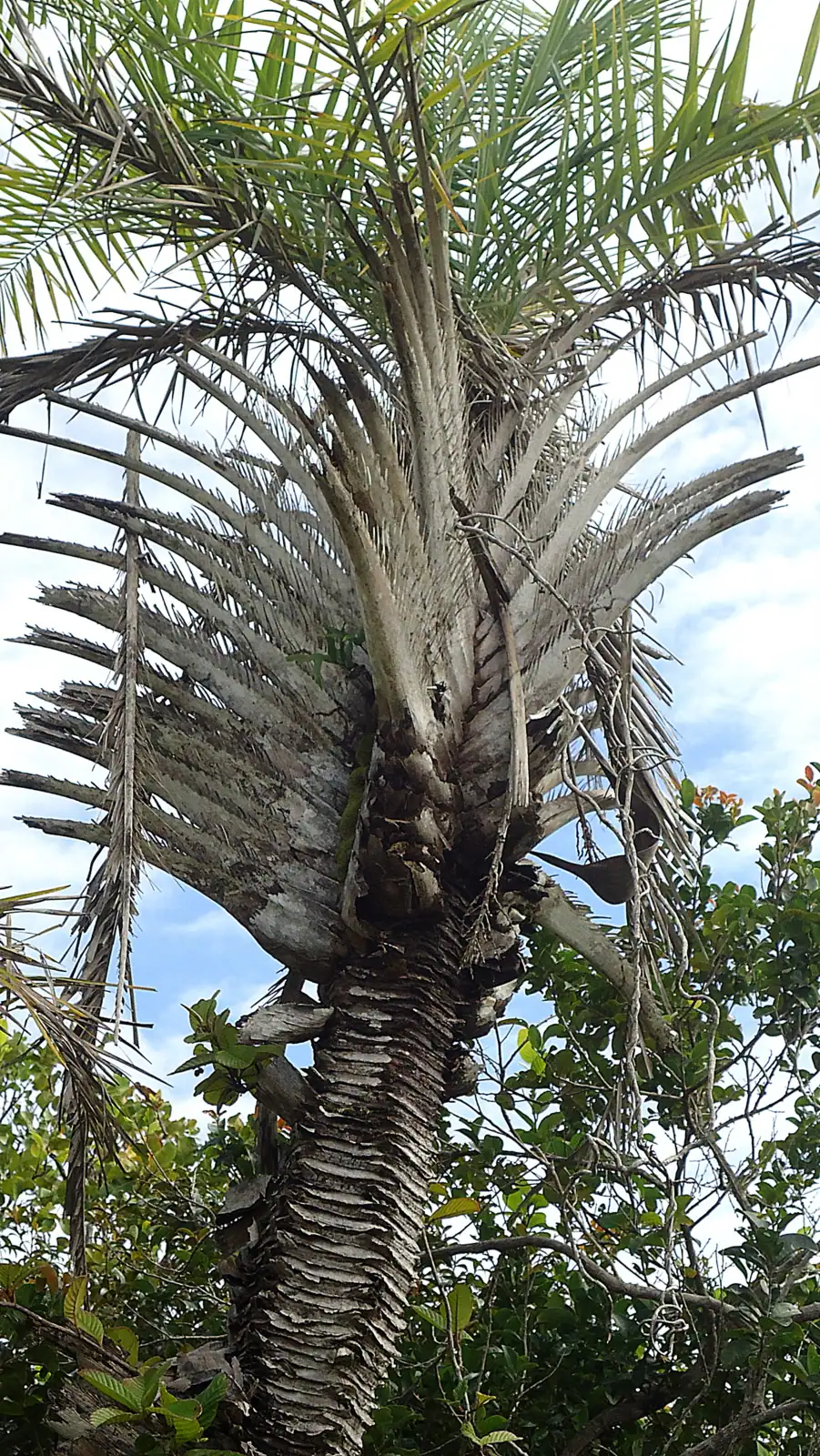

How to Grow and Care for Ouricury palm
Syagrus coronata
Written by Emilio Marruso · last checked
Toxic to: People · Why
At a glance
This sturdy palm loves full sun and shrugs off long dry spells, though regular watering helps it grow faster where the dry season is long. Give young plants a little shade at first and soil that drains freely. Its fruit pulp is eaten, and its tender top bud, the palm heart, is enjoyed as a vegetable.
- Sun
Full sun; give young plants partial shade
What the sources say (1)
Light: Full sun; partial shade in the early stage of growth
Requires full sun, but in the initial phase of growth when needing partial shading, and adapts to various types of soil
— Syagrus coronata - Monaco Nature Encyclopedia [4] - Water
Handles long dry spells; water regularly for faster growth, but never leave standing water
What the sources say (2)
Watering: Withstands long dry periods; grows faster with regular watering where the warm dry season is long
resists long periods of drought, but grows faster if regularly watered in the climates characterized by a long warm and dry season.
— Syagrus coronata - Monaco Nature Encyclopedia [4] Watering notes: Needs free-draining soil; does not tolerate standing water
fertile and deep to poor stony and rocky, provided draining, not bearing water stagnations, resists long periods of drought
— Syagrus coronata - Monaco Nature Encyclopedia [4] - Cold
Survives winters down to 20 °F (−6.7 °C)
Hardy in average winters · USDA 9 · RHS H4 · Z9
What the sources say (2)
Hardiness, coldest zone: 9 [winter low −6.7 to −1.1 °C (20 to 30 °F)]
Missouri Botanical Garden. (2023). Syagrus coronata. https://www.missouribotanicalgarden.org. [Accessed 19 Jun 2023] "Zone: 9 to 12"
— TAXON: Syagrus coronata (Mart.) [1] Hardiness, warmest zone: 12 [winter low 10 to 15.6 °C (50 to 60 °F)]
Missouri Botanical Garden. (2023). Syagrus coronata. https://www.missouribotanicalgarden.org. [Accessed 19 Jun 2023] "Zone: 9 to 12"
— TAXON: Syagrus coronata (Mart.) [1] - Soil
Soil that drains freely
What the sources say (1)
Watering notes: Needs free-draining soil; does not tolerate standing water
fertile and deep to poor stony and rocky, provided draining, not bearing water stagnations, resists long periods of drought
— Syagrus coronata - Monaco Nature Encyclopedia [4] - Harvest
The fruit pulp is eaten, and the palm heart is eaten as a vegetable
- Pests
Watch for butt rot, a rot at the base of the trunk
- Propagation
Grows from seed
What the sources say (2)
Propagation: Seed
It reproduces by seeds, previously kept in water for 3 days, in draining loam maintained humid at the temperature of 26-28
— Syagrus coronata - Monaco Nature Encyclopedia [4] Seed - best sown as soon as it is ripe in a deeply shaded position in a nursery seedbed.
— Syagrus coronata - Useful Tropical Plants [3] - Sowing
Sow the seed as soon as it is ripe
What the sources say (1)
Sowing: As soon as the seed is ripe
Seed - best sown as soon as it is ripe in a deeply shaded position in a nursery seedbed.
— Syagrus coronata - Useful Tropical Plants [3] - Safety
Not listed as toxic to people
Overview
Syagrus coronata (licuri palm) is a slow-growing, single-stemmed palm from eastern Brazil, where it grows mainly in the dry caatinga forest. [4][3] It is grown as an ornamental in tropical and subtropical climates and needs full sun once past the seedling stage. [4] Its fruit pulp and palm heart are eaten locally, and the seeds yield an oil. [3]
This record is incomplete: the sources we read do not cover every field yet.
Not yet covered by our sources: Pruning
Ouricury palm care
How to water Ouricury palm
Watering
Withstands long dry periods; grows faster with regular watering where the warm dry season is long
What the sources say (1)
resists long periods of drought, but grows faster if regularly watered in the climates characterized by a long warm and dry season.Watering notes
Needs free-draining soil; does not tolerate standing water
What the sources say (1)
fertile and deep to poor stony and rocky, provided draining, not bearing water stagnations, resists long periods of droughtHow much light Ouricury palm needs
Full sun; partial shade in the early stage of growth
What the sources say (1)
Requires full sun, but in the initial phase of growth when needing partial shading, and adapts to various types of soilHow much cold Ouricury palm can take
Hardiness, coldest zone
9 [winter low −6.7 to −1.1 °C (20 to 30 °F)]
What the sources say (1)
Missouri Botanical Garden. (2023). Syagrus coronata. https://www.missouribotanicalgarden.org. [Accessed 19 Jun 2023] "Zone: 9 to 12"Hardiness, warmest zone
12 [winter low 10 to 15.6 °C (50 to 60 °F)]
What the sources say (1)
Missouri Botanical Garden. (2023). Syagrus coronata. https://www.missouribotanicalgarden.org. [Accessed 19 Jun 2023] "Zone: 9 to 12"How to propagate Ouricury palm
Seed
What the sources say (2)
It reproduces by seeds, previously kept in water for 3 days, in draining loam maintained humid at the temperature of 26-28Seed - best sown as soon as it is ripe in a deeply shaded position in a nursery seedbed.Ouricury palm pests and problems
Ganoderma butt rot
What the sources say (1)
Reportedly susceptible to toganoderma butt rot. No other pest or disease issues of note.
— TAXON: Syagrus coronata (Mart.) [1]
Remedies
The sources we checked give no remedies for this plant.
Is Ouricury palm poisonous?
Reported by the source, quoted verbatim. This is not medical or veterinary advice: if a person or an animal may have eaten this plant, contact a poison control centre or a veterinarian.
407 Causes allergies or is otherwise toxic to humans y = 1, n = 0 n
[1]
Calendar
Sowing
As soon as the seed is ripe
What the sources say (1)
Seed - best sown as soon as it is ripe in a deeply shaded position in a nursery seedbed.Pruning
Not stated in the sources we read.
Months as given by the sources, which are mostly from the United States (northern hemisphere). In the southern hemisphere they shift by about six months.
Edibility
Reported by the source, quoted verbatim. Do not eat a plant on the basis of this page alone: identification mistakes can be dangerous.
Indicative values
Values from a secondary source, not checked word for word like the rest of this page. Use them as a starting point.
- Life cycle
- PerennialIndicative value, adapt it to your climate · Secondary source
- Mature height
- 609.6-914.4 cm (20-30 ft)Indicative value, adapt it to your climate · Secondary source
- Hours of sun
- 6-8 hoursIndicative value, adapt it to your climate · Secondary source
- Drought tolerant
- yesIndicative value, adapt it to your climate · Secondary source
- Soil pH
- 6-7.5Indicative value, adapt it to your climate · Secondary source
- Care level
- MediumIndicative value, adapt it to your climate · Secondary source
- Growth rate
- LowIndicative value, adapt it to your climate · Secondary source
- Pruning
- February, August, MayIndicative value, adapt it to your climate · Secondary source
Similar plants
- Abies grandis Abies grandis
- Abraham Trachystemon orientalis
- Abyssinian banana Ensete ventricosum
- Acacia longifolia Acacia longifolia
- Acanthus hungaricus Acanthus hungaricus
- Achlys triphylla Achlys triphylla
- Aconite Aconitum napellus
- Adam's Needle Yucca flaccida
Sources
Every value above is quoted from these documents. Links lead to the original publisher.
- TAXON: Syagrus coronata (Mart.) · plantpono.org, consulted
- Plants of Hawai'i | Bishop Museum · plantsofhawaii.org, consulted
- Syagrus coronata - Useful Tropical Plants · tropical.theferns.info, consulted
- Syagrus coronata - Monaco Nature Encyclopedia · monaconatureencyclopedia.com, consulted
Written by Emilio Marruso · last checked