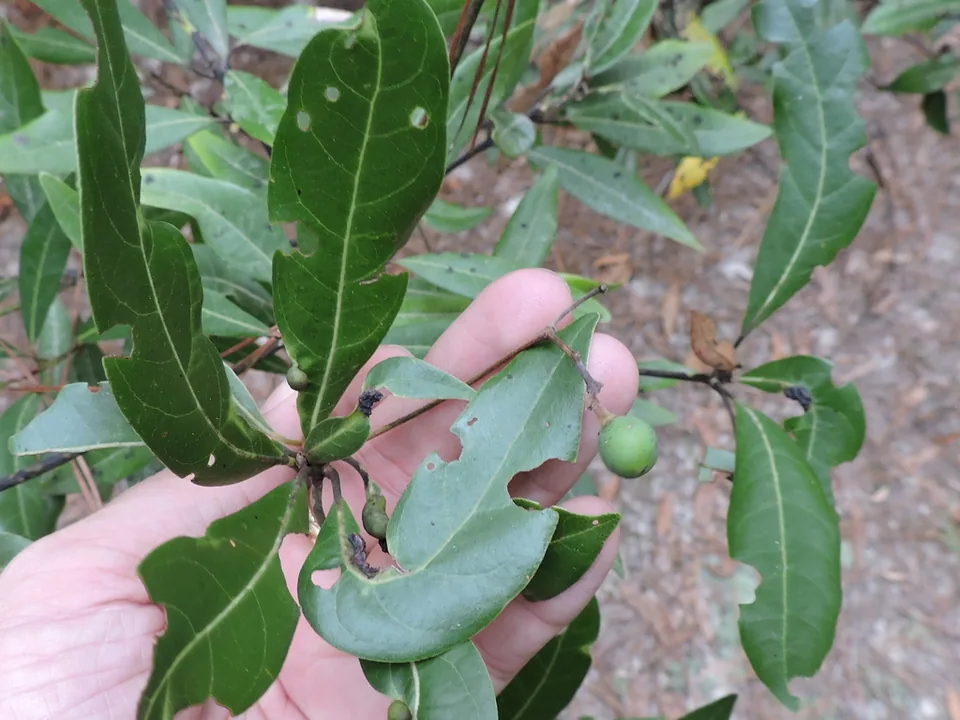
How to Grow and Care for Redbay
Tamala borbonia
Written by Emilio Marruso · last checked
At a glance
Redbay grows 30 to 70 feet tall in full sun or partial shade, and it gives you more than shade. Its spicy leaves flavor soups, and once dried they make an excellent substitute for bay leaves. In fall, from September to October, it carries showy, long-lasting fruit that you can eat too.
- Sun
Full sun to partial shade
What the sources say (1)
Light: Full sun to partial shade
Light: Full sun (6 or more hours of direct sunlight a day) Partial Shade (Direct sunlight only part of the day, 2-6 hours) Soil
— Tamala borbonia (Redbay, Red Bay) | North Carolina Extension Gardener Plant Toolbox [1] - Cold
Survives winters down to 0 °F (−17.8 °C)
Hardy in very cold winters · USDA 7a · RHS H6 · Z7
What the sources say (2)
Hardiness, coldest zone: 7a [winter low −17.8 to −15 °C (0 to 5 °F)]
USDA Plant Hardiness Zone: 7a, 7b, 8a, 8b, 9a, 9b
— Tamala borbonia (Redbay, Red Bay) | North Carolina Extension Gardener Plant Toolbox [1] Hardiness, warmest zone: 9b [winter low −3.9 to −1.1 °C (25 to 30 °F)]
USDA Plant Hardiness Zone: 7a, 7b, 8a, 8b, 9a, 9b
— Tamala borbonia (Redbay, Red Bay) | North Carolina Extension Gardener Plant Toolbox [1] - Harvest
Edible fruit in September–October; dried leaves flavor soups like bay leaves
What the sources say (1)
Harvest: Fruit available September-October
This tree produces a dark blue spherical fruit that becomes available September-October. -
— Tamala borbonia (Redbay, Red Bay) | North Carolina Extension Gardener Plant Toolbox [1] - Pests
Very prone to laurel wilt, spread by a beetle that has almost wiped it out
What the sources say (1)
Diseases: laurel wilt disease
Insects, Diseases and Other Plant Problems : This species is highly susceptible to laurel wilt disease.
— Tamala borbonia (Redbay, Red Bay) | North Carolina Extension Gardener Plant Toolbox [1] - Size
30 to 70 ft tall
What the sources say (1)
Mature height: 914.4-2133.6 cm (30-70 ft)
Redbay is an evergreen tree that may grow 30 to 70 feet tall.
— Tamala borbonia (Redbay, Red Bay) | North Carolina Extension Gardener Plant Toolbox [1] - Propagation
Grows from seed
What the sources say (1)
Propagation: Seed
Recommended Propagation Strategy: Seed Country Or Region Of
— Tamala borbonia (Redbay, Red Bay) | North Carolina Extension Gardener Plant Toolbox [1]
Overview
Redbay is an evergreen tree that may grow 30 to 70 feet [9.1–21.3 m] tall. [1] Its spicy leaves can be used to flavor soups and meats. [1] The species is highly susceptible to laurel wilt disease. [1]
This record is incomplete: the sources we read do not cover every field yet.
Not yet covered by our sources: Watering, Pruning
Redbay care
Measurements in square brackets are our conversion into the other unit system; the quoted text is unchanged.
How to water Redbay
Not stated in the sources we read.
How much light Redbay needs
Full sun to partial shade
What the sources say (1)
Light:
Full sun (6 or more hours of direct sunlight a day)
Partial Shade (Direct sunlight only part of the day, 2-6 hours)
SoilHow much cold Redbay can take
Hardiness, coldest zone
7a [winter low −17.8 to −15 °C (0 to 5 °F)]
What the sources say (1)
USDA Plant Hardiness Zone:
7a, 7b, 8a, 8b, 9a, 9bHardiness, warmest zone
9b [winter low −3.9 to −1.1 °C (25 to 30 °F)]
What the sources say (1)
USDA Plant Hardiness Zone:
7a, 7b, 8a, 8b, 9a, 9bHow to propagate Redbay
Seed
What the sources say (1)
Recommended Propagation Strategy:
Seed
Country Or Region OfHow to grow Redbay
The plant
Mature height
914.4-2133.6 cm (30-70 ft)
What the sources say (1)
Redbay is an evergreen tree that may grow 30 to 70 feet tall.Pests and diseases
Diseases
laurel wilt disease
What the sources say (1)
Insects, Diseases and Other Plant Problems : This species is highly susceptible to laurel wilt disease.Redbay pests and problems
Laurel wilt disease
Symptom: The species is highly susceptible; the plant has almost been wiped out by the Redbay Ambrosia Beetle.
What the sources say (2)
This species is highly susceptible to laurel wilt disease.
— Tamala borbonia (Redbay, Red Bay) | North Carolina Extension Gardener Plant Toolbox [1] This plant has almost been wiped out by the Redbay Ambrosia Beetle.
— Tamala borbonia (Redbay, Red Bay) | North Carolina Extension Gardener Plant Toolbox [1]
Remedies
Each remedy shows what official sources say about it; traditional remedies without an official source are marked as such. Harmful ones are listed so you know to avoid them.
Treating the plant
red bay triozid galls
neem seed extract spray at bud break Works
How: Spraying with a neem seed extract at bud break should protect the new leaves from the developing triozid nymphs.
Spraying with a neem seed extract or with a synthetic systemic insecticide at bud break should protect the new leaves from the developing triozid nymphs.
— content.ces.ncsu.edu [2] What the evidence says Spraying with a neem seed extract or with a synthetic systemic insecticide at bud break should protect the new leaves from the developing triozid nymphs.
— content.ces.ncsu.edu [2]
scale insects
insecticidal soap spray Partly works
How: Apply soon after the crawlers settle.
Insecticidal soap does a better job of controlling these scales and insect growth regulators like pyriproxifen and buprofizen work even better.
— purduelandscapereport.org [3] What the evidence says Oil does NOT kill these scale insects after they have settled down to feed and coat themselves with honeydew. Insecticidal soap does a better job of controlling these scales
— purduelandscapereport.org [3] dormant season horticultural oil Partly works
How: Applied in the dormant season.
Applying horticultural oil in the dormant season can be one of the most effective tools for getting rid of scales with a minimal impact on natural enemies.
— purduelandscapereport.org [3] What the evidence says Only armored scale insects that winter as adults or immatures beneath the waxy cover can be killed by oil in the dormant season.
— purduelandscapereport.org [3]
laurel wilt
remove and destroy infected trees Official source, not independently tested
Avoid transport of wood products (e.g. firewood or debris) from infected trees or from species susceptible to laurel wilt, especially in regions where disease has been confirmed.
— entomology.mgcafe.uky.edu [4] How: Remove and destroy infected trees on site.
Remove and destroy infected trees on site to reduce the potential for disease spread.
— entomology.mgcafe.uky.edu [4]
Calendar
Fruit available September-October
What the sources say (1)
This tree produces a dark blue spherical fruit that becomes available September-October.
-Not stated in the sources we read.
Months as given by the sources, which are mostly from the United States (northern hemisphere). In the southern hemisphere they shift by about six months.
Edibility
Reported by the source, quoted verbatim. Do not eat a plant on the basis of this page alone: identification mistakes can be dangerous.
Similar plants
- Silk Bay Tamala humilis
- Swamp Bay Tamala palustris
- Abies grandis Abies grandis
- Abraham Trachystemon orientalis
- Abyssinian banana Ensete ventricosum
- Acacia longifolia Acacia longifolia
- Acanthus hungaricus Acanthus hungaricus
- Achlys triphylla Achlys triphylla
Sources
Every value above is quoted from these documents. Links lead to the original publisher.
- Tamala borbonia (Redbay, Red Bay) | North Carolina Extension Gardener Plant Toolbox · plants.ces.ncsu.edu, consulted
- content.ces.ncsu.edu · content.ces.ncsu.edu
- purduelandscapereport.org · purduelandscapereport.org
- entomology.mgcafe.uky.edu · entomology.mgcafe.uky.edu
Written by Emilio Marruso · last checked