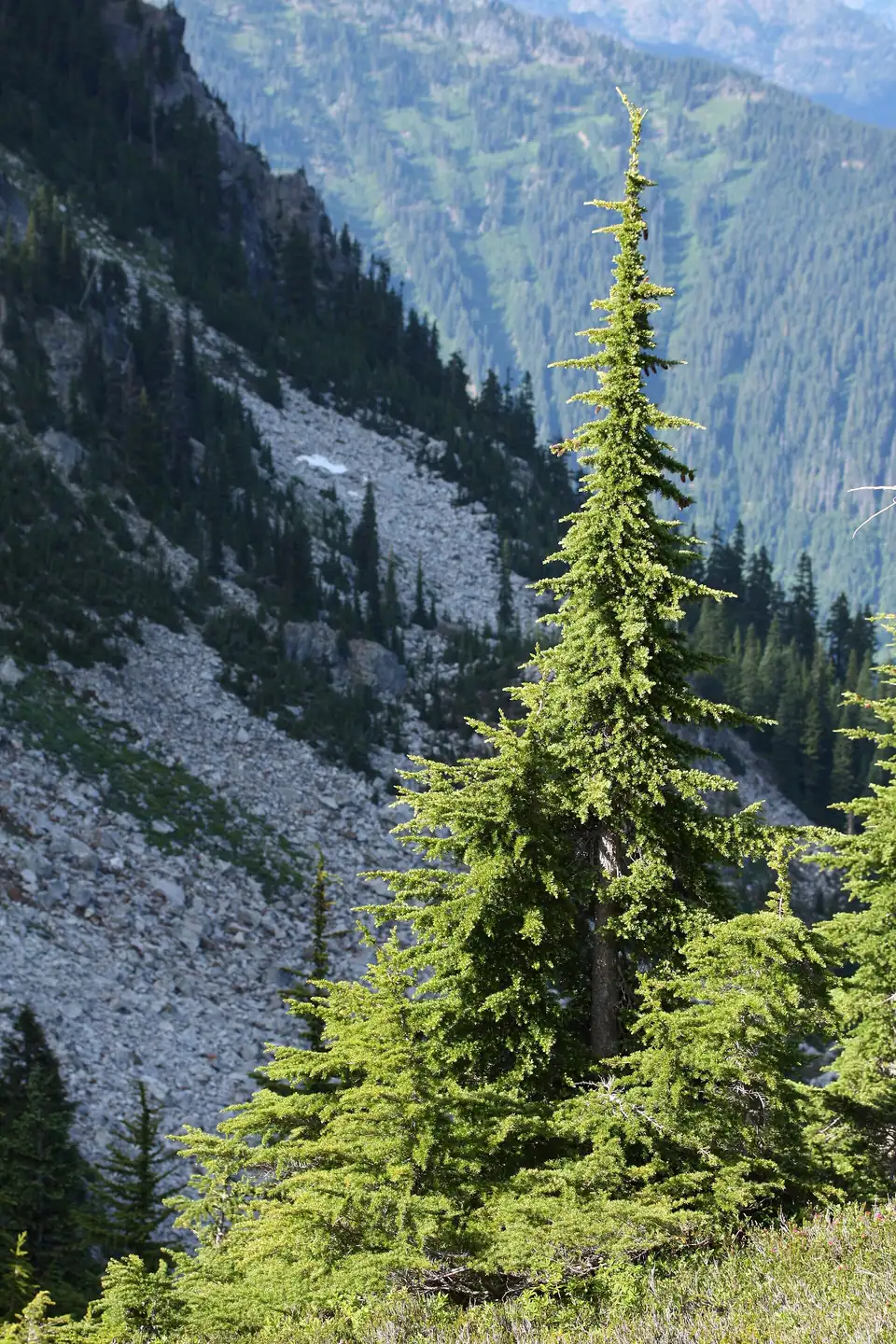


How to Grow and Care for Mountain Hemlock
Tsuga mertensiana
Written by Emilio Marruso · last checked
At a glance
Mountain hemlock is a tall, graceful conifer that can reach 30 to 100 feet, and it also grows in a container. It's happy in full sun or partial shade and likes acidic soil. While it's young, you can even prune it as a hedge, and you can make new plants from seed, stem cuttings or layering.
- Sun
Full sun to partial shade
What the sources say (2)
Light: Full sun to partial shade
Light: Full sun (6 or more hours of direct sunlight a day) Partial Shade (Direct sunlight only part of the day, 2-6 hours)
— Tsuga mertensiana (Black Hemlock, Hemlock Spruce, Mountain Hemlock) | North Carolina Extension Gardener Plant Toolbox [1] The mountain hemlock prefers full sun and moist, cool summers.
— Tsuga mertensiana (Black Hemlock, Hemlock Spruce, Mountain Hemlock) | North Carolina Extension Gardener Plant Toolbox [1] - Cold
Survives winters down to −20 °F (−28.9 °C)
Very hardy · USDA 5a · RHS H7 · Z5
What the sources say (2)
Hardiness, coldest zone: 5a [winter low −28.9 to −26.1 °C (−20 to −15 °F)]
USDA Plant Hardiness Zone: 5a, 5b, 6a, 6b, 7a, 7b, 8a, 8b
— Tsuga mertensiana (Black Hemlock, Hemlock Spruce, Mountain Hemlock) | North Carolina Extension Gardener Plant Toolbox [1] Hardiness, warmest zone: 8b [winter low −9.4 to −6.7 °C (15 to 20 °F)]
USDA Plant Hardiness Zone: 5a, 5b, 6a, 6b, 7a, 7b, 8a, 8b
— Tsuga mertensiana (Black Hemlock, Hemlock Spruce, Mountain Hemlock) | North Carolina Extension Gardener Plant Toolbox [1] - Soil
Acidic soil, pH 6.0 or lower
What the sources say (1)
Soil pH, maximum: 6.0
Soil pH: Acid (<6.0)
— Tsuga mertensiana (Black Hemlock, Hemlock Spruce, Mountain Hemlock) | North Carolina Extension Gardener Plant Toolbox [1] - Pruning
Prune while young; it can be shaped as a hedge
What the sources say (1)
Pruning: When young (may be pruned as a hedge)
When the mountain hemlock is young, it may be pruned as a hedge.
— Tsuga mertensiana (Black Hemlock, Hemlock Spruce, Mountain Hemlock) | North Carolina Extension Gardener Plant Toolbox [1] - Pests
Watch for spruce spider mites and hemlock woolly adelgid
What the sources say (1)
Pests: spruce spider mites, hemlock woolly adelgid
Potential pests include spruce spider mites and hemlock wooly adelgid.
— Tsuga mertensiana (Black Hemlock, Hemlock Spruce, Mountain Hemlock) | North Carolina Extension Gardener Plant Toolbox [1] - Watch out
Does poorly in hot, humid climates
- Size
30–100 ft tall and 10–15 ft wide
What the sources say (2)
Mature height: 914.4-3048 cm (30-100 ft)
A mature tree reaches a height of 30 to 100 feet with a width of 10 to 15 feet.
— Tsuga mertensiana (Black Hemlock, Hemlock Spruce, Mountain Hemlock) | North Carolina Extension Gardener Plant Toolbox [1] Mature width: 304.8-457.2 cm (10-15 ft)
A mature tree reaches a height of 30 to 100 feet with a width of 10 to 15 feet.
— Tsuga mertensiana (Black Hemlock, Hemlock Spruce, Mountain Hemlock) | North Carolina Extension Gardener Plant Toolbox [1] - Propagation
By seed, stem cuttings or layering
What the sources say (1)
Propagation: Layering, seed, stem cutting
Recommended Propagation Strategy: Layering Seed Stem Cutting
— Tsuga mertensiana (Black Hemlock, Hemlock Spruce, Mountain Hemlock) | North Carolina Extension Gardener Plant Toolbox [1] - Containers
Grows in containers too
What the sources say (1)
In containers: Yes
Use mountain hemlock in containers, a recreational play area or in a woodland landscape.
— Tsuga mertensiana (Black Hemlock, Hemlock Spruce, Mountain Hemlock) | North Carolina Extension Gardener Plant Toolbox [1]
Overview
Mountain hemlock is a medium-sized evergreen conifer native to Alaska, British Columbia and the western mountains of the United States. [1] It prefers full sun and moist, cool summers and does not perform well in the southeastern United States because of heat intolerance. [1]
This record is incomplete: the sources we read do not cover every field yet.
Not yet covered by our sources: Watering
Mountain Hemlock care
How to water Mountain Hemlock
Not stated in the sources we read.
How much light Mountain Hemlock needs
Full sun to partial shade
What the sources say (2)
Light:
Full sun (6 or more hours of direct sunlight a day)
Partial Shade (Direct sunlight only part of the day, 2-6 hours)The mountain hemlock prefers full sun and moist, cool summers.How much cold Mountain Hemlock can take
Hardiness, coldest zone
5a [winter low −28.9 to −26.1 °C (−20 to −15 °F)]
What the sources say (1)
USDA Plant Hardiness Zone:
5a, 5b, 6a, 6b, 7a, 7b, 8a, 8bHardiness, warmest zone
8b [winter low −9.4 to −6.7 °C (15 to 20 °F)]
What the sources say (1)
USDA Plant Hardiness Zone:
5a, 5b, 6a, 6b, 7a, 7b, 8a, 8bBest soil for Mountain Hemlock
6.0
What the sources say (1)
Soil pH:
Acid (<6.0)Where to grow Mountain Hemlock
Yes
What the sources say (1)
Use mountain hemlock in containers, a recreational play area or in a woodland landscape.How to propagate Mountain Hemlock
Layering, seed, stem cutting
What the sources say (1)
Recommended Propagation Strategy:
Layering
Seed
Stem CuttingHow to grow Mountain Hemlock
The plant
Family
Pinaceae
What the sources say (1)
Mountain hemlock is a medium-sized, needled, coniferous, evergreen tree in the pine family (Pinaceae).Mature height
914.4-3048 cm (30-100 ft)
What the sources say (1)
A mature tree reaches a height of 30 to 100 feet with a width of 10 to 15 feet.Mature width
304.8-457.2 cm (10-15 ft)
What the sources say (1)
A mature tree reaches a height of 30 to 100 feet with a width of 10 to 15 feet.Pests and diseases
Pests
spruce spider mites, hemlock woolly adelgid
What the sources say (1)
Potential pests include spruce spider mites and hemlock wooly adelgid.Mountain Hemlock pests and problems
Pests
Symptom: Potential pests include spruce spider mites and hemlock wooly adelgid.
What to do: Not given in the source.
What the sources say (1)
The mountain hemlock has no serious disease problems. Potential pests include spruce spider mites and hemlock wooly adelgid.
— Tsuga mertensiana (Black Hemlock, Hemlock Spruce, Mountain Hemlock) | North Carolina Extension Gardener Plant Toolbox [1] Heat intolerance
Symptom: Does not perform well in the southeastern United States.
What to do: Not given in the source.
What the sources say (1)
It does not perform well in the southeastern United States due to heat intolerance.
— Tsuga mertensiana (Black Hemlock, Hemlock Spruce, Mountain Hemlock) | North Carolina Extension Gardener Plant Toolbox [1]
Remedies
Each remedy shows what official sources say about it; traditional remedies without an official source are marked as such. Harmful ones are listed so you know to avoid them.
Treating the plant
spider mites
forceful jet of water (syringing) Works
How: Use a forceful jet of water from a hose (syringing); regular syringing keeps spider mites under control.
Since rainy weather seems to knock off spider mites, using a forceful jet of water from a hose (syringing) can perform the same task.
— extension.umaine.edu [2] What the evidence says Regular syringing can keep spider mites under control on most ornamental plants in the landscape.
— extension.umaine.edu [2] insecticidal soap or horticultural oil spray Works
Horticultural oils can be used on perennial and woody ornamentals during the summer but avoid spraying flowers, which can be damaged.
— extension.umaine.edu [2] How: Insecticidal/miticidal soaps are useful in the warm season; horticultural oil can be used on woody ornamentals in summer, dormant oil in fall and spring. Soaps and oils work by contact only, so cover upper and lower leaf surfaces thoroughly.
Most spider mites can be controlled with insecticidal/miticidal oils and soaps.
— extension.umaine.edu [2] What the evidence says Most spider mites can be controlled with insecticidal/miticidal oils and soaps.
— extension.umaine.edu [2]
hemlock woolly adelgid
insecticidal soap or horticultural oil spray Works
If coverage is not thorough or trees are too tall for the equipment that is available, surviving HWA soon will reinfest the trees.
— entomology.mgcafe.uky.edu [3] How: Spray foliage with insecticidal soap or horticultural oil at the proper times of the adelgid life cycle, almost to runoff.
Homeowners and private landowners have two treatment options: 1) spray foliage with insecticidal soap or horticultural oil at the proper times during the HWA life cycle
— entomology.mgcafe.uky.edu [3] What the evidence says Adelgids without the covering are very susceptible to contact with insecticidal soap or horticultural oil.
— entomology.mgcafe.uky.edu [3]
phytophthora root rot
improving soil drainage Official source, not independently tested
How: Improve soil drainage by incorporating organic material or use raised beds.
Improve soil drainage by incorporating organic material or use raised beds.
— hortsense.cahnrs.wsu.edu [4]
Calendar
Pruning
When young (may be pruned as a hedge)
What the sources say (1)
When the mountain hemlock is young, it may be pruned as a hedge.Months as given by the sources, which are mostly from the United States (northern hemisphere). In the southern hemisphere they shift by about six months.
Indicative values
Values from a secondary source, not checked word for word like the rest of this page. Use them as a starting point.
- Life cycle
- PerennialIndicative value, adapt it to your climate · Secondary source
- Hours of sun
- 6-7 hoursIndicative value, adapt it to your climate · Secondary source
- Watering
- FrequentIndicative value, adapt it to your climate · Secondary source
- Soil
- Loamy, RockyIndicative value, adapt it to your climate · Secondary source
- Care level
- MediumIndicative value, adapt it to your climate · Secondary source
- Growth rate
- LowIndicative value, adapt it to your climate · Secondary source
Similar plants
- Eastern Hemlock Tsuga canadensis
- Southern Japanese Hemlock Tsuga sieboldii
- Western Hemlock Tsuga heterophylla
- Carolina Hemlock Tsuga caroliniana
- Abies grandis Abies grandis
- Aleppo Pine Pinus halepensis
- Alpine Fir Abies lasiocarpa
- Armand Pine Pinus armandi
Sources
Every value above is quoted from these documents. Links lead to the original publisher.
- Tsuga mertensiana (Black Hemlock, Hemlock Spruce, Mountain Hemlock) | North Carolina Extension Gardener Plant Toolbox · plants.ces.ncsu.edu, consulted
- extension.umaine.edu · extension.umaine.edu
- entomology.mgcafe.uky.edu · entomology.mgcafe.uky.edu
- hortsense.cahnrs.wsu.edu · hortsense.cahnrs.wsu.edu
Written by Emilio Marruso · last checked